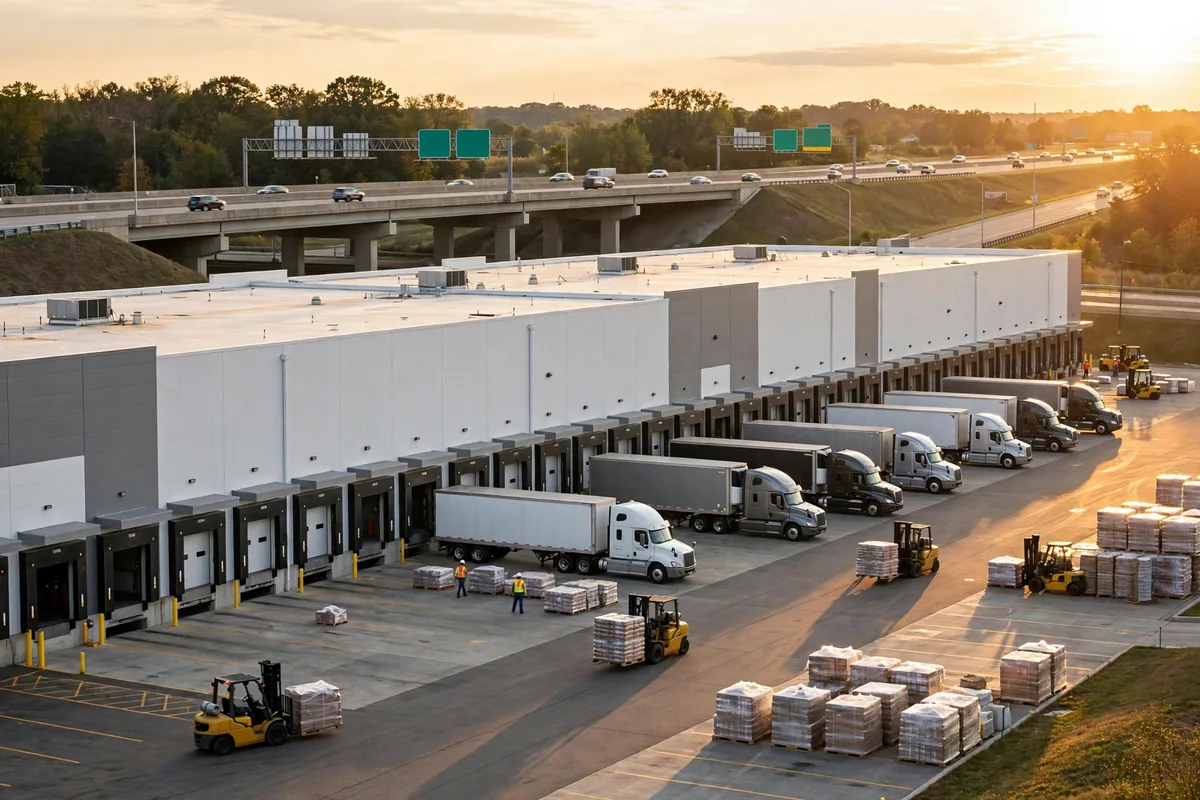
Last November, on a Tuesday morning, I walked into the warehouse at 6:40 a.m. and seven trucks were already lined up at the gate. Drivers were sitting in their cabs. One of them came over to ask when we could start unloading. Receiving did not start until 8:00, and the appointment sheet showed twelve trucks, all booked for the morning. Folks, let me be straight with you: warehouse receiving dock count planning is the kind of thing I used to do by gut feel, until it cost us enough that I learned to do the math.
By noon we had unloaded four trucks. The rest waited at the gate until 3 p.m. Detention charges piled up by the hour under the contract, the receiving crew worked until 9 p.m., and the slotting plan fell apart — freight that was supposed to hit the shelves that afternoon did not get put away until the next morning. That day taught me one thing: when docks run short, the cost never shows up on the dock itself. It shows up everywhere else.
When Docks Run Short, the Cost Hides Everywhere
A truck waiting at the gate costs detention money first. The meter runs by the hour under the contract, and a full day of waiting is real money. The second cost is overtime. Freight that does not get unloaded in the day gets unloaded at night, and overtime plus a tired crew the next day costs more than the detention did. The third cost is the one that hurts most: the slotting plan slips, putaway slips, and picking has nothing to pick, so shipping slips too. One jammed link and the whole warehouse feels it.
Here is how we work the math in our warehouse now: one dock short, on a peak-season day, costs us more in detention and overtime than hiring a temp for half a month. That figure comes from our own contracts and our own roster — it is an illustrative example, and every warehouse should run it with its own numbers.
Do Not Guess. Count the Peak.
We size dock count on one thing only: the arrival peak. Not the average. An average of eight trucks a day means nothing when a peak-season Tuesday brings eighteen. Build for eight and you queue every day of peak season.
The formula is one line: dock count = daily truck arrivals × average unload hours ÷ usable hours per dock per day, plus one spare dock. Run it with our peak-season example numbers: eighteen arrivals a day, 1.5 hours to unload each truck, ten usable hours per dock per day. Eighteen times 1.5 divided by 10 is 2.7, round up to three, add one spare, and you land on four docks as a starting point. These are illustrative example numbers — swap in your own arrival records. That is the whole point of warehouse receiving dock count planning: size for the worst day, not the average one.
Truck type goes into the same math. A 53-foot trailer takes 1.5–2 hours to unload. A box truck can be done in half an hour. Count trucks without counting truck types and the answer is wrong. We run the two types separately: big trailers on their own unload time, small trucks on theirs, then add them up. Appointment windows matter just as much. If every truck is booked between 8 and 10 a.m., no number of docks survives a two-hour flood. Stagger the appointments, at least half an hour apart.
| Peak-season day (illustrative example) | Number |
|---|---|
| Truck arrivals | 18 |
| Average unload time | 1.5 hours per truck |
| Usable hours per dock | 10 hours |
| Calculated dock count | 18 × 1.5 ÷ 10 = 2.7, round up to 3 |
| Plus one spare | 1 |
| Starting point | 4 docks |
More Receiving Docks Does Not Mean Faster Receiving
This is the most common misunderstanding I run into. Last year I toured a peer's warehouse. They had eight docks, and trucks were still queuing at the gate. Why? The receiving crew was four people, and four people can only unload four trucks at once. Four docks sat empty while trucks waited.
More docks does not mean faster receiving. The bottleneck is usually the receiving crew, not the doors. Docks are fixed. People are the moving part. Eight docks with four receivers means four docks working and four sunbathing. Flip it around: with enough people, one dock short just means a truck waits at the gate. We set dock count after we set crew size now: how many people on a receiving shift, how many trucks can they unload at once. Dock count follows headcount, not floor area. A big warehouse does not automatically need more docks, and a small one can queue every day.
Receiving and Shipping Fight Over the Same Doors. Split the Day.
In a lot of warehouses, receiving and shipping share the same doors. Morning inbound trucks and afternoon outbound trucks fight over the same dock doors. We used to do the same. Unloading ran until 11 a.m., outbound trucks showed up at 10, and arguments at the gate were a regular thing. The veterans argued with drivers while the new hires stood aside afraid to speak. That is how morale wears down.
What we do now is fixed: 8 a.m. to noon, the docks belong to receiving. 1 p.m. to 5 p.m., they belong to shipping. Noon to 1 p.m. stays flexible — whoever is in trouble gets it. Receiving and shipping each get half the day, and nobody fights over the other's time. In peak season, if we are truly buried, we open one extra shared dock on top, but the split stays. Since we fixed the split, the gate arguments are basically gone. Drivers know what time they can get unloaded, and the receiving crew knows what time they can go home.
There is no standard answer for dock count. There is only your own arrival record. Go back through the last three months of arrivals, find the busiest days, run the peak math, and check it against your receiving crew size. If the number comes out far from what you have now, do not rebuild in a hurry. Try it for one peak season and watch the gate. That is warehouse receiving dock count planning done right.
By Chen Feng, Warehouse Operations Manager