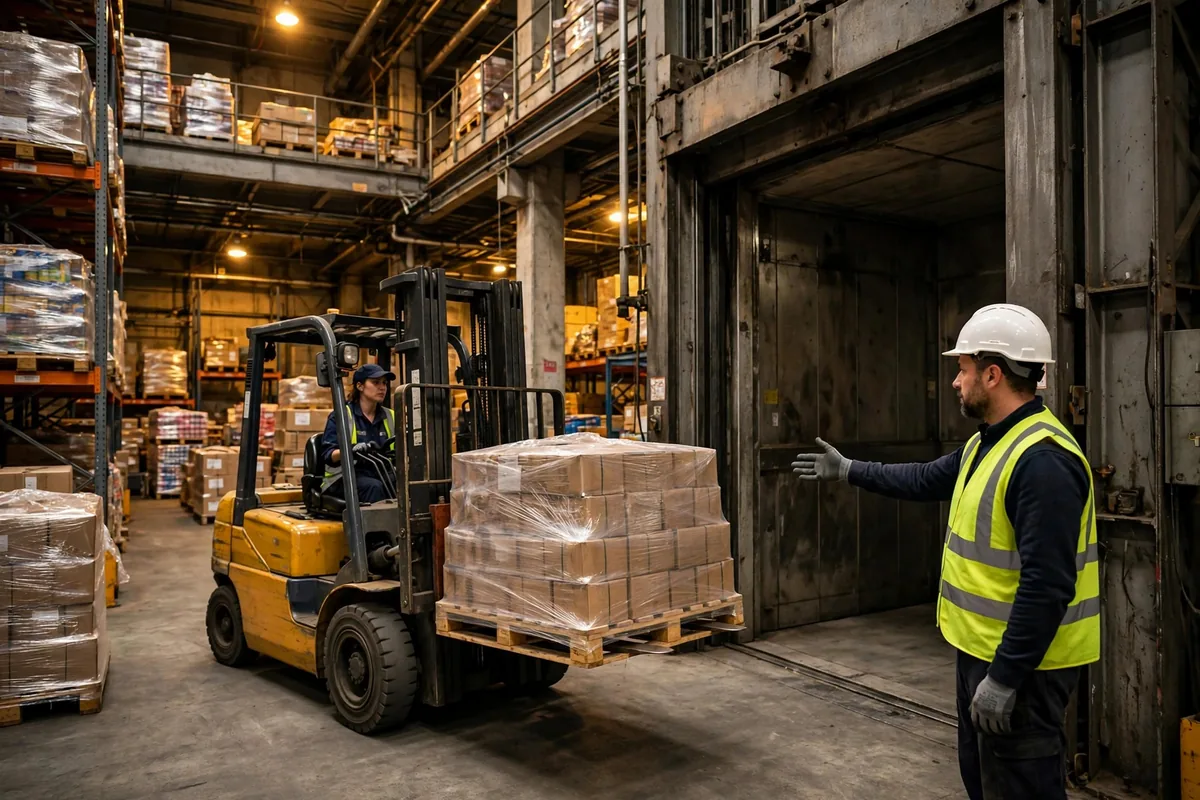
It was 6:40 in the morning, still half dark outside, and I was standing at the freight elevator on the third floor watching the numbers on the walkie-talkie climb. Four trucks were already waiting downstairs, the picking team upstairs had nearly two hundred orders backed up waiting for replenishment, and six pallets bound for the third floor were jammed at the elevator doors. Here is the honest truth about a multi-story warehouse: on paper it looks beautiful — small footprint, big floor area, cheap rent per square foot. But the moment your freight has to go up and down, you learn what "the building went up but the freight can't move" really means.
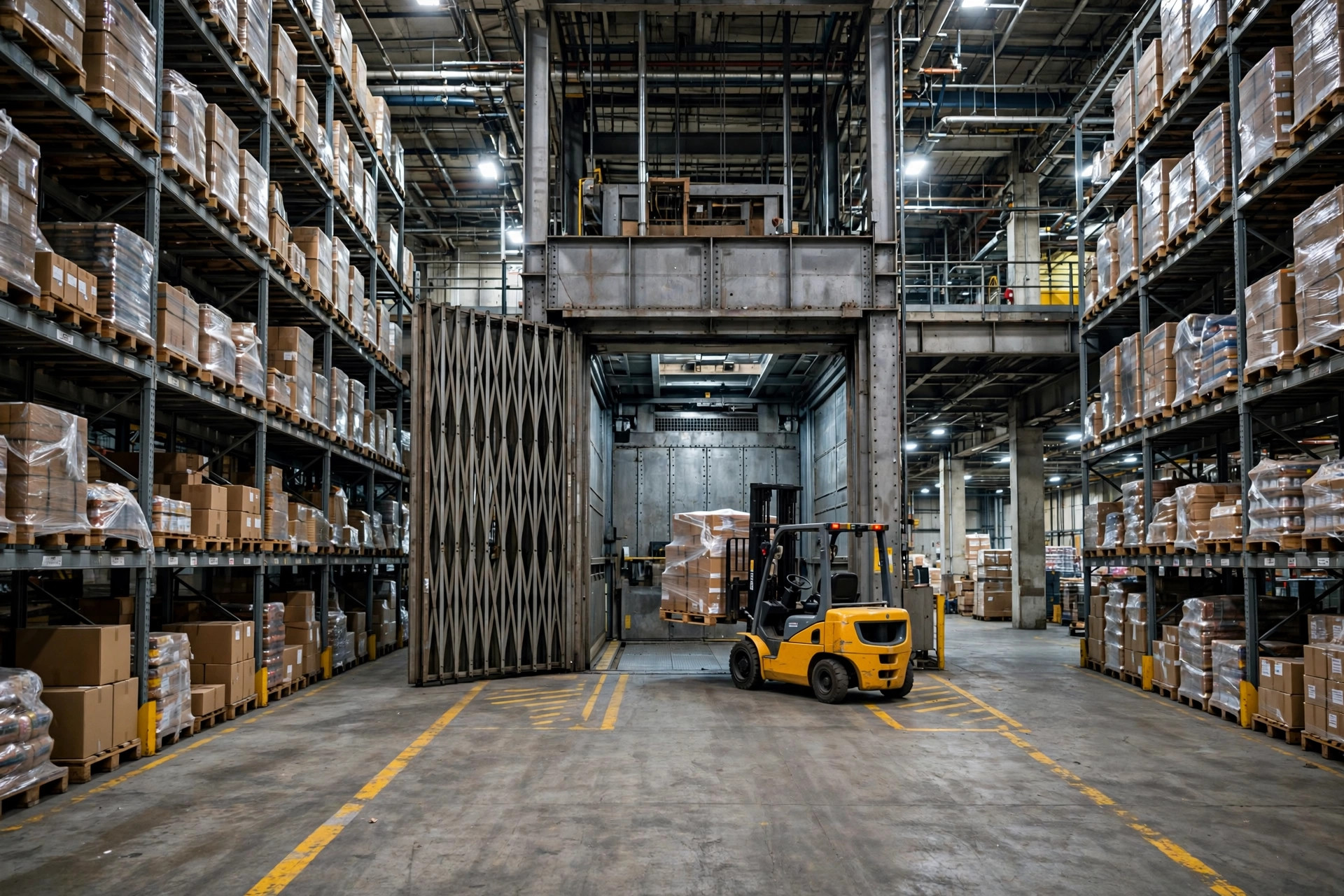
Our building has four floors, about 8,000 square meters per floor, and we moved in back in 2021. Receiving on the ground floor, picking and storage above — sounds like a clean division of labor. Within the first month I knew something was off. We had two freight elevators: one rated for 3 tons, one for 2 tons. Come peak season, the elevator doors became the most congested spot in the whole building. Forklifts queued, pickers waited for stock, drivers honked downstairs, and by the end of the day everybody's temper had collected in front of those two steel doors.
Count the elevator in a multi-story warehouse in trips, not in tons
Most people price a multi-story warehouse by rent and floor area. They never price the vertical move. We spent three days at the elevator doors with a stopwatch, and the numbers were sobering. One full round trip for the 3-ton elevator — doors close, rise from the first floor to the fourth, doors open, forklift in and out, doors close again — averaged four and a half minutes. Sounds short. But one pallet, door to door, including the forklift travel on each floor, ran about six minutes one way. On a day when 300 pallets need to move between floors, that is 30 hours of elevator work. Two elevators running flat out give you about 32 hours. In other words, at peak, the elevators run at full capacity with no slack at all.
And that assumes everything works. One time the door mechanism on the 3-ton elevator failed, and the repair took a day and a half. For that day and a half, every vertical move in the building depended on a single 2-ton elevator. Receiving stopped for half a day, picking orders piled up, and the night shift worked until 2 a.m. to clear the day's orders. That night I stood at the elevator watching that little car crawl up and down, and I had one thought: in a multi-story warehouse, redundancy in vertical flow is not waste. It is insurance.
We now live by three hard rules, and they have not changed since. First, size elevator capacity for peak volume times 1.5, never for the average. Averages lie; peak season tells the truth. Second, at least one elevator must be big enough to take a full pallet plus a forklift. A small elevator can only ever be a helper, never the backbone. Third, elevator maintenance is always staggered — the two cars are never serviced on the same day. Every one of those rules was paid for with night shifts.
Floor layout decides how many wasted trips you run
How busy your elevators are depends half on how many you have, and half on how you divide the floors. When we first moved in, receiving was on the first floor, storage on the second and third, picking on the fourth. Freight flowed upward, or so we thought. In practice, pickers came downstairs for replenishment all day and finished goods went from the fourth floor back down to the first for shipping. A single pallet rode the elevator two or three times a day, and most of those trips were wasted motion.
We tried several layouts over six months before settling on the one we still run: receiving and shipping both on the ground floor, picking on the second floor, storage on the third and fourth. The fastest-moving stock lives in the second-floor pick area, closest to shipping. Slow movers go up; anything that moves once a week sits on the fourth floor, in the back. That one change cut elevator trips by about a third, because most freight now rides the elevator once a day instead of two or three times.
One detail people overlook: chutes. A gravity chute from the second floor to the first sounds old-fashioned, but we run two of them for small parcels, and they are worth their weight. Picked small items slide straight down instead of waiting for an elevator, and that takes dozens of trips off the elevator schedule. A chute has strict rules, though: light, regular-shaped, drop-proof items only. Heavy, odd-shaped, or fragile goods never go down a chute. The veteran who manages the chutes inspects the gates and the cushioning pads before every shift. Skip that inspection and you are just waiting for an accident.
Peak-season queues are won with lead time, not horsepower
Extra elevators alone will not fix a peak-season queue. You need scheduling, and ours is low-tech but it works. Every morning before the shift, floor supervisors list the day's big vertical moves and set the order: urgent outbound freight first, replenishment second, bulky items on their own. A whiteboard at the elevator doors shows whose freight, how many pallets, and what time. Nobody jumps the queue, because one jump breaks the rhythm for the whole day.
We also stagger the work. Receiving peaks in the morning, replenishment peaks in the afternoon, so bulk storage moves and cycle-count freight ride the elevator at midday or at night, when the cars are idle. The night crew grumbled at first — it felt like day-shift work dumped on them. Then we built those night moves into their performance numbers, the night work ran smoothly, the day elevators freed up, and both sides came out ahead.
The thing about queues is that the real enemy is not waiting, it is disorder. Disorder makes people improvise: somebody stacks freight at the elevator doors to "hold a spot," somebody sends an empty forklift to grab time. Our rule now is that no more than two pallets may sit at the elevator doors; anything more goes back to staging. A pallet holding a spot looks like it won an advantage. In reality it blocks everybody's path.
More floors in a multi-story warehouse do not always mean less land
This is the most honest thing I can tell anyone considering a multi-story warehouse: more floors do not necessarily save land, and they certainly do not necessarily save money. A single-story warehouse moves freight horizontally. A multi-story warehouse moves it vertically, and every vertical trip costs time, labor, and equipment. Go from two floors to four and the floor area doubles, but elevator capacity does not double, and neither does the empty forklift travel between floors.
Here is a scenario to show the math — treat the numbers as an illustrative example, not a quote from a rate sheet. Take a four-story building, 8,000 square meters per floor, two freight elevators, 300 pallets moving between floors a day. The labor and time cost of vertical handling alone works out to roughly the cost of three or four extra forklift operators every day. In a two-story building with the same area, elevator trips would roughly halve. That is not an argument against multi-story warehouses. It is an argument for doing the vertical-flow math before you sign: are the elevators enough, how are the floors divided, what happens at peak, and what happens when one elevator breaks? Answer those four questions first, then talk about cheap rent.
And here is the counterintuitive part: what a multi-story warehouse fears most is not volume, it is freight on the wrong floor. Fast-moving stock on the fourth floor and storage on the second means extra trips every single day just to find and move goods. Our rule now is that fast movers always live on the floor closest to shipping, even if the second floor gets crowded. Floors are fixed; freight is not. We re-slot by velocity every quarter. It looks like extra work, but the elevator trips it saves show up within a single quarter.
After all these years, I have come to believe a multi-story warehouse is not won by how tall the building is. It is won by how smooth the trip up and down is. Elevators, chutes, floor layout, scheduling — get those four right and a multi-story warehouse is a smart way to save land. Let one of them jam, and the taller the building, the worse the jam. Tomorrow morning at 6:40, I will be standing at the elevator doors again. More floors are fine. A tangled vertical flow is not.
By Chen Feng, Warehouse Operations Manager