Warehouse rack safety column protectors are cheap. How much does it cost to fix one bent rack upright? Start with the number, because everything else follows from it. The upright itself is cheap. The expensive part is everything around it: unloading the bay, moving the pallets, taking the location out of service for half a day, then re-inspecting before it goes back into use. In the illustrative scenario I walk through below, a single moderate forklift strike runs past $8,000 in direct costs, before any damaged product or late shipments. Warehouse rack safety column protectors run tens to a little over a hundred dollars apiece. The question is not whether to install them. It is how many is enough.
Here is the first thing most warehouse managers get wrong: there is no single federal OSHA standard for pallet racking in the United States. Search 29 CFR 1910 and you will not find a rule that says how racking must be designed. OSHA enforces rack safety through two routes instead: 29 CFR 1910.176(b), which says stored material must not create a hazard, and Section 5(a)(1) of the OSH Act, the General Duty Clause, which requires a workplace free of recognized hazards. When an inspector walks in, the yardstick they use is the industry standard ANSI/RMI MH16.1. On July 31, 2026, OSHA renewed its National Emphasis Program for warehousing and distribution centers for five more years, so inspection pressure is going up, not down. A visibly bent upright still carrying pallets is a textbook recognized hazard, and per-violation penalties are set at the levels published on OSHA's website, which are substantial.
I audited a third-party logistics warehouse in Southern California in 2024, roughly 120,000 square feet with more than 300 pallet positions. The warehouse manager walked me down an aisle and pointed at two uprights at the end of a row: replaced the month before. A forklift had clipped the base of one while turning, bending it about 3 centimeters. Under MH16.1, visibly damaged racking must be unloaded and taken out of service until it is repaired. But those two uprights were still carrying three levels of product, and the manager's answer was to wait until after peak season. That is the wrong calculation: saving one shutdown while betting a whole row of racking and one inspection visit.
What Warehouse Rack Safety Column Protectors Actually Protect
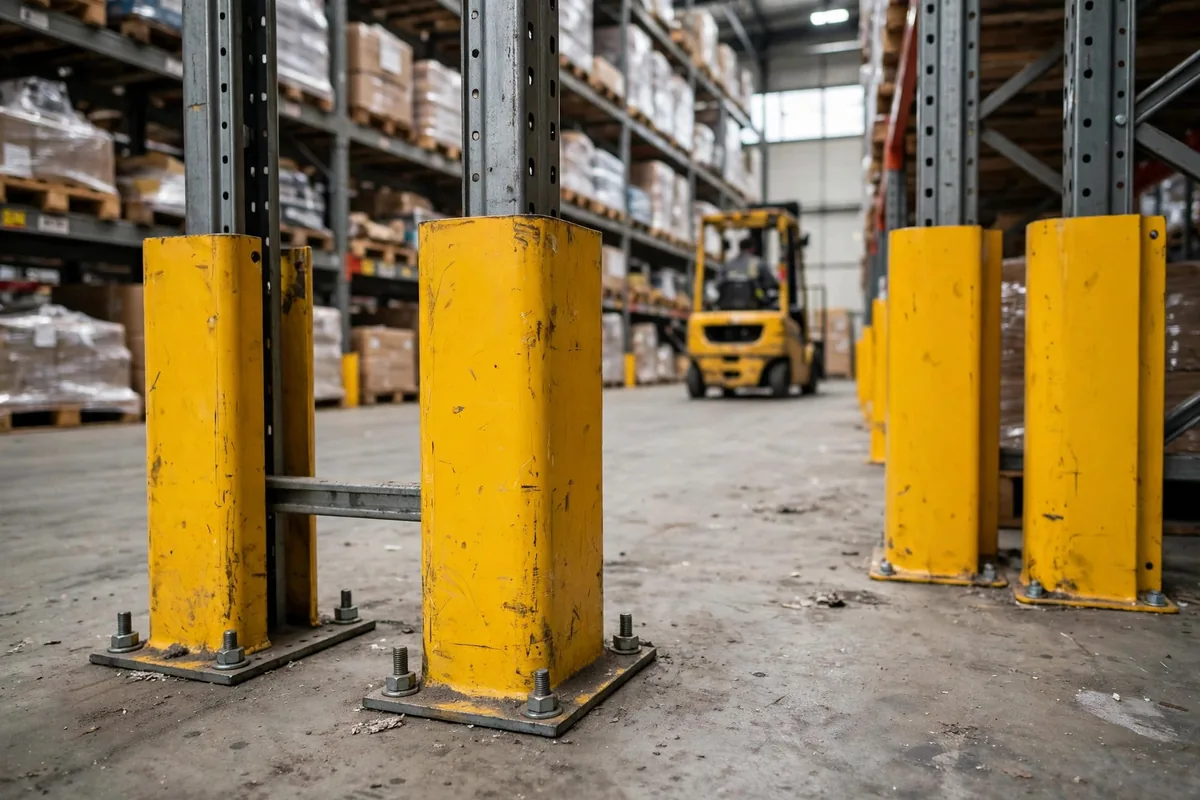
Warehouse rack safety column protectors do not protect the whole upright. They protect the most vulnerable stretch of it: roughly the first meter above the floor, the strike zone. Forklift forks, counterweight tails, and pallet corners land there in nearly every impact. The logic is simple. Let the protector take the hit, replace the protector, and leave the upright's structure untouched.
There are three common types, and they solve three different problems. Steel protectors are the toughest, suited to heavy-traffic aisles and row ends. Polymer protectors absorb impact through flex and recover part of their shape, which fits medium-duty aisles where forklifts pass constantly. End-of-row guardrails protect the face of a whole row where forklifts turn. One type does not substitute for another. Fitting column protectors without end-of-row rails is like locking the front door and leaving the back one open.
Protectors have a second use that rarely makes it into the quote: they record impacts. A deformed steel protector is a documented strike, no paperwork required. A bare upright that gets bent by a centimeter gets written up as "minor deformation" on an inspection sheet, and by the next strike nobody remembers when the first one happened. A protector that is visibly deformed must be replaced, and the replaced unit is an incident record that writes itself.
How Many Warehouse Rack Safety Column Protectors Does a Warehouse Need
How many you need depends on where impacts happen, not on how many uprights you own. My approach is to sort the warehouse into three tiers by strike probability and fit protection accordingly. The table below is a hypothetical worked example: replace the unit prices and quantities with your own vendor quotes before deciding.
| Zone | Strike risk | Fit-out | Illustrative unit price | Notes | | Aisle ends and turning points | Highest | Steel protectors plus end-of-row guardrails | About $120 per protector, $400 per guardrail set | Every turn is a strike waiting to happen, fit them all | | Cross-dock and high-frequency pick aisles | High | Steel or polymer protectors on every upright | About $60-$120 each | Forklifts pass many times per hour | | General storage aisles | Medium | Polymer protectors on alternating uprights | About $60 each | Start with the side facing the aisle entrance | | Low-frequency deep storage | Low | Inspection only, no protectors | $0 | Spend the savings on the high-frequency zones |
For a mid-size warehouse with 200 uprights, fitting everything runs to roughly $20,000, while the tiered approach comes in near $12,000. The $8,000 saved is only a real saving if the low-frequency zone gets a proper inspection routine: a visual check every quarter, recorded. A tiered fit-out without inspections is trading safety for money, and that trade always comes due.
Budget for protectors as consumables, too. A steel protector is spent after one serious deformation, and a polymer unit typically survives two or three light strikes. Hold back 10 to 15 percent of the original spend each year for replacements. A warehouse that fits protectors in year one and replaces nothing in year two has effectively uninstalled them.
The Three Costs Nobody Puts in the Quote
The first is downtime. A bent upright takes a whole bay out of service, not a single pallet position. One strike in peak season costs half a day of capacity in unloading and re-inspection. The second is insurance and inspection cost. When a claim is filed, the insurer asks for inspection records under MH16.1. If you cannot produce them, the deductible and the next premium negotiation both go against you. The third is product damage. A bent upright does not fall over at once; it lets pallets sit slightly out of level until one slides off, and that is when the real bill arrives.
The counterintuitive part is this: the more protectors you fit, the less you can afford to skip inspections. Protectors hide impacts. The upright looks fine, the protector is deformed, and the strike count quietly accumulates behind a tidy appearance. A warehouse that fits protectors and stops inspecting is more dangerous than one that never fitted them, because it has lost its most obvious warning signal, the bent upright itself. A protector is a cushion, not an inspection waiver.
Here is a conclusion you can calculate. Take the number of forklift strikes on uprights in the past twelve months, multiply by the average cost of dealing with one strike, and compare that with the cost of fitting protectors in the high-frequency zones. If your warehouse logs more than three strikes a year, the high-frequency fit-out usually pays for itself within twelve months. If your log shows zero strikes, do not rush to buy protectors. Check first whether anyone is actually reporting strikes, because zero records and zero accidents are two different things. Run that calculation, then decide how many is enough.
By Lao Zhou, Logistics Cost Analyst