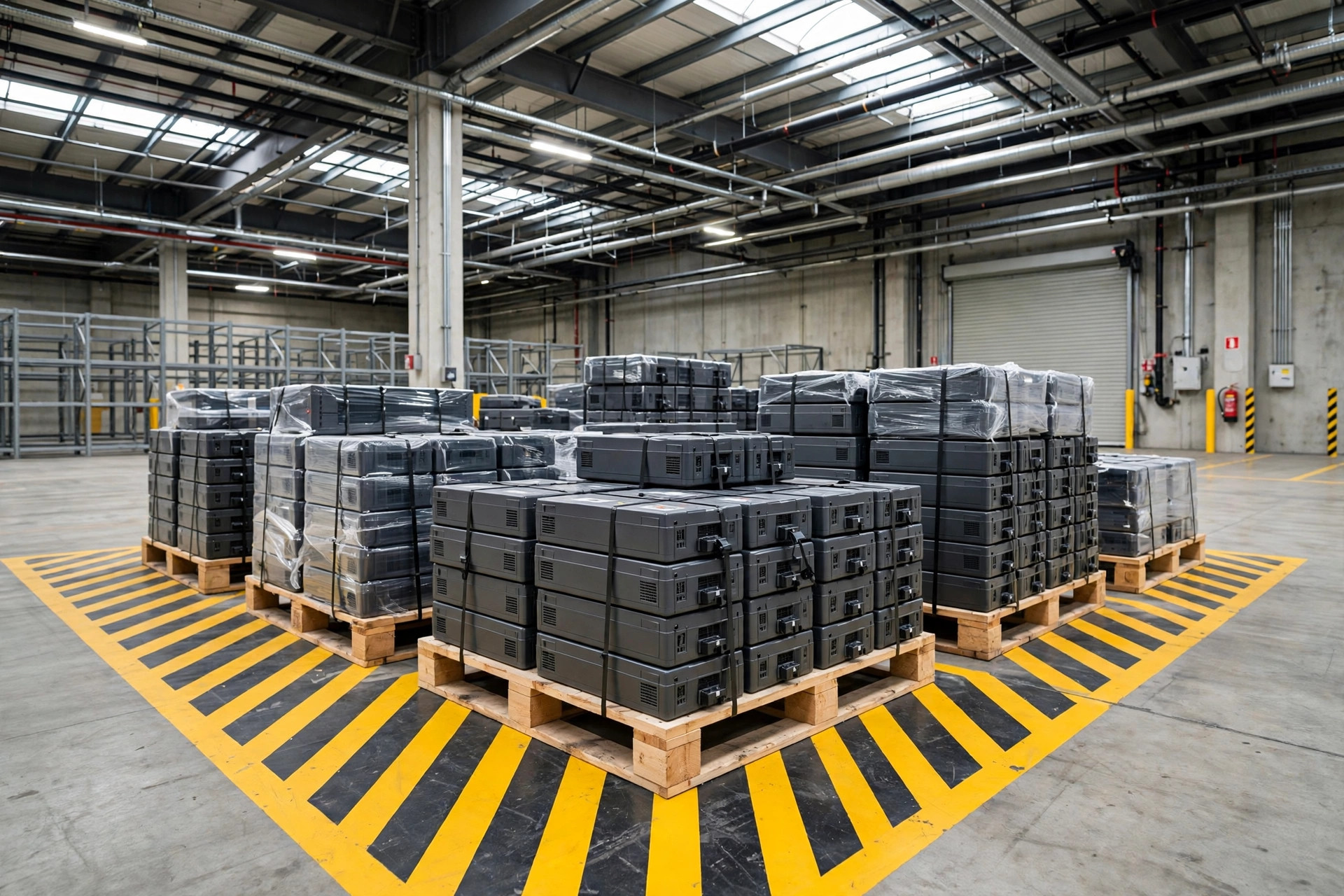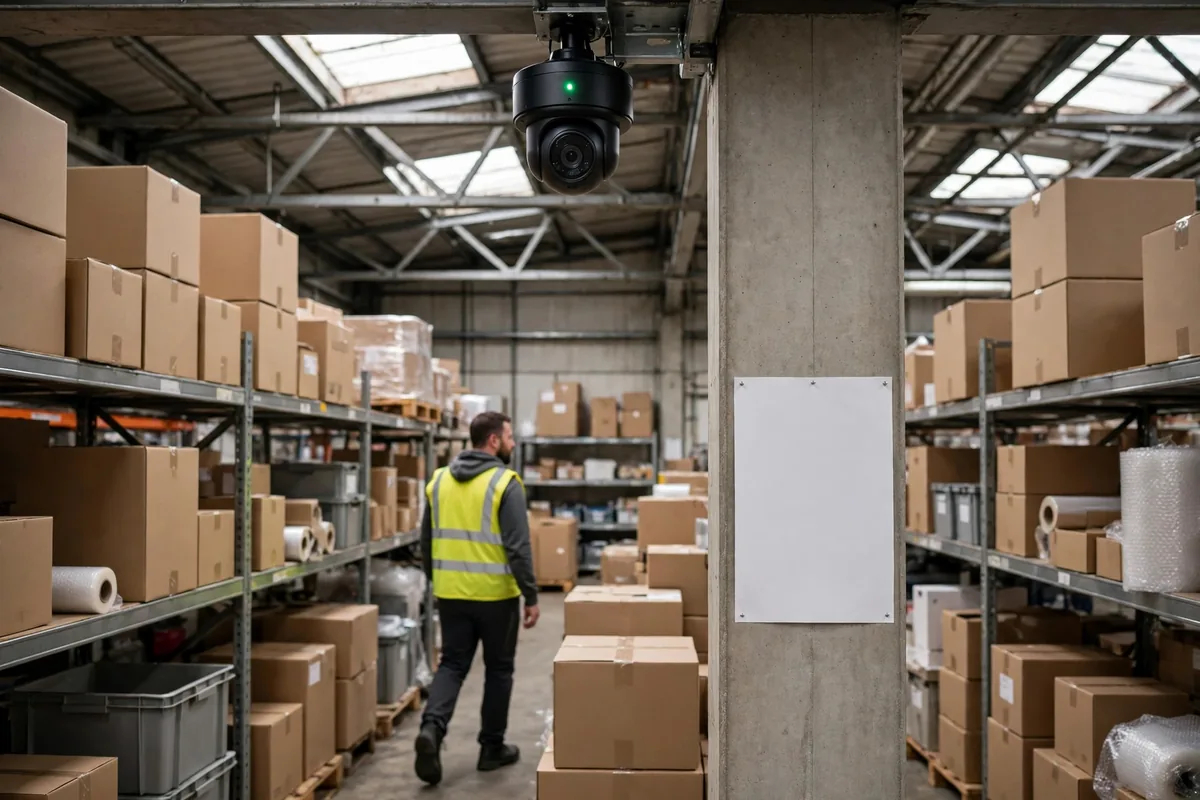
Lithium battery returns are not hard at the receiving dock. They are hard in the hour after receiving, when somebody has to decide where that box of batteries actually goes. Good batteries have a slot, a rotation plan, and a ship date. Bad batteries have none of those. Nobody at receiving can say for sure whether one is swollen, hot, resellable, or shippable by air. Think of it as a small, quiet fire risk that does not belong on a normal shelf.
Start with the physics. A lithium battery fails through thermal runaway. You can think of it as an internal short circuit that heats the cell from the inside, pushing the temperature higher until the separator fails, the electrolyte ignites, and the fire starts. A healthy battery can do this too, but the odds are low. A damaged, defective, or recalled battery is different: its internal structure is already hurt, so a knock, a squeeze, or an odd self-discharge pattern can start the chain. That is why the U.S. DOT treats damaged, defective, and recalled (DDR) lithium batteries as a separate shipping category under 49 CFR 173.185(f). This is not paperwork. It is the law telling you that these batteries are not ordinary freight.
Lithium Battery Returns Receiving: Four Visual Checks First
Returns, replacements, and recalls arrive on three different paths, and receiving must treat them separately. Do not put a returned battery straight onto a shelf. Run four visual checks first: swelling, physical damage, smell, and heat. Swelling means the casing has puffed up. Damage means cracks, leaks, or exposed tabs. Smell means a sweet or sharp chemical odor. Heat means a warm spot you can feel through a glove.
If any one of those four checks fails, the battery goes straight to quarantine. Not to inspection, not to good stock, and not to a temporary spot at receiving "until later." In one illustrative scenario, a returned power-tool battery looked fine outside, so a receiver set it on the returns rack. The next day, one cell had swollen enough to split its packaging, and the cardboard beside it was stained by electrolyte. Nothing caught fire. That was luck. Luck is not a process.
Receiving inspection needs a record: who received it, when, which model, which check failed, and whether a photo was taken. That record is your evidence later with the customer, the carrier, and the insurer. Without it, a fire or a rejected shipment becomes the warehouse's fault by default.
Damaged Lithium Battery Storage: Non-Combustible Containers, Separation, and Labels
How should a quarantine area be built? It has to do three things: use non-combustible containers, keep physical separation, and carry clear labels.
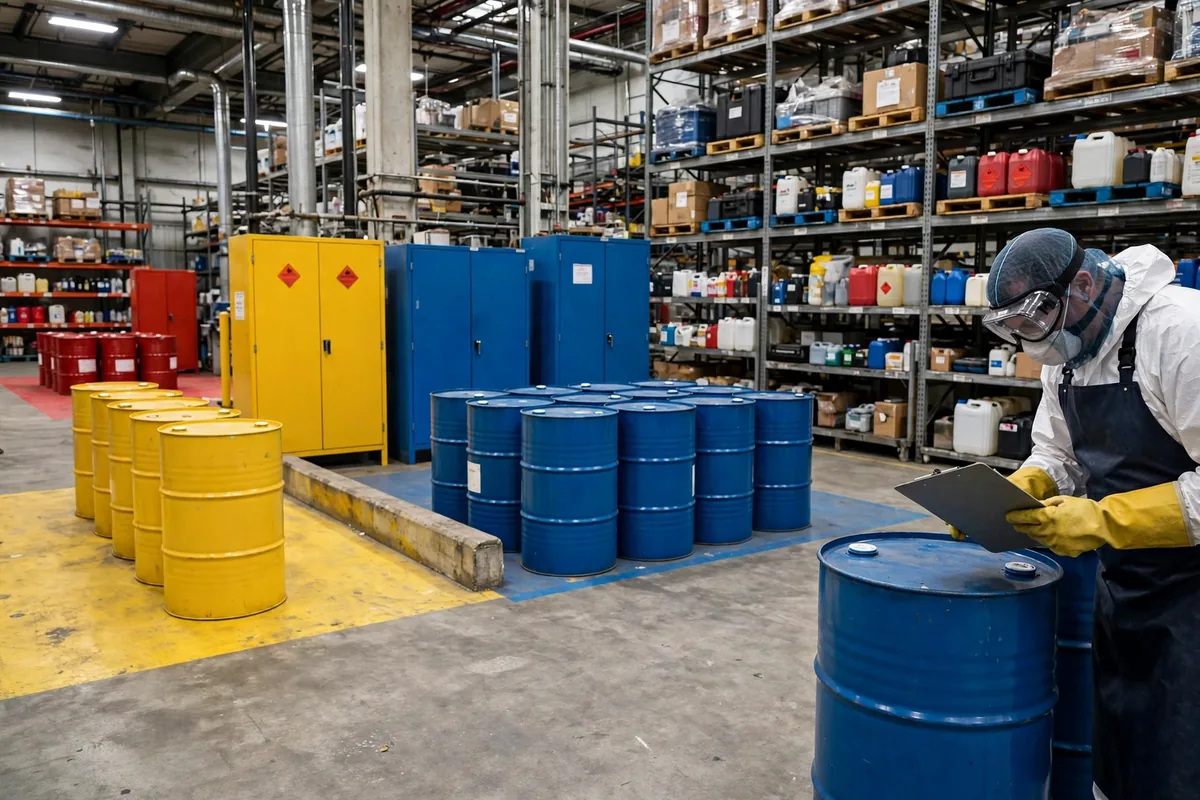
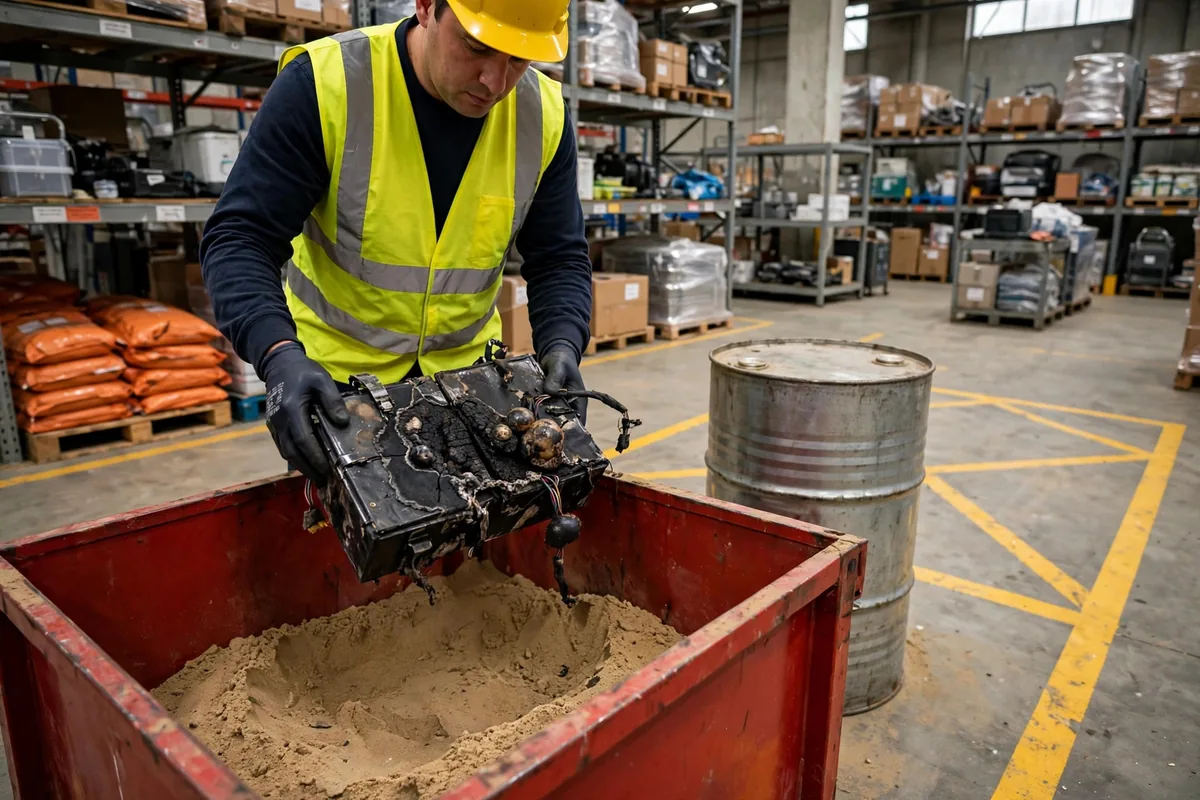
The container is the hard requirement. Damaged batteries must be stored in isolation in a non-combustible container, typically a steel drum or a dedicated container, often with sand or vermiculite as cushioning. You can think of it as giving each bad battery its own fire hood: if it burns, it burns inside the drum, not across the next rack. The container must close, move, and carry a label. Do not improvise with cardboard boxes or plastic totes. Cardboard softens when electrolyte touches it, and plastic melts under heat. Putting either of those in a quarantine area is like storing gasoline next to a fire extinguisher.
Separation means bad and good batteries are physically apart, not on the upper and lower levels of the same rack or opposite sides of one aisle. Ideally, they sit in a separate room or a zone divided by a fire-rated barrier. Labels must be readable at a glance by a new night-shift temp: what is here, why nobody should touch it, and which number to call first if it catches fire. Unclear labels mean no quarantine area in practice.
Now for a fake requirement. Some warehouses spend heavily on temperature and humidity monitoring, smoke detection, and sprinklers for the quarantine area, then feel safe. Monitoring answers "how fast do we find a fire," not "will this battery catch fire." Get the container, separation, and labels right first, then upgrade monitoring. Spend in the wrong order and the money lands on the handle of the knife, not the blade.
Damaged Battery Shipping: Ground Only, Proper Packaging, Qualified Carriers
Shipping is the second hurdle. DDR batteries are forbidden on aircraft and may move by ground transport only. That is a DOT rule, with no workaround. Some customers ask, "Can we pay extra for air freight?" The answer is no. No surcharge makes it safe to put that risk on a plane. For intact lithium-ion batteries shipped alone by air (UN3480), the state of charge is capped at 30% of rated capacity. Remember that number, because it applies to good batteries. DDR batteries do not even get that opening.
Ground transport is not "any truck will do" either. Packaging must follow DDR requirements, labels must be correct, and the carrier must be qualified for this freight. The receiving record earns its keep here: when the carrier asks what condition the batteries are in, you have evidence; when the customer asks why air freight is impossible, you have the regulation. On disposal, the EPA recommends managing waste lithium batteries as universal waste under 40 CFR Part 273. Do not throw them out as ordinary trash.
Here is a cost comparison. The figures below are an illustrative scenario, not a price quote. The point is to show which money you cannot save.
| Item | The easy way | The compliant way | Cost of the easy way (illustrative) |
|---|---|---|---|
| Receiving inspection | A quick glance, straight to stock | Four checks, photos, and a record | One swollen battery slips into good stock and triggers a full-batch recall |
| Quarantine container | Cardboard box for now | Steel drum with sand or vermiculite | The container burns through and fire spreads to the next rack |
| Shipping channel | Air freight as ordinary cargo | Ground only, compliant packaging and labels | Carrier rejects the shipment, goods sit, customer claims |
| Disposal | Ordinary waste | Universal-waste channel | Environmental compliance risk; fines per the latest official policy |
The table says one thing: the money spent on quarantine and compliance is small money. The money lost to a fire or a rejected shipment is big money. Whatever the first three rows save, the last row takes back in one go, with interest.
Recalled Batteries Are Not Ordinary Returns
Recalled batteries and everyday returns need different thinking. An everyday return is often a customer who changed their mind or ordered the wrong model. The battery is probably fine, and once it passes inspection it can rejoin normal flow. A recall is different. A recall already tells you this batch has a known defect. Treat it as faulty by default: straight to quarantine, inspect first, and decide next steps after that. Never shelve it first and inspect later.
The most overlooked case is the replacement return. A customer says, "The battery will not charge," so you send a new one and the old one comes back. Failure to charge can be aging, or it can be an early sign of an internal short. A receiver looks at it, sees nothing wrong on the outside, and sets it in the returns area. Overnight, the battery starts to heat up, and nobody notices until the next morning. This is not a rare story in the industry. It happens every year.
Here is the counterintuitive judgment: the most dangerous battery in the warehouse is not the good stock on the shelves. It is the "looks fine" bad battery sitting in the returns area. Good batteries have slots, cycle counts, and owners. Bad batteries often have nobody, sitting in a corner while they wait for someone to deal with them. And waiting is exactly when things go wrong.
So the process must give every bad battery a next step right away: repair, return, or dispose. One of the three has to be available now, not written down as "pending." Pending is the most dangerous status of all, because pending has a habit of being forgotten. Put a card on every quarantine container: date in, battery model, defect found, next step, owner, and deadline. If the deadline passes with no movement, the system should flag it and a supervisor should ask why.
Is the money worth it? Look at one number: how many batteries in your quarantine area have been "pending" for more than a week? If that number is zero, the process is alive. If it keeps climbing, your quarantine area is turning into a junkyard, and the junk in it happens to be the most flammable thing in the building.
By Da Liu, Automation Engineer