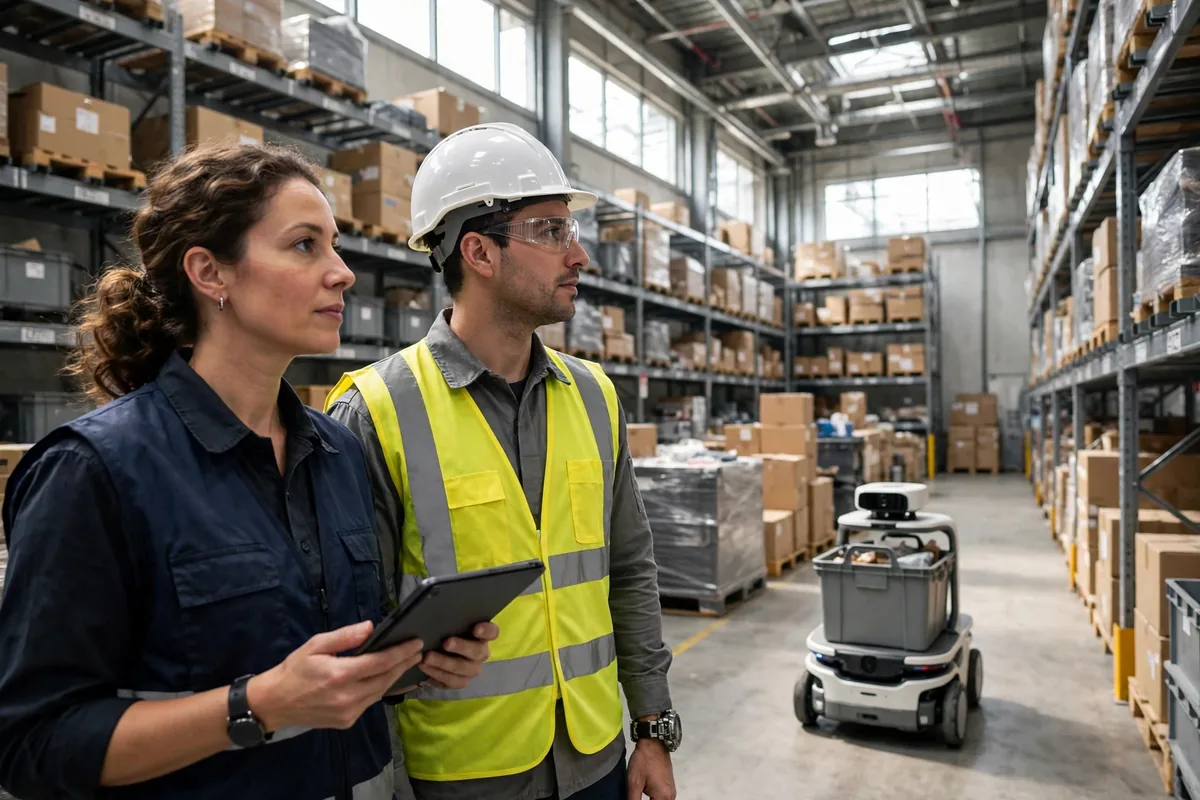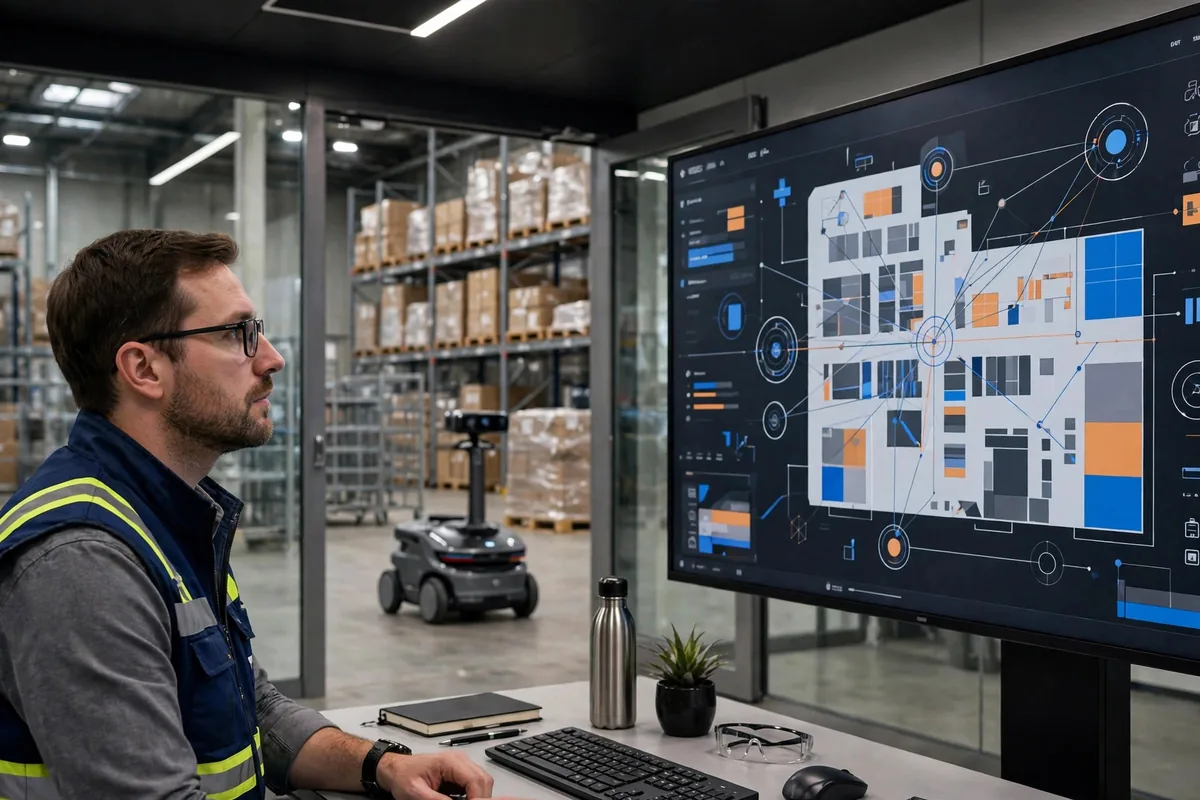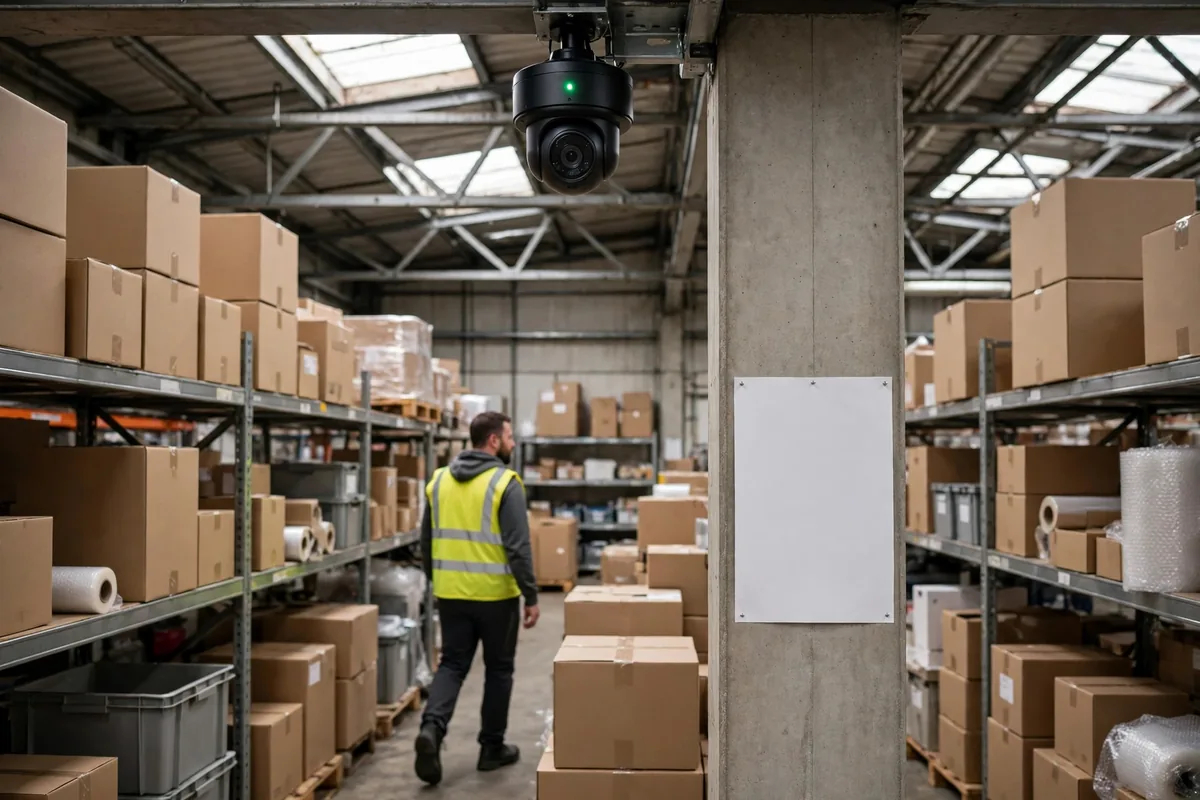
A warehouse ai camera privacy employee notice is not a poster you stick on the wall and forget. It is the conversation you have before the cameras go up. I run a 3,000-square-metre small warehouse in California with twelve people. In March 2026 I installed eight AI cameras to stop losing boxes and to keep forklifts away from racking. The next day a veteran picker asked me: "Boss, does this thing track how long I spend in the bathroom?" I had no good answer. That is the problem this article fixes.
A warehouse ai camera privacy employee notice should answer five questions in plain language: where the cameras are, what they record, who can watch the footage, how long it is kept, and what it is used for. If your workers can answer those five questions after reading one page, you have done the job.
What a Warehouse AI Camera Privacy Employee Notice Must Say
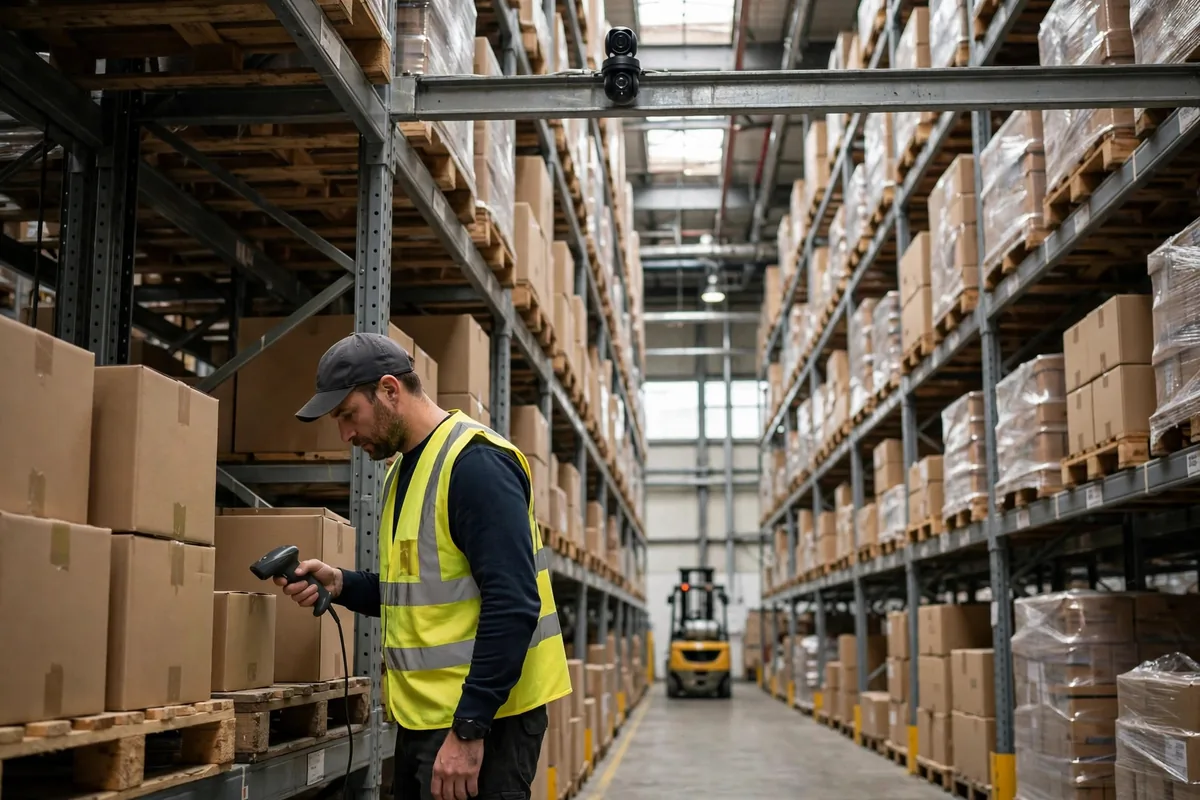
Our notice fits on one page. New hires get a copy on day one, a full copy hangs in the break room, and a small card sits under each camera. Where: four cameras cover the docks and packing area, two cover the racking aisles, and two cover the parking lot. No cameras in the break room, the changing room, or near the restrooms. That is a hard line.
What: video in public work areas only. No audio by default, and no facial close-ups for attendance. Who: only the shift supervisor and I can review footage. How long: ordinary footage is kept 30 days, then overwritten automatically. Clips tied to a dispute are stored separately and deleted once the case closes. What for: finding lost stock, reviewing safety incidents, and improving the workflow. Not for timing breaks.
The counterintuitive part is that the more specific the notice, the less people worry. Vagueness is what makes a camera feel like surveillance.
The United States Is Not One Rulebook
I am not a lawyer, and this is not legal advice. Rules differ by state, and some cities add their own requirements, so check the latest official policy for your state and talk to a lawyer before relying on anything here.
When we spoke to a lawyer, the first thing we learned was that there is no single national camera law in the United States. Some states are strict about audio recording. Some have specific employee-notice requirements. Some have separate rules for biometric information, which matters the moment an AI camera turns on face recognition. We turned face recognition off and left it off. We needed to know where the freight went and where the forklift hit the racking. We did not need to know whose face was on screen.
That gives small warehouses a simple rule: fewer features, less risk. Do not let a salesperson switch on every AI feature at once. Behaviour analysis, dwell-time tracking, and headcounts look impressive in a demo and are mostly decoration in a small warehouse. Of our eight cameras, we use only two AI features: a line-crossing alert and a warning when a forklift gets close to a pedestrian.
Keep a paper trail, too. A verbal announcement does not count, and a group-chat message is not enough. Our notice is signed in duplicate, one copy for the worker and one for the file, with the date on the sign-off sheet. In March 2026 all twelve signed within a day. They were not signing away a right. They were confirming they had been told.
A Low-Cost Rollout in Three Steps: Post, Talk, Prove
Step one is post. Put a card under each camera saying the area is under video monitoring, footage is used only for safety and lost-shipment checks, and recordings are kept 30 days, with a line that says "questions? Ask Xiao Ma." Put the full notice in the break room where people can see it, not behind a door. As a hypothetical example, at a few dollars per card, covering the whole warehouse stays in the tens of dollars.
Step two is talk, for fifteen minutes, not an hour. Say three things: why the cameras are there, what they do and do not record, and who to ask. Then leave ten minutes for questions. Someone asked, "I eat lunch in the packing area. Will I be filmed?" I said we do not review lunchtime footage. Questions beat a lecture every time.
Step three is prove. In April 2026 we lost a carton worth, as a hypothetical example, a few hundred dollars. The shift supervisor pulled footage from the two dock cameras only, found the twenty minutes where a forklift driver had put the carton on the wrong rack. Nobody's other footage was reviewed. Weeks later a worker asked me to pull footage himself, because a customer claimed he had short-shipped an item. The video showed the carton was complete when he packed it, and the complaint went away.
Warehouse AI Camera Privacy: Employee Notice and Footage Retention
Retention is where small warehouses get hurt. Keep footage too briefly and you have no evidence when a dispute arrives. Keep it too long and you pay more for storage, carry more risk, and make your team uneasy. We settled on tiered retention. The figures below are our own practice and hypothetical examples, not an industry standard:
| Footage type | Retention | Who can review |
|---|---|---|
| Everyday public-area footage | 30 days | Xiao Ma, shift supervisor |
| Dock footage | 60 days | Same as above |
| Incident and dispute clips | Deleted when closed, max 90 days | Xiao Ma only |
| Parking lot footage | 30 days | Same as above |
As a hypothetical example, eight cameras recording twelve hours a day for 30 days need storage on the order of a few terabytes, which one enterprise drive can hold. Stretch that to 90 days and the drives roughly double or triple, and so does the cost and the risk. Complaints usually arrive within a week, so 30 days is enough in our experience.
There is a trade-off to say plainly. Short retention saves money and reassures the team, but leaves you without evidence for a slow-surfacing loss. Long retention keeps every piece of evidence, but costs more and makes people uncomfortable. We chose 30 days as the middle ground.
A Checklist You Can Copy
Here is the checklist we use now. Copy it, then change it to fit your warehouse. First, subtract features: switch on only the AI functions you use, and leave face recognition off if you do not need it. Second, write the five answers on one page, post it, hand it out, and get it signed. Third, never install cameras in sensitive areas: break rooms, changing rooms, and restroom entrances are off limits. Fourth, tier your retention: 30 days for everyday footage, 60 days at the dock, dispute clips deleted when the case closes. Fifth, run one real case through the process so your team sees the camera proves their work instead of policing their breaks.
We are twelve people, 3,000 square metres, and eight cameras. This approach has run for most of a year without a dispute and without anyone leaving because of a camera. A warehouse ai camera privacy employee notice is not a contest of legal fees. It is a test of whether the owner will explain things clearly. Say the five things plainly, and the cameras can do the job you bought them for: watching the freight and watching safety. Small warehouses have their own way of surviving, and this one works for us.
By Xiao Ma, Small Warehouse Owner