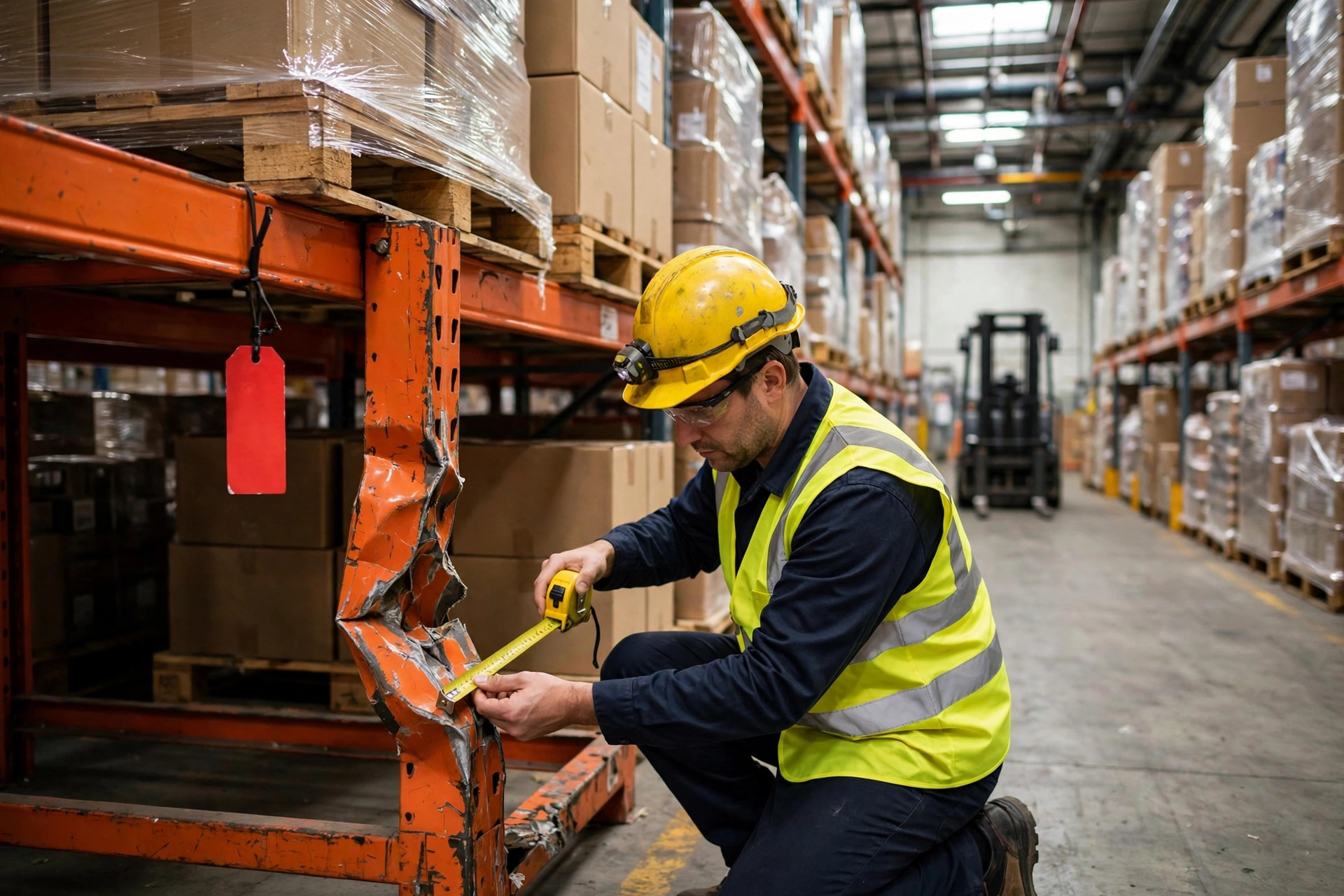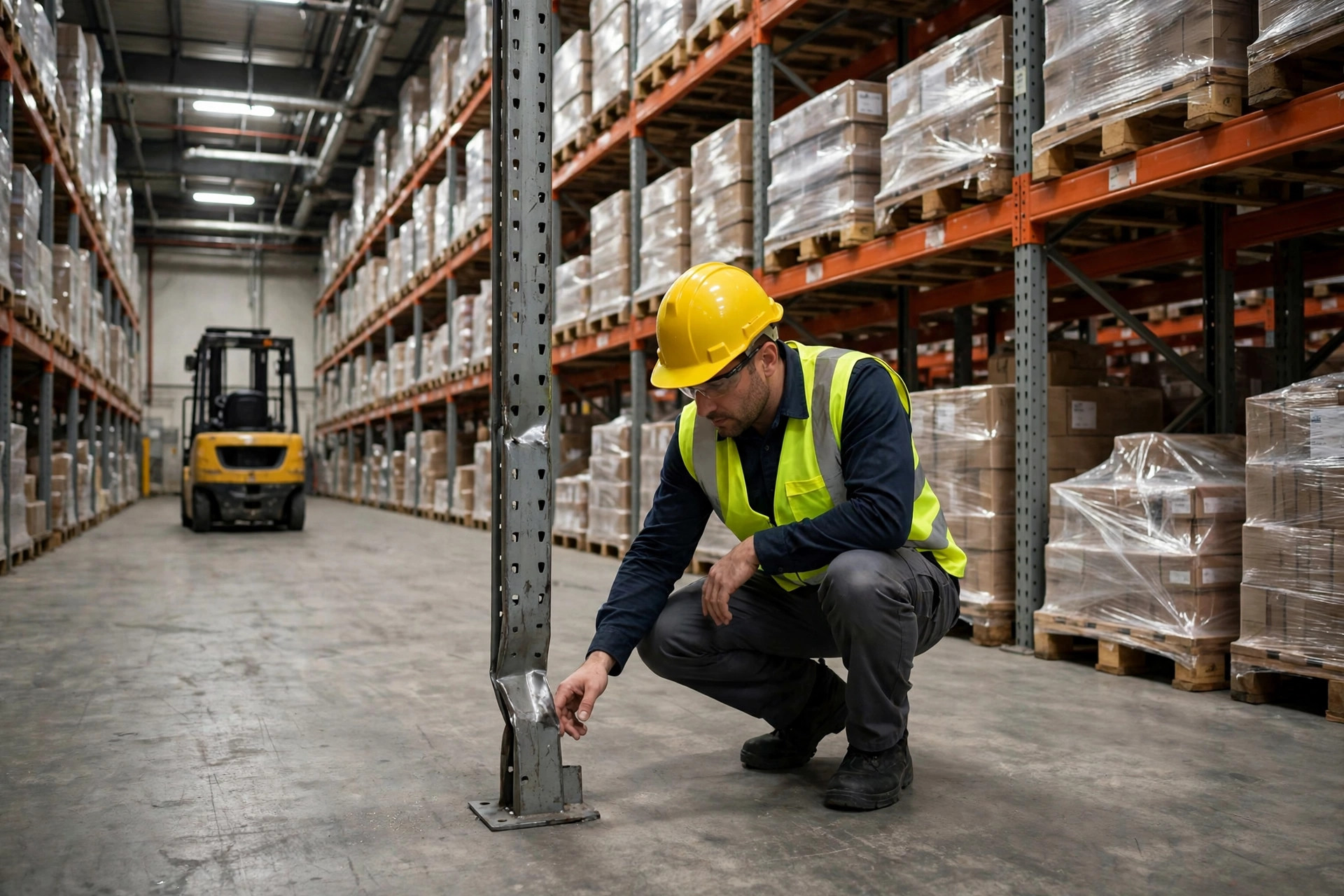
We have a client in Ontario, California, a 3PL running home goods out of a roughly 60,000-square-foot warehouse. One night shift in October 2024, a forklift clipped an upright while turning into an aisle. The dent was not dramatic. Paint was gone, the face of the upright was pushed in, and the night supervisor sent me photos and asked the question I hear most often after an impact: do we have to replace this whole run? The warehouse rack inspection that followed is why I still tell this story.
I told him to stop there. Do not order steel, and do not start pulling the run apart while two levels of product are still sitting on it. That is the first lesson of a warehouse rack inspection done properly. The risk is rarely the dent you can see. The risk is making a big decision before anyone has graded the damage: you either replace a whole run over a small hit, or you keep loading a rack that should have been taken out of service.
That job ended in a way that still surprises people. We replaced the one upright that took the hit, reinforced and re-measured the two next to it, and left the rest of the run in service. More than a year later, that location is still turning normally, and follow-up checks have found nothing new. The money saved was not the point. The point was that every call had a reason, a photo, and a piece of paper behind it. If a customer or an insurer asked why that upright stayed, we could show our work.
A Warehouse Rack Inspection Starts With Grading, Not Replacing
Most teams treat inspection as a walk-through: spot obvious damage, note it, move on. A real judgment, though, has to be tied to one specific upright.
Direction and height matter. A dent facing the aisle is not the same as a twist running along the depth of the rack. Damage near the foot is more worrying than damage halfway up, because that is where the load path starts. Then check what the impact did to everything around it. Are the beam connectors still seated? Did a neighboring upright shift? Did a floor anchor lift? A single upright can look acceptable while the whole run has drifted out of line, and that run is not a pass.
And check whether product is still on the rack. If a deformed upright is still carrying load, the first step is always to unload it before anyone argues about repair or replacement. It sounds obvious. On a night shift, with trucks waiting, it is the step most likely to get skipped.
We graded that Ontario job in three bands, and I still use the same bands because a warehouse manager can apply them without an engineering degree:
| Damage grade | What you see | What to do |
|---|---|---|
| Minor | Limited surface deformation, connections intact | Record it and shorten the recheck interval |
| Moderate | Visible deformation, no tearing or major displacement | Unload, repair or replace the damaged part under a manufacturer-approved method, then re-measure |
| Severe | Tearing, obvious twist, loose foot, or a run out of line | Unload and isolate immediately, no return to service until parts are replaced |
The exact tolerances are not mine to invent. They come from the manufacturer's manual for that rack, and where a rule is uncertain, per the latest published regulation. Different rack designs do not share one number, and anyone who quotes you a universal bend limit without asking which rack you own is guessing.
Here is the counterintuitive part: the upright that got hit is not always the most dangerous one on that run. Force travels through beams into connectors and neighboring uprights. The column that looks untouched can have a connector that took load it was never meant to take. That is why the inspection area is never one upright. It is the impact point plus a full bay in every direction, at minimum, including the connections above eye level that a quick aisle walk never sees.
What Your Warehouse Rack Inspection Report Has to Say to Hold Up in a Dispute
The expensive part of rack damage is often not the steel. It is the argument afterward. The operator calls it normal wear. The 3PL says the customer's product caused it. The insurer asks for the last qualified inspection record. The manufacturer asks whether the repair kit was one it approved. Everyone has a version of events. The only version that survives is the written one.
A useful warehouse rack inspection report does not say "damage found, replacement recommended." It says where, with photos; what grade; which manufacturer standard it was judged against; whether the action is repair or replacement; who re-measures after the repair; and whether the location stays out of service until that re-measurement passes. Leave out those last two items and you have a reminder note, not a decision.
The same points belong in the contract before anything gets hit. Does the inspection scope include high bays and cold storage? How often does it happen? Who counts as a qualified inspector? Must repair parts follow a manufacturer-approved method, or is any part with the right dimensions acceptable? How soon after a repair does re-measurement happen, who pays first, and how is the cost split afterward? Most disputes I have sat through were not technical disagreements. They were contracts that never mentioned these questions, so everyone started negotiating after the damage was done.
Run the money honestly, too. On the Ontario job, replacing the whole run meant steel, labor, and taking an aisle out of service while product was moved elsewhere. Replacing one upright plus two reinforcements cost far less, but only because the re-measurement passed and the report was complete. Doing nothing looked free on the day, and it was the most expensive option of all, because it left the risk sitting in the next audit and the next insurance conversation.
There is a second judgment here that cuts against instinct. A report full of minor findings does not mean a warehouse is badly run, and a spotless report does not mean the racks are safe. The first usually means someone is actually looking. The second can mean the inspector walked the aisles and never checked the high connections. I would rather defend a report that lists twenty minor dents with recheck dates than a beautiful blank one.
A Dallas client learned that the hard way in early 2025. They had taken over a building from a previous tenant and inherited the racks with it. Handover included a visual walk-through, but no complete inspection record from a qualified inspector. Months later, a loose beam connector turned up, the insurer asked when the last qualified check had happened, and the operator could not produce a credible report. The repair itself was not costly. The months of back-and-forth were. After that, they wrote annual inspection into the contract exhibit, naming the inspector, the standard, and who owns re-measurement.
Inspection cadence deserves the same plain treatment. In practice, I like to see operators walk their aisles weekly, a supervisor review findings monthly, and a qualified inspector cover the building at least annually, with a full re-check after any significant impact. Treat that as a working rhythm, not a legal citation: where a specific requirement applies to your operation, per the latest published regulation. The point of a regular warehouse rack inspection rhythm is that damage is caught while it is still minor, when the fix is a note and a recheck rather than an aisle shutdown.
Three Questions to Ask Before You Sign
So the next time you talk to a rack vendor or an inspection firm, whether you operate the warehouse or you are the 3PL in the middle, ask these three questions before you sign anything.
What grading standard do you follow, and will the report grade upright by upright? If the answer is a general "everything looks fine," that report will not help you when it matters.
Is the repair method manufacturer-approved, who re-measures after the repair, and what happens if it fails? The line between repair and replacement lives in that written answer, not in a sales conversation.
How long are inspection records kept, and who explains the report if there is a dispute months later? People leave jobs. Photos and reports do not, as long as someone kept them.
A good inspection program does not exist to find faults for their own sake. It exists so that every impact ends with a defensible answer: this one gets replaced, this one gets repaired, this one gets watched, and every step is signed off. Get that logic into the contract now.
By Susan, 3PL Sales Director