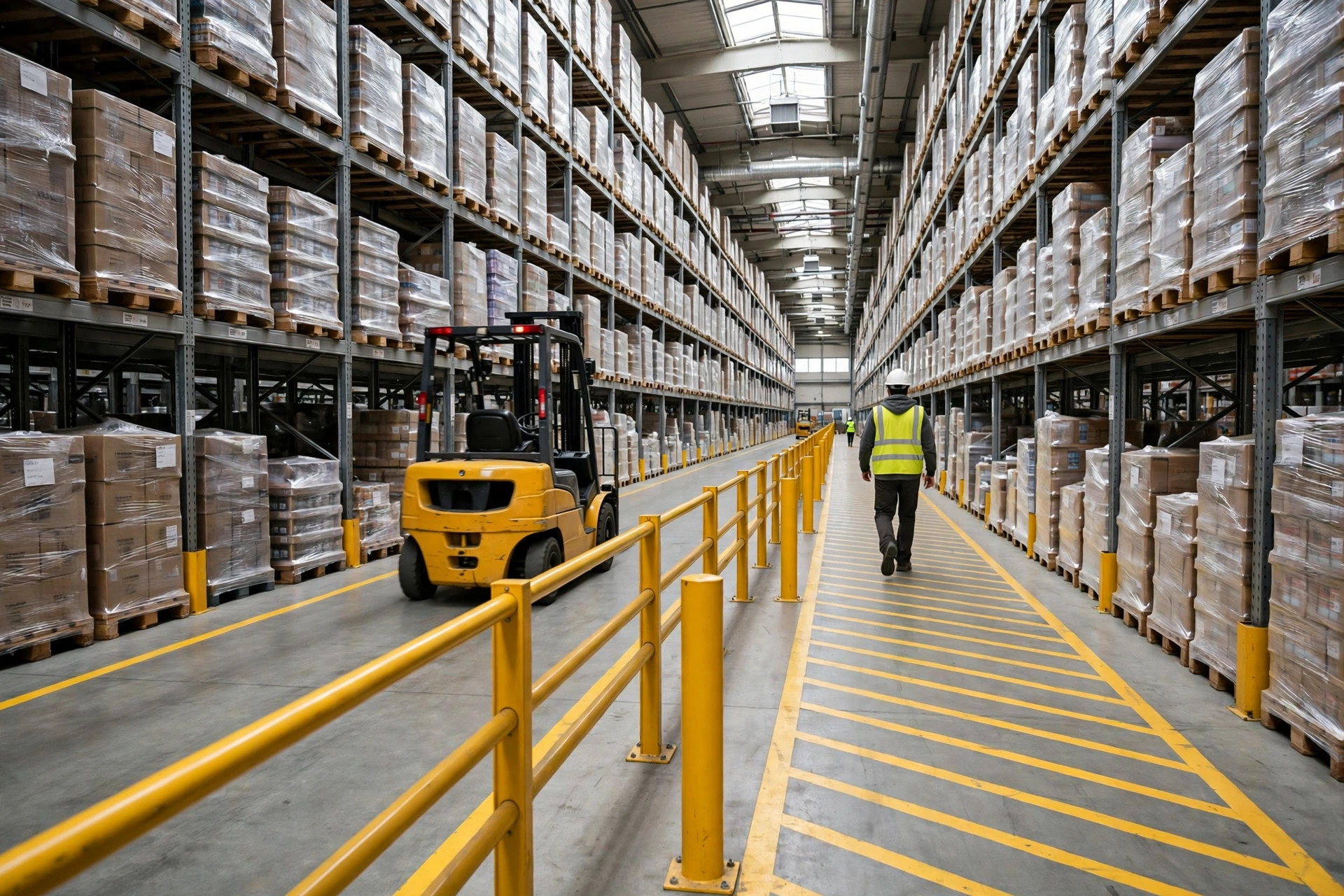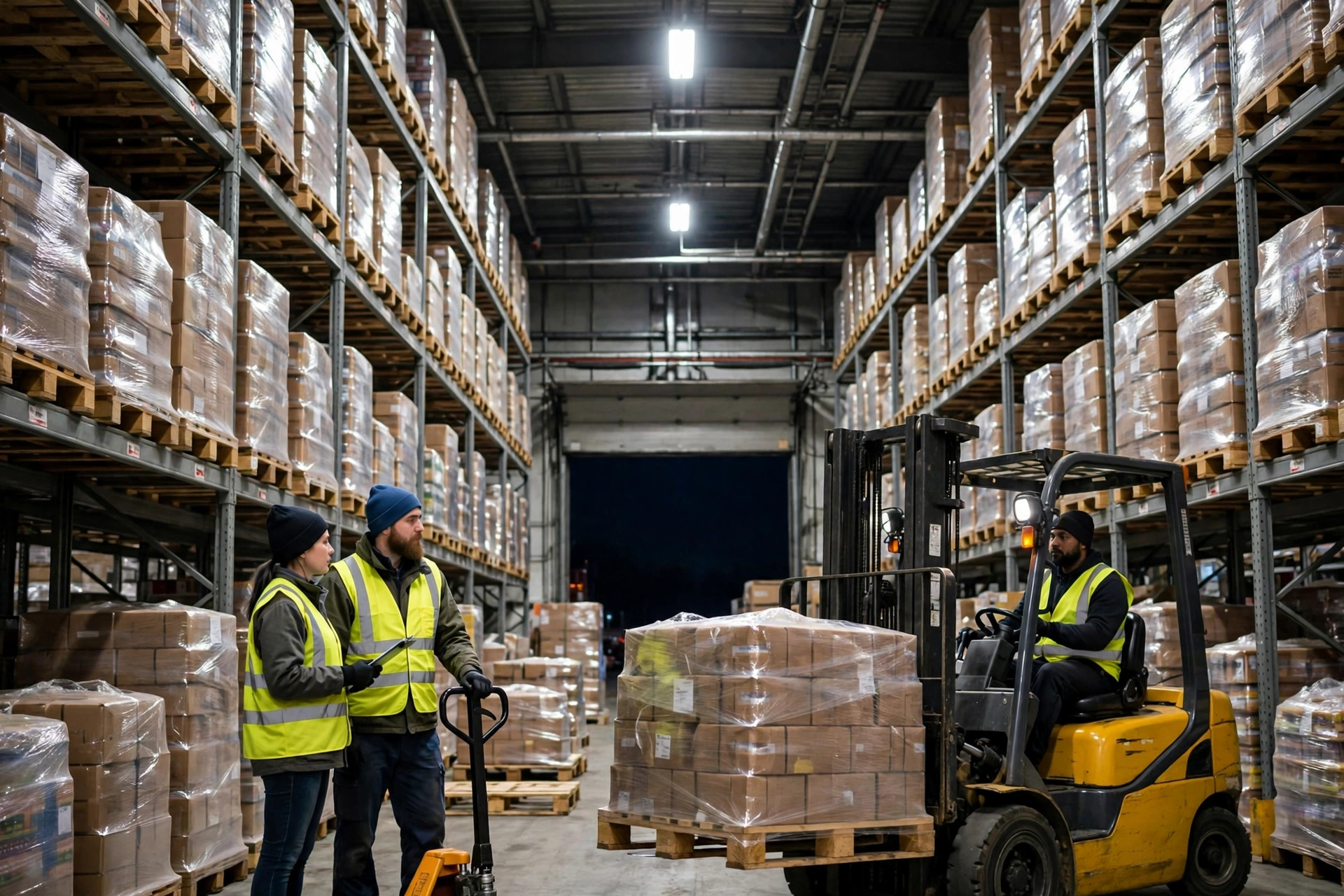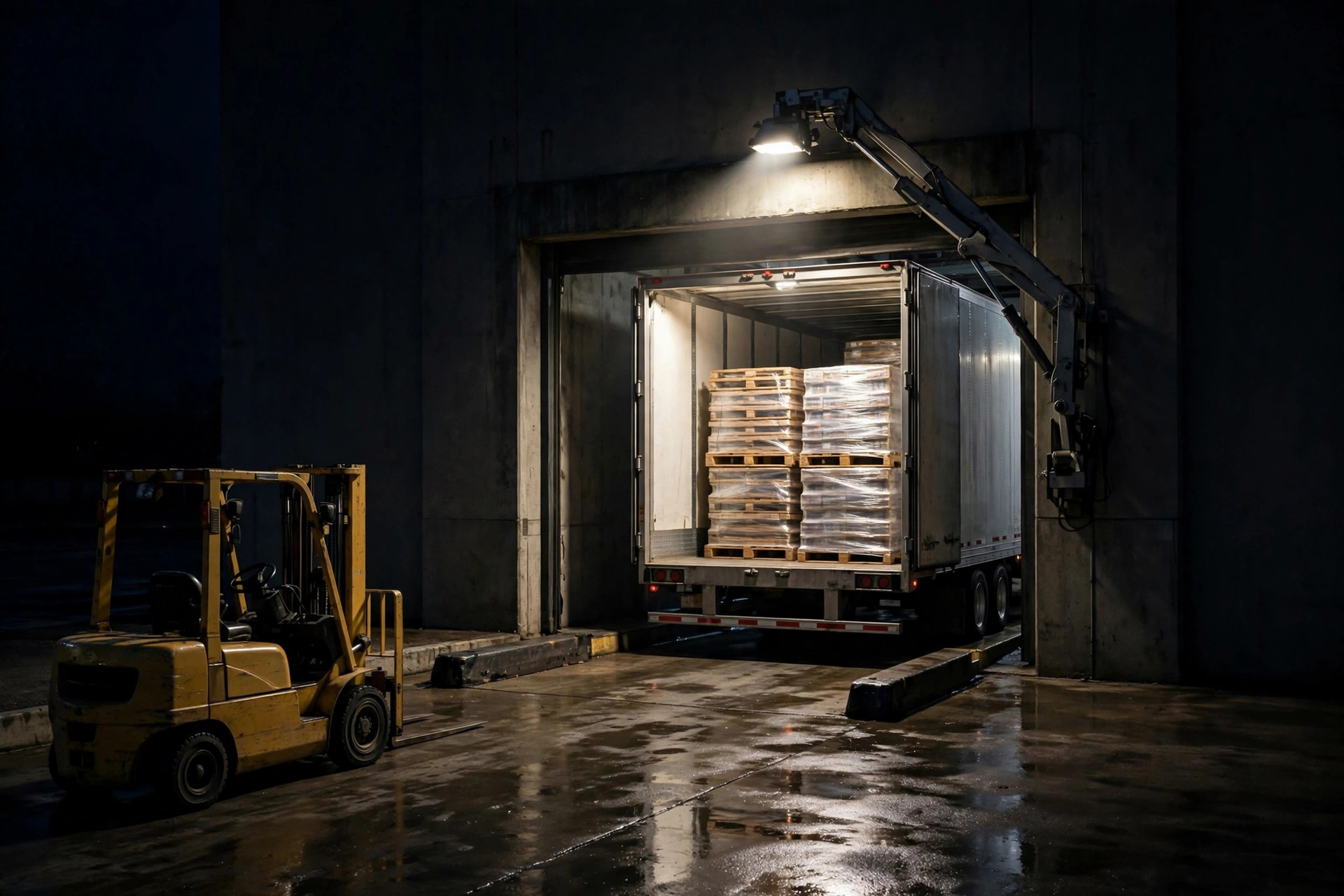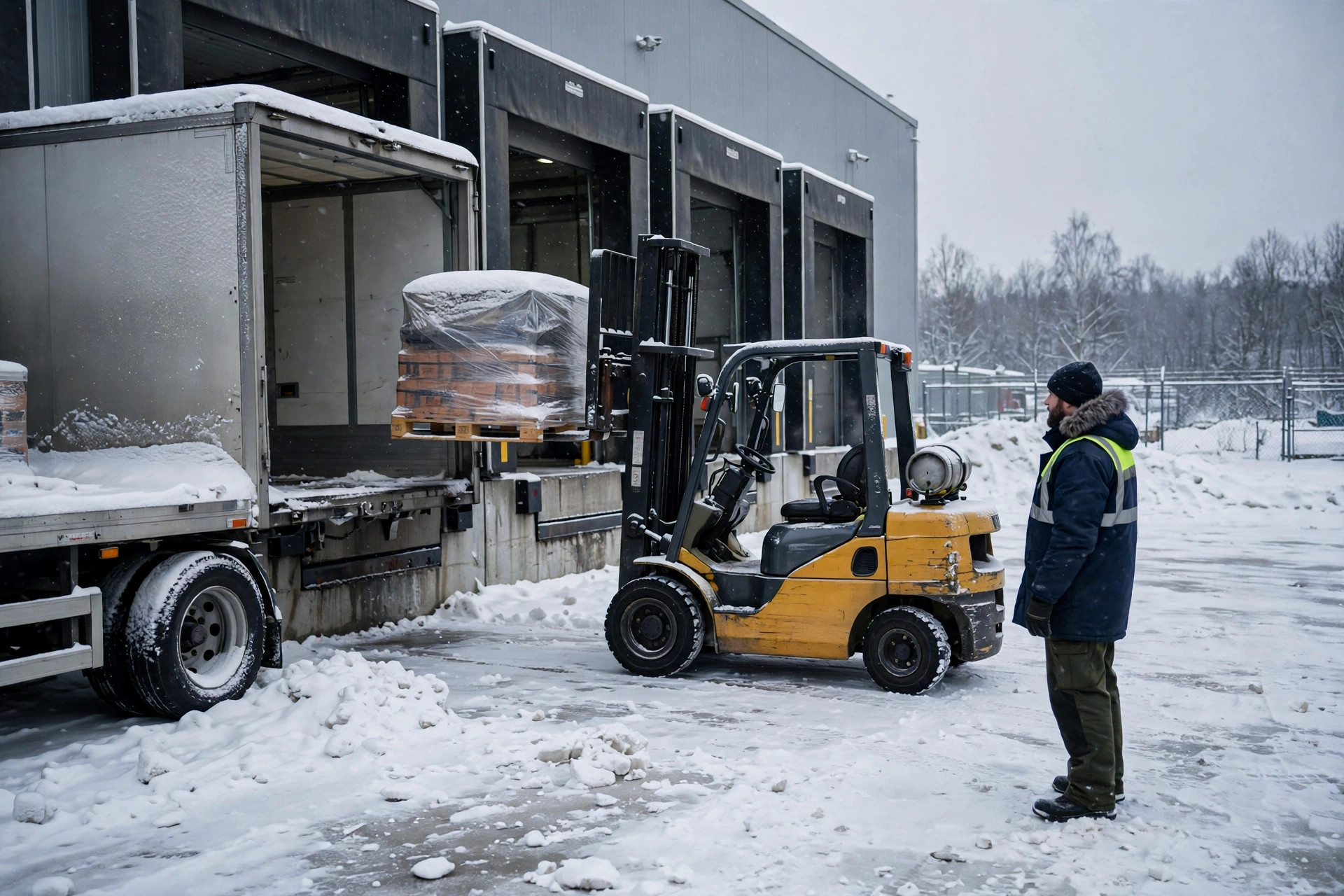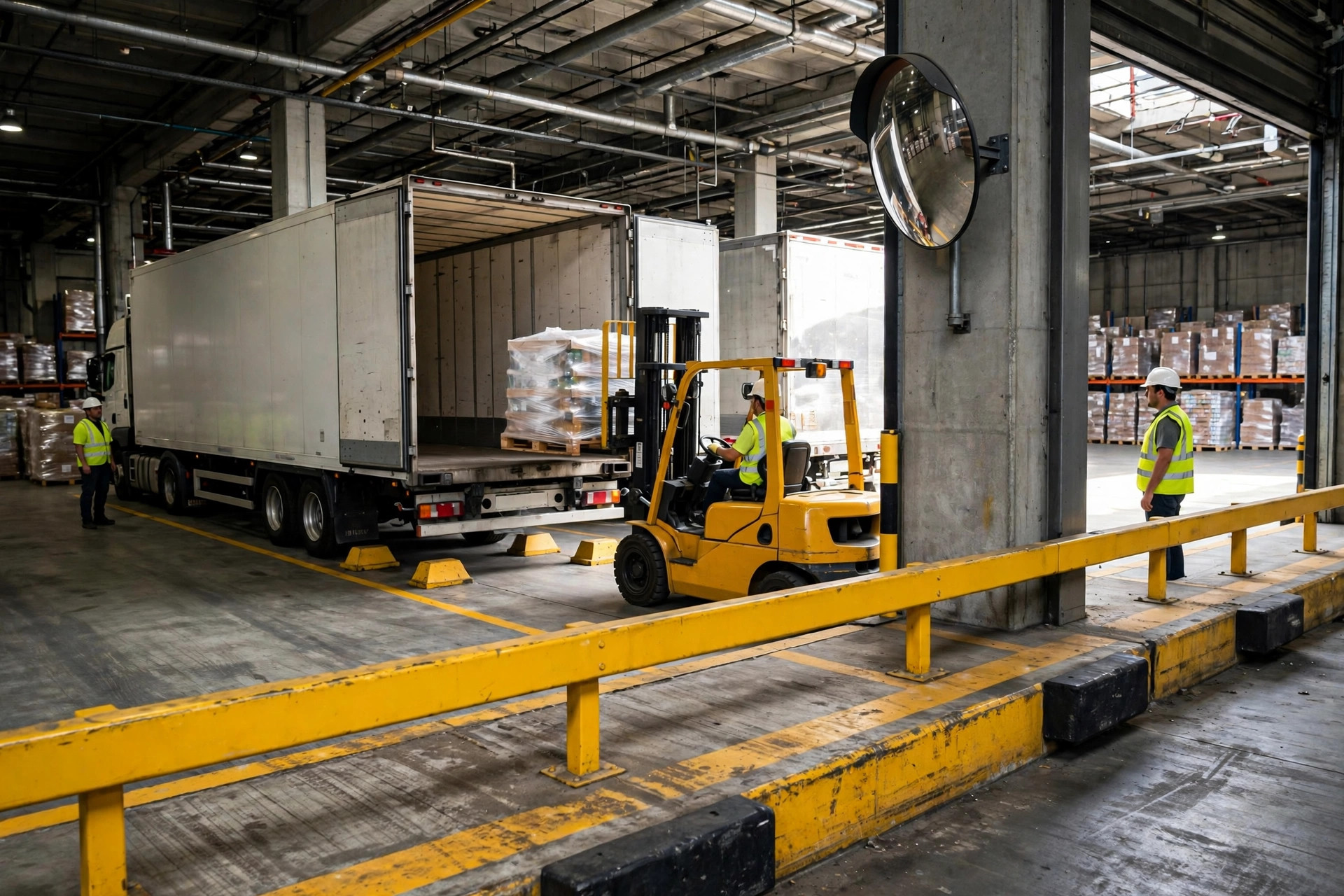
It was 4:30 in the morning, peak season, and the dock lights were still on. A truck had just pulled away from Door 8, and a forklift driver named Li was backing into the building with half a meter between his wheels and the dock edge. Nobody fell that day. But I stood there watching, and my shirt was soaked through. Let me be straight with you: warehouse loading dock fall protection feels like somebody else's problem until the one second it becomes yours.
Our warehouse is in California, and our dock sits about four feet off the ground. That does not sound like much. Fall from that height feet-first and you can still break something. Fall head-first, or go over with a forklift, and you are not talking about a few days off. This piece is not a lecture. It is how our warehouse handles the dock edge now, in three places: guardrails, wheel stops, and mirrors, plus a few work rules that hold the whole thing together.
Here is a night I will not forget. One winter night in 2023, around 11 p.m., Door 6 was loading household goods and a driver in a hurry released his handbrake before our spotter gave the signal. The truck rolled back about half a meter. A checker named Wang stepped back to get clear, and half his foot went over the edge. A coworker grabbed his arm and pulled him back. Nobody got hurt. The next morning I kept the whole shift after the meeting and said it plainly: a dock edge with nothing solid between people and the drop is not a workplace, it is a bet.
The second scare came in the summer of 2024, right in the middle of peak season, when we were running more than 40 trucks a day. A new forklift driver was backing out of a trailer between Doors 3 and 4, and the trailer wall blocked his view completely. A checker was walking past on the other side, and neither of them could see the other. The forklift braked hard, the pallet rocked, nothing fell, nobody got hit. That day I understood something I had been missing: the dock edge problem is not only a person falling off. It is trucks and people not seeing each other.
After those two nights, we rebuilt the dock edge, fixing the three spots that could actually hurt somebody.
Warehouse Loading Dock Fall Protection, Spot One: Guardrails on Every Empty Door
Our rule today is simple: if no truck is backed up to a door, that door's edge gets a guardrail. Not a painted yellow line. Not two traffic cones. A steel guardrail a person can actually lean on without going over.
We learned this the hard way. Our first guardrails were fixed and tall, and they got in the way of forklift traffic. Workers hated them, so they pulled the pins and left the rails swung open all day. A guardrail that stays open protects nobody. We switched to swing gates: the rail stays closed, the shift lead opens it when a truck docks, and it closes again the minute the truck leaves. The lead signs the handover log. That small change made the whole system real, because a rail only counts when it is closed.
A few details matter. The rail has to be high enough to catch a person's center of gravity, and the bottom gap has to be small enough that a foot cannot slide under it. The posts must be anchored into the concrete, not just bolted on lightly. One inspection found a post a forklift had clipped loose; we shut that door until it was fixed. A loose rail is worse than no rail, because people lean on it trusting it will hold.
Warehouse Loading Dock Fall Protection, Spot Two: Wheel Stops So the Truck Stays Put
Wheel stops look like they are about protecting the building. Honestly, they are about protecting people. When a truck creeps or shifts at the dock, everyone on the dock starts moving out of the way, and moving fast near an edge is how feet go over it.
Every door we use regularly now gets two things: floor wheel stops and a set chocking routine. The driver backs in, our dock hand sets the stops, and we check the gap between the trailer floor and the dock. If the gap is wider than a boot, we do not load. The driver re-spots first. While loading runs, the driver hands the keys to the dock attendant. No keys back until the truck is done. Drivers argued about lost time at first. Then one day a truck got bumped from behind during loading. The stops held it, and the truck moved only a few centimeters instead of half a meter. After that, the arguments stopped.
Stops need daily attention. They crack, they shift, they go missing. In peak season, with more than 40 trucks a day, they wear fast. We count them every month and replace damaged ones on the spot, no waiting for a bulk order.
Dock Edge Visibility: Convex Mirrors So Trucks and People See Each Other
The third spot is visibility. Dock corners, trailer side walls, and columns create blind spots all over the place. We mounted large convex mirrors at every corner and across from the doors we use most. A forklift driver checks the mirror before reversing. A pedestrian checks the mirror before rounding a corner.
Mirrors are cheap, and that is exactly why they get neglected. Dust builds up, angles drift, and suddenly the mirror shows the wrong lane. We put mirrors on the Monday morning checklist: the shift lead walks the dock with the crew, wipes every mirror, and resets any angle that drifted. A cracked mirror, or one that stays foggy after wiping, gets replaced the same day.
Mirrors alone are not enough, so we added three work rules. Pedestrians stay in the marked walkway and never cut behind a truck to save steps. A forklift never reverses without a spotter behind it. On night shift and in the early morning, when light is poor, every dock light stays on, and a dead bulb gets reported the same shift, not the next week. These rules sound basic, and they work.
What the Three Fixes Cost, and How We Inspect Them
People always ask what this costs. Here is our math. Outfitting one busy door with a swing guardrail, stops, and a mirror costs far less than one fall injury: the medical care, the lost shifts, the temp worker brought in to cover, and the schedule chaos that follows. And morale after a serious injury is a cost no invoice shows.
| Fix | What it stops | How often we check it | Who owns it |
|---|---|---|---|
| Swing guardrail | A person walking off an empty door edge | Every morning before doors open; posts tightened monthly | Shift lead |
| Wheel stops and chocking | A truck creeping and forcing people to dodge near the edge | Confirmed before every load; counted and replaced monthly | Dock attendant |
| Convex mirror | Blind spots at corners and trailer sides | Wiped and realigned every Monday; replaced same day if damaged | Shift lead with crew |
We also folded all three checks into one handover sheet posted in the dock office. The incoming shift walks the dock first: rails closed, stops in place, mirrors clean. They tick the boxes before taking over. If the sheet sits blank for two days, I go talk to the shift lead directly. A ticked box is evidence.
Here is the counterintuitive part, and it is the one I repeat to other managers. The most dangerous moment at the dock edge is not when no truck is there. It is the few minutes right after a truck pulls away, when the door stands open and empty. People relax the second the truck is gone, their steps drift toward the edge, and that is when a foot slips. Our rule now is that the rail closes the minute the truck leaves, and the door light stays on. We guard those few minutes of relaxation. And a taller rail does not mean you can stop watching your feet.
For fellow managers, it comes down to three sentences. An empty door gets a rail. A truck stays put before people move around it. A corner gets a mirror check before anyone walks around it. Get those three right, and you can hand over the night shift knowing nobody spent the shift one step from the edge.
By Chen Feng, Warehouse Operations Manager