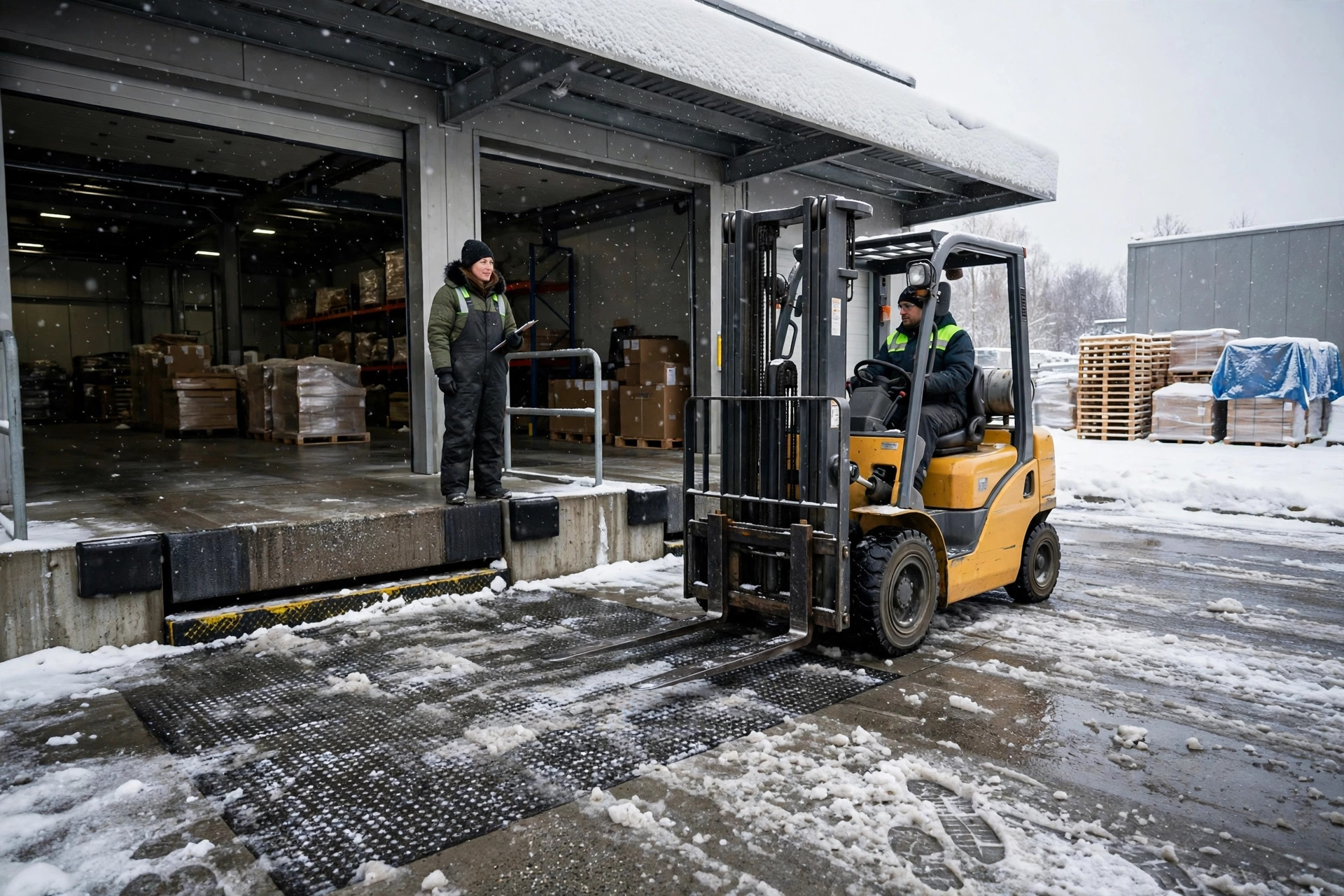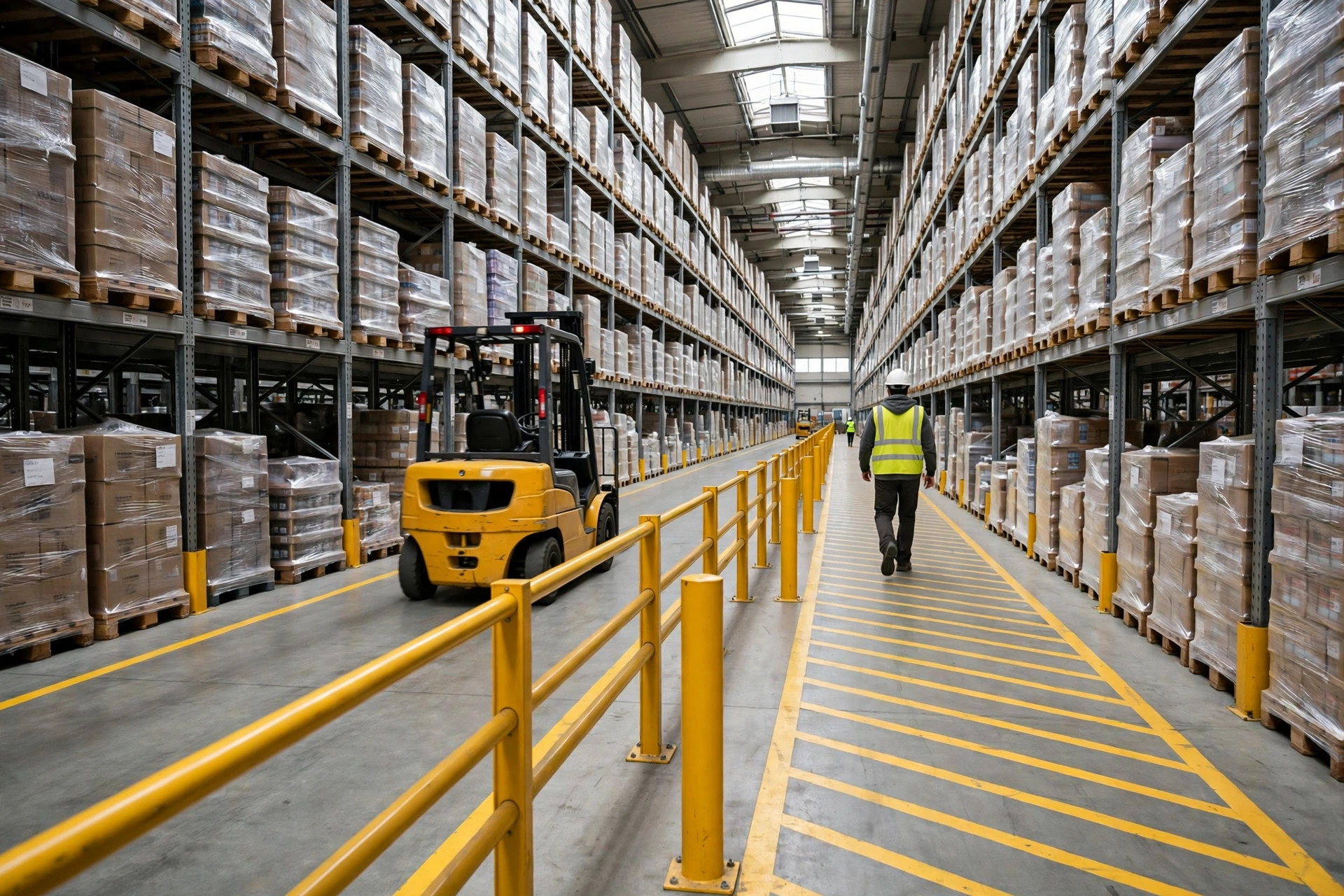
Let me tell you something. After all these years on the road, the place that scares me most is not the highway. It is the few yards of concrete beside a warehouse dock. A worker walks out from between the racks, a forklift turns the corner with a load in front of it, and neither sees the other until they are almost touching. That is what warehouse forklift pedestrian safety really comes down to: two people sharing a space where neither can see, hear, or predict the other well enough. I have spent years waiting at docks watching that dance, and the fix is not complicated. Most warehouses just never finish it.
The Morning I Watched a Near Miss at the Dock
It was a fall morning in 2023, outside a food distribution warehouse in California. I was in line to get loaded, and the dock lights were half on, half out. A picker carrying a carton cut across the forklift lane from the cooler to packing, a shortcut everybody took. At the same moment, a forklift came out of the racking with two pallets of drinks stacked high, and the driver could not see over the load. The forklift braked hard enough to leave a black mark on the concrete, and they stopped less than two meters apart. Nobody was hurt, but the carton hit the floor and drinks rolled everywhere. At the morning meeting, the supervisor said one sentence: no more shortcuts. Nobody repainted the lines that day, and nobody added a barrier. The rule changed on paper. The floor stayed the same.
A second scene stuck with me more. In spring 2024, I picked up an e-commerce load at a third-party warehouse in the Inland Empire. My appointment was 10 a.m., and the scheduler told me to park at Door 7 and walk in for the paperwork. To reach the office, I had to cross a main forklift lane. There was no sidewalk, no guardrail, just yellow paint worn down to almost nothing. A forklift came toward me, empty and fast, while the driver turned his head to talk to someone beside the lane. I pressed myself against the racking and waited. That warehouse did not lack pedestrians. It lacked a place for pedestrians to be.
Neither day produced an accident report, and that is exactly the trap. When nothing happens, everybody assumes the system worked. Most of those quiet days are luck doing the job that design should be doing, and luck will not cover a warehouse running all year.
Forklift Pedestrian Safety Starts With Blind Spots, Not Blame
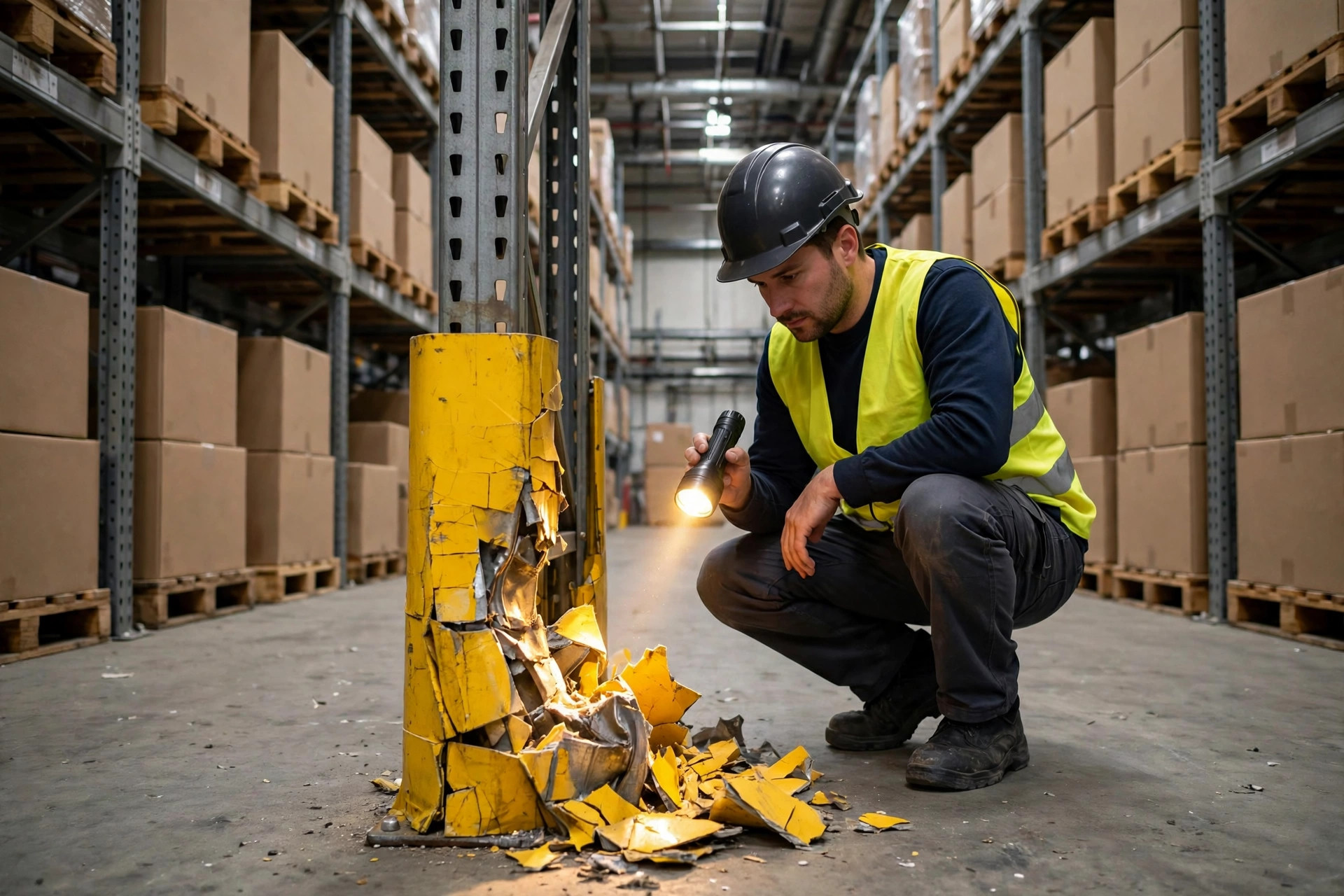
It is easy to blame the forklift driver, but wild driving is not the main problem. A loaded forklift is a moving wall. The driver can see left and right, but the ground right in front of the load, two or three meters out, is basically invisible. A worker crouching to label a carton, or stepping out from between racks, is in that invisible zone. Backing up is just as bad: the tail swings, and a person behind it assumes it will go straight.
Pedestrians have their own blind spots too. Warehouses are loud, and electric forklifts are quiet. A worker wearing earplugs, carrying a box, and reading a pick slip will not hear one coming. So two people both assume the other will give way. That unspoken deal is the most dangerous thing on the floor. Real separation builds itself into the floor instead.
Forklift Pedestrian Safety by Zone: A Practical Separation Framework
Painting the whole warehouse yellow is not a plan. Different zones carry different risks, so the money should go where the risk is:
| Zone | Where people walk | Where trucks run | What matters most |
|---|---|---|---|
| Dock and loading area | A marked walkway, kept clear of the forklift turning radius at each door | A dedicated forklift lane, with a spotter for reversing | Ground markings plus guardrails; no pedestrian enters a door that is actively being loaded; reversing always has a spotter |
| Rack aisle entrances | A marked crossing point, like a crosswalk on a street | Forklifts slow down and sound the horn before entering or leaving an aisle | Convex mirrors on corners, guardrails on both sides of the crossing |
| Packing and picking area | Walkways separated from workstations by guardrails | Forklifts stay on the outer lane and never enter the workstation area | No forklifts inside the work zone; replenishment happens between shifts, not during peak picking |
| Office and break-room exits | A walkway starting right at the door, leading to parking | The forklift lane kept at least one guardrail away from the door | Speed bumps and warning lights at the exit, so a worker stepping out can see the lane immediately |
| Outdoor yard | A sidewalk and a marked route from parking to the office | Truck and forklift lanes kept apart, with the reversing area cleared | Visiting drivers get a walking route on arrival and are told plainly where not to walk |
The cheapest items there are floor markings and mirrors; the expensive ones are guardrails and re-routing a lane. But do the math: one scrape shutting a dock for half a day, plus claim and paperwork, costs more than repainting lines and hanging mirrors several times over — a big uncertain loss traded for a small certain one.
The Counterintuitive Truth: More Mirrors Change Nothing Without Enforcement
Here is the part managers do not always want to hear. I have walked into warehouses with mirrors on every corner, signs on every wall, and a five-mile-per-hour limit, where forklifts still flew through aisle entrances and workers still cut across lanes. Nobody enforced any of it. Mirrors went dusty, a guardrail got bent and stayed bent, and the yellow lines wore away. Everything was perfect on installation day, and a little worse every day after.
So here is my counterintuitive judgment: adding more mirrors and signs changes almost nothing, while genuinely slowing the trucks down beats any gadget you can buy. Dropping a forklift from eight miles per hour to five shortens the stopping distance by a wide margin and buys the driver reaction time a pedestrian's life may depend on. At higher speed, all the mirrors in the world only let the driver see the person a fraction of a second before impact. Enforcing speed is simple: a limiter, a log of overspeed events, a daily supervisor check, and a conversation when somebody speeds. The hard part is being willing to have that awkward conversation.
There is also a trade-off nobody talks about honestly. If the walkway takes a long detour, pickers will walk an extra kilometer or two a day, get annoyed, and go right back to cutting across. A rule that fights human nature will lose. Draw the walkway where people actually need to go, in as straight a line as you can, and put crossings where people actually cross, not in a quiet corner that looks tidy on a drawing.
What Shippers and Warehouses Should Actually Do
If you are a shipper visiting a warehouse, do not just check whether the racks are full and the software looks modern. Spend ten minutes walking the floor. From the gate to the dock, does the walkway break anywhere? Are there mirrors at aisle entrances? Does anyone spot reversing forklifts? If those three pass, the place takes separation seriously. If any one is vague, your freight sits in a building where the risk travels with it.
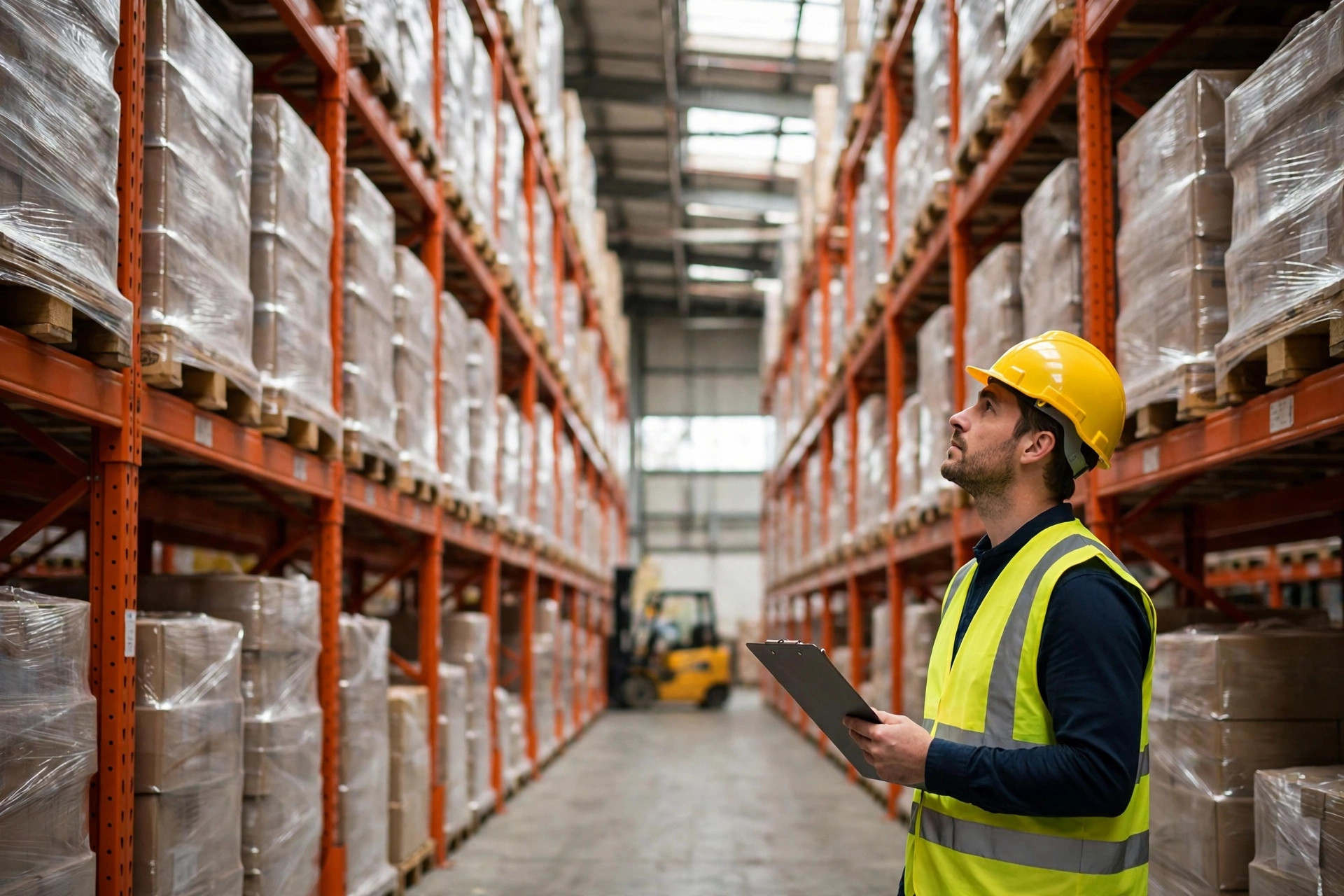
If you run a warehouse, do not wait for an accident to audit yourself. Once a month, stand at an aisle entrance for half an hour during a busy shift and count how many people cut across and how many forklifts fail to slow down. Fix one thing at a time. When a visiting driver arrives, hand them a simple yard walking map. A driver is not your employee; if you do not tell them where to walk, they will navigate by feel, and feel is the least reliable guide in a forklift yard.
On the regulatory side, I will not quote section numbers or fine amounts from memory, because those details change. Check the official source for the latest requirements, and keep records: training sign-ins, overspeed conversations, guardrail repairs. That paperwork looks tedious on a quiet day. On the day something goes wrong, it is the evidence the warehouse did its job.
The good warehouses I have seen share one trait: people walk on a path made for people, trucks run on a lane made for trucks, and nobody has to guess. Separate the paths and the place calms down, and work gets faster because nobody spends the shift watching over their shoulder.
By Shifu Zhao, Trucking Veteran (15 yrs)