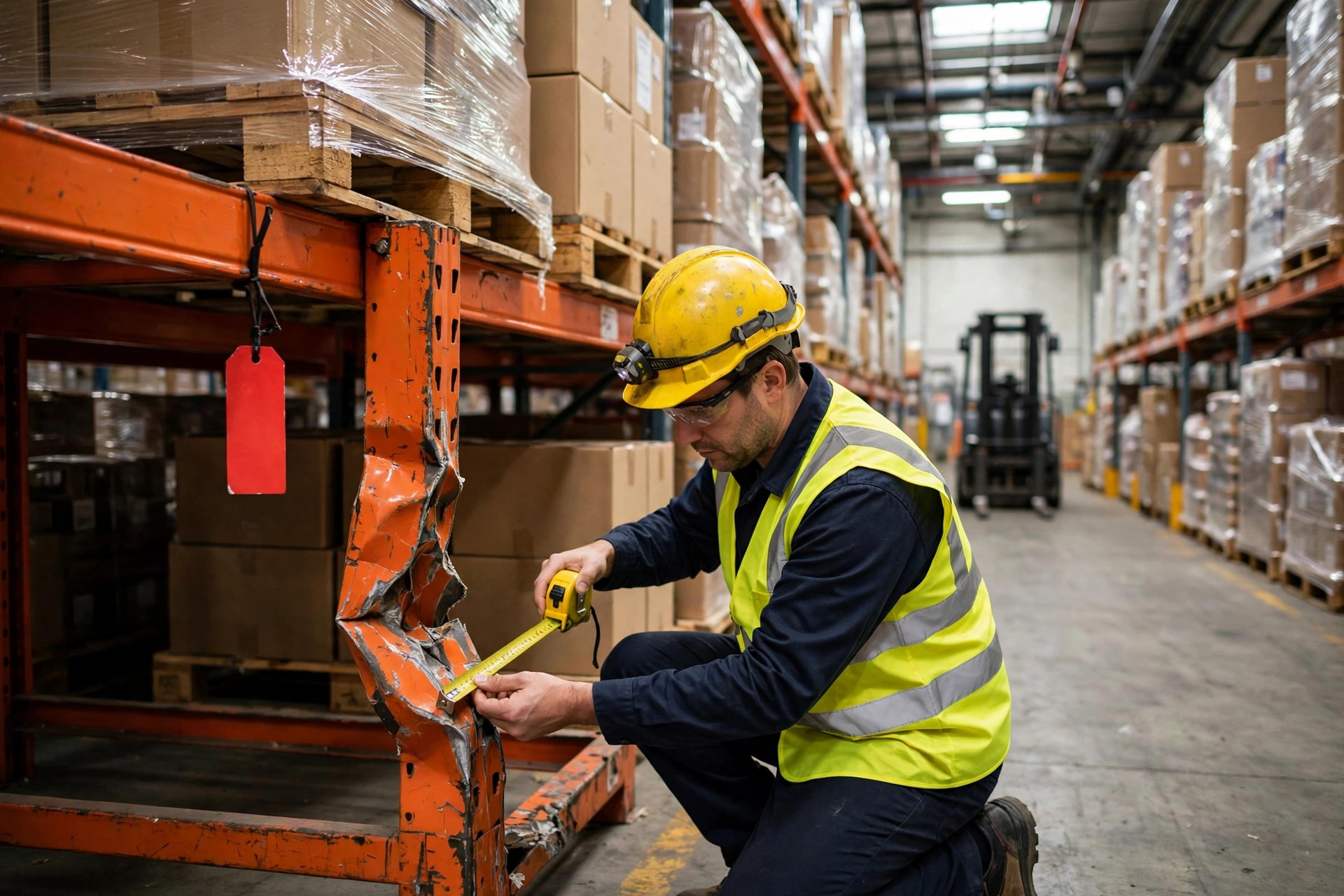
First, the conclusion: a pallet rack damage inspection cannot be judged by gut feel, and it cannot be sorted into just two buckets of "usable" and "unusable." A system that works has three grades — green, amber, red. Green means keep using it and keep it on record. Amber means repair it within a deadline, and do not reload it until the repair is done. Red means unload it and isolate it immediately. I have seen this failure three times, and all three times it was the same defect: somebody saw the damage, nobody graded it, and the damage sat there for months until it became an incident.
One framing point matters before anything else. The green-amber-red grading method comes from the UK's SEMA and HSE system. It is not US law. In the United States, the legal basis is OSHA 1910.176, which requires material handling equipment to be kept in safe condition, together with the current text of ANSI MH16.1 and the rack manufacturer's load plaque. Borrow the grading method by all means — but set your numeric limits from your manufacturer's plaque and the current standard text. Copying UK numbers and presenting them as American regulation is exactly the mistake I refuse to make.
Pallet Rack Damage Inspection: Grade the Action, Then the Number
The power of grading is not the color. It is the action tied to the color. Plenty of warehouses post a red-amber-green chart on the wall and then respond to every grade the same way: "note it down and deal with it later." That is not grading. That is paperwork.
| Grade | Meaning | Required action |
|---|---|---|
| Green | Damage within acceptable limits; load-bearing capacity not affected | Record the location and a photo; re-check at the next inspection for any worsening |
| Amber | Damage needs repair but is not immediately dangerous | Schedule the repair; once the bay is unloaded, it must not be reloaded until the repair and re-inspection are complete |
| Red | Severe damage; continued loading carries risk | Unload immediately, tag and isolate the bay, and keep it out of service until parts are replaced and re-inspection passes |
Amber is where systems quietly fail. The internal rule I set for clients borrows the UK SEMA practice: an amber item gets four weeks from the day it is found, and if it is not repaired in that window it automatically becomes red. The four-week figure is not written into US law — it is a deadline discipline. An amber grade with no deadline always ends up as an amber grade nobody manages. Write the deadline into your own inspection procedure, in plain language, where everyone can see it.
How do you set the numeric limits? Work through three sources in order. First, the damage limits and load plaque from your rack manufacturer. Second, the deformation criteria in the current ANSI MH16.1 text. Third, if no written limit exists for your system, bring in a qualified rack engineer to set one and put it in writing. If you cannot verify a number, write "per the manufacturer's load plaque and the current standard" — do not invent a millimeter figure and stick it on the wall. An invented number is more dangerous than no number, because it creates false confidence.
The Pallet Rack Damage Inspection Regime: Three Layers, No Shortcuts
Grading without a regime is the same as no grading. In my experience, nine out of ten warehouses that have had an incident were missing one layer of the regime. A complete regime has three layers.
Layer one is everyone reporting. Any person working around racking — forklift drivers, pickers, receivers — reports damage the moment they see it, to a named responsible person. No waiting for a weekly meeting, no approval chain. The reporting channel should be as simple as possible: one photo plus the bay number.
Layer two is scheduled internal inspection. Trained in-house staff walk the entire facility on a fixed cycle, photographing, grading, and logging every bay. Set the cycle in writing: tighter for high-traffic aisles, looser for slow zones, but never absent. I have seen a warehouse turn its inspection sheet into a checkbox game, walking the aisles and marking everything green without looking. That kind of inspection is worse than none, because it manufactures a false record of "already inspected."
Layer three is independent expert inspection. A technically competent outside party periodically assesses the whole system and catches what internal checks miss — upright verticality, floor anchor bolts, beam safety locks, the items that need professional judgment. Set the frequency from the manufacturer's documentation and the current standard text. Do not take an inspection company's sales pitch of "once a year is plenty" as regulation — that is a sales line, not a legal requirement.
Across all three layers sits a named responsible person. The UK system calls this role the PRRS, the Person Responsible for Rack Safety. American warehouses need the same role under whatever title you use: one person who receives reports, schedules inspections, chases repairs, and owns the records. Without that person, the procedure is paper on a wall.
Red-Tag Lockout and the Re-Inspection Loop: No Closure, No Fix
The red tag is not the end of the process. It is the beginning. In one project I worked on, a forklift struck an upright in an aisle. The shift supervisor did three things on the spot: unloaded that bay and the adjacent bays, tagged the bay red and photographed it, and notified the responsible person. The next day the damaged part was replaced — and the bay did not go back into service until the responsible person re-inspected it and signed off. The file for that bay holds the complete record: discovery time, photos, grade, unload time, replacement record, re-inspector, and re-inspection time. That record is what you hand to an insurer or an OSHA inspector when they ask questions.
Four gaps break the closure loop most often, so check yourself against each one. First, a repair with no re-inspection, where the crew decides it "looks fine" and reloads. Second, a re-inspection with no written record, just a verbal okay. Third, a replacement part that is not an original or manufacturer-approved equivalent, changing the load capacity without anyone knowing. Fourth, the adjacent bays never checked — impact forces travel, and fixing only the upright that was hit is not enough.
Records deserve a workable method, so here is one you can copy directly: one file per bay, photos in chronological order, every grade change traceable. The moment an amber item turns red, the file must show when it was found, when it expired, and why it was not repaired. A file that only says "handled" proves nothing when you need to demonstrate diligence later. Records are not for the inspector. They are evidence for your future self.
One more point that gets overlooked: training for new hires and temporary staff. The best grading system in the world fails if the people executing it cannot tell amber from red. In the first week on the job, every new hire should learn three things: who to report damage to, that a red-tagged bay must never be loaded, and that an amber item past its deadline becomes red automatically. Teach it, then get it signed and filed — do not rely on a verbal handover.
The common thread across all three failures I have seen is this: after every incident, the file always contained an earlier damage record. Damage never appears out of nowhere. It is first seen, then delayed, then finally becomes an accident. The whole point of a pallet rack damage inspection program — green, amber, and red — is to close the gap between "seen" and "fixed." Walk your racking aisles tomorrow and look for damage that has never been graded. If you find any, give it a color and a deadline today.
By Lin Xiao, WMS Implementation Consultant