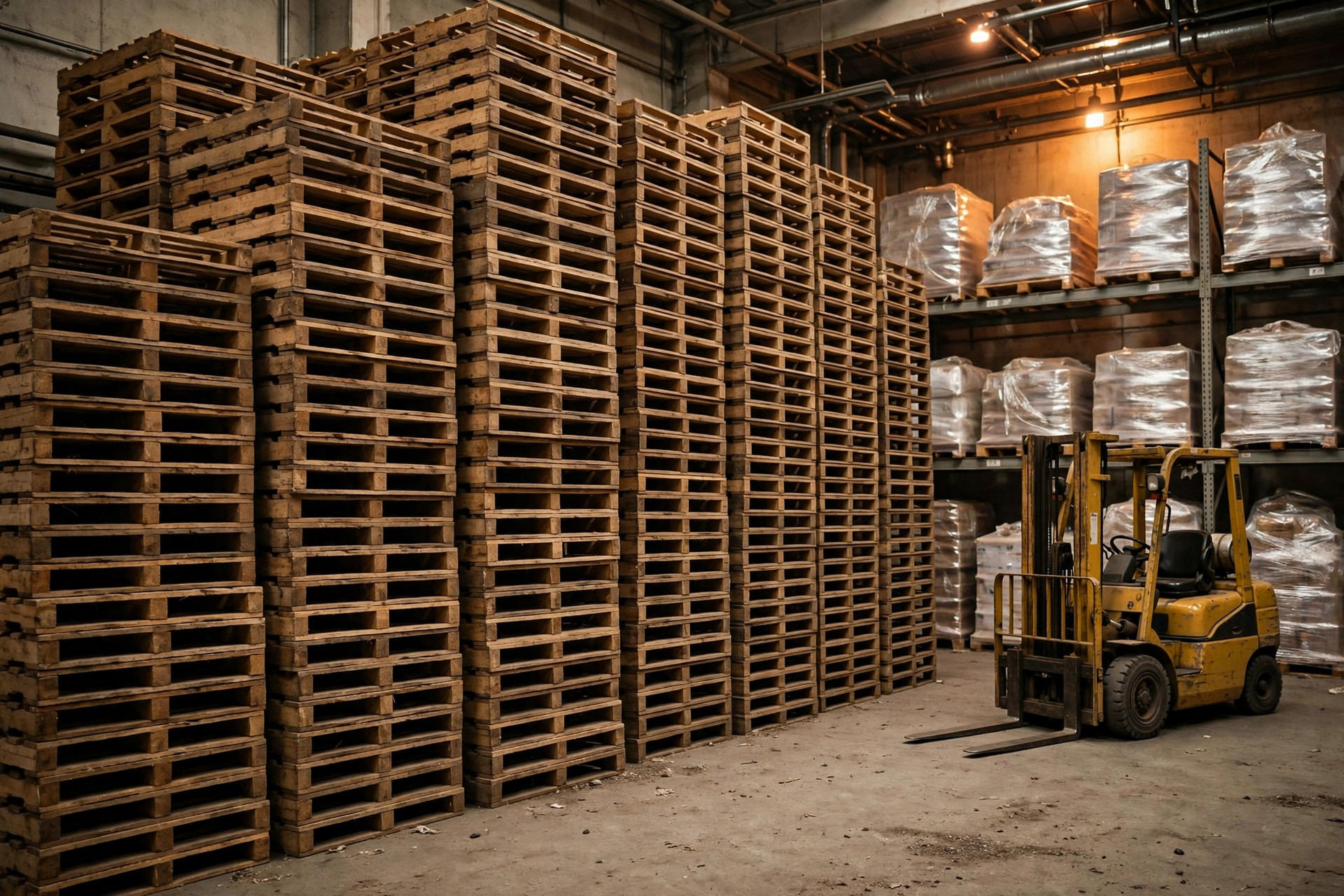
Last quarter's reconciliation landed on my desk with a familiar mess: several hundred pallets missing from the pool, a half-stack of damaged pallets waiting for a decision, and a deposit deduction notice arriving on almost the same day as a customer complaint. The money was not enormous. The problem was that nobody could explain it. Pallet pool losses, lost and damaged pallets, and deposits had all been lumped into one number, and one number cannot settle three different arguments.
My position is simple, and it comes from the finance side of the table: keep three ledgers. Loss is a quantity ledger. Damage is a condition ledger. A deposit is a cash ledger. If the quantity does not reconcile, do not jump to a deduction. If damage has not been graded, no deduction has a defensible basis. And if the deposit clause is vague, the final settlement will become a negotiation nobody enjoys.
Pallet Pool Losses Start With Three Ledgers
The first case I keep coming back to involved a regional beverage distributor during a three-week peak. Drivers dropped full pallets at customer sites. Some empty pallets came back on the same truck, some were promised for the next delivery, and some were pushed by the customer's forklift into the customer's own stack and forgotten. At month-end, the pool was short by more than four hundred pallets. The warehouse manager wanted to deduct deposits. The customer pushed back immediately: we did not lose them, you never collected them.
That objection was actually correct, and it is why the loss ledger needs three columns before any money moves. The first column is pallets issued. The second is pallets returned. The third is the variance, and the variance must then be split into confirmed lost, still held by the customer, and in transit or unconfirmed. Confirmed lost means the pallet is gone. Customer-held means the customer has it and has not returned it. In-transit or unconfirmed means the paperwork has not closed, and the pallet may be on a truck or sitting in a return staging area. These are not the same commercial event, and they should not carry the same charge.
Reconcile monthly at the very latest, weekly if the volume allows. The longer the cycle, the more customer-held and in-transit pallets harden into a disputed lump sum, and by then both sides are negotiating from memory. Keeping daily inbound and outbound movement balanced is what stops a small variance from becoming a quarterly argument; for the practical routine, see small-warehouse pallet balancing.
The second case is quieter and more embarrassing. During one count, a warehouse found several dozen pallets that were clearly not pool specification, while pool pallets were short by a similar amount. A delivery had been loaded from the wrong stack: customer-owned pallets went out as pool pallets, and pool pallets stayed behind at the customer. Counting heads alone made the total look almost right. Counting by specification and pool ownership exposed the error. The lesson is blunt: a pallet pool count that ignores specification is a count that can be simultaneously accurate and wrong.
Damaged Pallets Need Three Grades, Not Two Verdicts
Damage disputes are rarely about the money first. They are about the word "damaged," which is too coarse to price. The grading system I recommend has three levels. Normal wear covers light scuffs, a loose nail, or an aged surface, where load capacity and racking are unaffected; this belongs in ordinary pool attrition, not in a deduction. Repairable damage covers a broken deck board or a missing block, where replacing one component returns the pallet to service; the charge should be the repair cost, not the replacement price. Scrapped covers a broken main stringer, structural deformation, or unreliable load capacity; only this level supports a replacement-price or agreed residual-value settlement.
| Condition | Test | Settlement basis | Question to settle first |
|---|---|---|---|
| Normal wear | Carries load and racks normally | No deduction; pool attrition | Was the wear standard photographed before use |
| Repairable | One board or block restores service | Repair cost only | Is repair priced per job or under an agreed rate |
| Scrapped | Structure failed or capacity unreliable | Replacement price or agreed residual value | Who signs the scrap decision, and are photos attached |
The table matters less as arithmetic than as timing. Most damage arguments happen because nobody photographed the pallet, graded it, and signed the decision when it happened. My rule is to move damaged pallets to a separate inspection area, photograph them, and decide repair versus scrap within the same week. A month later, nobody can credibly prove who caused the damage.
Here is the counterintuitive judgment that finance people learn the hard way: chasing every small variance to the last pallet usually loses money. A single pallet is worth a limited amount, but a reconciliation meeting, a week of document searches, and three rounds of emails with a customer cost far more in staff time than the pallet itself. That does not mean writing everything off. It means setting a threshold: variances below the threshold go into a monthly summary, and only variances above it get case-by-case pursuit. Control has a cost, and uncontrolled control is just another loss.
Pallet Pool Deposits: Higher Is Not Always Better
Deposits look like protection in a contract and often behave differently in practice. Three questions matter more than the headline amount. First, what does the deposit actually cover: loss only, or also damage and late return? A clause that says only "deposit" has said almost nothing. Second, what is the settlement cycle and whose count governs, and is there a review window before a deduction becomes final? A deduction with no review window invites distrust. Third, what happens on exit: how are pallets still held by the customer returned, what price applies if they are not returned, and is there a final joint count? Many deposit disputes do not start during the relationship at all; they start on the last day, when the total is finally calculated.
The level of the deposit is itself a trade-off. Set it too high, and customers avoid the pool altogether, switching to their own pallets or one-way pallets, which reduces pool circulation. Set it too low, and the constraint against loss becomes weak. A sensible deposit should be anchored to two things: the replacement cost of the pallet, and how difficult return actually is for that customer. A customer with a short, simple return route can carry a lower deposit. A customer with a long chain and many handoffs needs a higher deposit and more frequent reconciliation. Specific amounts should follow the contract and the supplier's current pricing; copying another company's number is how a sensible clause becomes an argument.
Exit settlement deserves its own checklist, because it is where the three ledgers meet. Do a joint count before the relationship ends, with both sides signing the customer-held, repairable, and scrapped quantities. Give held pallets a clear return deadline, and apply the agreed price only after that deadline passes. Then settle the deposit in one net payment, over or under. That sequence, written as a contract appendix, is worth more than any verbal assurance.
That discipline is what turns pallet pool losses from a dispute into a routine, and it keeps lost and damaged pallets from turning into deposit arguments. Pallet pool accounting is not really an arithmetic problem. It is a process problem: every issue has a document, every return has evidence, every damaged pallet has a photo, every variance has a grade, and every settlement has a deadline. Put those five controls in place and the argument changes. Instead of debating what happened, both sides debate a number they can both see.
The conclusion you can act on tomorrow is this: split your current pallet account into loss, damage, and deposit ledgers, give each its own reconciliation cycle and its own threshold, and only then negotiate the deposit level. The saving is not just the pallet cost. It is the hours you stop spending each month arguing about pallets.
By Lao Zhou, Logistics Cost Analyst