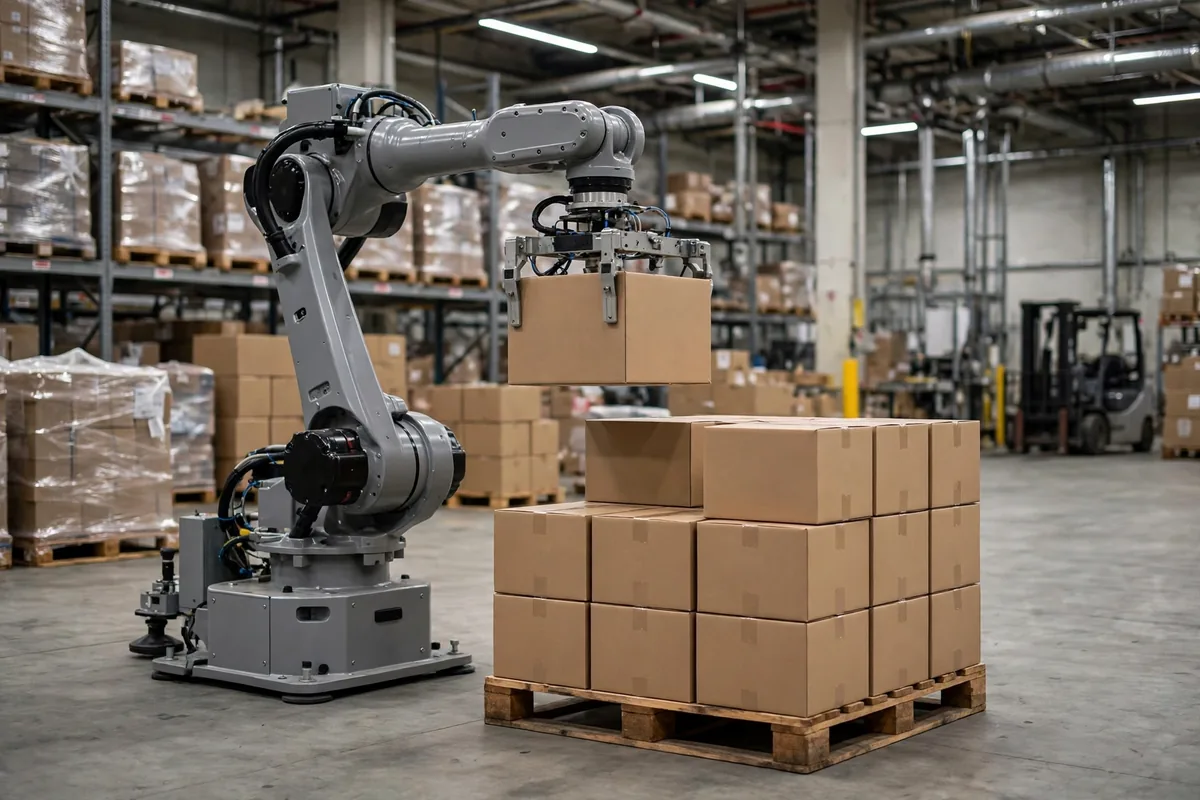
Before you ask how strong he is, ask how many cases he has to move a day, how heavy they are, and what shape the pallet has to end up in. Warehouse palletizing robot selection goes wrong the same way nine times out of ten: the buyer watches a demo first and thinks about their own freight second. Then your freight hits the line, case sizes change three times a week, weights swing up and down, and the cycle rate falls off a cliff. Every number on a spec sheet was measured in a lab.
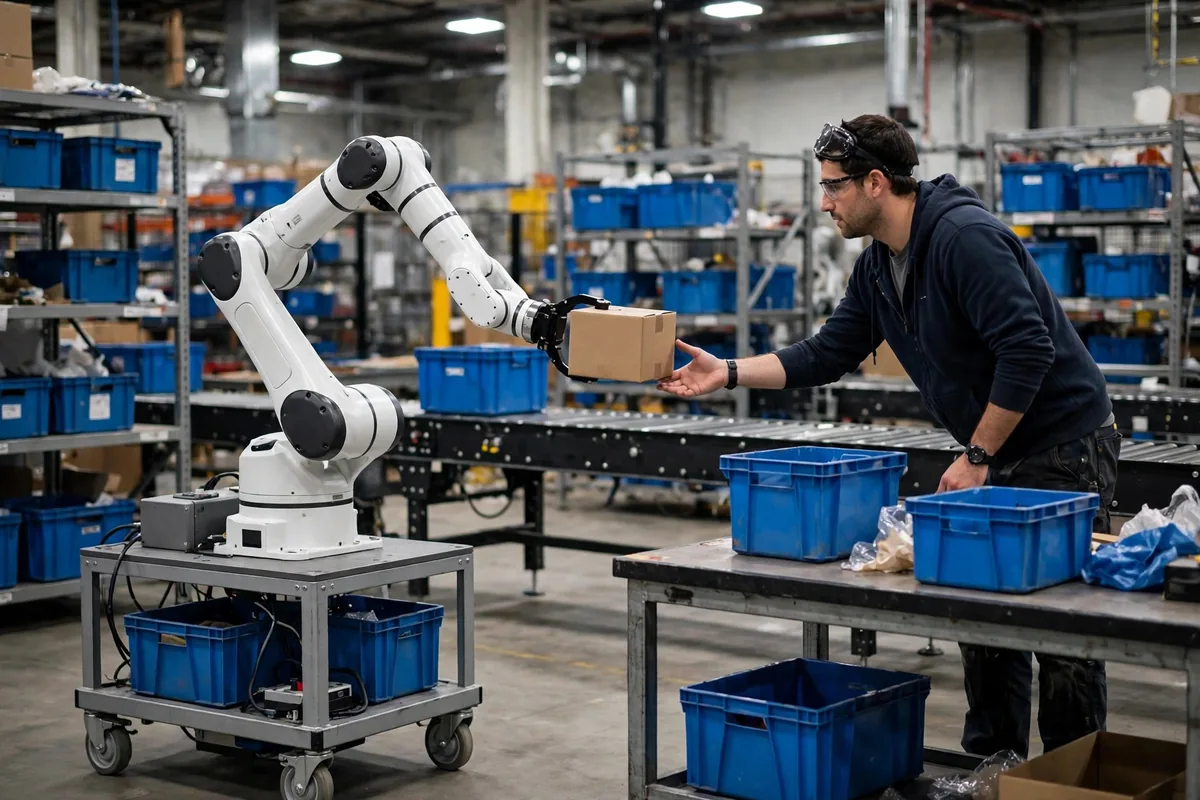
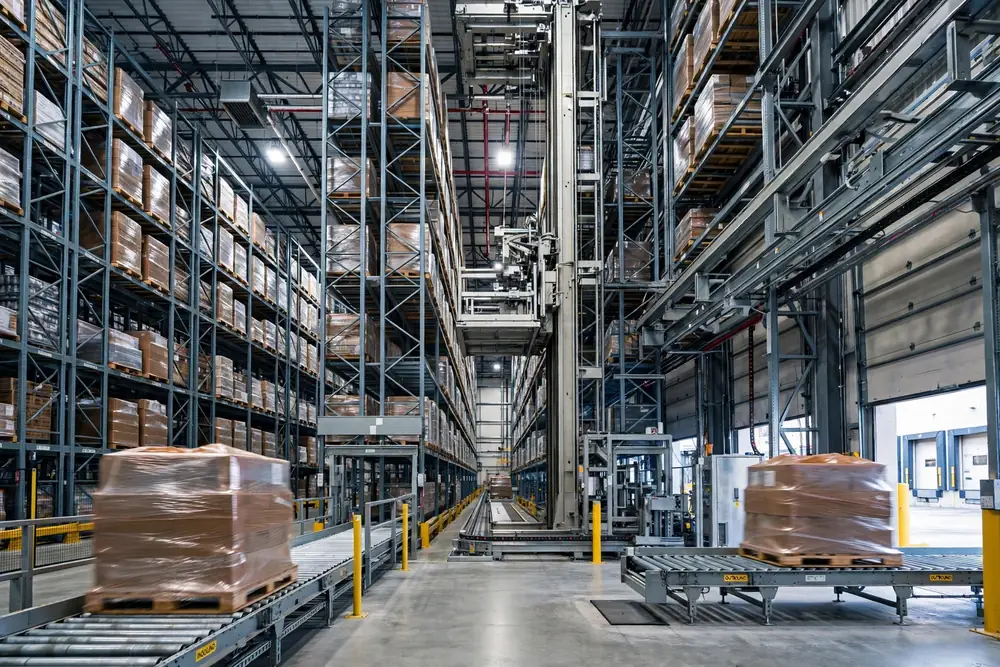
Start with how the three machine types actually work. An articulated palletizer is a robot arm, four or six axes, that picks a case off the conveyor, swings it around, and sets it on the pallet. You can think of it as a shoulder, an elbow, and a wrist that never gets tired. A gantry palletizer is a frame on rails with the gripper hanging from a crossbeam; it moves in straight lines and picks up a whole layer at once. A collaborative palletizer is a lightweight arm with no safety fence, designed to work beside people, using force limits so a bump does not hurt anyone. The dividing line is physics, not branding: the articulated arm trades reach for flexibility, the gantry trades flexibility for full-layer speed, and the collaborative arm trades speed for safety. Pick the wrong type and no amount of reprogramming will save the cell.
Articulated, Gantry, and Collaborative Palletizing Robots: The Specs Side by Side
Lay the core numbers out and the dividing lines draw themselves.
| Type | Cycle rate (typical published range) | Payload | Stack height | Fencing needed |
|---|---|---|---|---|
| Articulated (industrial) | 10–20 cycles/min | 140–350 kg class machines common | about 2,000 mm | Yes, fully fenced cell |
| Gantry (full-layer) | about 270 cycles/hr (full-layer basis) | Whole layers, hundreds of kg per layer | about 2,000 mm | Yes, gantry zone isolated |
| Collaborative | 3–6 cycles/min; vendors claim 8–10 for light cases | 10–25 kg | 1,500–1,700 mm | No, works beside people |
Read the numbers in the right place. The articulated arm's 10–20 cycles a minute is measured empty-handed or with a light case over a short travel path. Give it a heavy case, a long reach, and six pallet positions to serve, and real throughput lands at sixty or seventy percent of the brochure figure. The gantry's 270 cycles an hour counts full layers — a dozen cases in one grab — so its per-case speed is very fast, but only if your freight can be grabbed by the layer: uniform case size, fixed layer pattern. Mix the freight up and the layer gripper cannot hold, and the gantry's advantage drops to zero. The collaborative arm's 3–6 cycles a minute looks slow, yet it skips the fence, skips the safety scanners, and skips the downtime of moving a fence when the line changes. In a low-volume cell, its output per person is not necessarily worse.
Run the comparison in real numbers. Hypothetical example: a beverage plant runs one line at 1,200 cases an hour, 12-bottle packs at 12 kg each, on a 1,200 × 1,000 mm standard pallet, 12 cases a layer, 5 layers high. An articulated arm at an effective 12 cycles a minute manages 720 cases an hour, so one line needs two arms to keep up. A gantry grabs a full layer of 12 cases in one move, so 100 cycles an hour covers the whole 1,200, with one machine and room to spare. A collaborative arm at 5 cycles a minute manages 300 cases an hour; even four of them cannot catch the line, and they would occupy four workstations. Putting collaborative arms on that line is like entering four sprinters in a marathon. Now flip the scenario. Hypothetical example: a small e-commerce warehouse ships 800 orders a day, case weights from 1 to 18 kg, with seven or eight pallet patterns a day. An articulated arm is overkill, and every pattern change needs reteaching by someone who can program. A collaborative arm beside the packing bench switches patterns in five minutes from a touchscreen, and the operator does it alone. For small batches and endless variety, it outperforms the industrial arm where it counts. The selection line is simple: under 25 kg a case, under 6 cases a minute, patterns changing daily — collaborative. Over 25 kg, over 10 cases a minute, patterns mostly fixed — articulated. Highly uniform cases, full-layer stacking, maximum single-machine output — gantry.
The Palletizing Robot Maintenance Traps to Count Before You Buy
Here is the counterintuitive part: the most expensive part of a palletizing robot is not the robot. It is the robot standing still. The articulated arm's MTBF looks impressive on paper, but most unplanned stops come from the gripper, not the arm. Aging suction cups, worn clamp jaws, a vacuum pump with a slow leak — those three account for the majority of palletizing-cell downtime. Treat the gripper as a consumable: swap suction cups every quarter, check vacuum weekly, and replace anything that has lost 10% of its pull. Do not wait for the day a case slips. The gantry's trap is the rail and the hoist. Long travel means dust on the guide rails and lubrication that gets skipped, so positioning drifts a fraction of a millimeter at a time until the stack leans a layer at a time. Clean the rails monthly and recalibrate positioning quarterly; it costs a tenth of an emergency repair. The collaborative arm's trap is the most invisible: with no fence, people walk past it all day, and the force threshold gets nudged up a little, then a little more. The cycle rate climbs, and the whole point of collaboration disappears. One bump incident shuts the line down for a safety review, and that stoppage costs more than two new machines.
Two more traps never appear on a quote. The first is the pallet itself. Mix 1,200 × 1,000 mm pallets with 1,200 × 800 mm Euro pallets and the program needs a pattern set for each size; a worker grabs the wrong pallet and the stack goes crooked. Keep pallet types in separate, color-tagged stacks at the inbound dock, and lock the machine if the selected pallet size does not match. The second is incoming carton quality. A poorly sealed or damp-softened carton picks up fine and collapses one corner on the stack, taking the whole pallet with it. The robot will not tell you the carton is soft. It will stack it anyway, exactly as programmed. For the first month after go-live, pull ten cartons a day and test seal strength; hand over control only when the numbers hold steady.
I watched one stoppage that belongs in every warehouse palletizing robot selection checklist. Hypothetical example: a food plant's articulated cell, three months after startup, started dropping cases the week before peak season — three stops, two hours each. The fault was not the program. It was the suction cups. Summer heat in the plant had aged the rubber faster than expected, vacuum fell from a normal 0.06 MPa to 0.04 MPa, light cases still held, heavy ones slipped on the lift. A fresh set of cups cost under $300, but the three stoppages cost more than 3,600 cases of lost output at 600 cases an hour, and peak orders nearly slipped. At acceptance, do not only check the cycle rate. That is the warehouse palletizing robot selection lesson in one line: check the wear parts before you sign. Get the gripper wear-parts list, the replacement intervals, and the spare-parts prices in the contract in writing. The cheaper and simpler the wear parts, the lower the true cost of owning the machine.
Finish with the calculation that decides whether the money is well spent. Hypothetical example: an articulated palletizing cell, fence, conveyors, and integration included, lands at about $600,000. One shift, 8 hours a day, 250 days a year, at an effective 600 cases an hour, stacks 1.2 million cases a year. Spread over five years, that is $0.10 a case. Manual stacking runs about 300 cases an hour per person; one person stacks 600,000 cases a year, and wages plus benefits run about $120,000 a year, or $0.20 a case. On paper the robot costs half as much. But if your volume is only 400,000 cases a year, the robot costs $0.30 a case — more than the human — and buying it loses money. This money is well spent or not comes down to one number: your annual palletizing volume divided by the robot's annual capacity. Above 60% utilization, talk about buying. Below 40%, rent first, or outsource first. A machine is never too expensive. It is only ever too idle.
By Da Liu, Automation Engineer