The first question people ask me about warehouse pallet stacking is always the same: how many layers can we stack? My answer is always the same too. Do not ask about layers first. Ask whether the bottom pallet can take the load. The number of layers is only a result. What really decides it is four variables: the load capacity of the bottom pallet, the compressive strength of the goods, the center of gravity of the whole stack, and how level the floor is.
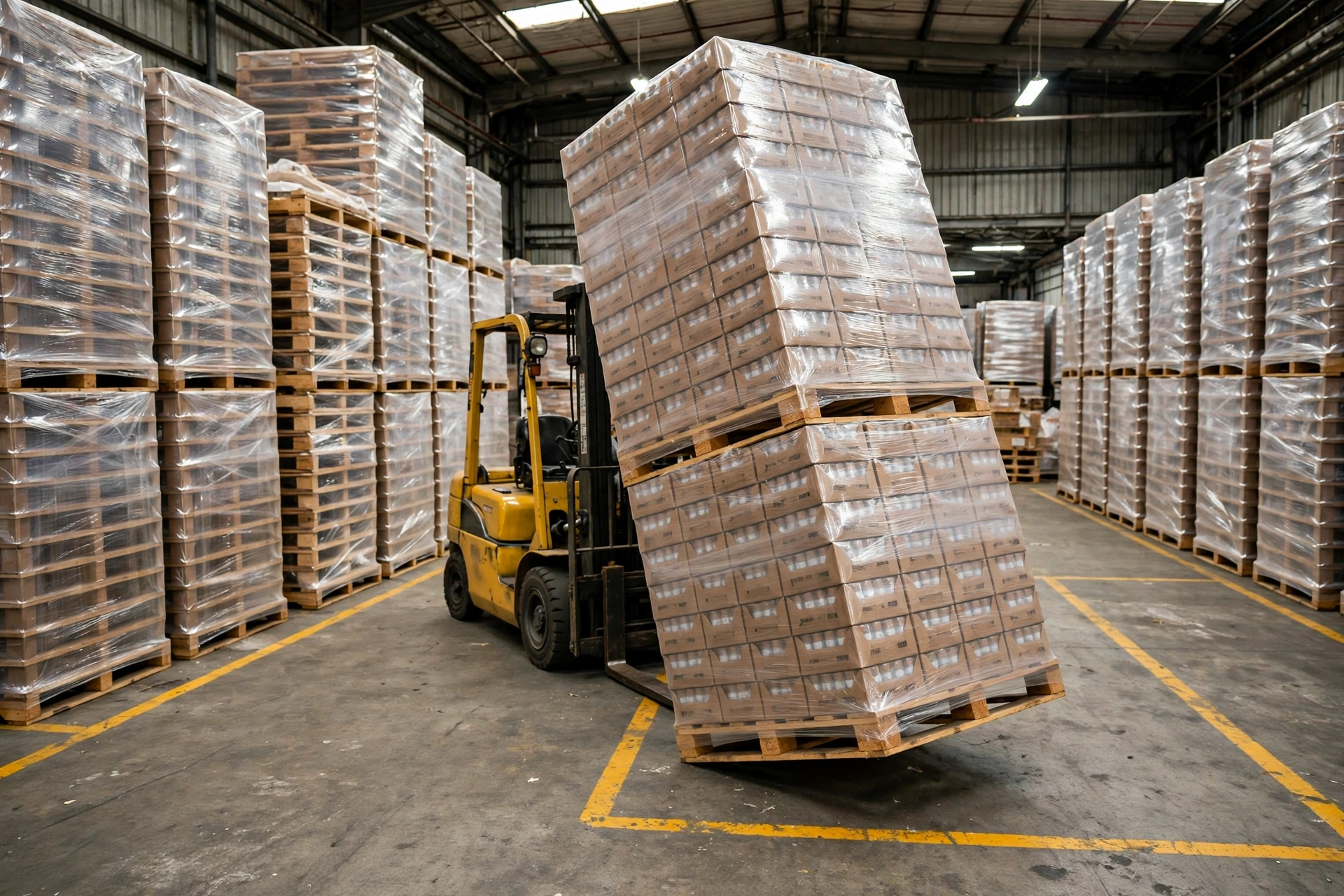
Start with the principle. In a floor stack, force travels from the top down. Think of it like a building: if the foundation is wrong, nothing above it matters. The bottom pallet carries the weight of every layer above it, plus the shock of a forklift setting a load down. The compressive strength of a carton drops as it absorbs moisture and sits in storage, and bagged goods and drums carry load differently. Heavy goods on top and light goods underneath push the center of gravity up, and a tall stack with a high center of gravity sways at the lightest touch. On uneven ground, a pallet rests on two corners instead of four, and over time the stack leans, a little at first and then all at once.
Warehouse Pallet Stacking Safety Limits: Start at the Bottom, Then Count Up
A safety limit is not something you guess. You work it out from the bottom up. My method is to calculate in reverse: first confirm the rated capacity of the bottom pallet and the compressive strength of the goods, using the pallet and product manufacturers' data, then add up the weight of every layer above and check whether it stays inside that number. If it goes over, take a layer off. When the goods are not strong enough, the number of layers does not matter. One crushed carton corner shifts the center of gravity of the whole stack, and every risk after that is a chain reaction.
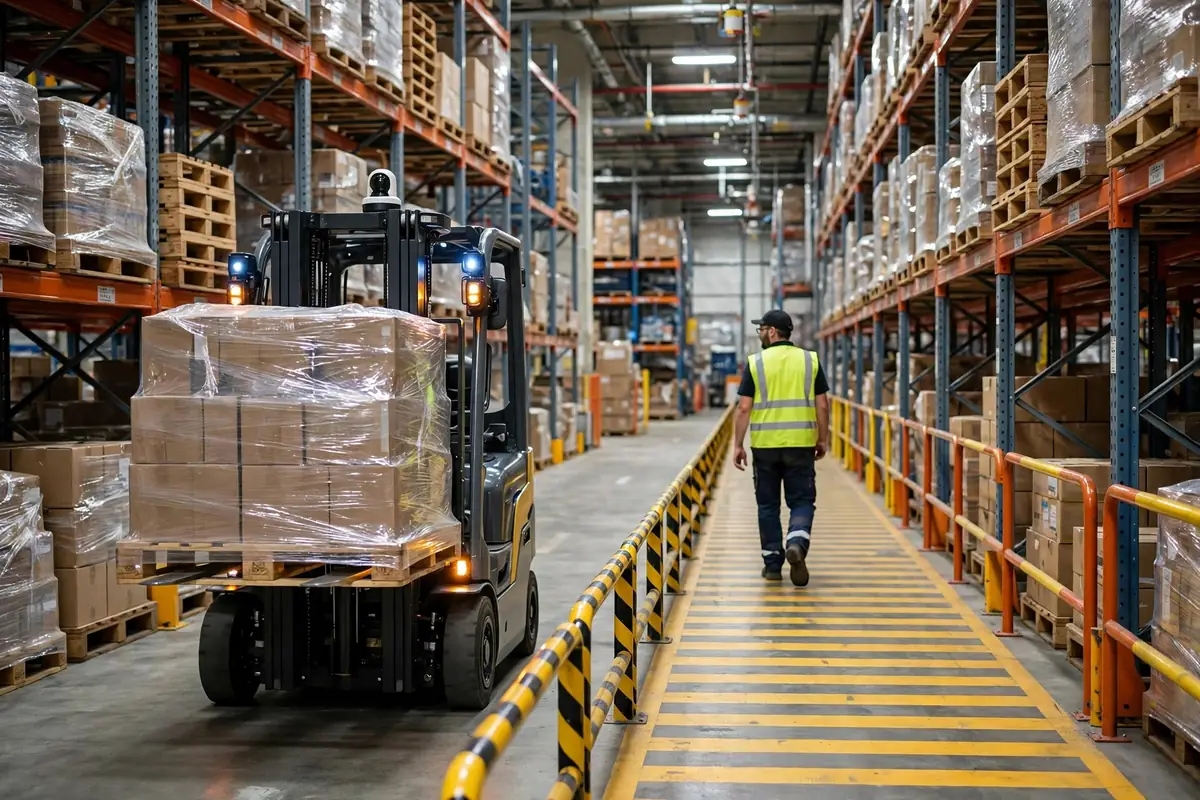
Floor flatness is the variable most people miss. The floor under a floor stack has to be level. A pallet set down properly sits on all four corners and does not rock when you push it. A floor with a dip, a slope or a crack leaves a pallet sitting crooked, and a crooked stack that keeps growing taller only falls over in the end. Forklift impact is another variable. One brush does no harm. What hurts is the same spot getting brushed every day, the base shifting a fraction at a time until one light touch is the one that brings it down. Leave enough room between stacks and aisles for a forklift to work. Do not squeeze in extra pallets until the forklift can only pass by scraping the stack.
I worked on a case like this (illustrative scenario). A consumer-goods warehouse sat on an old factory concrete floor with a settlement joint running across it that nobody had paid attention to. A pallet happened to sit right over the joint, with two of its four corners unsupported. Overnight, moisture softened the bottom cartons, one creased under the load, and the morning inspection found the whole stack leaning a few degrees to one side. It was caught early, and rebuilding the stack took half a day. The lesson is simple: look at the floor before you stack on it. If the floor is not good enough, fix the floor first.
Warehouse Pallet Stacking Patterns: Column Stacking Versus Pyramid Stacking
Column stacking sets each pallet directly above the one below, aligned edge to edge. Its strengths are a small footprint and easy access. Its weakness is that it demands the most from the bottom layer: if any layer goes crooked, the whole stack follows it. Pyramid stacking steps each layer in, so the top is narrower than the base. Its strengths are a low center of gravity and good stability. Its weaknesses are a bigger footprint and the need to move the upper layers out of the way to reach the ones below.
Neither pattern is better in the abstract. Heavy, strong, fast-moving goods suit column stacking. Light, irregularly shaped, long-stored goods are safer in a pyramid. Interlayer pads are a detail that column stacking often misses. A pad spreads the weight of the upper layer evenly across the lower one and stops the load concentrating on one point of the pallet. Pads have to be flat, solid and matched to the pallet size. A cracked or warped pad should be replaced, not reused out of thrift.
Stretch wrap is a second line of defense. It binds the layers into one unit so they cannot slide against each other. The wrap has to go all the way down and catch the edge of the bottom pallet. Wrapping only the upper layers is the same as not wrapping at all. Too loose and it holds nothing. Too tight and it crushes cartons out of shape. And one thing to be clear about: wrap stops sliding and scattering. It does not stop overloading. An overloaded stack will collapse at the bottom no matter how tightly it is wrapped.
Before a Stack Falls, It Talks First
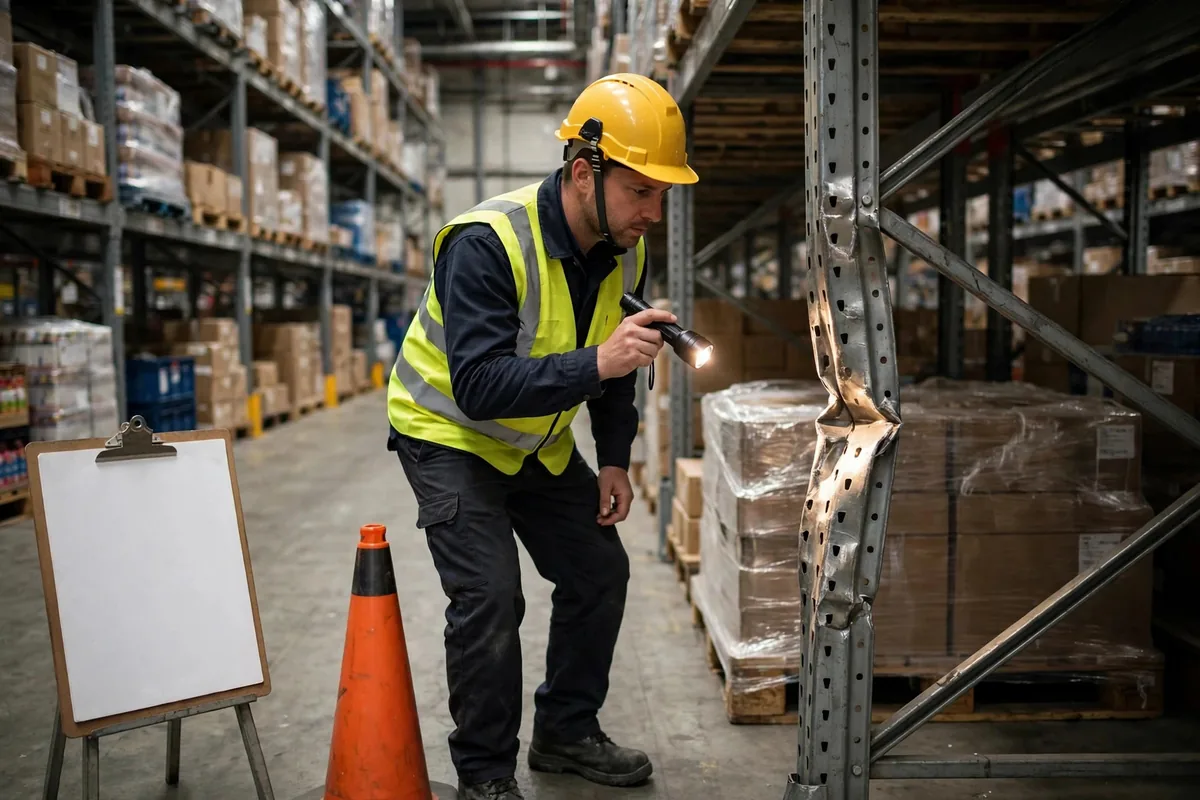
A stack rarely falls without warning. On inspection, look for these: a visible lean, cartons creased or bulging under pressure, a pallet cracked or warped, stretch film stretched open or torn, and new cracks or damp patches on the floor. If any one of these shows up, stop and work out what is happening.
A warehouse I worked with had an incident like this (illustrative scenario). A stack had been sitting for two months when an inspector found one slat of the bottom pallet cracked. The crack was small and nobody treated it as serious. A week later, two cartons at the top had shifted a few centimeters out of line. When the stack was taken down, two slats of the bottom pallet had broken through, and the whole stack had been held together by the stretch film alone. After that, the warehouse made a rule: a pallet with a crack is scrapped on the spot, and pallet condition got its own line on the inspection sheet.
How often you inspect has to follow how long the stack has been standing. A newly built stack needs a close look in the first few days, because most settling and deformation happens early. A stack that has been standing a long time cannot be left alone either. Moisture, temperature change and forklift knocks are slow variables, and they need a fresh check at intervals. Inspection is not a walk past the stack. Stop in front of it, walk around it, look at it from three sides, and push the top layer gently to feel whether it sways. Those moves take a few minutes. What they save could be an entire aisle.
Decision Table: Can This Stack Take One More Layer?
| Check | Safe to add a layer | Do not add — fix this first |
|---|---|---|
| Bottom pallet capacity | Spare capacity confirmed | Pallet cracked, warped or repaired |
| Goods strength | Cartons intact and dry | Cartons creased or bulging |
| Center of gravity | Heavy below, light above | Top-heavy, or stack leaning |
| Floor | Level, dry, four corners resting | Settlement, cracks, water or slope |
| Securing | Pads sound, wrap to the bottom | No pads, no wrap, or wrap torn |
| Surroundings | Clear distance to aisles | Forklifts brushing the base |
| Storage time | Short-term, inspected regularly | Long-term, no scheduled recheck |
If any one of the seven rows shows the right-hand signal, do not add the layer. Fix the problem first. Goods, packaging and storage conditions differ from site to site, and the specific limits and operating rules should follow the latest local regulations and the manufacturers' data. If you are unsure, ask the manufacturer or the local authority. Do not invent a number and write it into your own operating procedure.
Here is the counterintuitive part. Stacking higher does not always save space. The higher a floor stack goes, the slower a forklift works: the upper layers have to be moved before the lower ones can be reached, picking slows down, and inspection gets riskier. The space you think you saved is often imaginary. Real space saving comes from putting fast-moving goods where they are easy to reach and slow-moving goods in a stable pyramid where they can sit undisturbed. The number of layers is a balance between cost and risk, not a score to maximize.
Whether the money is worth it comes down to one number: the spare capacity of the bottom pallet under your stack. If the margin is there, the layers are worth discussing. If it is not, talking about layers is talking about luck.
By Da Liu, Automation Engineer