Start with the money. An outbound line ships 3,000 orders a day, and every order that waits 10 extra seconds at the verification station burns more than 8 hours of labour a day — a full worker's shift, gone. Verifying, weighing and labelling look like three separate jobs, but in many warehouses they are strung together in a single line, each waiting on the one before it: weighing waits for scanning, scanning waits for labelling, labelling waits for the next carton to arrive. Those waiting seconds never show up on any report, yet they are all sitting inside the labour cost at the end of the month.
In my years of logistics cost analysis, I have seen too many warehouses spend foolish money at the bench. Some buy an expensive automatic checkweigher. Some upgrade to the priciest scanner on the market. But the station layout itself is tangled — people walk circles around the bench, cartons queue on the bench, and no piece of equipment can save a bad flow. It is like putting a faster car on a jammed road. The car is faster, and the road is still jammed.
Three Steps in Series at the Verification Station Means Three People Waiting on One
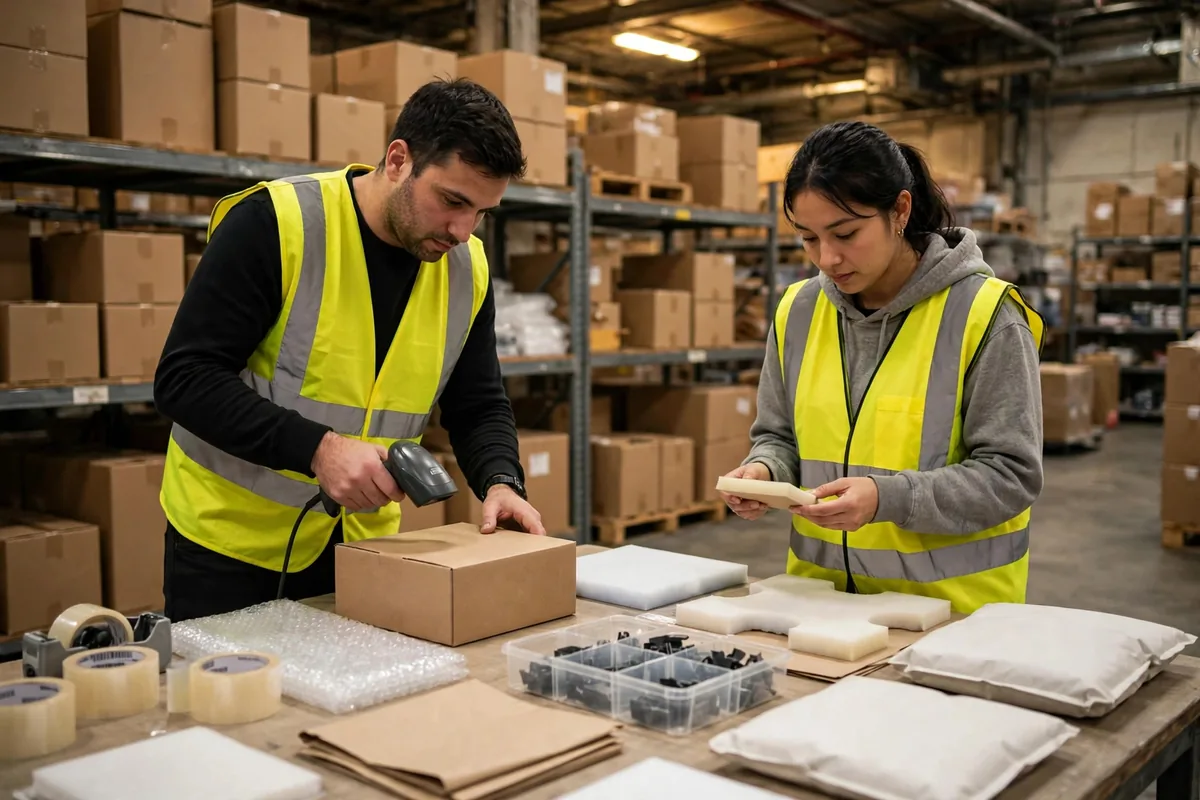
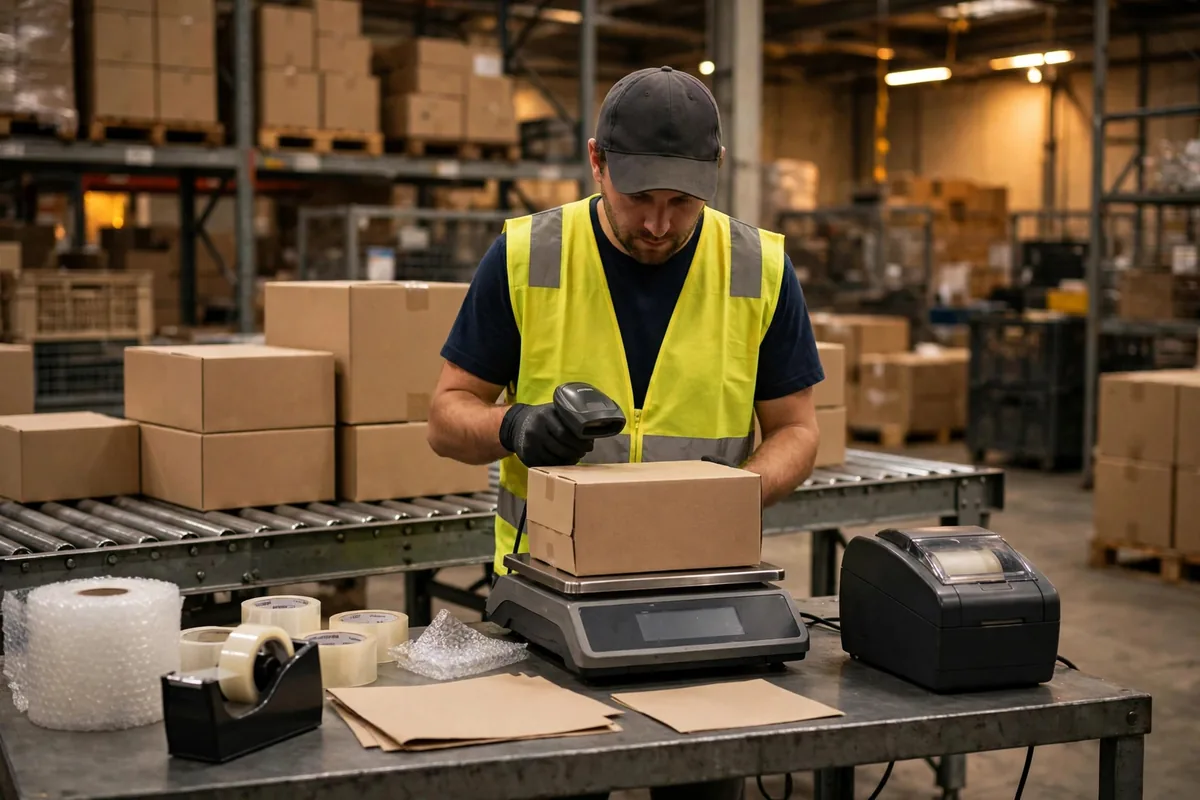
Break down what actually happens at the outbound verification station. Each order goes through three actions on the bench: verifying (counting goods against the pick list, checking the right items are in the carton), weighing (putting the carton on the scale, waiting for the weight to settle, comparing it against the system), and labelling (printing the shipping label, sticking it on, scanning to confirm). None of the three is hard. The hard part is that they are arranged in a line.
I visited a home-goods warehouse in southern China during last year's peak season, and the scene was like this: the verifier finished checking a carton and pushed it to the weigher; the weigher waited for the scale to settle and reported the weight; once the system matched the weight, the carton was pushed on to the labeller. Three stations in a straight line, 45 seconds per order. Where was the loss? During the 8 seconds the scale needed to settle, the verifier's hands stopped. While the first two steps were still running, the labeller could only stand and wait. Of three people, only one was working at any moment — the other two were waiting. The figures are a hypothetical worked example, but the logic is real: in a serial flow, the slowest step sets the speed of the whole line, and everyone else's time goes into waiting.
Peak season makes it worse. Order volume doubles, a queue builds up in front of the verification station, pickers wait with their carts for verification, verifiers wait for weighing, and the whole outbound line is choked by a single bench. The warehouse threw two extra people at the problem, and it got worse — the bench is only so big, people kept stepping aside for each other, and the time per order went up instead of down.
Weighing, Scanning and Labelling: The Order Matters
Here is the counterintuitive part: a verification station does not get faster by adding people, and a smaller bench does not save money. What actually saves money is stopping the three steps from waiting on each other.
First, remove the waiting. During the seconds the scale needs to settle, the verifier should not stop — they should already be checking the next order's goods. The labeller should not wait for a carton to be pushed over — the label can be printed in advance so it is ready the moment the carton arrives. In plain terms, put buffers between the steps: verified cartons wait on a short slide, the scale always has a carton on it, the labelling bench always has a carton queued. Each step keeps its own pace and never waits for the previous step to hand over.
Second, get the sequence right. My recommendation: verifying and weighing can run in parallel, but labelling must come last. Why? Weight checking is a second line of defence for verification — if the weight does not match, the count is wrong, and at that point the carton is still open and the label is not yet stuck on, so opening it up and recounting costs almost nothing. Once the label is on and a weight mismatch turns up, you are peeling off labels, reprinting and resticking — a minute extra per order, plus the risk of sticking on the wrong label. So the sequence is: verify the goods while the carton is on the scale, and only stick the label on after the weight check passes. Labelling is the last door out of the warehouse. Every check has to be done before that door closes.
Weight matching also needs a tolerance. Cartons themselves vary in weight from batch to batch. Set the tolerance too tight and the alarm goes off constantly, dragging the whole station to a halt for re-checks. Set it too loose and missing or extra items sail straight through, making the check worthless. My approach is to set it by product category: tighter for light, small items, looser for large or irregular ones, and review it monthly against the reasons weight checks fail.
Third, the bench size. Many verification benches are too small: scale, scanner, label printer and a stack of labels all squeezed onto a 1.2-metre bench, with the worker struggling to turn around. Widen the bench so two cartons fit side by side — one being weighed, one being labelled — and the worker never has to walk. Their arms can reach everything, and the time per order drops directly. The cost of an extra bench is earned back by a month of labour savings. Here is the maths:
| Layout | Time per order (worked example) | Total hours, 3,000 orders/day | Peak queue |
|---|---|---|---|
| Three steps in series, one person does all | About 45 seconds | About 37.5 hours | Long queue at the bench |
| Three steps split, parallel with buffers | About 28 seconds | About 23.3 hours | Barely any queue |
| Parallel plus two-carton bench | About 22 seconds | About 18.3 hours | Peak volume absorbed |
Same 3,000 orders a day, and the gap between serial and parallel is 14 hours — roughly two workers' daily shifts. The cost of changing the layout? An extra bench top and a short buffer slide, a few hundred dollars of hardware. At a verifier's daily wage of 300 yuan (worked example), saving two workers a day pays back more than 10,000 yuan a month. Whether that money was wasted before, the numbers speak for themselves.
Before You Change the Verification Station Layout, Do the Maths: Is One More Bench Worth It?
So my conclusion is direct: when optimising an outbound verification station, do not buy equipment first. Change the sequence and the buffers first.
Before you touch anything, measure three numbers: the current seconds per order at verification, the longest queue of cartons waiting at the bench during peak, and the weight-check failure rate. Those three numbers will tell you exactly where the problem is. If time is lost to waiting, add buffers. If the queue is long because the bench is small, widen the bench. If the weight-check failure rate is high, go and fix picking accuracy — do not add people at the verification station, because a jam at verification usually starts with a picking problem upstream.
There is one more cost that is easy to miss: the cost of a wrong label. One mislabelled order means a returned parcel, a reshipment and a customer complaint — tens of dollars at least. When the flow runs smoothly, the labeller is not rushing, and the mislabelling rate falls with it. That saving never appears on the labour report, but it goes straight into profit.
One thing you can do tomorrow: stand by the bench for twenty minutes with your phone's stopwatch, and time each order from the moment the carton lands on the bench to the moment it leaves with the label on — and note how many of those seconds the worker spends waiting. Multiply the waiting seconds by the day's order volume, and that is the money your warehouse burns at the verification station every day. Once you see the number, you will know for yourself whether the layout needs changing.
By Lao Zhou, Logistics Cost Analyst