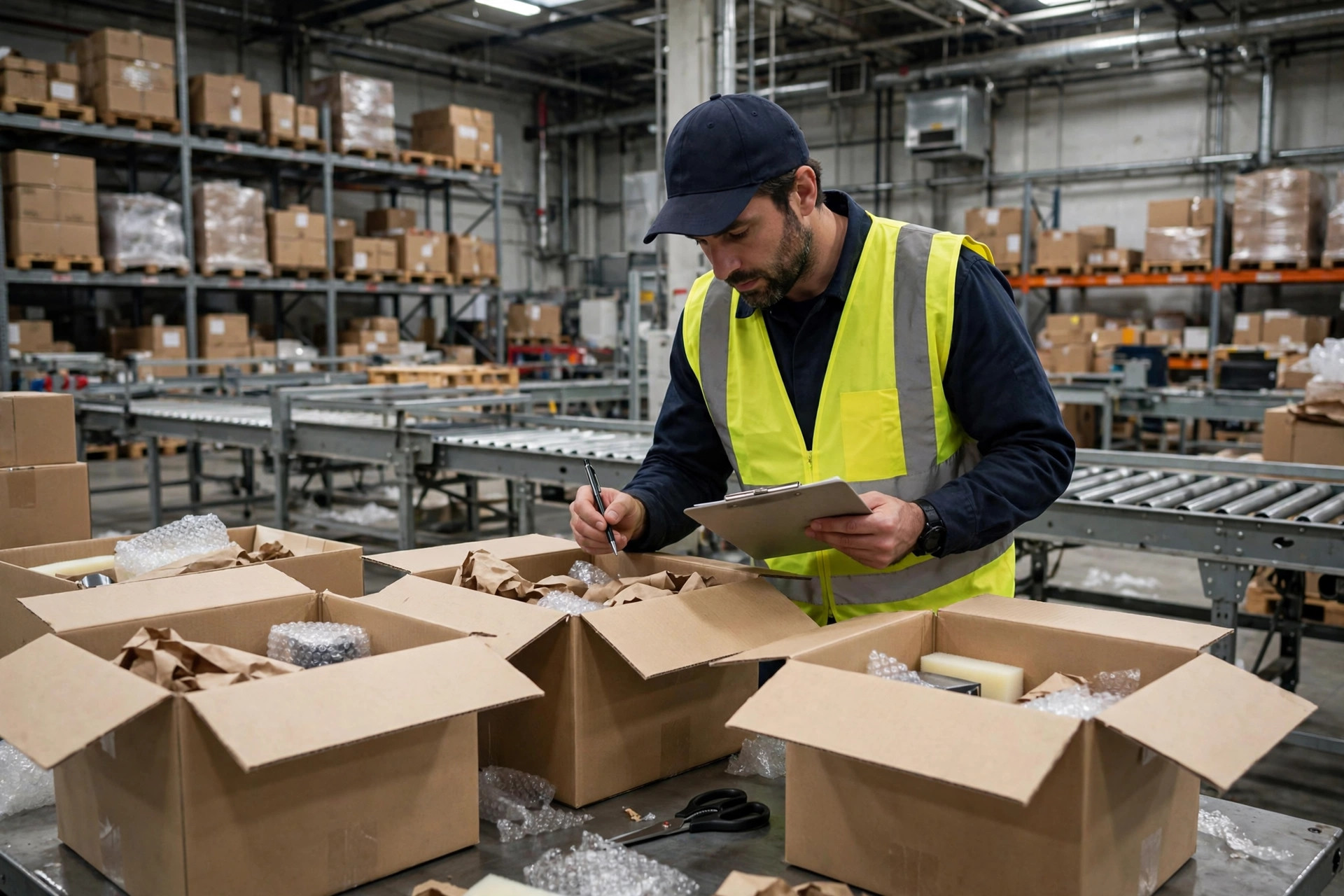
Let me be blunt: most warehouses get outbound AQL sampling wrong in one of two ways. Either they don't sample at all and rely on pickers being careful, or they sample at some made-up percentage, fill in the logbook, and when a bad batch ships, the logbook proves absolutely nothing. It's a two-sided problem — sampling costs money, but so do customer complaints. Setting your sampling ratio and acceptance level is really a bet: how much are you willing to spend to buy how much protection against a disaster?
I've seen too many warehouses treat sampling as a placebo. Five percent a day, a few checkmarks in the book, management feels like "we have QC," and everybody's happy — until a full batch of mislabeled product ships out and the claim invoice arrives.
The verdict first: AQL sampling protects your process, not your product — but a protected process is what keeps you off the hook
AQL (Acceptable Quality Level) sampling never answers "is this batch 100% good." It answers: "we sampled per the agreed plan, the defect rate is within the acceptable limit, this batch can ship." Note the wording — "can ship," not "is good." That distinction is the line between being covered and being blamed when something goes wrong.
Here's a scar I still remember. Fall 2023, a 3PL warehouse in Ontario, California, shipping about 1,500 orders a day for a big beauty client. Their outbound sampling was 5% a day, and QC only counted quantities — if the piece count matched, the box passed. One promo run of 8,000 units arrived with the supplier's cartons mislabeled (product A labeled as product B). Pickers picked by label, QC counted by quantity, and everything passed. Three days after shipping, complaints poured in: over 600 customers received the wrong product. Returns, reshipping, and compensation burned close to $90,000, and the client nearly walked.
During the post-mortem I said something nobody wanted to hear: your logbook says "75 orders sampled, passed" every day, but not one of those 75 was ever opened to verify the right product was inside. That piece of paper didn't protect you when it mattered — it proved your sampling was theater.
Let's do the math: the labor cost of sampling versus the cost of one complaint
Cost first, benefit second — that's how I think.
Take a warehouse shipping 2,000 orders a day. A QC tech opening boxes and verifying item and quantity manages about 80 orders an hour. Sampling 10% means 200 orders, roughly 2.5 labor hours. At $22 an hour for US warehouse QC labor, that's $55 a day, or about $1,210 a month over 22 working days.
Now the other side. What's one mispick complaint worth? Return shipping at $8–12, reshipping the correct item, two or three rounds of customer service emails, plus marketplace penalties or client chargebacks — $25 per incident is a conservative estimate. At a historical mispick rate of 0.3%, that's 6 bad orders a day out of 2,000, or about $3,300 a month in complaint costs — not counting lost customers, which you can't put a number on.
So the math is clear: that $1,210 a month on sampling is money well spent. But here's the counterintuitive part — "more sampling is always better" is wrong.
I've watched warehouses push sampling from 10% to 30%, grow QC headcount from one to three, burn an extra $2,400 a month, and see complaint rates not budge. Why? Because sampling catches systematic deviations, not random errors. A whole batch mislabeled — a systematic problem — shows up in a sample of 80. A picker occasionally grabbing the wrong item — a random error — slips through even at 50% sampling. Inspectors are human too; they miss things.
| Approach | Monthly cost | Catches | Still misses |
|---|---|---|---|
| 10% sampling (AQL 1.0) | about $1,200 | Systematic batch problems | Random single-item mispicks |
| 30% sampling | about $3,600 | Same, marginally more | Random errors still get through |
| Scan verification at pick (mistake-proofing) | Mostly one-time investment | Random wrong picks, dramatically | Supplier-level batch mislabeling |
A live example: in 2024, an apparel warehouse in Illinois tightened AQL from 2.5 to 1.0 and raised sampling from 8% to 20%, doubling QC from two to four people. Complaint rate didn't move — because the root cause was pickers confusing two similar SKUs (black vs. charcoal), which no human inspector could reliably tell apart either. They added barcode scan verification at the pick, and complaints dropped 60%. The money was spent in the wrong place first.
So the real trade-off: set sampling at the level that catches systematic problems (usually 5–10%, or whatever the AQL tables say), and spend the savings on mistake-proofing at the source — pick scan verification, weight checks. Those are what stop random errors. Sampling is an audit. An audit's job is to detect whether the process has drifted systematically, not to wipe every speck of dust the process leaves behind.
What AQL 0.65/1.0/2.5 actually mean — and stop guessing your sample size
AQL is an agreed acceptance line between you and your customer, not a quality target. The three common levels:
- AQL 0.65: strict. Reject the lot if the defect rate exceeds 0.65%. For critical defects — safety items, regulated products, high-value SKUs. In outbound, "wrong item shipped" on expensive goods usually goes here.
- AQL 1.0: the default starting point for outbound sampling. You're checking "did we ship the right thing," which is a major defect, and 1.0 is the industry's standard opening position.
- AQL 2.5: loose. For minor defects — a slightly crushed outer carton, a crooked label that still scans.
How do you set the sample size? Look it up; don't guess. The standard is ISO 2859-1 (in the US, ANSI/ASQ Z1.4, formerly MIL-STD-105E). For single sampling, normal inspection, General Inspection Level II, the lot-size-to-sample-size mapping runs roughly like this:
- Lot of 501–1,200 units → sample 80
- Lot of 1,201–3,200 units → sample 125
- Lot of 3,201–10,000 units → sample 200
- Lot of 10,001–35,000 units → sample 315
(That's the table-lookup logic; verify against the current edition of the standard in practice.) Once you have the sample size, look up the acceptance number for your AQL: say sample size 125 at AQL 1.0 — accept the lot at 3 or fewer defects, reject at 4 or more. The line between 100% inspection and sampling is equally simple: if one mispick's complaint cost covers a week of full-inspection labor, if it's a safety/regulated item, if it's a new SKU with a bad history, or if it's a supplier's first three shipments — don't sample, inspect everything. Everything else goes through AQL sampling.
When a sample fails: double the sample or rework the lot — and keep the paper that speaks for you
The worst response I've seen to a failed sample: pull the bad pieces, reship, and send the rest on its way. That's wishful thinking. The standard playbook has three levels:
Level one: a defect shows up — first classify it. Isolated or systematic? Double the sample size and re-inspect. If the expanded sample still falls within the acceptance number, treat it as isolated, log it, and ship.
Level two: the expanded sample exceeds the acceptance number — that's systematic. Freeze the lot and rework or 100%-inspect it. And the reworked lot goes through sampling again; it doesn't ship straight out.
Level three: the same SKU or supplier triggers level two twice in a month — escalate. Either that SKU goes to 100% inspection for a month, or you have a corrective-action conversation with the supplier. Problems found by sampling that never get closed mean you never really sampled.
Back to the headline promise: not getting blamed when things go wrong. Blame isn't decided by how hard you tried before the incident — it's decided by what evidence you can produce after it. A proper sampling record must answer four questions: how much did you sample, how did you sample it, what did you find, and what did you do about it.
Every lot record needs at minimum: date, lot/order range, total lot size, the sampling plan (AQL level, sample size, acceptance number), actual sample count, defect count with descriptions, the verdict (accept/reject), the disposition action, and the inspector's sign-off. If it runs in a system, make those fields mandatory; if it's paper, photograph and archive it. Keep records at least a year — or whatever the client contract says, since big clients often write two years in, and you don't want to discover your retention was three months when the claim arrives.
One piece of advice from twenty years in this business: the real value of sampling isn't how many bad shipments it stops — it's that on the day something goes wrong, you can put that record on the table and say "we sampled to the agreed standard." Next time someone asks "what sampling percentage should we use," don't rush to quote a number. Ask them back: when it blows up, what will you show to prove you sampled at all?
By Lao Mi, Supply Chain Veteran (20 yrs)