Let me be honest up front: our small warehouse cannot afford to burn money on one of those forklift pedestrian proximity warning systems. Three thousand square meters, three forklifts, eleven people total including pickers and drivers. Last month a sales rep from a big vendor came by to pitch an "AI forklift collision avoidance system," and when he named the price I laughed out loud. That number would cover half a year of our rent. After I showed him out, I sat in the office for a long time, because here is the thing: laughing does not solve the problem. Forklifts and people share the same aisle every day, and the whole safety plan is basically "be careful." That is not management. That is gambling.
The numbers are sobering. The U.S. Bureau of Labor Statistics recorded 84 fatal work injuries involving forklifts in 2024, up from 67 in 2023. OSHA's long-standing estimate is around 85 deaths a year, and OSHA itself says roughly 70 percent of forklift accidents could have been prevented. Eighty-four sounds like a small number until it lands on your building. One serious incident — the fines, the shutdown, the compensation — would wipe out a small operation like ours overnight. So I had to do this math, and I had to do it the small-warehouse way.
Where Forklift-Pedestrian Incidents Actually Happen
Our first near-miss was last September, and I still break into a sweat thinking about it. Around ten in the morning, a forklift was reversing out of Zone B around a blind corner, and Xiao Chen, one of our pickers, walked straight across the aisle with his earphones in, coming out from behind a rack. The driver slammed the brakes. The forks stopped less than half a meter from Xiao Chen's legs. Nobody got hit. Pure luck. Xiao Chen went white. The driver's hands were shaking when he climbed down. That day I finally understood: forklift accidents are rarely about bad driving. They happen when three things line up at once — a blind corner, a distracted pedestrian, and a reversing truck nobody is watching.
The second pattern is peak-season night shift. November 2025, we were rushing a big promotion order, past one in the morning, lights dim, and a temp worker cut across the forklift lane as a shortcut from receiving. The forklift was carrying a full pallet, blocking the driver's view completely. He hit the horn. The temp had earplugs in and never heard it. The driver stopped on instinct. Again, no one was hurt. I did not sleep that night. Night shift, temp workers, blocked sightlines — put those three words together and you have the standard recipe for an accident.
Then there is the one everyone forgets: forklifts and people fighting over the same lane. Our warehouse has one main aisle. Forklifts use it, people use it, pallet jacks use it. Big warehouses paint pedestrian walkways, install guardrails, run one-way loops. Us? We painted two yellow lines on the floor, and they wore off in three months. Our "traffic management" is yellow paint plus luck. I am laughing, but only because crying costs extra.
Cameras, UWB, or Lidar: Picking a Forklift Pedestrian Proximity Warning Route
I priced all three and talked to other small operators. The short version: none of them does everything. The question is which one fixes the thing most likely to kill someone in your building.
| Route | How it warns | Upside | The catch | | AI vision cameras | Camera spots a person, calculates distance, alarms | No tags to hand out, works out of the box | Blind behind racks, false alarms in poor light | | UWB positioning | People wear tags, forklift carries anchors, real-time ranging | Precise — 10–30 cm real-world accuracy, works through obstacles | Everyone must wear a tag; lost or dead tag means no protection | | Lidar | Scans surroundings for obstacles | Works in the dark, no tags needed | Cannot tell a person from a pallet, priciest, hates dust |
Vision cameras are the easiest starting point for a small warehouse. Mount them on the forklift or at the corner, and they flash and beep when someone enters the danger zone. No tags, no new process. But the weakness is real: a rack blocks the view and the camera is blind, and in dim night-shift light the false alarms can get so bad the driver wants to rip the buzzer out.
UWB accuracy is genuinely impressive — 10 to 30 centimeters in real-world deployments, alarming while the forklift is still three meters away. But it has one fatal flaw for us: people have to wear tags. Eleven people, eleven tags, and then the replacement, charging, handing out, and collecting. And what about temp workers? Visitors? The drivers themselves? The labor cost of managing tags is something a big company can absorb. We cannot.
Lidar I will talk small operators out of directly. The performance is fine, but it cannot tell a person from a loaded pallet, so accuracy depends entirely on tuning, and it costs the most of the three. It is built for automated mega-warehouses. For a small warehouse, it is buying an expensive ancestor to worship.
Here is the counterintuitive part: the biggest enemy of a warning system is not missed detections. It is false alarms. Cry wolf enough times and within three days the drivers stop believing it. The alarm goes off and they ignore it. That is called alarm fatigue, and it is more dangerous than having no system at all. A missed detection is a system failure. False alarms burn through people's trust as well. So when you evaluate a system, do not only ask how accurate it is. Ask how many false alarms it throws per day. And ask at what proximity it fires — three metres of warning is useful, thirty centimetres is a post-mortem. That number decides whether the system survives its first month.
The Lightweight Setup a Small Warehouse Can Actually Afford
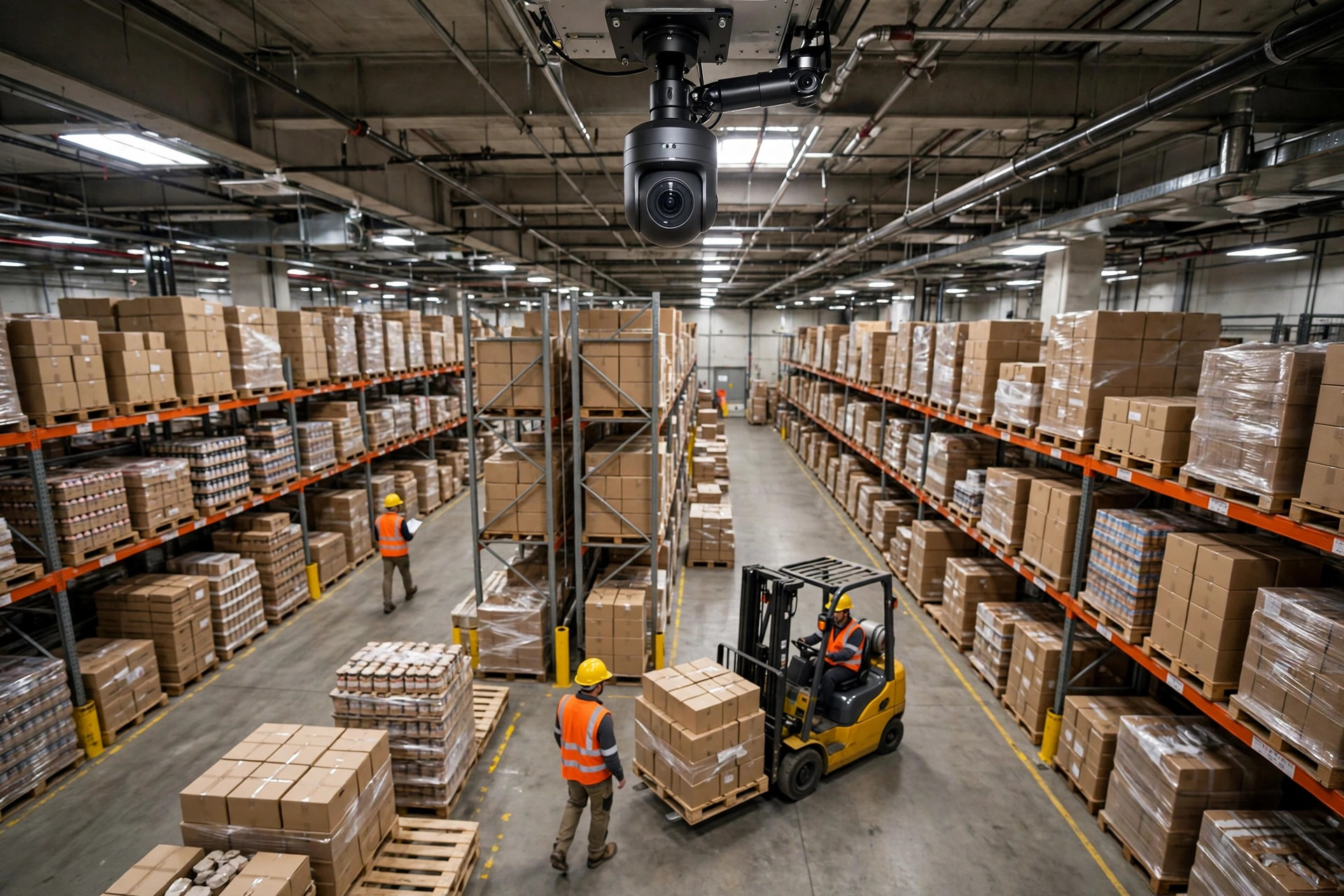
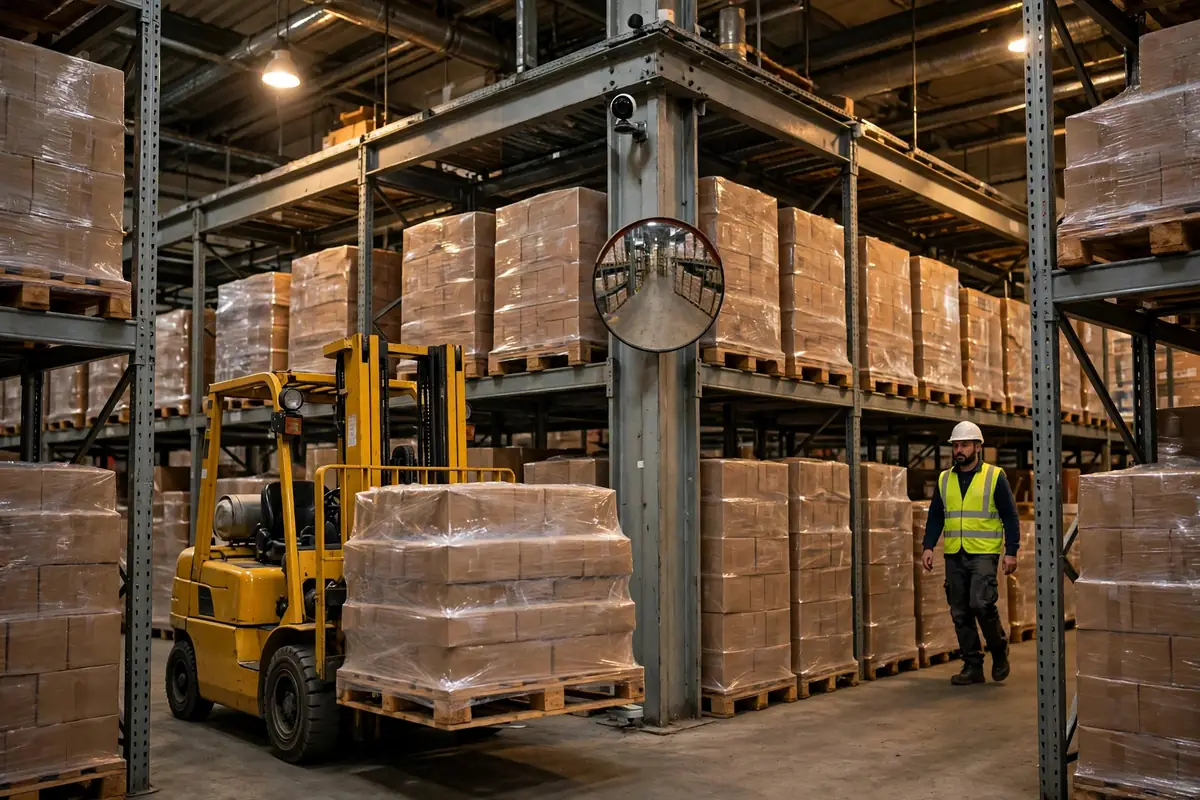
What we ended up installing is almost embarrassing to admit, but it works: two convex mirrors and two AI cameras, watching only our two most dangerous corners; the pedestrian walkway repainted properly; a forklift speed limit; and a rule that reversing requires a spotter. Night-shift temps get a ten-minute safety briefing before they touch anything, and earphones are banned outright. The camera part cost less than a tenth of the big vendor's quote.
Now the payback math — a hypothetical example, clearly labeled as such. Suppose the lightweight setup costs $8,000 total and lasts three years. In those three years it only has to prevent one moderate injury. By U.S. workers' compensation cost measures, a single forklift injury serious enough for hospitalization runs into the tens of thousands of dollars in medical costs, downtime, and compensation before you even count insurance hikes and lost orders. One avoided incident pays for the system, with change. Flip it around: $8,000 over 36 months is a little over $200 a month — about half a tank of diesel for one forklift. Once I did that math, my "we can't afford it" excuse fell apart. What we cannot afford is one accident.
To be fair, this cheap setup has a ceiling. It covers the corners, not the whole floor. It handles fixed routes, not improvised shortcuts. When we grow and volume doubles, I will move to UWB, because by then the tag-management labor spreads across a bigger team. You eat one bite at a time. Safety systems work the same way.
The big vendors' full-floor coverage is a cannon aimed at a mosquito, as far as we are concerned. Not because their product is bad — it is not — but because we do not have that many mosquitoes. Cover the two deadliest corners first. Set the night-shift rules. Keep false alarms low enough that drivers still listen. Do those three things, and a small warehouse's safety math works out.
Small warehouses have their own way of surviving. On safety, we do not compete with the big players on spectacle. We compete on who plugs the one or two deadliest holes first. We plugged ours. Have you plugged yours?
By Xiao Ma, Small Warehouse Owner