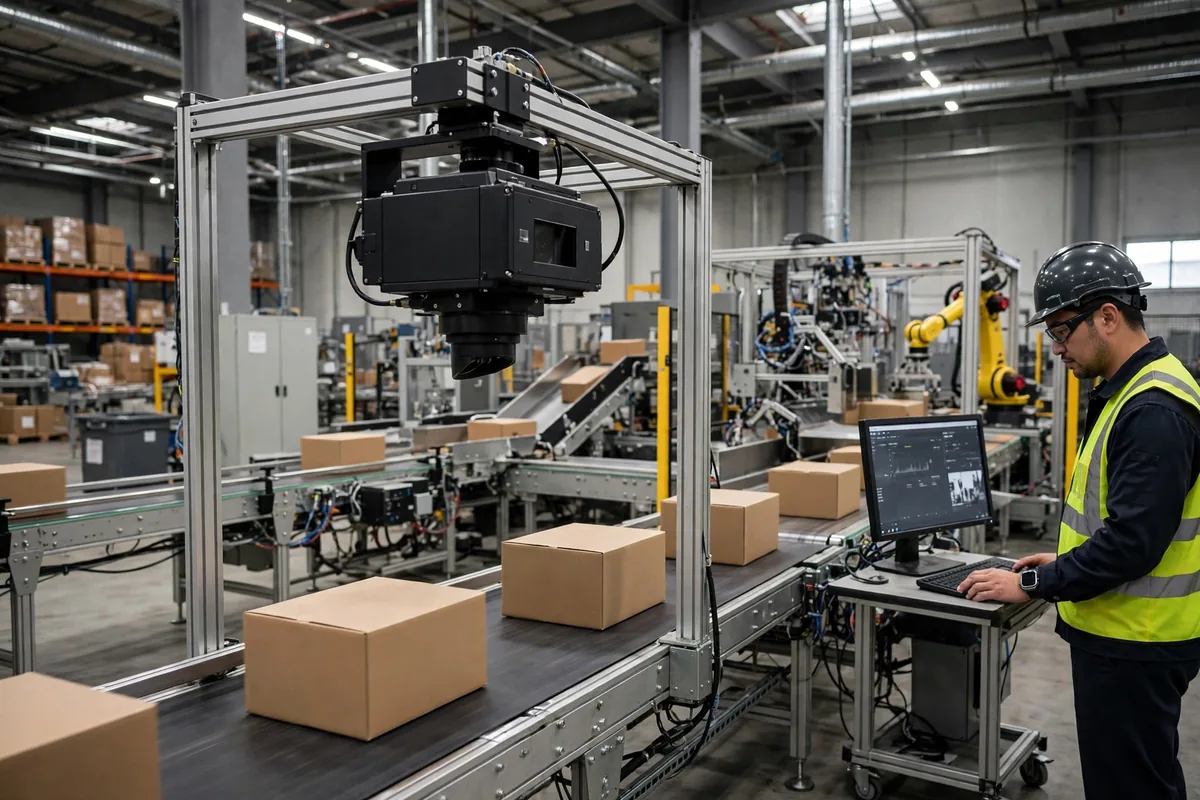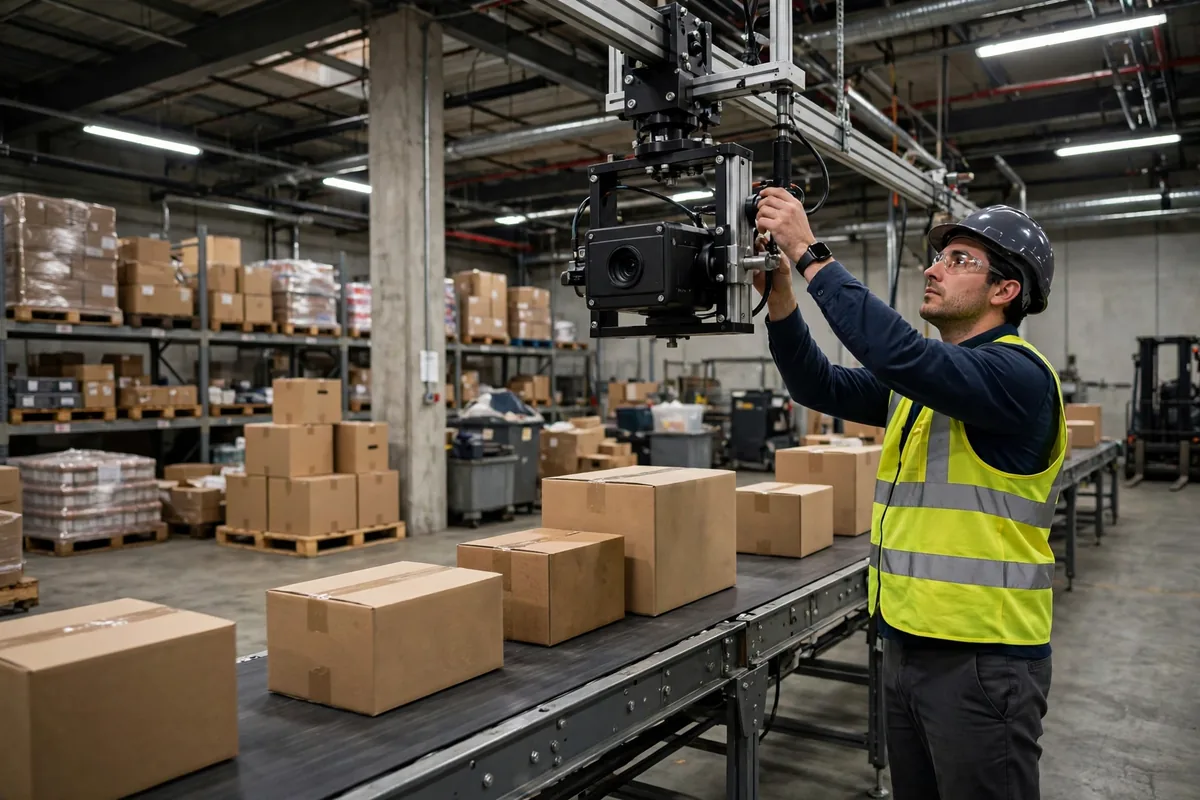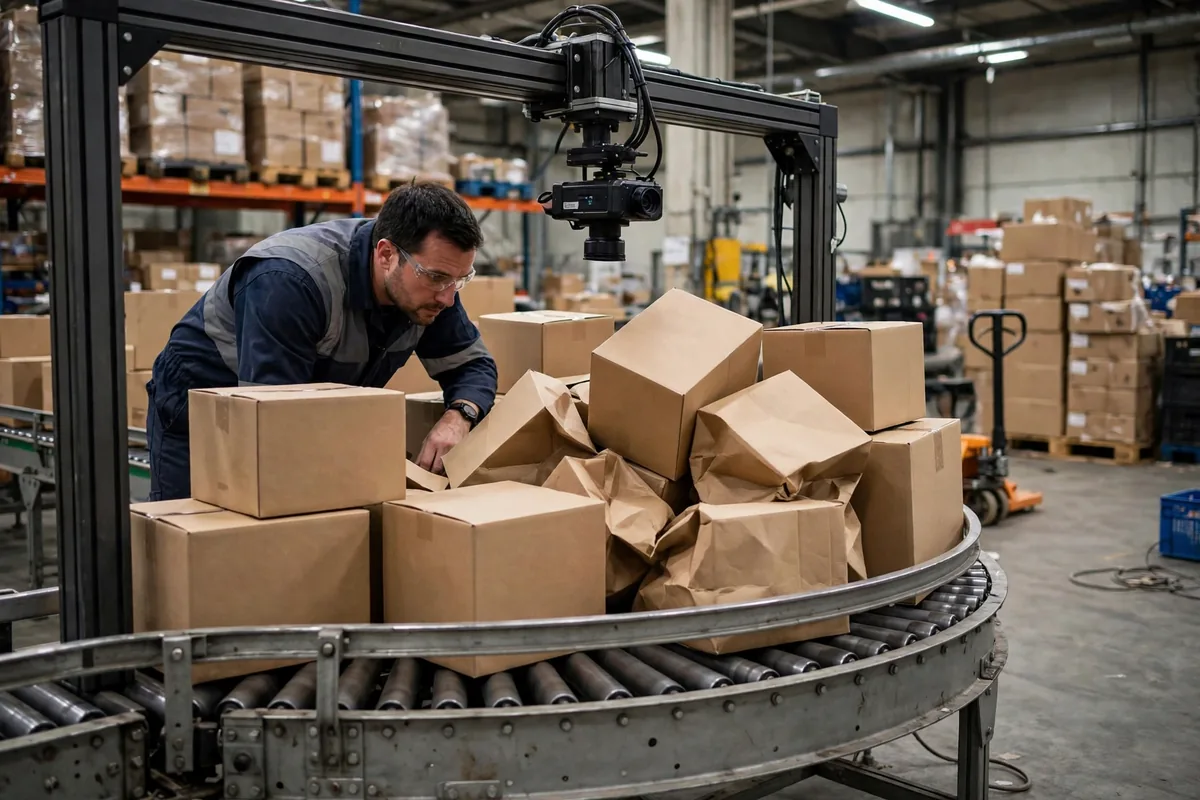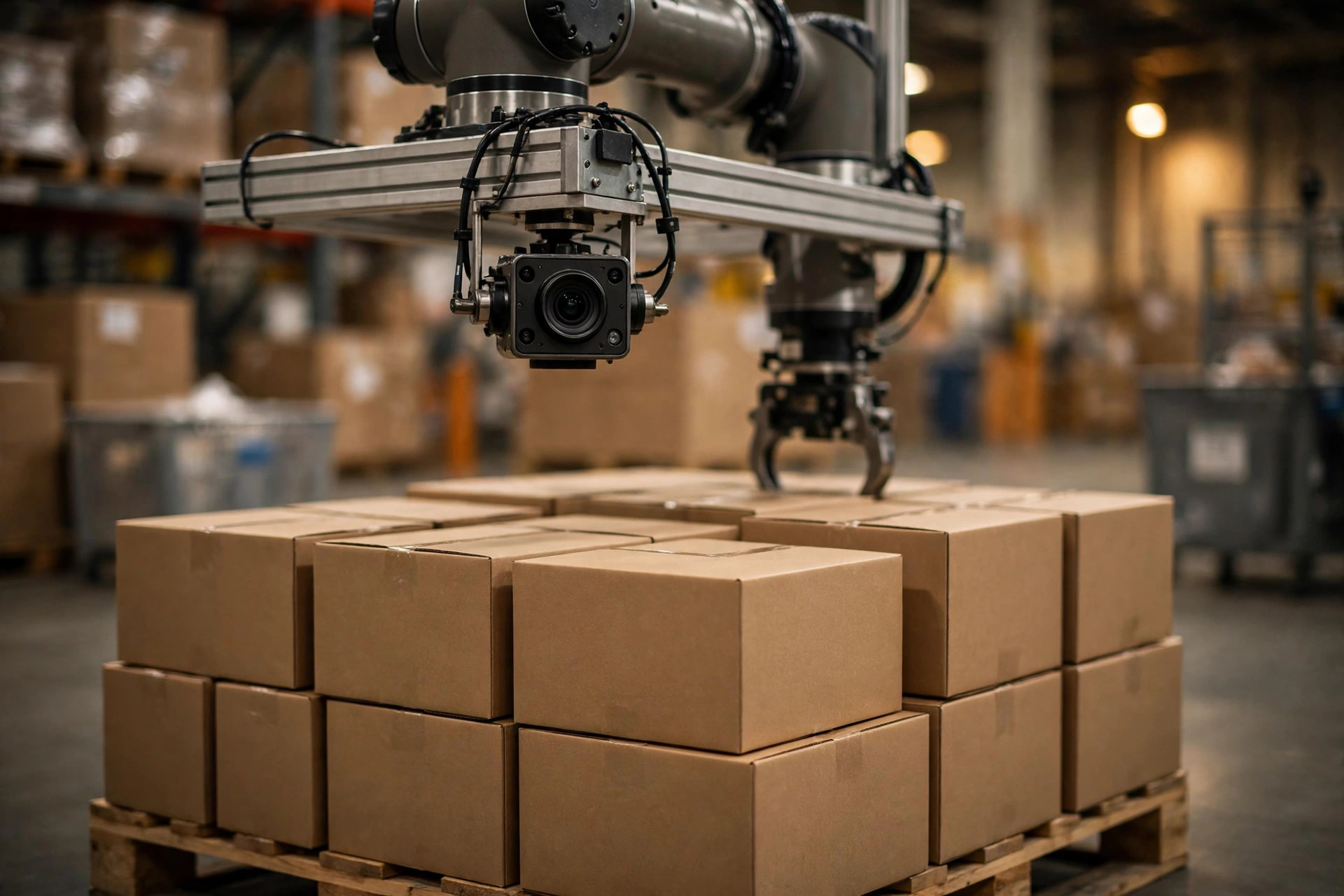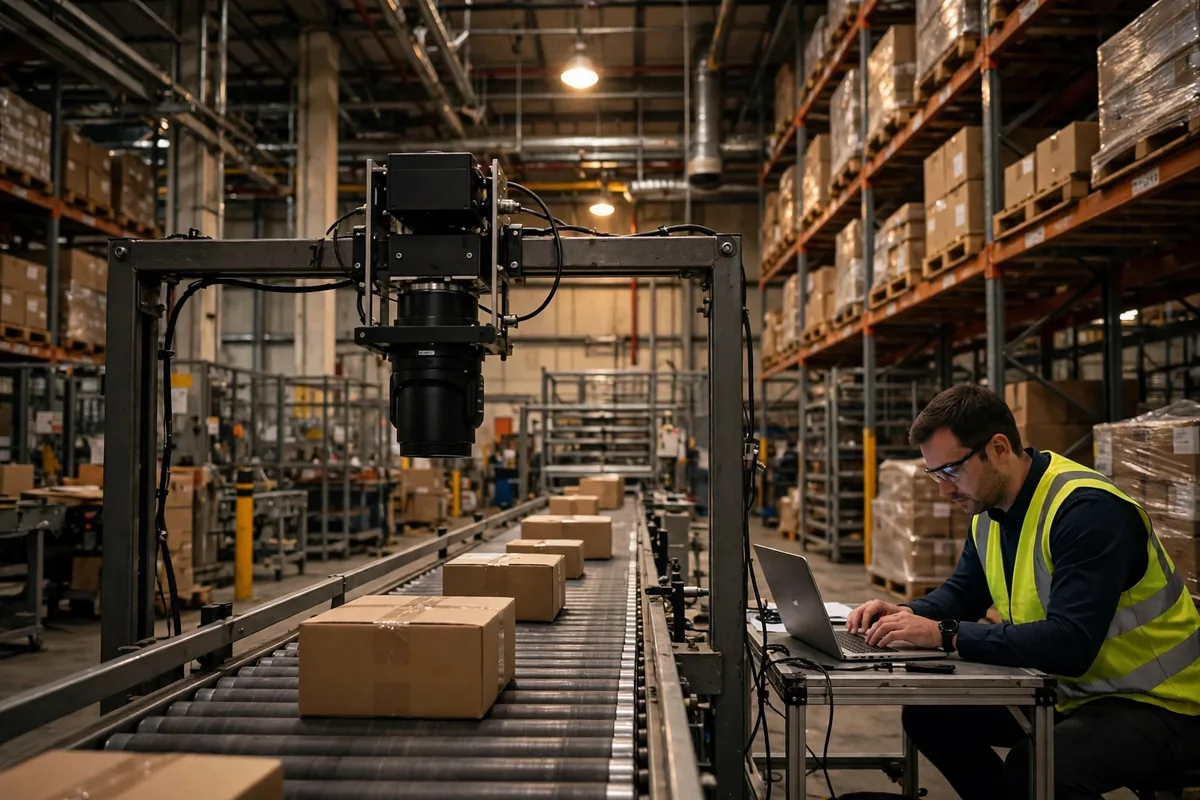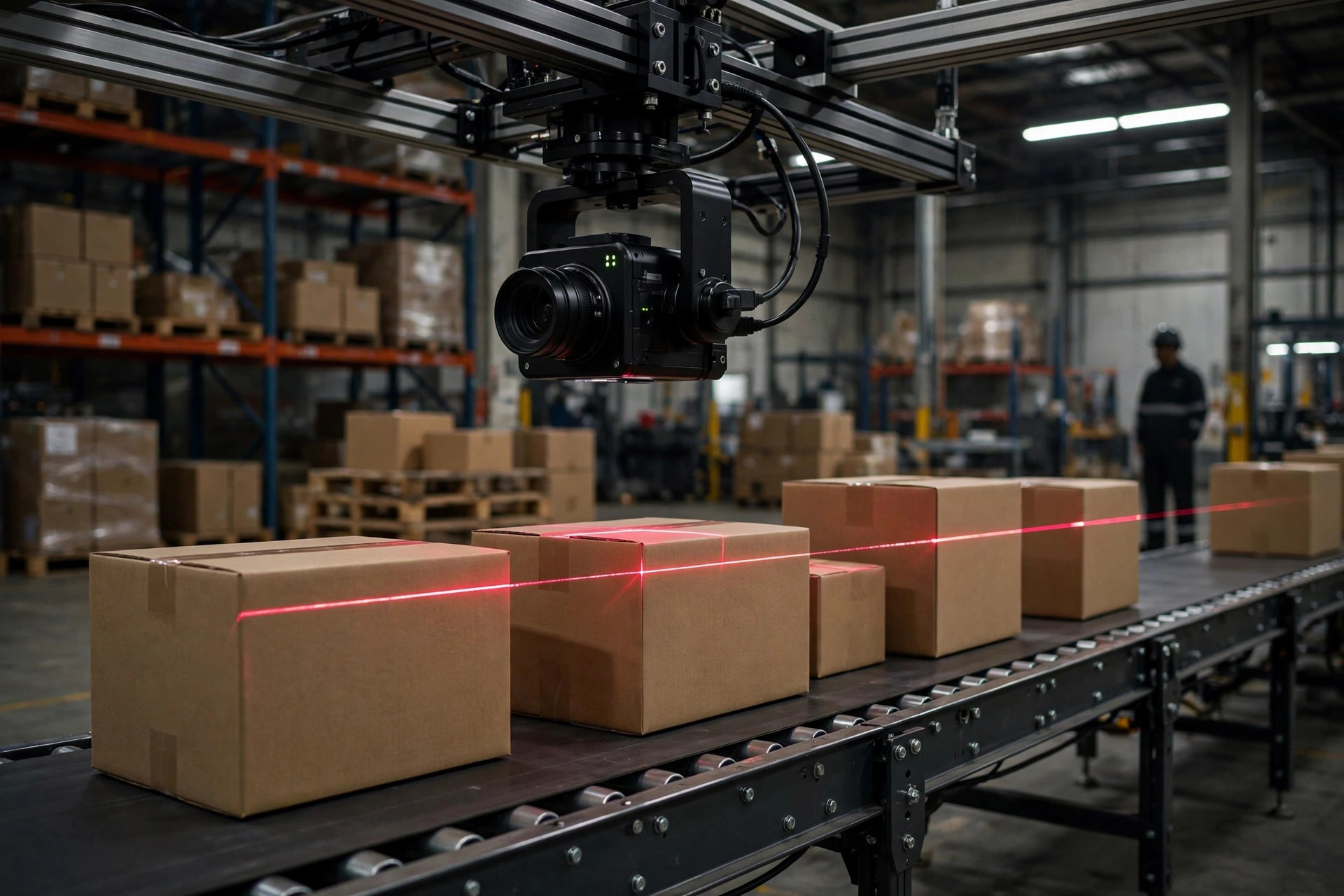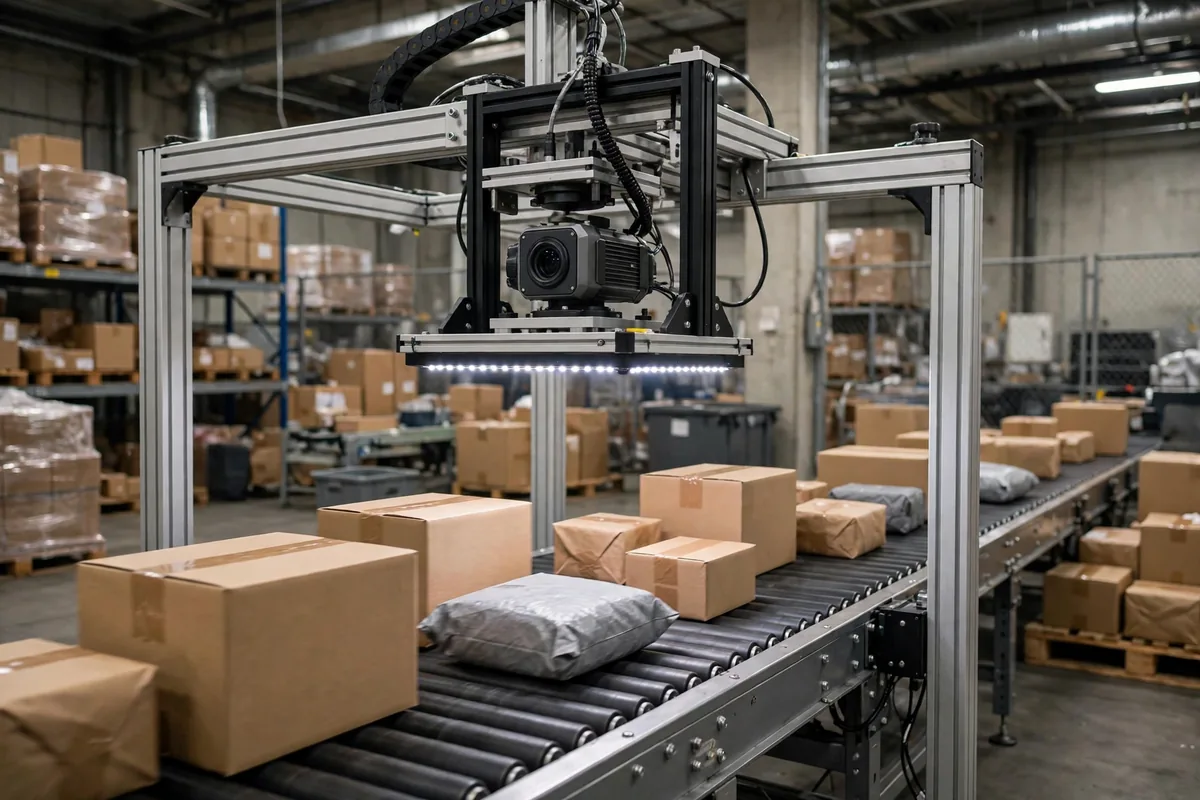
In the fall of 2024, I was doing field research at a 3PL warehouse in Ontario, California. The operations manager walked me over to a vision system they had installed three months earlier: two 3D cameras mounted above a conveyor, modeling every carton that passed underneath, measuring height, comparing volume. The system itself ran well. The only problem was that the job it was doing could have been done by the 2D cameras they already had — for much less money. The building is about 60,000 square feet and moves roughly 15,000 parcels a day, and nine out of ten are flat cartons with standard barcodes. The manager showed me the math: the 3D system, hardware plus integration, cost nearly twice the 2D alternative, and the gain in read rate was less than one percentage point. That was not a technology failure. It was a selection process that asked the wrong question first.
In warehouse machine vision, the 2D versus 3D debate is usually told as an upgrade story, one generation replacing the last. The project data I have tracked does not support that telling. A 2D camera reads a flat image: barcodes, text, surface damage. A 3D camera adds depth: height, volume, stacking, orientation. These are different tools with different jobs, not rungs on a ladder. And the line between them is not on a spec sheet. It is in what your freight looks like and what your process actually needs to decide.
Look at the Freight Before You Look at the Camera
The most common selection mistake is to read the product brochure first and then try to fit your freight into it. The order should be reversed. In the project reviews I sit in on, I insist on one exercise: pull the problem freight from the last three months and sort it by what the camera is supposed to judge.
In 2023, an auto parts distribution center in Ohio asked me to review their vision project. Their pain was specific: cartons of parts in mixed sizes, stacked unevenly on pallets, and short pallets kept slipping past manual checks, only to be discovered as shortages at the customer site. The center ships more than 800 pallets a day. A 2D camera could only see the top layer; it had no way to tell how many layers were stacked or whether one pallet sat an inch lower than the rest. After they switched to 3D cameras, every scan produced a height map, and short pallets were stopped on the line. Over three months, the system flagged more than 200 pallets for height anomalies, and shortage complaints from customers fell by nearly 40 percent. In that project, the 3D camera was not "better." It was the only tool that could see the problem at all.
Contrast that with the Ontario 3PL. Their cartons were almost all standard boxes, and the camera only had to answer two questions: can the barcode be read, and is the carton visibly damaged? A 2D camera with decent lighting was already at the ceiling of what that decision needed. The extra depth data had no decision to feed. A camera that sees more does not automatically make a warehouse earn more.
A quick self-test: write down everything you want the camera to judge. If every item can be described as "visible on a flat surface," a 2D camera is probably enough. The moment one item requires height, volume, layer count, or orientation, 3D enters the conversation.
A Framework for Drawing the Line
To make this line concrete, I put together the framework I now use most often when reviewing vision proposals, drawing on the two projects above and the selection dimensions that keep recurring across the industry:
| Dimension | 2D is enough | Consider 3D |
|---|---|---|
| Freight profile | Flat cartons, standard pallets, single layer | Mixed loads, stacked, multi-layer, irregular shapes |
| What is judged | Barcode reads, text, surface damage | Height, volume, layer count, orientation |
| Typical use | Pick verification, barcode checks, photo evidence at dispatch | Dimensional billing, load completeness checks, shortage and misload prevention |
| Purchase plus integration cost | Baseline | Often several times the 2D option |
| Maintenance burden | Lens swaps and lighting tweaks the site team can handle | Calibration and point-cloud tuning that often needs vendor support |
The last row deserves attention, because it is where the real cost hides. A 3D system's price is not just the purchase order. Point-cloud calibration, depth recalibration, re-tuning after lighting changes — much of this is work a warehouse's own team cannot do, and every visit is a service fee. When the Ontario warehouse added up three years of total cost, their 3D system's service spending ran far above the 2D alternative, and that money had never appeared in the original project budget.
Three Things 3D Cameras Get Overestimated On
Across the projects I have followed, three expectations about 3D cameras fail almost every time. The first is that higher accuracy is always worth paying for. The accuracy printed in a lab datasheet gets discounted on a warehouse floor: conveyor vibration, glare on taped cartons, shifting ambient light all eat into it. Arguing over the second decimal place on a spec sheet is a poor use of time compared with a week of testing on your real freight.
The second is that 3D means no more human checks. Six months after go-live, the Ohio center told me about one in ten flagged exceptions still needed a person — a height reading thrown off by reflective tape, for example. A 3D camera reduces repetitive judgment. It does not remove judgment.
The third is the most subtle: people assume a 3D camera will quietly fix a process problem. The Ontario warehouse eventually found that what really slowed them down was inconsistent label placement upstream — barcodes sometimes landing on a carton seam where no camera reads them well. That was fixed by standardizing where labels go. It cost nothing in hardware.
These three point to the same counterintuitive conclusion: the line between 2D and 3D warehouse machine vision was never a technology gap. It is a question of whether your process needs depth information to decide anything. Before buying a 3D camera, ask one question: if we swapped this system back to 2D tomorrow, which decisions would immediately become impossible? If you cannot name them, you are not buying capability. You are buying reassurance.
My Judgment: Reach the 2D Ceiling First
Over the next few years, 3D cameras will get cheaper and calibration tools will get simpler, and the line will move down — more use cases will fall on the 3D side. The logic will not change: depth information is only worth paying for when it participates in a decision. My advice to warehouses working within a budget is to get the 2D setup right first — lighting, camera angle, label placement standards, an exception-handling routine. Any one of those four left undone means a 3D camera just repeats the same problem at a higher price. Once you can list three or more decisions that genuinely cannot be made without depth data, then go and talk about 3D. At that point you will be buying a camera, not an expensive lesson.
By Dr. Chen, Supply Chain Researcher