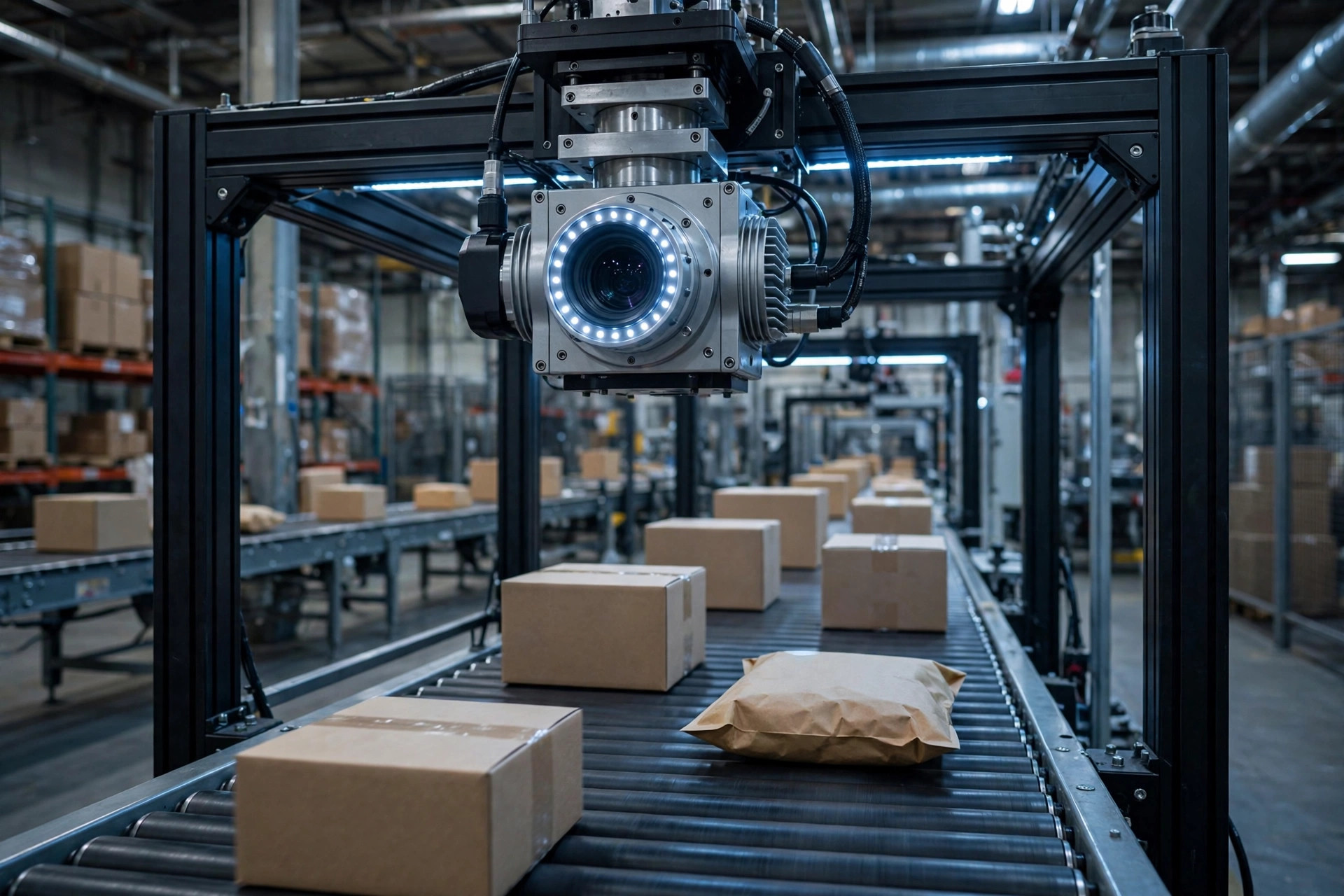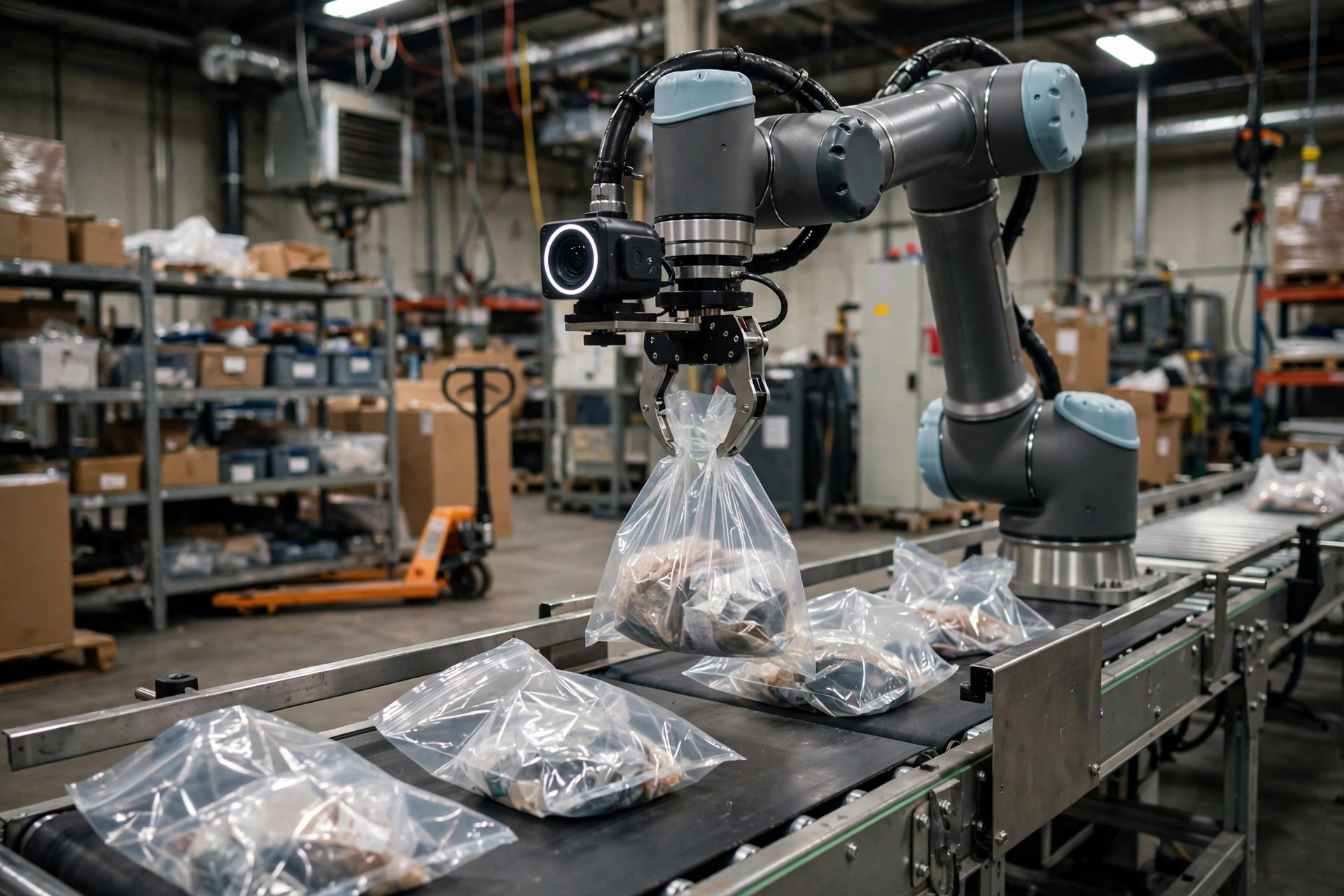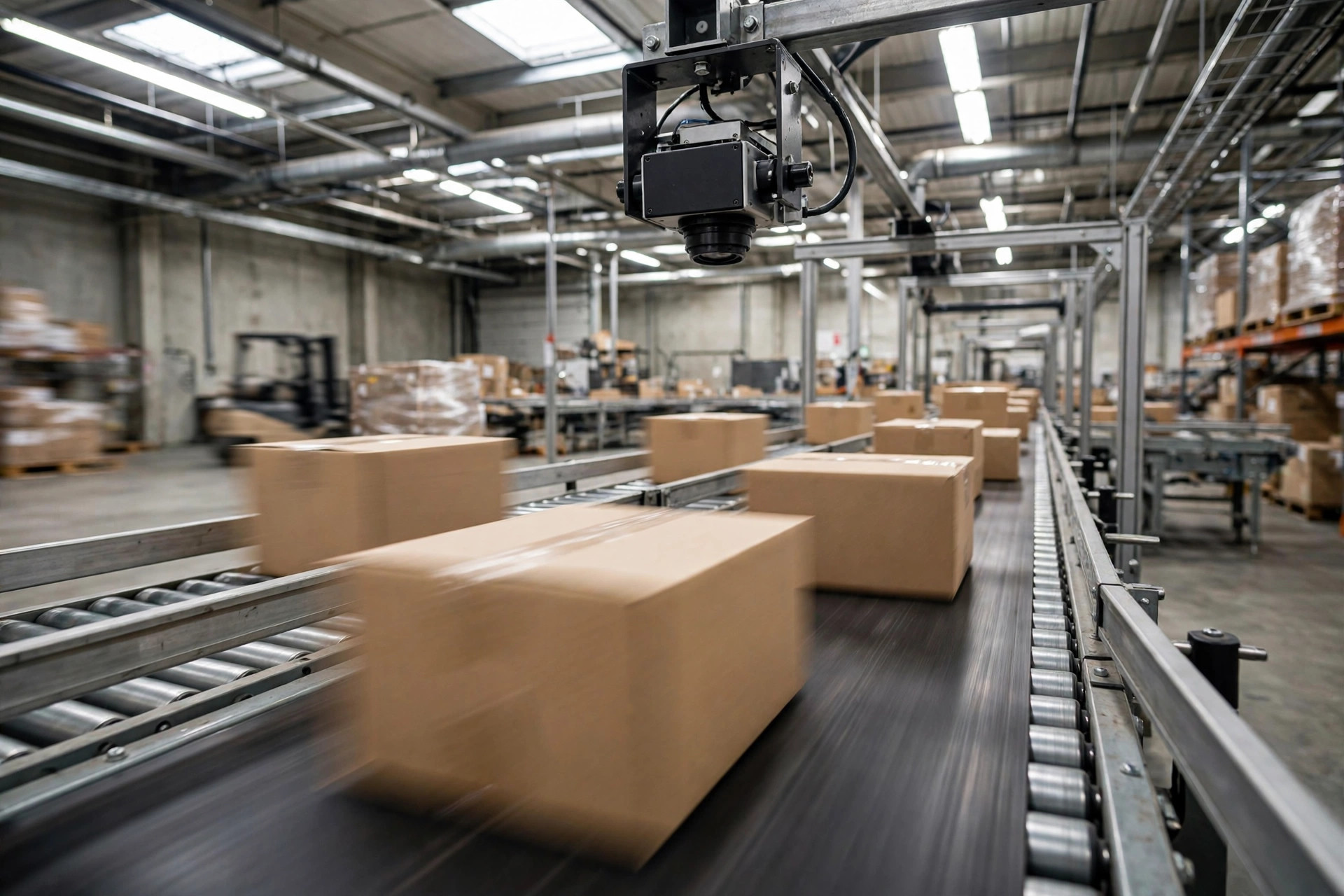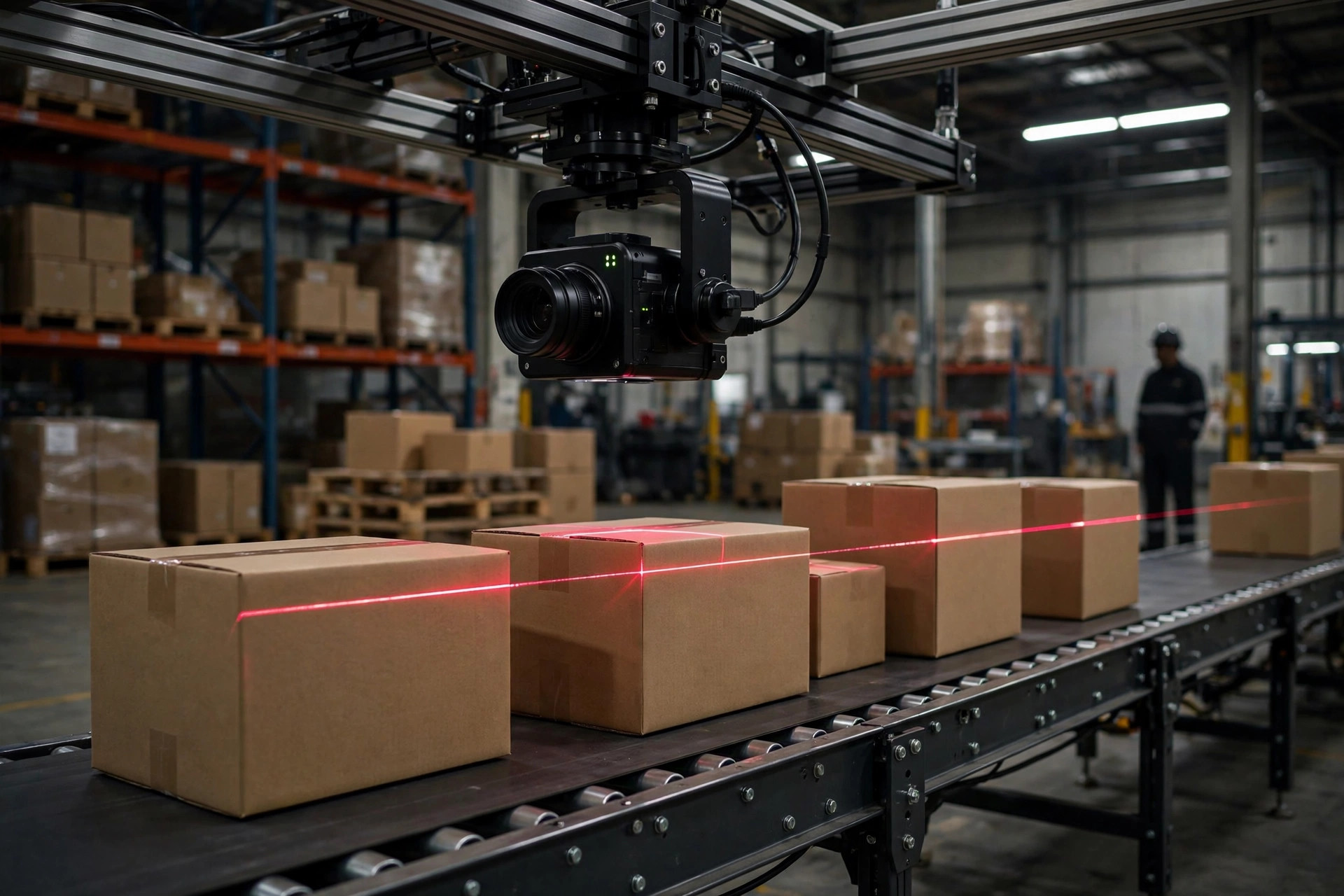
Bottom line up front: for warehouse machine vision, the dividing line between 2D and 3D cameras is a single question — does your output need a Z axis? Barcodes, labels, color checks, surface defects: a 2D camera is all you need. Height, volume, pick poses: no 2D camera, however expensive, can see depth. You need 3D. I'm a WMS implementation consultant writing about vision hardware, which makes me the outsider here — and that's exactly the point. My only lens is go-live: will this thing survive the first night in production without someone babysitting it?
Why the line sits exactly there
A 2D camera gives you a flat image — pixels with X and Y. A 3D camera gives you a point cloud, where every point carries X, Y, and Z. 3D sounds "more advanced," but more than ninety percent of warehouse vision work is recognizing things, not measuring things. Recognition is 2D territory. Measurement is where 3D earns its keep.
I've watched this decision go wrong with real money on the table. In 2024, an e-commerce fulfillment center in Shenzhen, doing around 30,000 orders a day, installed structured-light 3D cameras to read shipping labels at the verification station. Six figures in RMB per station. A barcode is flat information. A 2D camera with decent lighting reads it all day for a fraction of that. I've seen this exact failure mode three times now, and the sales pitch is always the same: "3D is more advanced." Advanced is not the same as appropriate. They ended up ripping the 3D units out, mothballing them, and redoing the station with 2D. An expensive lesson in buying the wrong tool.
The counter-story: in 2025, a 3PL warehouse in eastern China needed dimensional verification for DIM-weight billing disputes with carriers. A 2D camera sees only the top face of a parcel — no volume, no matter how you tune it. They put in time-of-flight 3D cameras measuring length, width, and height with centimeter-level error, and the billing disputes dropped off within a month. That is 3D's real job: outputting numbers (dimensions), not recognizing patterns.
2D vs 3D cameras for warehouse machine vision: the comparison table
| 2D camera | 3D camera | |
|---|---|---|
| Typical use | Barcode reading, label verification, OCR, surface defects, color sort | Volume measurement, palletizing guidance, robot picking, empty-slot detection |
| Output | Flat image — pass/fail or a string | Point cloud — dimensions or spatial coordinates |
| Accuracy | Pixel-level, depends on resolution and field of view | Depth accuracy from millimeters to centimeters (structured light beats ToF); check the vendor datasheet |
| Hardware cost | Thousands to low tens of thousands RMB per station | Tens of thousands to low hundreds of thousands RMB per station; check the vendor datasheet |
| Maintenance | Aging light sources, dusty lenses — site staff can handle it | Calibration drifts and must be redone; reflective and transparent materials are the enemy |
| WMS integration | Simple output, small integration effort | Coordinate-system calibration and algorithm tuning — integration often costs more than the hardware |
One decision rule falls out of that table: if the output has no Z axis, it's a 2D job.
A four-step selection method, with a go-live-night checklist
Don't start by comparing spec sheets. Walk these four steps, write down the output of each, and the selection makes itself.
Step one: define exactly what you want out of the camera. Pass or fail? A barcode string? Three dimension numbers? XYZ coordinates for a robot arm? If the required output is vague, the selection will be wrong. I've seen requirement docs that just say "intelligent recognition." Those projects always get reworked.
Step two: survey the lighting. A 2D camera is seventy percent lighting. If the dock has mixed light and forklifts blocking fixtures, test the lighting before you pick the camera. I learned this the hard way in 2023 at a pharma warehouse: the POC read 99% during the day, then the night shift came with half the ceiling lights burned out and nobody fixing them, and the read rate fell to 92%. The verification queue jammed for half an hour. Since then my rule is simple — the lighting test must cover all three shifts, and it only passes if the system still runs with half the lights dead. Structured-light 3D has the same weakness against ambient light; for bright or outdoor areas, pick a model with strong ambient-light rejection and verify it in the vendor datasheet.
Step three: cost the whole project, not the camera. A 2D station needs lighting, lenses, and an industrial PC. A 3D station needs calibration services and days of algorithm tuning. The number software people underestimate most is integration: aligning the 3D point cloud's coordinate system with the WMS or the robot controller routinely takes weeks of tuning.
Step four: run a POC on real freight before you buy. Real parcels, real lighting, real throughput, for a full week. Then work the go-live-night checklist: (1) eight continuous hours with no dropped frames; (2) acceptable false-reject rates across shift-change lighting; (3) the WMS interface tested end to end; (4) automatic recovery after a power cut, with nobody climbing up to click a mouse; (5) site staff trained to swap a light source and run basic calibration. Item five matters most — I've seen too many systems die the week the integrator's engineer flies home.
Three ways 3D cameras fail in production
First, 3D cameras hate black and transparent. Black polybags and reflective stretch film leave holes in the point cloud. The POC runs beautifully on standard cartons, then go-live hits and half the freight is black bags, and measurement success drops in half. The POC test set must include the ugliest packaging on your floor. Non-negotiable.
Second, calibration drifts. The camera sits on a gantry, a forklift clips it, six months pass, the coordinate frame shifts, and the robot arm starts grabbing air. The maintenance plan must say "recalibrate quarterly" with a named person responsible — not "the equipment team."
Third, a 2D camera with a bad light is blind. Spend twenty thousand on the camera and two hundred on a light strip, and the image is full of noise no algorithm can save. Budget at least a third of the station cost for lighting, and write that into the purchasing standard.
The counterintuitive take
A 3D camera is not an upgraded 2D camera. It's a different species. The most reliable warehouse vision setup is usually "2D plus good lighting plus a mature algorithm": cheap, maintainable, fixable by site staff at 2 a.m. without waiting for the vendor's engineer to fly in. 3D is special forces — deployed only where 2D can't go: measuring volume, determining pose. Anyone telling you to "just go all-3D to be safe" is really saying "buy more units from me." The trade-off is honest: every step up in capability multiplies cost and maintenance complexity by more than the step itself.
One thing you can use tomorrow: list every vision station you're considering, and answer one question per station — does the output need a Z axis? Yes, go 3D. No, go 2D with good lighting, and spend the savings on dinner for the team.
By Lin Xiao, WMS Implementation Consultant