A decade ago, a camera in a warehouse existed so that someone could see what was happening. That change is what made 2D vs 3D camera warehouse vision selection a real decision instead of a catalog choice. Today the system itself is expected to judge by what the camera sees: read the code, count the items, measure the volume, tell a robotic arm where to grip. The camera has changed from a pair of eyes into the sensory organ that precedes a physical hand. It is at precisely this point that the most frequently asked selection question arises: what actually separates a 2D camera from a 3D camera, and where should the line between them be drawn.
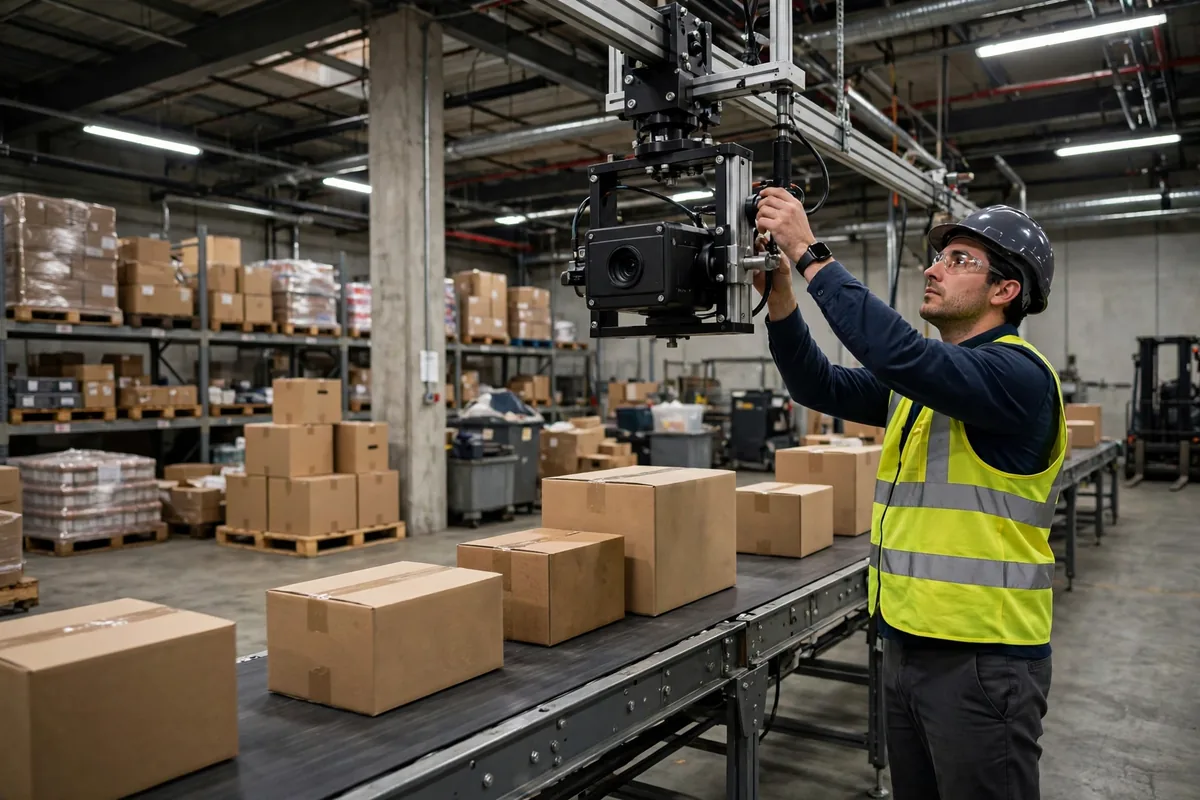
According to the selection guides published by equipment vendors, the distinction is not mysterious. A 2D camera records a flat image and answers questions of the form "what is this, and what does it say." A 3D camera adds depth information and answers questions of the form "where is it, how tall is it, and what shape is it." That sounds almost trivially true, yet when it lands on a specific warehouse task, it determines whether the system can run at all. An e-commerce warehouse in eastern China automated a sortation line two years ago and used ordinary 2D cameras for barcode reading, handling tens of thousands of parcels a day without trouble. When the same line was later asked to measure parcel volume as well, no amount of 2D image processing could recover height, and a 3D camera had to be added downstream as a separate measurement station. The money was not spent on the camera itself. It was spent on rework.
An auto-parts warehouse tells the opposite story, and it is equally instructive. Reasoning that more advanced must mean better, they specified 3D cameras across the entire line, including the reading stations, where the depth data was never examined by anyone. The computing load, the calibration effort, and the maintenance cost arrived in full all the same. Six months later, in a review, the reading stations were switched back to 2D, and the budget saved went to the palletizing stations where 3D was genuinely needed. Taken together, the two cases point to the same conclusion: 2D vs 3D camera warehouse vision selection should start from the task, not from the specification sheet, because the sophistication of the camera does not always track the difficulty of the task.
2D vs 3D Camera Warehouse Vision Selection Starts With the Task: Reading Is 2D Home Ground
Flat tasks are 2D home ground. Barcode and QR reading, optical character recognition, label presence and position checks — the information in all of these already lives on a plane, and a 2D image is sufficient. The algorithms are mature, the cost is low, and maintenance is straightforward. Just as important, the deployment barrier is low: lighting schemes, mounting angles, and calibration procedures are all established practice, and a field engineer can bring a reading station up in half a day. For a reading application running tens of thousands of items a day, 2D is the default answer, and adding 3D only burdens the system with data nobody asked for.
The Dividing Line in 2D vs 3D Camera Selection: Three Tasks That Require 3D
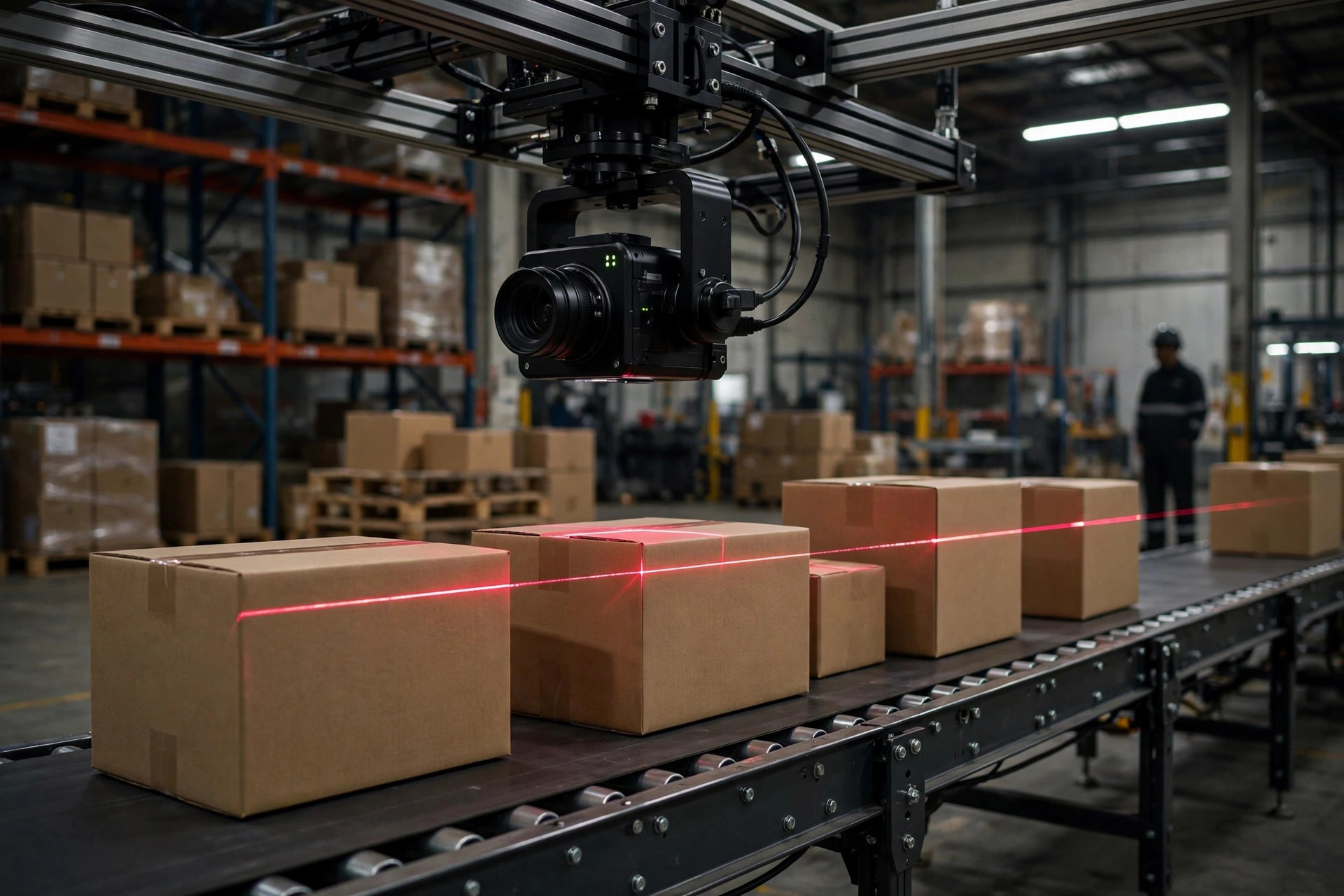
The line appears the moment a task needs space. The first category is dimensioning: cubing, dimensional weight, and load-utilization accounting cannot rest on estimation, because an estimate does not hold up where billing is involved. The second is palletizing and depalletizing, where stack profiles are uneven and layer counts vary, and the arm must know the height and pose of each item before it dares to move. The third is unstructured picking and mixed-case sortation, where parts lie jumbled in a bin and a flat image cannot tell the upper layer from the lower one — depth information is the precondition for a successful grasp. What these three categories share is that the cost of failure is not measured in recognition accuracy but in physical consequences: a wrong grip, a crushed item, a miscalculated volume are all losses in real money.
| Task type | 2D camera | 3D camera | Selection guidance |
|---|---|---|---|
| Barcode and character reading | Fully capable | Capability surplus | Choose 2D |
| Label presence and position checks | Fully capable | Capability surplus | Choose 2D |
| Volume and dimension measurement | Estimation only, unusable for billing | Direct three-dimensional output | Choose 3D |
| Palletizing and depalletizing guidance | Cannot judge height or pose | Outputs position and pose | Choose 3D |
| Unstructured picking, mixed-case sortation | Cannot separate layers | Resolves occlusion and stacking | Choose 3D |
There is a counterintuitive judgment here that deserves attention: a 3D camera is not an upgraded 2D camera. The two are closer to different senses than to successive generations of the same sense. Treating 3D as simply stronger 2D produces waste in both directions — paying for depth information on flat tasks that never use it, and assuming on genuinely spatial tasks that a high-resolution 2D image can somehow be made to substitute, then burning weeks of on-site tuning trying to coax depth out of a flat picture. The true cost of selection was never just the camera price. It includes calibration, computing, maintenance, and rework, and when the total is counted, choosing in the wrong direction usually costs far more than the price gap between the cameras.
Looking one layer deeper at the causes, the price gap between the two camera types is narrowing, but that does not mean the dividing line is disappearing. According to vendor publications and product lines shown at industry exhibitions, entry-level 3D cameras are indeed more affordable than they were a few years ago. At the same time, 2D cameras are improving too, with faster reading and better stability under difficult lighting. Both lines are advancing, and the line between them has grown sharper rather than blurrier, because tasks are now specified at finer granularity: warehouses no longer ask whether to adopt vision at all, but what information a particular station actually needs.
For the trend judgment, my inclination is that hybrid deployment becomes the mainstream pattern over the next three to five years, and that is why 2D vs 3D camera warehouse vision selection is best treated as a station-by-station decision rather than a site-wide purchase. Reading and verification stations stay on 2D and hold the cost floor, while dimensioning, palletizing, and picking stations use 3D and hold the capability ceiling, with both camera types doing their own jobs inside one system. One further point is worth watching: the value of depth information may not be confined to the task that justified it. Volume data feeds back into billing and load optimization, and grasping data accumulates into a posture library for the goods handled. Part of what a company pays for 3D today may turn out to be payment for a data asset tomorrow. That arithmetic only holds, of course, if the company actually uses the data; otherwise it has simply bought a more expensive camera.
Selection, in the end, is a judgment about information: can 2D supply what the task needs. If it can, use 2D and do not pay for capability that goes unused. If it cannot, adopt 3D and do not expect a flat image to grow depth. Whether the line itself moves again as algorithms advance is a question for the time when it actually does.
By Dr. Chen, Supply Chain Researcher