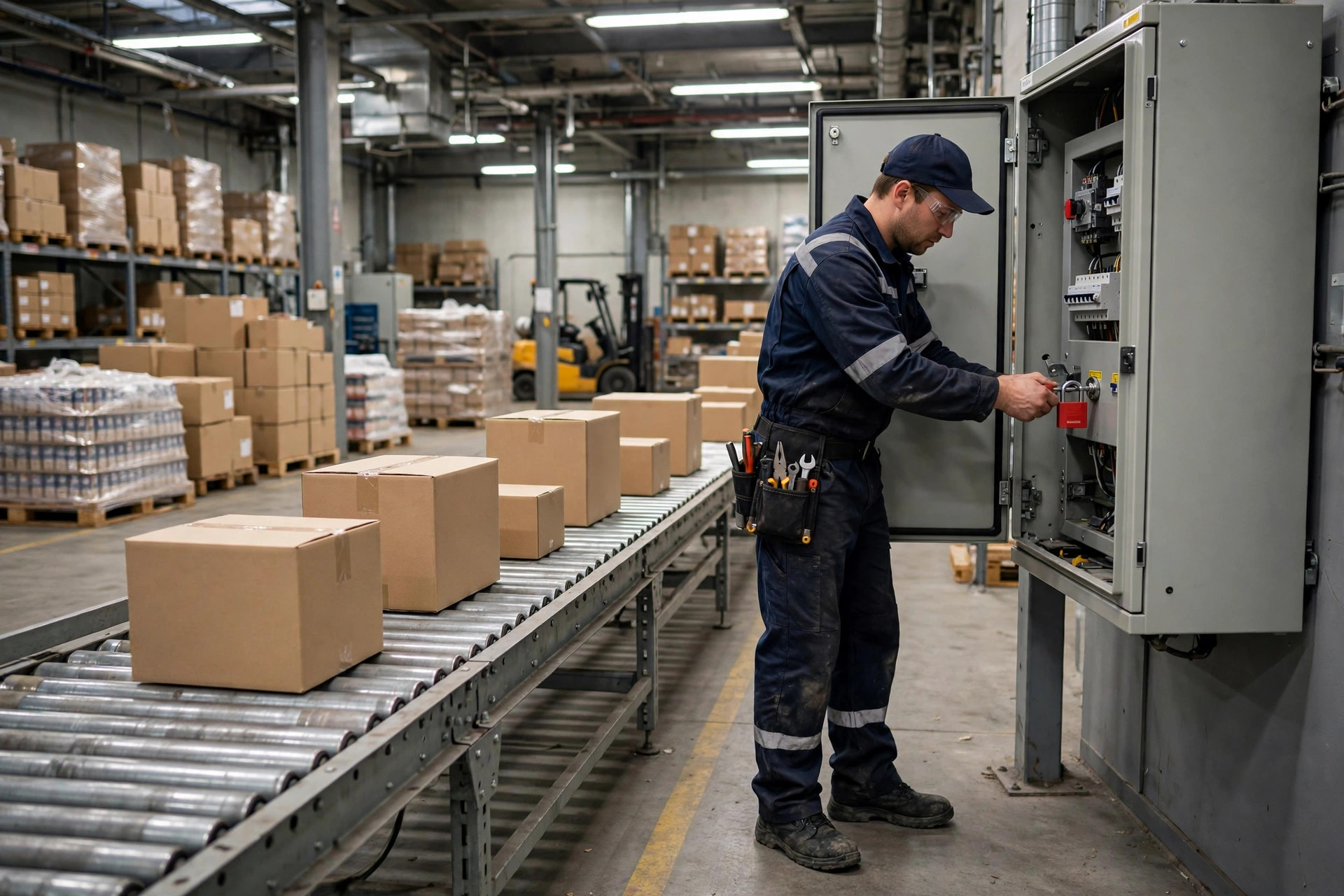
The most dangerous moment in conveyor maintenance is not when the equipment breaks. It is the few minutes when a technician is inside the machine, believing it cannot move. In the fall of 2023, a third-party warehouse in Ohio learned that the hard way. A pallet jammed a belt conveyor on the night shift. The technician cut the main switch and climbed in to clear it. No lock, no tag, no verification. A colleague from another shift saw the line stopped, assumed it was a planned stop, and closed the breaker. The belt moved, and the technician's arm was pulled between the roller and the belt. Forty-plus stitches, three months off work. There was not even a tag on the switch.
Lockout tagout exists to solve exactly one problem: a stopped machine must be physically unable to move, and everyone walking past must be able to see that it cannot move.
Power Isolation in Lockout Tagout Means Every Energy Source, Not Just the Main Switch
Many people treat lockout as "turn off the power and hang a lock." That is like closing a faucet while ignoring the tank still feeding the pipe. A conveyor has more than one energy source. Main power is one. Compressed air in the pneumatic tensioner is another. Gravity is a third: product sitting on an inclined section will roll on its own. Then there is the residual charge in a variable-frequency drive after the power is cut.
Think of it this way: the isolation step has to answer three questions. Where does the electricity come from, through how many circuits? Where does the air bleed off? Will anything heavy slide downhill on its own? Our warehouse keeps an energy list inside each control cabinet door. It names every energy point, how to isolate it, and how to bleed it off. The technician checks items off the list on site instead of relying on memory. When we built that list for a sortation line in 2024, we found two gaps: a lift's pneumatic brake had a second air feed, separate from the main supply, keeping the tensioning cylinder pressurized even after power isolation. Power off, air on, belt still able to snap tight.
Isolation is not complete until it is verified. Verification does not mean watching an indicator light go dark or tapping the housing. An indicator lamp can sit on its own circuit, and a dark lamp proves nothing about the main circuit. Our rule is simple: measure with a multimeter, and write the reading on the work order. A meter check takes two minutes. The people who skipped those two minutes spent months recovering.
The Lockout Lock Is About Who Gets to Restore Power
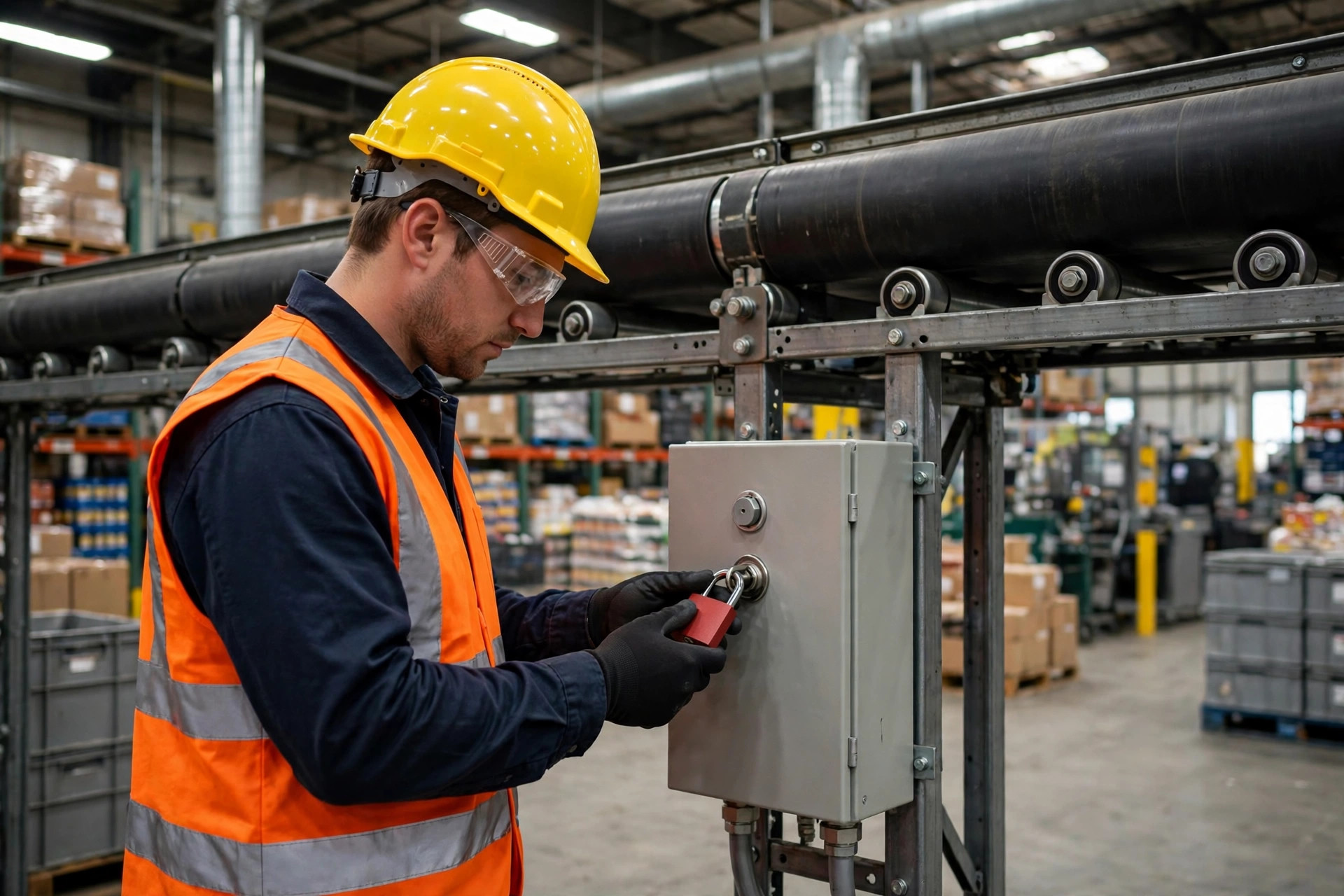
The core rule of locking has one sentence: the person who hangs the lock removes it. Not the supervisor. Not the next shift. Not the helpful colleague. When several people work on one line, everyone hangs their own lock on a hasp box. Until the last lock comes off, the breaker cannot close.
In early 2025, a California e-commerce warehouse came close to a serious injury over this rule. Two people were working on one conveyor: one replacing a motor, one clearing rollers. The motor technician finished first, saw the other person still inside, removed his own lock, and closed the breaker "just to check the motor direction." The person inside nearly got caught by a starting roller and escaped with scrapes. The investigation did not blame the number of locks. It blamed the idea of "just a quick test." Our rule now is blunt: any trial run counts as a new job. Full procedure again, fresh locks, fresh verification. There is no "just a quick test" option.
Personal locks and department locks serve different purposes and must stay separate. A personal lock belongs to one technician, with one key, and no duplicate is ever cut. A department lock is a handover lock used during shift changes: hang the department lock first, then remove the personal lock. Reverse that order and you create a window where nobody owns the lockout. Lock quality matters too. If one master key opens every lock in the building, the lock is decoration, not protection.
The Spending Line: What Is Worth Buying and What Is Theater
I am blunt about pseudo-needs. Some warehouses buy a full smart-lock management system first: chipped locks, card readers, automatic logging in a dashboard. It sounds advanced. But if your warehouse runs four conveyors with three fixed technicians, most of that money buys features you will never use. Meanwhile, the cheap items that actually form the foundation go unbought: hasp boxes, personal locks, a decent meter, energy-list placards. Those four cost little, and the whole system stands on them.
Here is how I draw the line:
| Investment | Fits which warehouse | Cost of skipping it |
|---|---|---|
| Personal locks, hasp boxes, meter | Every warehouse with conveyors | Loss of control over who restores power, which means no real lockout at all |
| Energy lists and work-order records | Every warehouse with conveyors | Hidden energy sources like air feeds and gravity sections get missed |
| Lockable disconnect retrofit | Older equipment whose switches have no lock hole | Locks hang on cabinet doors as theater |
| Smart lock management system | Multi-shift sites with many contractors and more than twenty lines | Slower paper tracing, but no immediate safety gap |
The message is plain: buy the foundation first, then talk about smart systems. Reverse the order and you pay a premium for the feeling of safety while the real risk stays open.
The Maintenance Trap: A Procedure Nobody Follows Is Not a Procedure
The biggest enemy of a written procedure is habit. Three traps show up again and again.
The first is "short jobs don't need locks." Clearing tape wrapped around a roller, pulling out a jammed carton, a five-minute job. People think locking is too much trouble for five minutes. That mindset is the most dangerous one, because short jobs are exactly when people reach furthest into the machine. Our red line is absolute: if any part of your body enters the conveyor's travel envelope, it gets locked out, no matter how short the job.
The second is hanging the lock and pocketing the key. The key sits in a pocket, the technician walks off to fetch a tool, and the next person arriving has no idea someone is inside. That is why the tag must say who is inside, when the lock went on, and when the work is expected to finish. The tag is not for the inspector. It is for the next person walking past.
The third is contractors who bring their own habits. An outside maintenance crew may be used to cutting power and getting straight to work. The contract must state it plainly: outside crews follow this warehouse's lockout procedure, use this warehouse's locks, and one violation stops the job. That clause costs nothing to write. Remembering it after an incident costs everything.
Here is the counterintuitive part: stricter lockout procedures make maintenance faster, not slower. It sounds backwards, but strict procedures cut rework and arguments. Our warehouse used to spend twenty minutes before each job confirming whether a line could stop and who owned the restart. With the checklist in place, technicians are inside in ten minutes. What we saved was not locking time. It was the time spent arguing about who was responsible. The real cost of a safety procedure is never the hardware. It is the chaos of having no procedure.
So is the money worth it? Look at one number: the total downtime hours your warehouse lost last year to unexpected conveyor restarts. If that number is not zero, the locks and lists already pay for themselves. If it is zero, do not celebrate yet. Check whether your work-order records are genuinely complete first, because in many warehouses zero incidents just means zero records.
By Da Liu, Automation Engineer