In most warehouses, lockout tagout warehouse procedures live in a binder on the wall — until something goes wrong and somebody finally opens it. This article has no sermon, only arithmetic: what one missing LOTO procedure actually costs on the books, versus what it costs to run a real program for a year. Put the two numbers side by side and the conclusion writes itself.
The headline first: a single mid-severity LOTO incident lands somewhere between $350,000 and $600,000 on the books. A mid-size warehouse running a solid LOTO program spends under $12,000 a year. That is 45 to 1. This is not a safety expense. It is a risk hedge with a multi-decade annualized return.
The Bill: What One Missing Lockout Tagout Procedure Costs
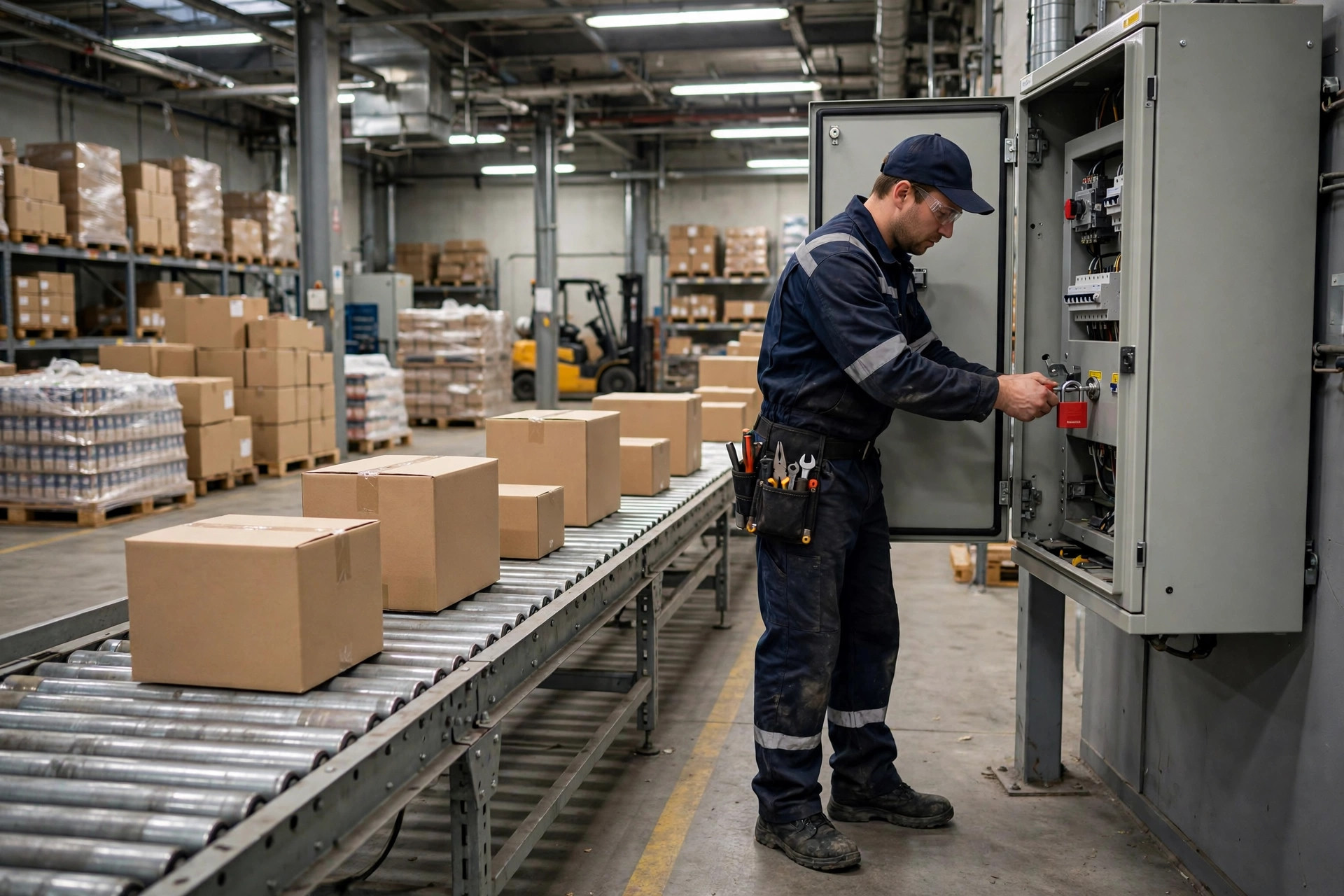
Fall 2023, a 120,000-square-foot 3PL warehouse in the Inland Empire, two weeks before peak season. The main sortation conveyor jammed. A mechanic climbed into the line to pull out a crushed carton — the breaker at the control cabinet was switched off but never locked, never tagged. A new hire in the control room saw an empty-looking line on the monitor and hit reset. The conveyor moved. Broken right forearm, plus crush injuries to soft tissue.
OSHA walked in, and the invoices started arriving. I built a conservative cost model for this exact scenario. The money comes out of four pockets:
| Cost item | Conservative estimate | Notes |
|---|---|---|
| OSHA citations | $30,000–$50,000 | Modeled as 2–3 serious violations; the 2025–2026 maximum is $16,550 per serious violation (no increase for 2026 — check OSHA's site for the latest figures) |
| Downtime | $80,000–$120,000 | Sortation line down 1.5 days: late-order penalties, emergency overtime, short-term outside capacity |
| Workers' comp medical | $100,000–$150,000 | Surgery-level fracture, medical plus lost-wage benefits |
| Insurance hike (EMR) | $60,000–$100,000 | Experience modification rate increase, amortized over 3 years |
| Legal and settlement | $50,000–$150,000 | Defense, investigation support, potential civil settlement |
Total: $350,000–$600,000, midpoint roughly $450,000. And this is the "moderate" version — nobody died, and there was no willful finding. If OSHA determines the employer knew the risk and did nothing, a willful violation runs up to $165,514 per item, and the citation line alone multiplies several times over.
The Counterintuitive Part: The Fine Is the Cheapest Line
Here is the finding most people get backwards: the OSHA fine is the cheapest line on that table.
The citation is the only cost with a legal ceiling — $16,550 per serious violation, countable and capped. Everything else is uncapped: every extra day of downtime burns another day of money, the EMR surcharge eats for three years, lawyers bill by the hour. The "invisible" costs run 8 to 10 times the fine.
The second counterintuitive point is about "lockout wastes production time." Plenty of floor supervisors genuinely believe a full LOTO sequence costs 30–40 minutes they do not have during peak. I ran that time math too: one unplanned full-line stoppage from an accidental startup, at 1.5 days, equals 54 compliant lockout sequences. You are not saving 40 minutes. You are gambling $450,000 to save 40 minutes. On a spreadsheet, that is a bad trade.
What a Real Lockout Tagout Warehouse Procedure Costs Per Year
Contrast that with a food distribution warehouse in Chicago's south suburbs, 80,000 square feet, that showed me the other ledger. They stood up their LOTO program at the end of 2023: a machine-specific energy-source card for each of their 32 powered machines, a lockout station right outside the maintenance room. In July 2024 a conveyor motor burned out. The mechanic ran the full sequence — notify, shut down, isolate, lock and tag, release stored energy, verify with a try-start — and the line was back in 40 minutes. Total LOTO spend that year: $9,600, including one external compliance audit.
For a mid-size warehouse with roughly 200 powered devices, the program economics break down like this:
| Item | One-time | Annual recurring |
|---|---|---|
| Lockout station, personal padlocks (one per person, one key each), hasps | $3,000–$5,000 | ~$500/yr replacements |
| Tags, ties, consumables | — | $800–$1,200/yr |
| Machine-specific energy control procedures | $8,000–$12,000 | $2,000–$3,000/yr review |
| Training (authorized, affected, other) | $4,000–$6,000 | ~$2,000/yr refresher |
| Periodic inspection (1910.147 requires at least annual review) | — | $3,000–$5,000/yr |
Year one: roughly $25,000–$35,000. From year two on: $8,000–$12,000 a year. Against a $450,000 single incident, that is 45 to 1.
Three Leverage Points: Spend Where It Moves the Needle
Once the cost structure is visible, the leverage points pick themselves:
First, write an "energy ID card" for every machine. The most common LOTO deficiency OSHA cites is a generic procedure — one document pretending to cover every machine, which neither inspectors nor accident investigators accept. One card per conveyor and sorter: energy sources, isolation points, stored-energy release steps. Write it once, reuse it every year, marginal cost declining to near zero. The best one-time spend on the table.
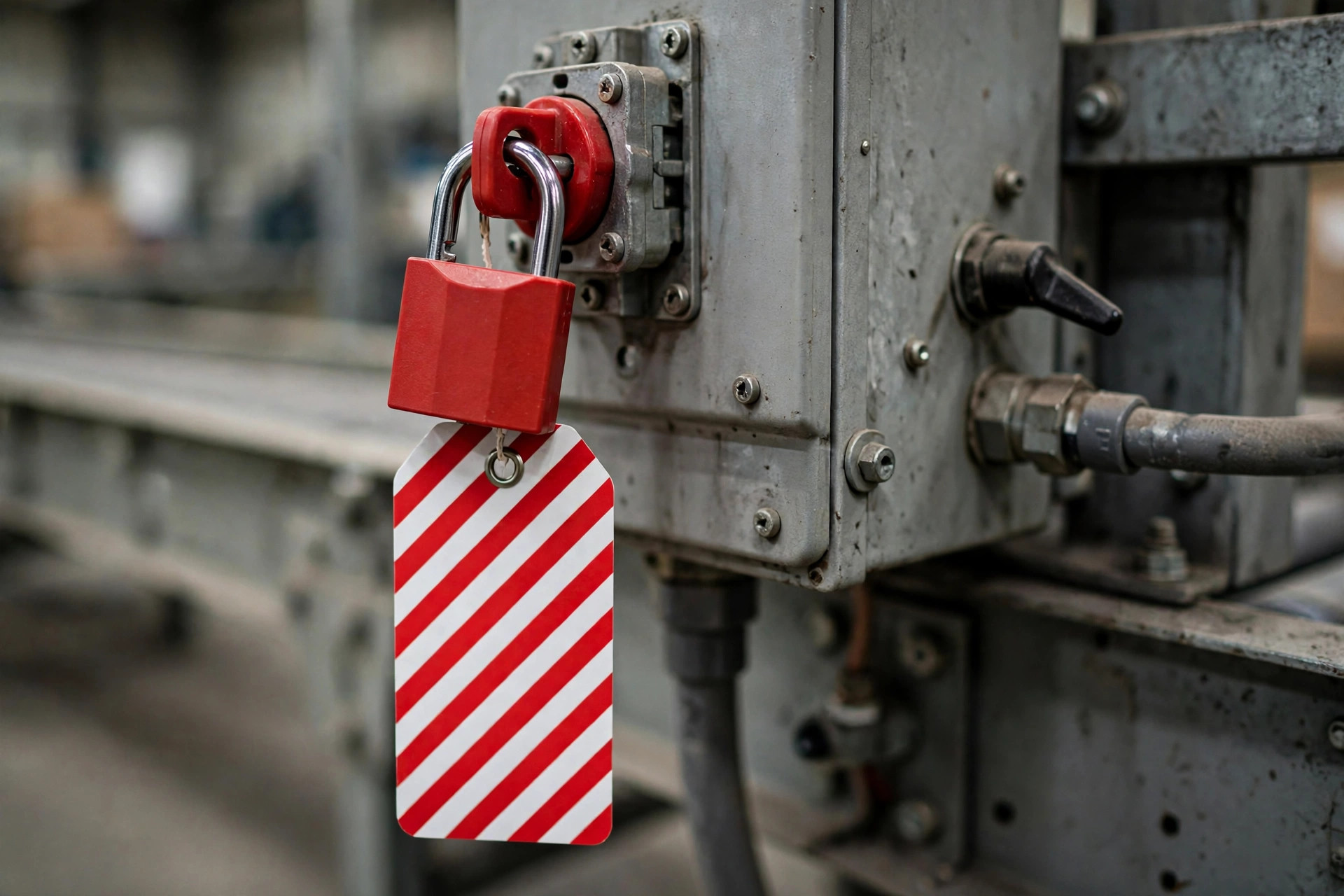
Second, one personal lock per person, one key. A compliant padlock costs $15–$25 — the highest-ROI line item in the entire budget. Shared locks are not locks. This is money you cannot afford to save, and there is no reason to.
Third, outsource the first annual review, then bring it in-house. 1910.147 requires the procedure to be reviewed at least annually. Hire an outside consultant to build the system and train your safety lead in year one; from year two, run the annual review internally and bring the consultant back every three years for a spot check. Audit fees drop by half, compliance does not.
A Calculable Conclusion
Here is the formula — plug in your own warehouse's numbers:
Let N be your powered devices, C your annual LOTO cost (about $12,000 for a mid-size site), and E the book cost of one incident (about $450,000 in the conservative model). The program pays for itself whenever your annual incident probability p exceeds C / E, roughly 2.7%.
And the reality check: lockout/tagout sits in OSHA's top-ten most-cited standards year after year, and conveyors and sorters are the most energy-dense equipment in the building. Your true p is higher than 2.7%, not lower.
So my conclusion carries no sentiment, only numbers: a LOTO program is not a cost center. It is a positive-expected-value hedge. At 45 to 1, skipping it is the expensive choice.
By Lao Zhou, Logistics Cost Analyst