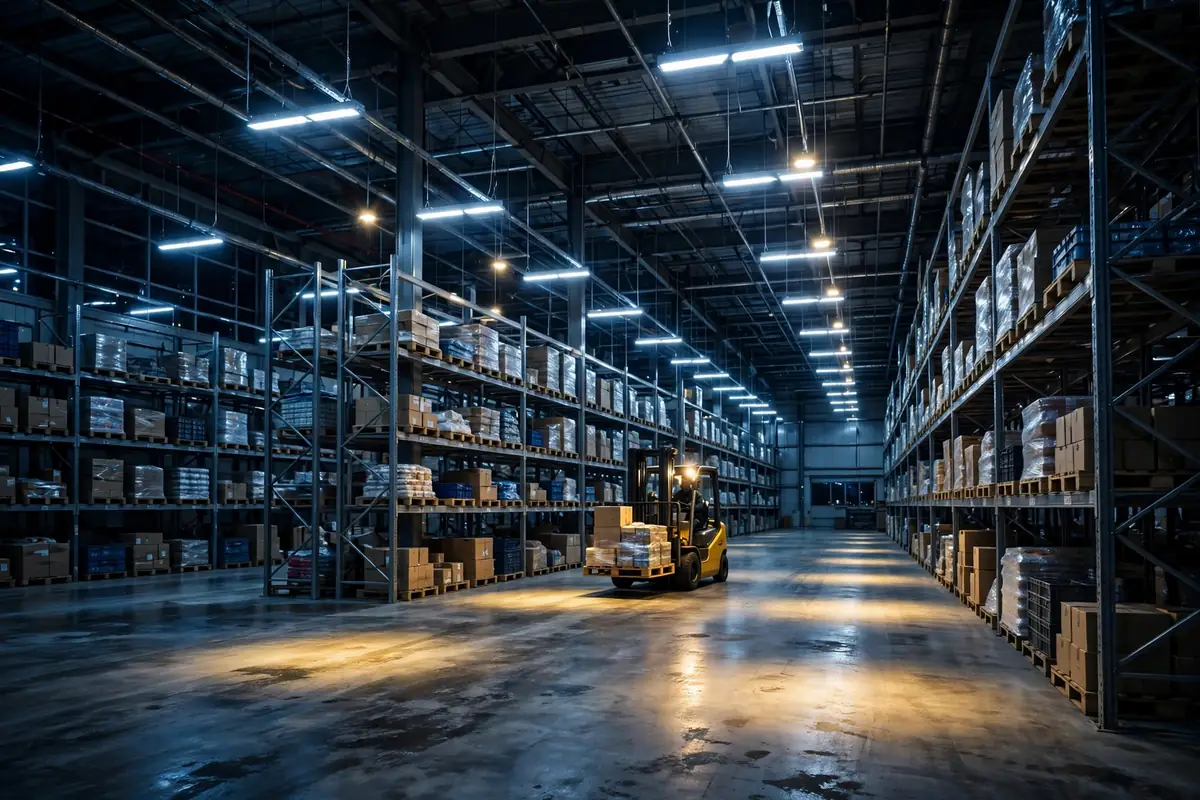
Verdict first: a warehouse lighting upgrade earns half its savings from the lamps and half from zoning and sensors. Swap lamps alone and you bank maybe half the promised savings. Get the lamps, the zones, and the sensors right, and the savings cover the extra labor of a phased install. I have watched the same failure three times: an owner approves the swap, the crew replaces fixtures one for one, and the next power bill saves only half of what the sales quote promised — while pickers complain they still cannot read labels in the aisles. New lamps, same problems.
Start a warehouse lighting upgrade with targets by zone, not one number
Light levels cannot be one number for the whole building. The U.S. occupational safety standard requires a minimum of 5 footcandles in warehouse areas — that is a floor, not a target. The lighting industry's recommended practice draws finer lines: inactive storage 5 to 10 footcandles, general warehousing 20 to 30 footcandles, picking and packing 30 to 50 footcandles. One footcandle equals about 10.76 lux. Measure with a light meter at the work plane; never trust the number printed on the fixture box.
| Zone | Target | Where to measure | | Inactive storage | 5–10 footcandles | Floor | | General warehousing | 20–30 footcandles | Floor plus rack faces | | Picking and packing | 30–50 footcandles | Workbench plus rack faces | | Dock and loading | 30–50 footcandles | Floor |
In November 2024, a 3PL in Ontario, California, running e-commerce fulfillment out of roughly 12,000 square meters with 9-meter racks and more than 40 pickers across two shifts, had exactly this problem. The floor measured bright enough, but labels on the middle rack levels were unreadable, so pickers carried flashlights and mispick complaints kept coming. The retrofit lifted picking zones to 35 footcandles, added dedicated light on the aisle rack faces, and left bulk storage near 10 footcandles. Within two weeks, mispick complaints had fallen by more than half, and the night-shift lead said the flashlights could finally stay in the drawer.
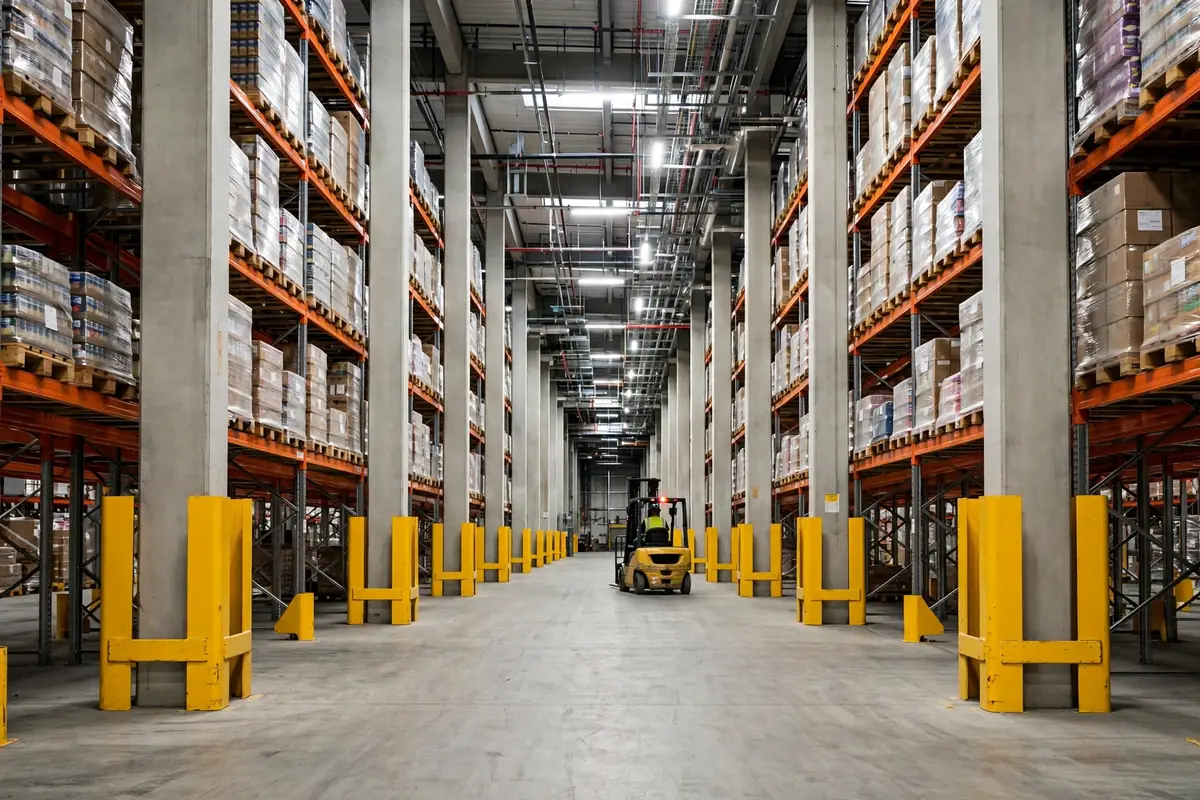
I have seen this pit three times: acceptance testing that measures only the floor while the rack faces sit in shadow. Test two places: the work plane about 1 meter off the floor, and the middle height of the rack face. If vertical light is short, barcodes will not scan, pickers squint upward, and speed and accuracy fall together. With the wrong beam distribution, no amount of brightness pushes light down a narrow aisle — and the install crew will not volunteer that fact.
A warehouse lighting upgrade lives or dies on three fixture numbers
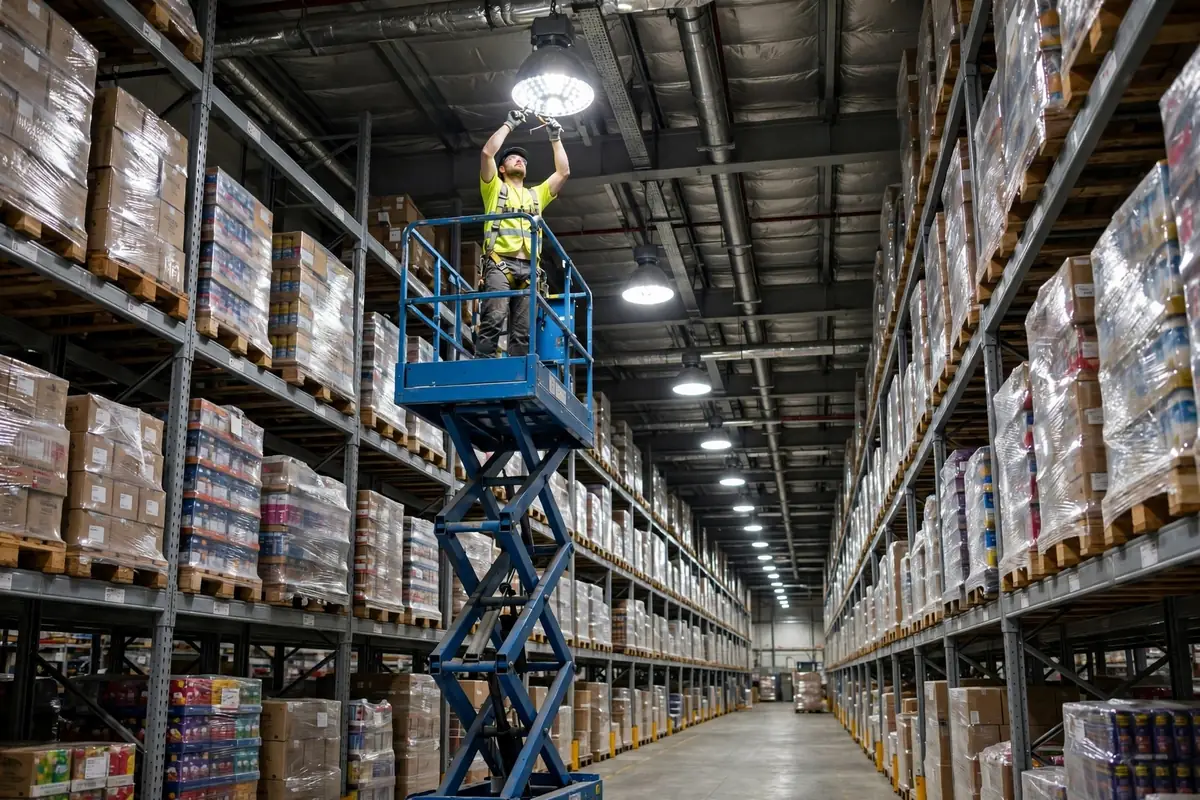
Judge a fixture on three numbers only: efficacy, distribution, and life. Everything else is a supporting actor. Efficacy is lumens per watt; good high-bay fixtures deliver 130 to 180 lumens per watt, while metal halide and high-pressure sodium manage roughly half that once ballast losses are counted. Published industry guidance shows a 400-watt metal halide replaced by a 150-watt LED, at equal brightness, cutting energy use by 60% to 75%. That figure is a public benchmark, not a sales promise, and it holds up in a business case. Distribution comes in two shapes: circular for open areas, and aisle optics for narrow aisles, pushing light down between two rack rows instead of wasting it on rack tops. Life is rated hours: LEDs are rated 50,000 to 100,000 hours, metal halide 10,000 to 15,000 hours before replacement — and the labor plus lift-truck cost of a lamp change often exceeds the lamp itself.
Run down this selection checklist before ordering: first, demand the photometric test report and check efficacy and the distribution curve; second, confirm color temperature between 4000 and 5000 Kelvin — too warm and labels blur, too cool and glare hurts; third, get the warranty in the contract, with fixture body and driver listed under separate terms; fourth, install two sample fixtures and measure for a week, floor and rack face both, before placing the bulk order. Skipping the sample saves a week and gambles several hundred fixtures.
Sensors are where a warehouse lighting upgrade actually pays
This sounds backwards, yet the meter readings back it up: brighter is not better. Over-lighting creates glare, and pickers read labels more slowly, not faster. The real savings come from dark aisles staying dark. Dim an unoccupied aisle to 20% to 30% and bring it to full brightness when someone enters; sensor controls typically add another 20% to 40% in energy savings on top of the lamp swap. Draw the zones along the traffic flow: high-frequency picking stays lit, low-frequency storage aisles dim on sensors, the dock switches on a shift timer, and the office corridor gets its own circuit. Do not set the delay too short — a forklift turning into a dark aisle has to brake hard — and do not set it too long, or lights burn for half an hour after everyone leaves. Ten to 15 minutes per aisle is a safe starting point; run a week, then tune against actual traffic counts.
In March 2025, an auto-parts warehouse in Dallas, Texas, ran 6 aisles by day and only 2 aisles at night, yet the old lights burned all night across the whole building. The retrofit grouped sensors by aisle, dimmed empty night aisles to 25% brightness, and put the dock on a shift timer. Night lighting energy fell by about 40% in the first month (illustrative example, estimated from that site's meter readings). I have seen this pit three times: sensors mounted on top of the racks, so every passing forklift triggers a whole row to flash. Mount sensors above the aisle entrance, aimed at the travel path, never at the rack face.
The payback math and the night-before checklist
Run the payback math yourself; never trust a recovery period quoted in a sales deck. The calculation is four lines: old total wattage minus new total wattage, times annual operating hours, gives annual kilowatt-hours saved; multiply by the power rate for annual savings; divide total project cost by annual savings for the payback period. The table below is an illustrative example, estimated for a 200-fixture warehouse at $0.12 per kilowatt-hour:
| Item | Before | After | | Watts per fixture | 400 W metal halide | 150 W LED | | Fixture count | 200 | 200 | | Annual operation | 300 days, 16 hours/day | 300 days, 16 hours/day | | Annual power cost | about $46,000 | about $17,000 | | Extra sensor savings | — | about 20% to 40% | | Payback period | — | about 20 months |
A warehouse lighting upgrade can proceed without stopping operations if the work is phased by zone: storage areas by day, picking zones at night, the dock on the weekend. Accept each zone the night it is finished; rework the next day if it fails, and never wait until the whole building is done before checking anything. Work through the night-before checklist and sign it off item by item: every fixture powered and tested, every sensor triggered one by one; floor and rack-face light levels re-measured at 10 sample points each; emergency lighting tested against the sensor system in a power-cut drill; old-fixture recycling paperwork complete; meter readings photographed and filed as the baseline for the payback math. When the checklist is done, the warehouse lighting upgrade is genuinely finished.
By Lin Xiao, WMS Implementation Consultant