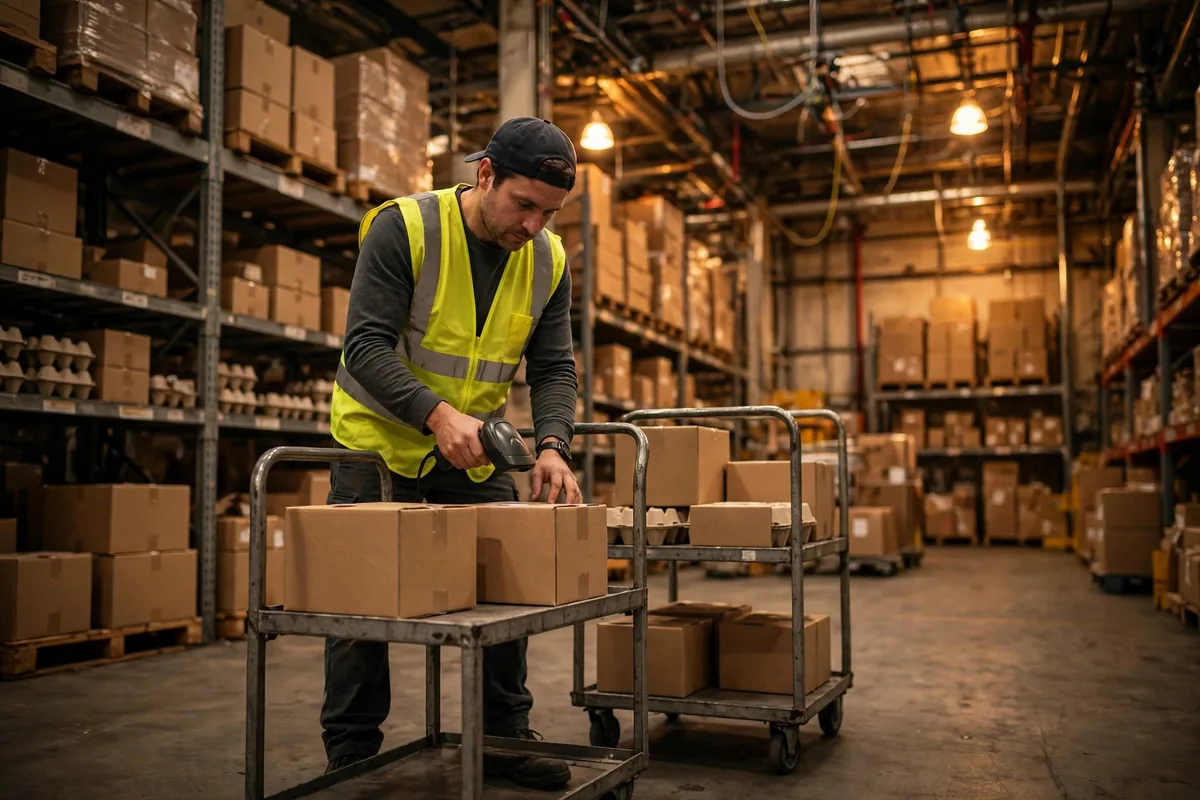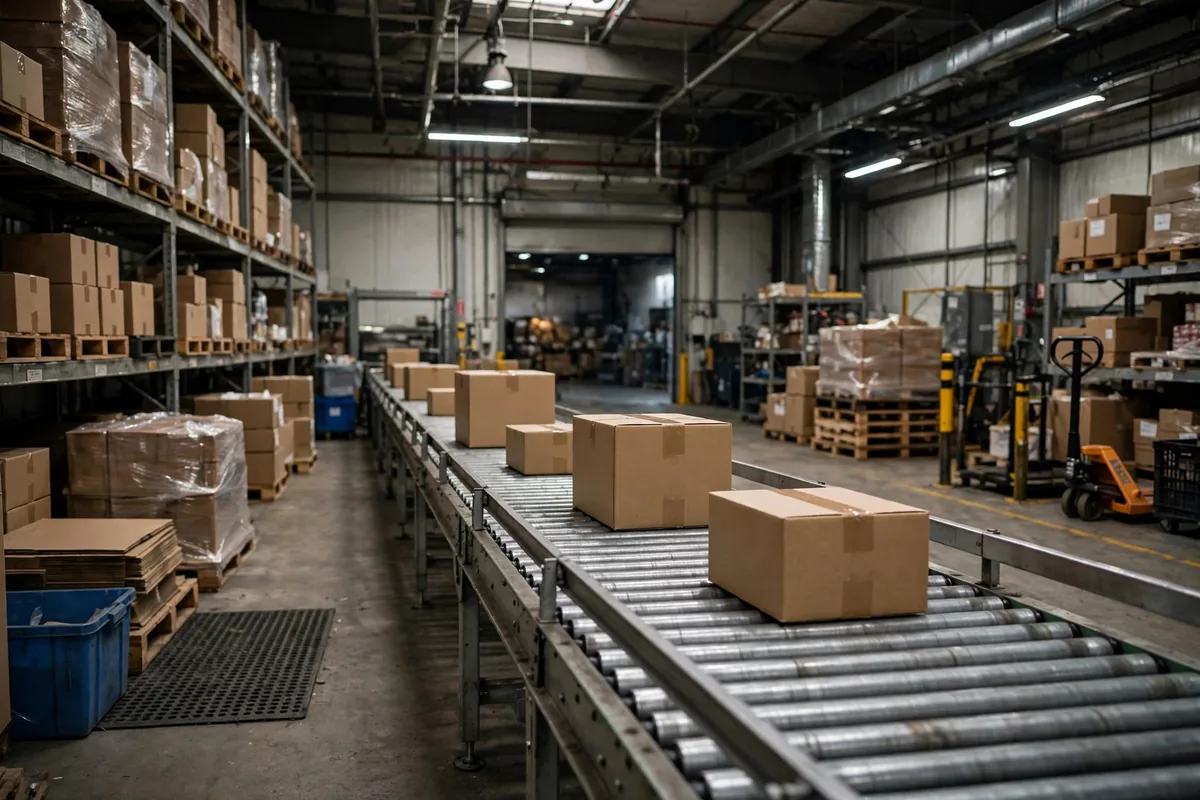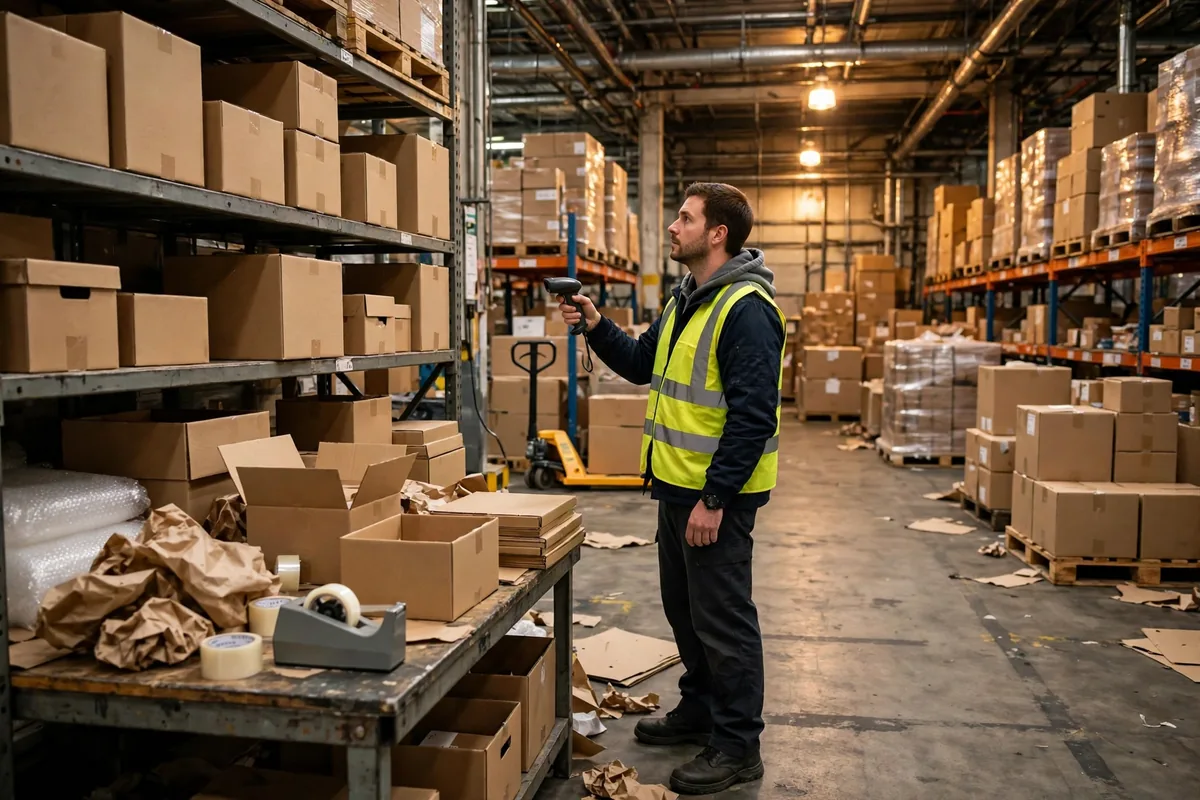
Two in the morning, and the conveyor is still running. Black Friday week — warehouse labor cost per order was staring me in the face: our warehouse outside Los Angeles was pushing 18,000 orders a day, and I needed to know how much labor one order eats up, from the shelf to the truck. Listen, nobody does this math in a normal week. In peak week, you do the math and all you find are holes.
Here is where our building starts. In May 2025, the US Bureau of Labor Statistics put median hourly pay at $22.06 for hand laborers and material movers, $21.49 for stock clerks and order fillers, and $23.16 for forklift operators. The industry-wide average hourly earnings reached about $26.74 by August 2026. But the hourly wage is only the starting price. Payroll taxes, health cover and workers' comp stack on top — and in warehousing, workers' comp runs higher than in office work, because the injury risk is real. The worked example below assumes a $22 hourly wage with a 30% burden, which works out to $28.60 per labor hour.
For market context, Amazon said in September 2025 that average pay for its US fulfillment and transportation workers would rise to more than $23 an hour, or over $30 an hour including total compensation. That is the floor the labor market is standing on now. If your budget still assumes $18-an-hour labor, your budget is living in the past.
Warehouse labor cost per order: where the minutes go
| Step | Minutes per order | Labor cost per order (USD) |
|---|---|---|
| Picking | 4 | 1.91 |
| Packing | 3 | 1.43 |
| Check and label | 1 | 0.48 |
| Supervision and support | 2 | 0.95 |
| Total | 10 | 4.77 |
That is how warehouse labor cost per order works out: $28.60 an hour, ten minutes of labor per order, $4.77. The two minutes for supervision are not made up — shift leads doing rosters, quality spot-checks, clearing problem orders. Nobody touches freight in those two minutes, but every order carries a share of them. Plenty of managers cost only picking and packing and skip the rest. Their per-order number comes out 20% low, they quote a low price, and at month end the whole thing is underwater.
Peak season: how warehouse labor cost per order blows up
Black Friday 2025, night shift, 120 people on the floor, conveyor running from 8 p.m. to 4 a.m. Temps come through an agency. They cost more per hour than our own people, and they work slower. Worked example: a temp's fully loaded cost at $37 an hour, taking 13 minutes per order instead of 10. That is 37 × 13 ÷ 60 = $8.02 per order, against $4.77 in a normal week — up by nearly 70%. An extra $3.25 an order, times 18,000 orders a day, is $58,500 a day. That money burns every single day of peak.
Overtime makes it worse, and it is the line nobody budgets properly. Overtime is time-and-a-half on the wage — $22 becomes $33 an hour, and with burden that is about $42.90 an hour. Twenty overtime hours a week per person at $42.90 instead of $28.60 is an extra $286 a week, per person. Across a 120-person night shift, that is $34,320 a week. You do not feel it on day one. You feel it when the payroll report lands in January.
What hurts more than any of this is the new hire. A veteran training a temp, first week on the floor, slow and error-prone. One wrong pick means a return, a re-pick, a re-ship and a customer service call — four rounds of labor for one order. The rework on a single bad order costs more in labor than a dozen good orders. Peak season is not scary because volume is high. It is scary because mistakes multiply. Volume makes you tired. Mistakes make you lose money.
Three things that actually bring the number down
First, touches. Every time another pair of hands touches an order, the cost goes up a notch. If pick, check and pack can go from three touches to two, do it. What we do now is check while we pick — the scanner verifies as the picker works, and a separate check station only handles high-value orders. That change alone cut a minute per order. One minute is $0.48 — and at 18,000 orders a day, one minute is worth $8,640 a day.
Second, slotting. In summer 2024 we moved our best sellers to the racks closest to the pack benches. Pickers stopped walking pointless miles all day, and average pick time dropped from over four minutes to under four. Moving stock costs nothing but an afternoon. Walking is the silent killer in picking — in most manual picks, more than half the minutes go to walking between locations, not handling product. Shorten the walk and the minutes fall on their own.
Third, hiring rhythm. Do not wait for the surge to hire. Bring temps in two weeks early, pair them with veterans, and put the training weeks in the quiet period. Temps are not the problem — temps with zero training on day one are. A trained temp works close to a regular's pace. An untrained one is slow and wrong, and every hour you saved on hiring gets paid back in rework.
Next time someone quotes you $2 of labor per order, ask three questions: does it include supervision? Does it include rework on bad orders? Is that a peak number or a normal-week number? Three questions and the quote falls apart. Once you know your warehouse labor cost per order for real, pricing, rostering and hiring all get easier — because you are working from the true number, not the hopeful one. Run the math on your own building tonight: ten minutes, your loaded rate, your volume. See what number comes back.
If you take one habit from this piece, make it a weekly review of warehouse labor cost per order, split by pick, pack, and rework. A single blended number hides where the money actually goes, and a trend line tells you whether a bad week was a fluke or the start of a slide. When the pack line creeps up three weeks in a row, walk the line before you approve overtime. When rework spikes after a new SKU launch, the problem is usually the pick face or the label, not the people. Small warehouses cannot afford a full industrial engineering team, but a supervisor with a stopwatch and a spreadsheet can find most of the waste in a month. Track the number, talk about it in the morning huddle, and let the crew see it move. The moment the crew owns the number, the number starts to improve. By Chen Feng, Warehouse Operations Manager