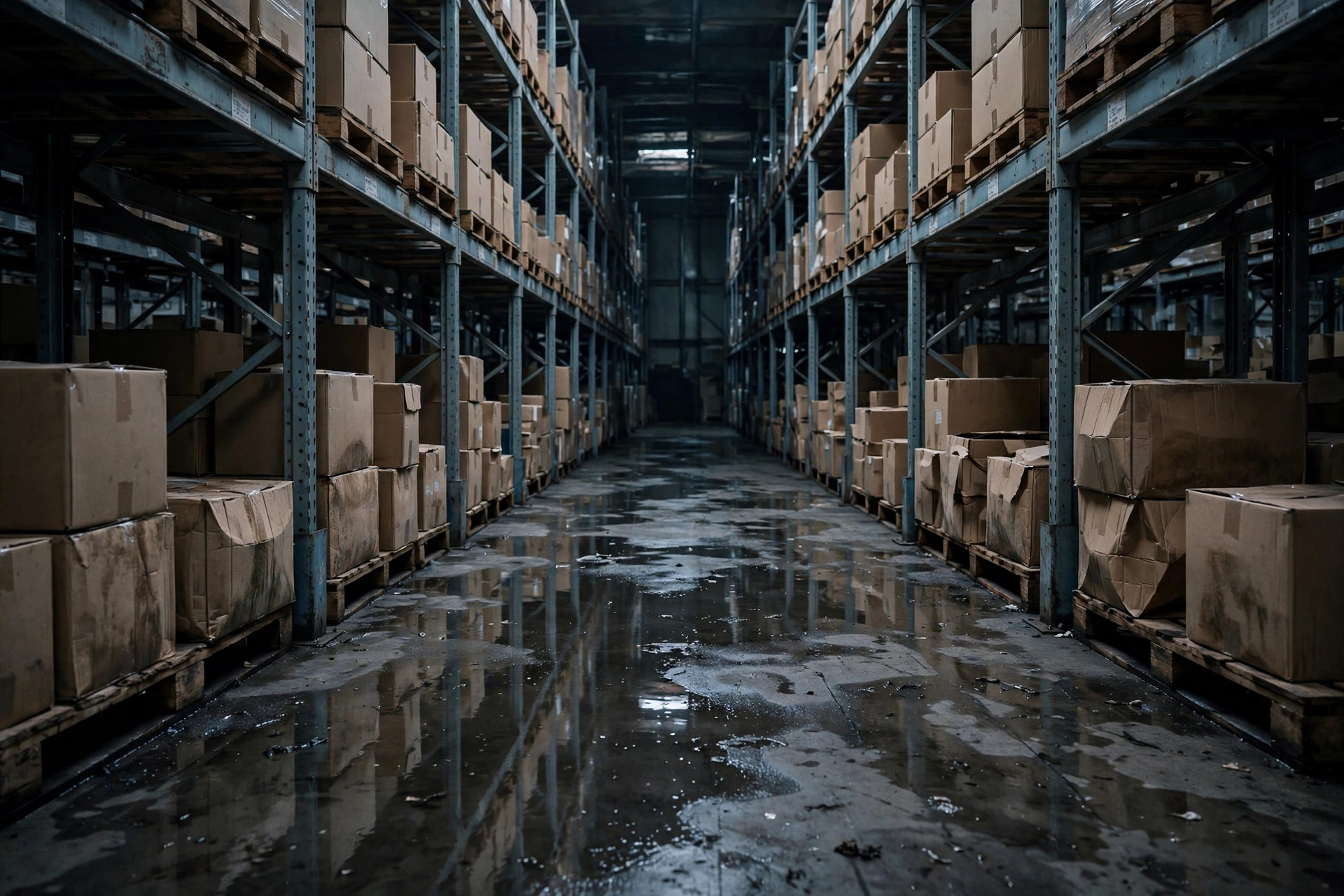
We had a client in Fontana — 120,000 square feet, a 1980s-vintage building — who learned about insurance exclusions the expensive way. During the rainy season last year, a clogged roof drain let water seep through a seam for three straight weeks before anyone noticed. Two pallets of a customer's goods underneath: cartons soaked through, forty-some thousand dollars of inventory ruined.
The client's first instinct was to file a claim. He had a commercial property policy, premiums paid on time every year, felt perfectly covered. The adjuster walked the site, went back to the office, flipped through the policy, and came back with one word: denied. The reason sat in the exclusions section in plain English — gradual damage. A slow leak that develops over weeks is excluded. If a windstorm had ripped the roof off that day and water had poured in all at once, that's a sudden accident, covered. But three weeks of quiet seeping? That's deferred maintenance. Not covered.
The client was furious: "Then what have I been paying for all these years?" I get it — when you're the client, it feels like a betrayal. But here's an insider truth from the 3PL side of the table: the coverage pages of a policy are written for you to read; the exclusions pages are the ones the carrier actually plans to use. After a loss, an adjuster's first job isn't to assess your damage — it's to comb the exclusions for a reason to deny. That's not a conspiracy theory. That's standard operating procedure.
So today we're skipping the usual "how much coverage should I buy" talk and going somewhere more useful: the five most common exclusions in US warehouse policies. Ten minutes with this now beats a six-figure lesson later.
What Insurance Exclusions Look Like: Five "Not Covered" Cards
Here's the short version — the five exclusions I've seen cause the most claims and the most arguments over the years. Each one comes with a fix, because knowing you're not covered is useless unless you know where to plug the hole.
| Exclusion | How it reads in the policy | What the loss looks like | How to close the gap |
|---|---|---|---|
| Flood | Flood excluded | Heavy rain, low-lying water intrusion, river overflow | Buy standalone flood insurance (federal NFIP or private flood) |
| Earthquake / earth movement | Earth movement excluded | Quakes, mudslides, sinkholes | Buy an earthquake endorsement — negotiate it separately in California |
| Mold | Mold excluded, or capped at a low sublimit | Heat, humidity, mold after an HVAC failure | Negotiate a mold buyback, or build temperature/humidity control into your SOP |
| Gradual damage / wear and tear | Gradual damage, wear and tear excluded | Slow roof leaks, dripping pipes, aging equipment failure | Only sudden accidents are covered; protect yourself with inspections and maintenance logs |
| Employee theft | Employee dishonesty excluded | Internal theft, pilferage | Buy a standalone fidelity bond or commercial crime policy |
War and nuclear incidents are also excluded, but those fall in the "written in, and you can't buy your way out anyway" category. Accept and move on.
Here's the counterintuitive takeaway: the most expensive part of your policy isn't the premium — it's the coverage you thought you had but don't. Premiums buy peace of mind every year; the exclusions quietly carve out the exact scenarios you're most afraid of. That gap is the real price tag.

The Two Most Painful Ways to Lose: Flood, and the Slow Leak
Why single out these two? Because they're where I've watched clients get burned most often — and the burns feel the most unfair.
Flood first. During California's atmospheric river storms a couple of years back, a client in San Bernardino had a low-lying facility take on a few inches of water. Forklift batteries submerged, bottom-layer cartons destroyed. He asked me, "Susan, our property coverage is pretty solid — we should be fine, right?" My stomach dropped. Standard US commercial property policies exclude flood by default. Flood coverage is a separate purchase — the federal flood program (NFIP) or private flood insurance — and it is not inside your property policy. When the broker had asked "want to add flood?" at signing, the client figured "we're not next to a river" and skipped it. Then came an unusually wet year, and the low-lying buildings got hit first. The client ate the loss himself.
Here's a piece of broker-side reality I'll share freely: brokers earn commission on premium. Flood and earthquake endorsements have to be sold as add-ons, and when a client hears "that costs extra," eight out of ten say no. So plenty of brokers breeze through the exclusions page — "these are all standard terms" — and move on. If you don't push, they don't explain. It's not malice; the incentive structure just doesn't reward thoroughness.
Then there's the slow leak — the Fontana client's cause of death. This one stings because the same water is covered or not depending on speed. A sudden deluge: covered. A three-week seep: excluded. The carrier's logic is that sudden accidents are beyond your control, while gradual deterioration means your maintenance fell short. Sounds reasonable in theory, but the line is brutally blurry in practice — is a three-day leak sudden or gradual? When the adjuster says gradual, good luck arguing.
A Houston client had it even worse in the summer a couple of years ago. A shipment of apparel sat in the warehouse while a rooftop HVAC unit died unnoticed for four days. Humidity spiked, and the cartons came out smelling of mildew. The claim revealed a mold sublimit so low it barely dented the loss. The client's take: "If I'd known, I'd have spent that premium money on humidity alarms instead." Crude, but fair — some risks are better managed than insured. Mold is routinely excluded or tightly capped; the real fix is monitoring and inspection routines, not hoping someone pays you after the fact.
Treat the Exclusions Page Like a Contract Negotiation
If you're leasing warehouse space, renewing a policy, or negotiating with a 3PL, here is my negotiation advice. Remember: buying insurance works like signing a warehouse contract — terms are negotiated, not handed down on stone tablets.
First, when the policy lands on your desk, skip the coverage pages and read the exclusions first. Go through them line by line with a pen, and circle every exclusion that matches your actual risk. In California, circle the earthquake clause. In Houston, circle mold and flood. In a thirty-year-old building, read the gradual-damage language twice. Then ask your broker: for our address, our building age — how does this clause actually apply?
Second, get separate quotes for flood, earthquake, and mold. Don't ask "should I add it" — ask "how much, what does it cover, what doesn't it." The first phrasing sounds like an upsell, and clients reflexively refuse. The second turns it into a normal procurement comparison, and the whole dynamic changes. Rates move every year, so work off current official quotes — never trust a verbal "ballpark" from anyone, including me.
Third — and this is where 3PL relationships blow up most — whose policy covers the customer's goods sitting in your building? Your property policy covers your building and your equipment. The inventory usually rides on the cargo owner's own freight or warehouse policy. But plenty of small shippers carry nothing, or carry too little. After a loss, two carriers point fingers at each other while you're stuck in the middle. So write it into the warehouse contract: which policy responds to inventory loss, who eats the deductible, who owes whom cooperation during the claim. Don't wait until after the loss to read that paragraph.
One honest closing thought. Your broker is your vendor, and your 3PL is your client's vendor — vendors are wired to keep terms simple, because simple closes deals. But you're the client, and a client's edge shows up before signing. Three extra questions on the exclusions page now saves three months of arguing later.
Next time you negotiate a contract or renew a policy, ask these three: which exclusions actually match our real-world risk? For flood, earthquake, and mold — do we add coverage at this address, and at what price? And when a customer's goods are damaged, whose policy responds?
Ask those three, and you'll understand your policy better than 80% of warehouse operators out there.
By Susan, 3PL Sales Director