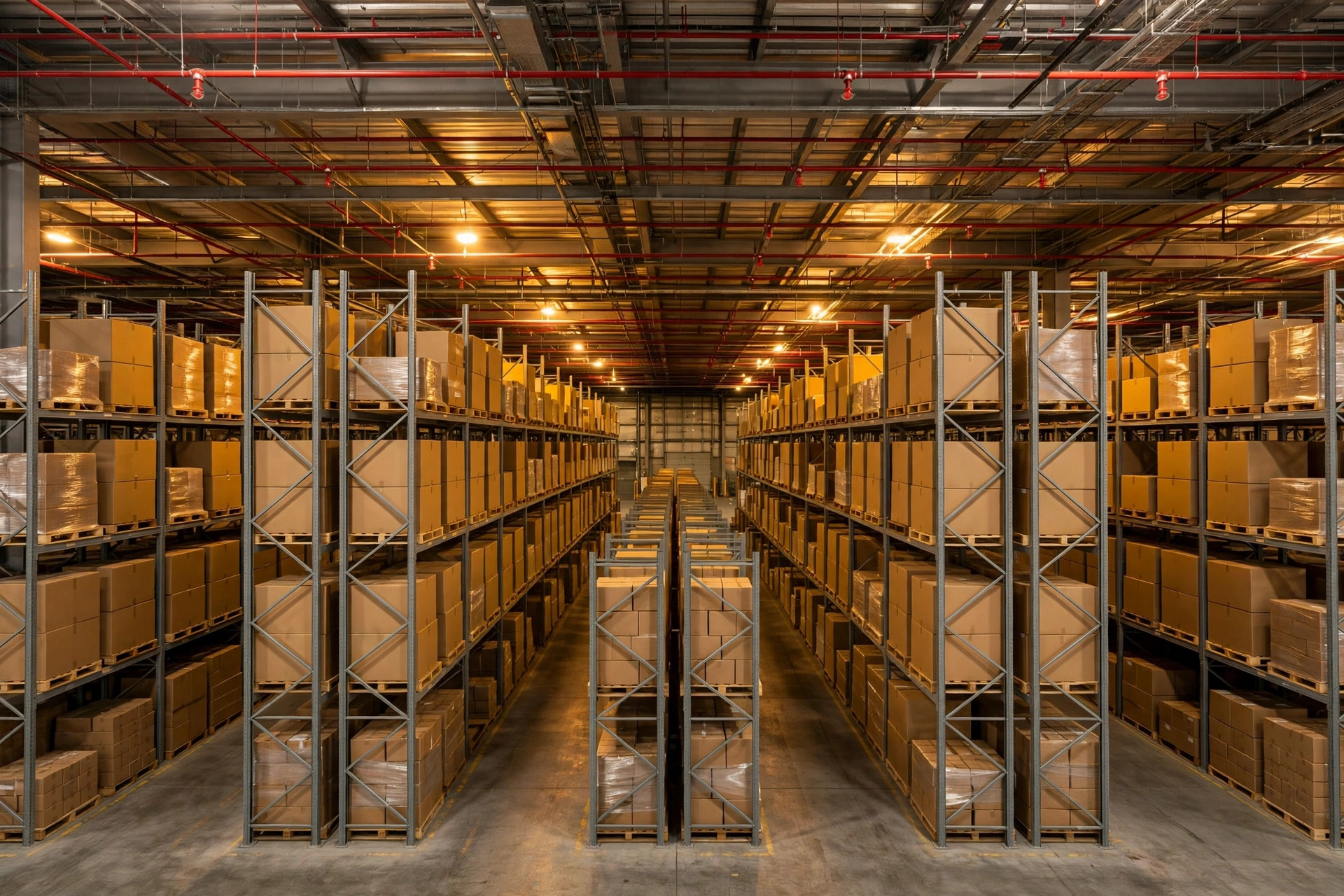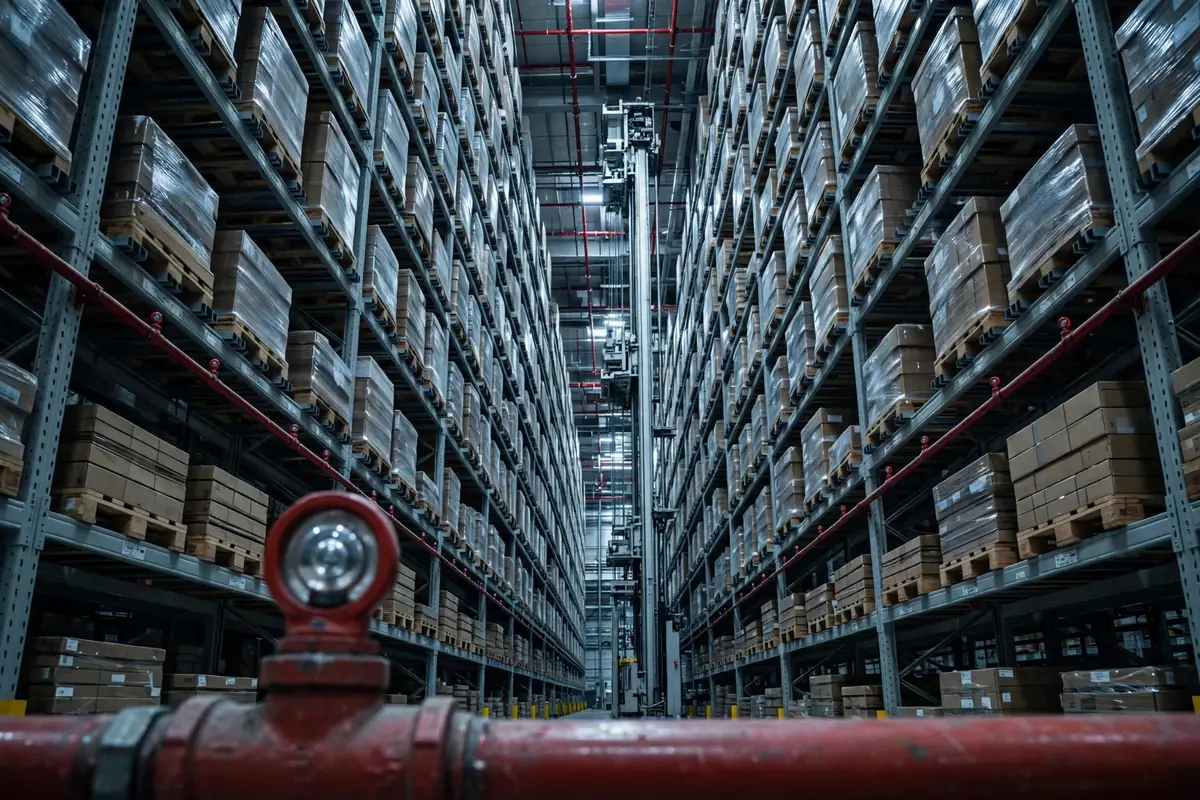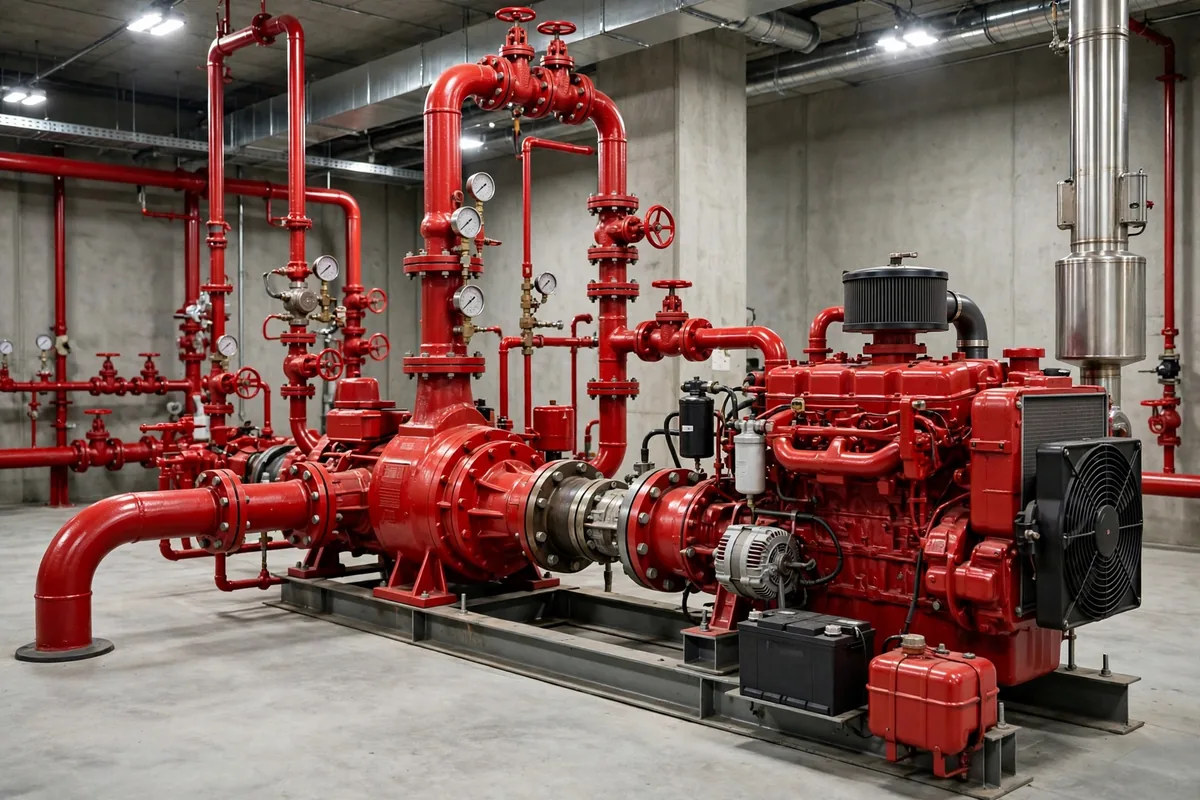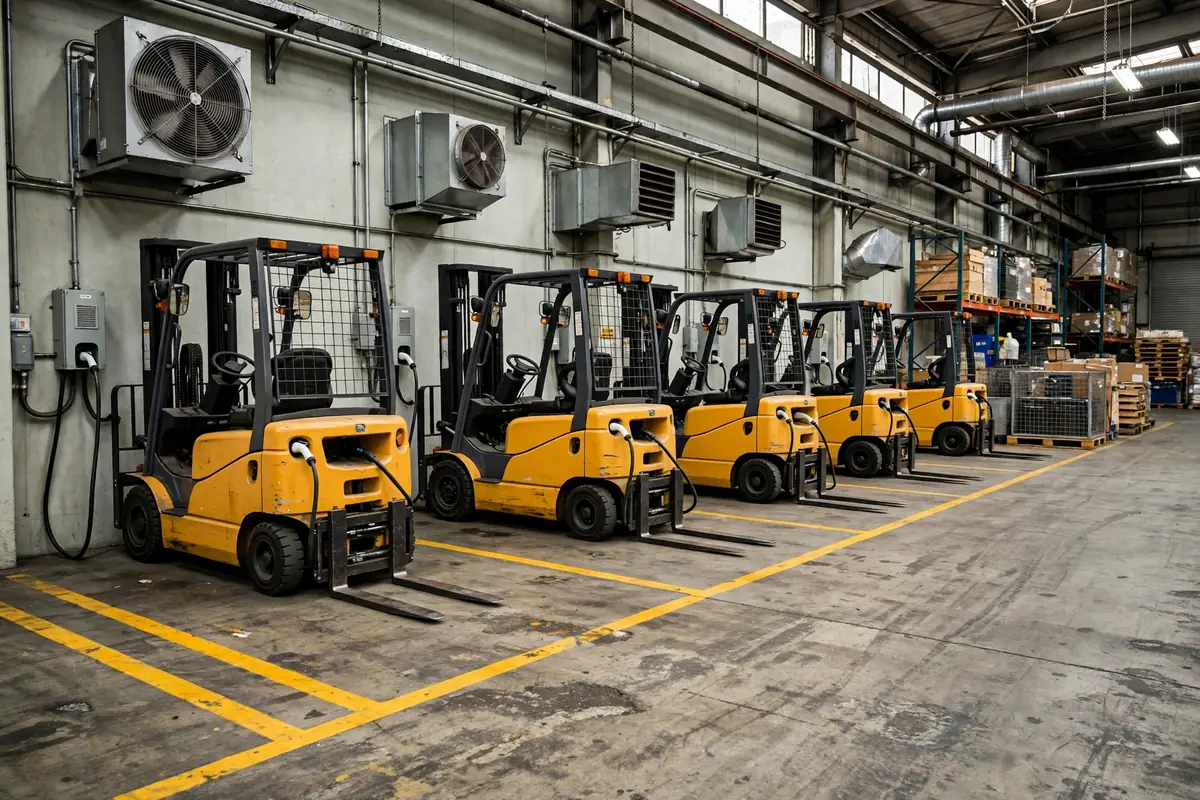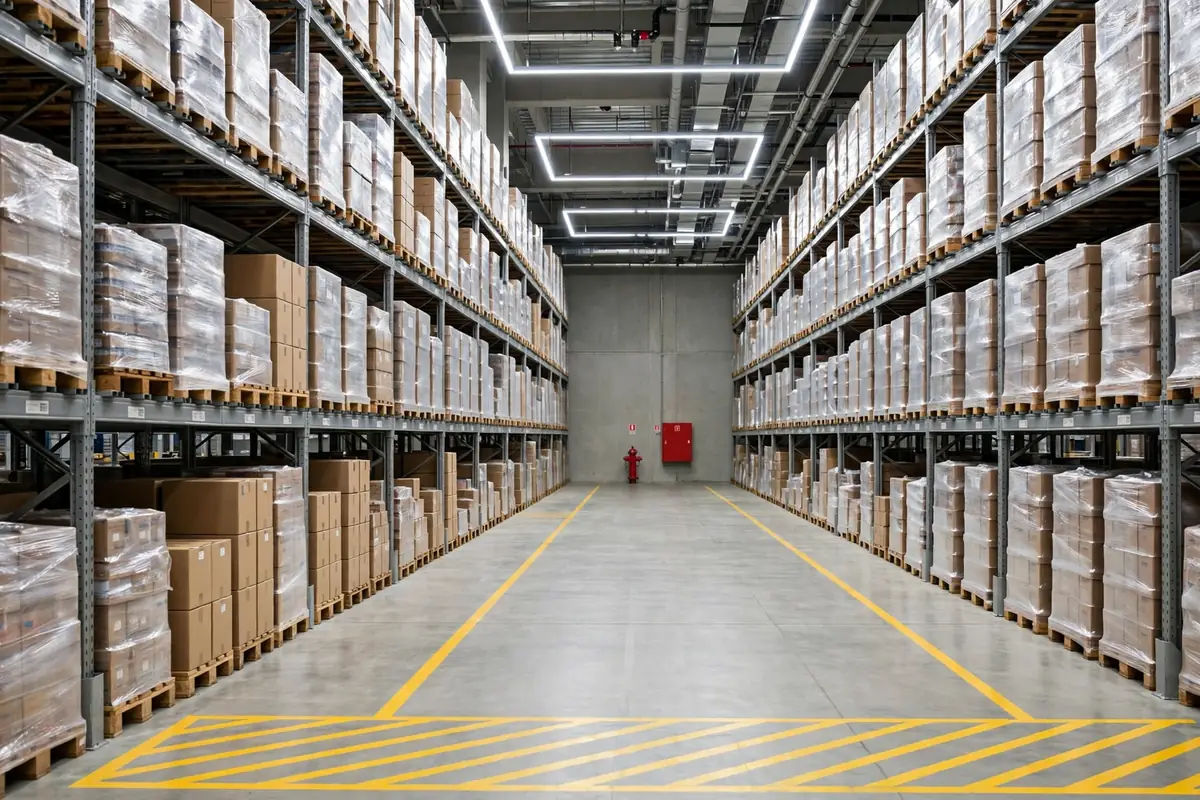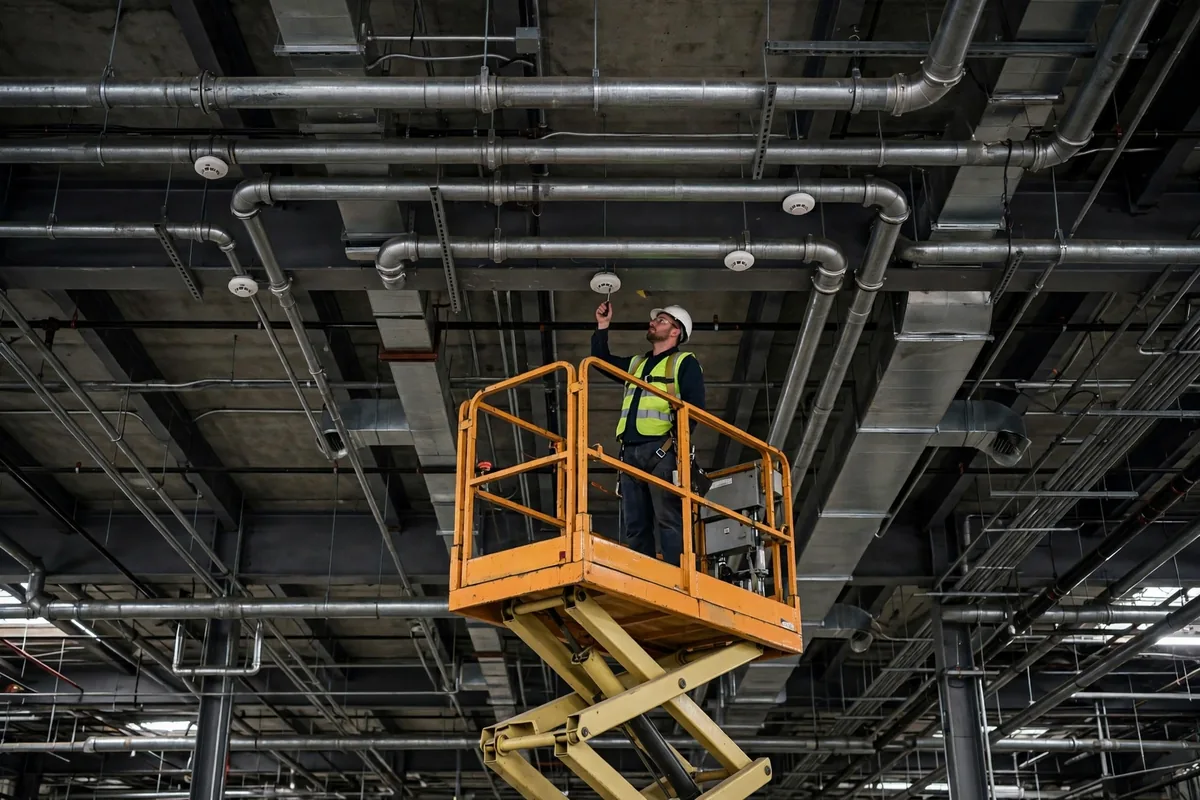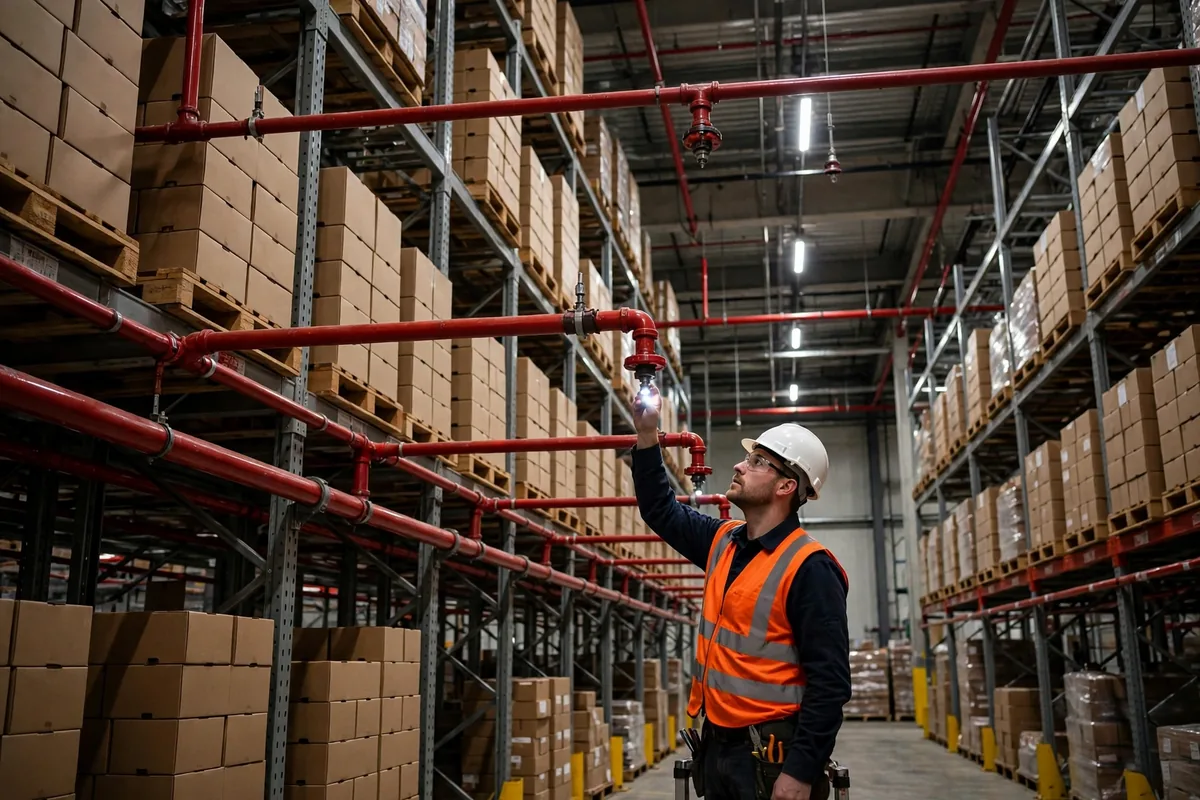
Here is the bill first: the warehouse in-rack sprinkler quote for a 100,000-square-foot high-bay warehouse just landed, another six figures on top of the ceiling system. The owner's first reaction is that somebody is padding the quote. I ran the numbers and told him the opposite. Skip the in-rack system and the money already spent on the ceiling system is the wasted part. A fire inside the rack never sees a drop from the ceiling. You paid to protect the roof, not the goods.
I worked on a 3PL warehouse in Ontario, California last year, 12-meter racking holding paper goods and household products. Standard ceiling sprinklers, passed inspection, insurance in place. In the fall of 2024 the product mix changed and the cartons started arriving with expanded plastic inserts. That changed the commodity classification, the engineer re-ran the design, and the existing ceiling system no longer protected the storage. Two options: upgrade the ceiling to ESFR or add the in-rack option. ESFR meant new heads, higher pressure, and a bigger water supply, and the quote came in higher than the in-rack option. They went in-rack, the install took three months, and the insurer dropped the rate a notch afterward.
Why Ceiling Water Never Reaches a Rack Fire — and In-Rack Sprinklers Do
The physics is simple. A fire burns deep inside the rack while ceiling water falls from 13 meters up and gets blocked by layer after layer of cartons. NFPA 13 (2025 edition) puts storage protection in Chapters 20 through 25, with the rules for warehouse in-rack sprinkler protection in Chapter 25 on their own. The standard assumes, in so many words, that ceiling-only protection is not the default for high-bay storage. Transverse flue spaces are set at a nominal 6 inches, and double-row racks stored above 25 feet need a nominal 6-inch longitudinal flue. Those dimensions are not decoration. They are the channels water travels down and hot gases travel up. Block the flues with product and the system might as well not exist.
That does not make ceiling sprinklers useless. Under NFPA 13 Table 23.3.1, ceiling-only ESFR covers ceilings up to 13.7 meters and storage up to 12.2 meters, with at least 36 inches of clearance between the deflector and the top of storage. The catch is the conditions: clean rack geometry, the right commodity class, no solid shelves in the way. Taller racks, mixed commodities, solid shelving, and ESFR's working envelope shrinks fast. The counterintuitive part is that the most expensive ceiling system is not the best-protected warehouse. ESFR money goes into the ceiling while the fire sits in the belly of the rack. The in-rack option is cheap because it sits next to the fire, and expensive because it also sits next to the forklifts.
What a Warehouse In-Rack Sprinkler System Actually Costs
The table below is a hypothetical example for a 100,000-square-foot warehouse with 12-meter racking, meant only to show the cost structure. Real pricing depends on your fire protection engineer's design and your local authority having jurisdiction.
| Option | Upfront cost | Annual upkeep | The risk |
|---|---|---|---|
| Standard ceiling sprinklers only | Already spent | Low | A change in height or commodity can leave you non-compliant, and the insurer may deny a claim |
| Ceiling upgraded to ESFR | High: heads, pressure, and water supply all change | Medium | Narrow application limits; a new product mix can force another redesign |
| Add in-rack sprinklers | Medium: piping, heads, and zone valves | Medium to high; forklift strikes on pipe are routine | Pipe lives inside the rack, so impact damage, leaks, and accidental discharge all cost money |
That bill splits three ways. Start with the pipe and heads, the big piece, priced by the number of levels. NFPA 13 allows at most 10 feet of storage above the top in-rack level for Class I through IV commodities in single- and double-row racks, with levels typically spaced 10 to 15 feet apart vertically. More levels, more pipe. Second, zoning and valves. In-rack sprinklers need to be isolated and serviced level by level, or one repair shuts down the whole warehouse's protection. Third, long-term maintenance, the piece everyone underestimates.
I know a warehouse that installed them and, within three years, had forklifts bend pipe in six places. Two pallets of goods got soaked, and repairs plus damaged stock added up to nearly a third of the original installation cost over those three years. The leverage for saving money is not in squeezing the installation quote. It is in three decisions: route risers and laterals where forklifts cannot reach them and put column guards at the base of the uprights; use larger-orifice heads at fewer points, since traditional small-orifice heads run 22 to 30 gallons per minute and need dense spacing while larger heads can discharge 60 gallons per minute from fewer locations; and write the 6-inch transverse flue into your slotting rules, with whoever blocks a flue owning the problem, because a blocked flue is a blocked path for water.
There is one more line item people miss: insurance. That Ontario warehouse I mentioned got its premium re-rated after the in-rack install, and the annual savings, spread over ten years, covered close to half the installation cost. Run it the other way and the math is brutal. A fire in a warehouse whose ceiling system was never adequate for its storage, and the insurer will quote NFPA 13 back at you and ask why the in-rack protection was never installed. The loss is not six figures. It is the building.
When You Must Install Them, and When You Can Skip Them
Three checks, and you can run them before the engineer arrives. Start with storage height. Anything stored above 12 feet is high-piled storage, and the higher it goes, the more you should doubt the ceiling system. Second, commodity class. Paper, wood, and plastics mixed together push the classification up, and Group A plastics deserve particular attention. Third, rack configuration. Solid shelves, deep-lane racks, and the odd corners a ceiling system cannot see all break the coverage logic from the start.
If any one of those three is a yes, stop betting that the ceiling system has always been enough. The standard revises every three years. The 2022 edition of NFPA 13 already tightened deep-lane storage: depths over 20 feet now need 6-inch flues on all four sides of every pallet load or in-rack sprinklers, and the 2028 edition is under discussion with stricter language on the table. A design that is compliant today can stop being compliant after one product change or one added storage level. Fire compliance is not a one-time inspection. It moves with your commodities and your racking.
My conclusion can be calculated: racks above 12 meters, commodities including plastics or paper goods, and a standard ceiling system rather than ESFR. Hit two of those three and that money is money well spent. Before spending it, get the engineer to design around your actual commodity class and rack layout, not the warehouse next door's. Your neighbor stores hardware, you store cartons, and copying their design means copying the wrong bill. After the install, put flue checks and pipe protection into the daily walk-through. The biggest enemy of the system is not fire. It is forklifts and product blocking the flues.
By Lao Zhou, Logistics Cost Analyst