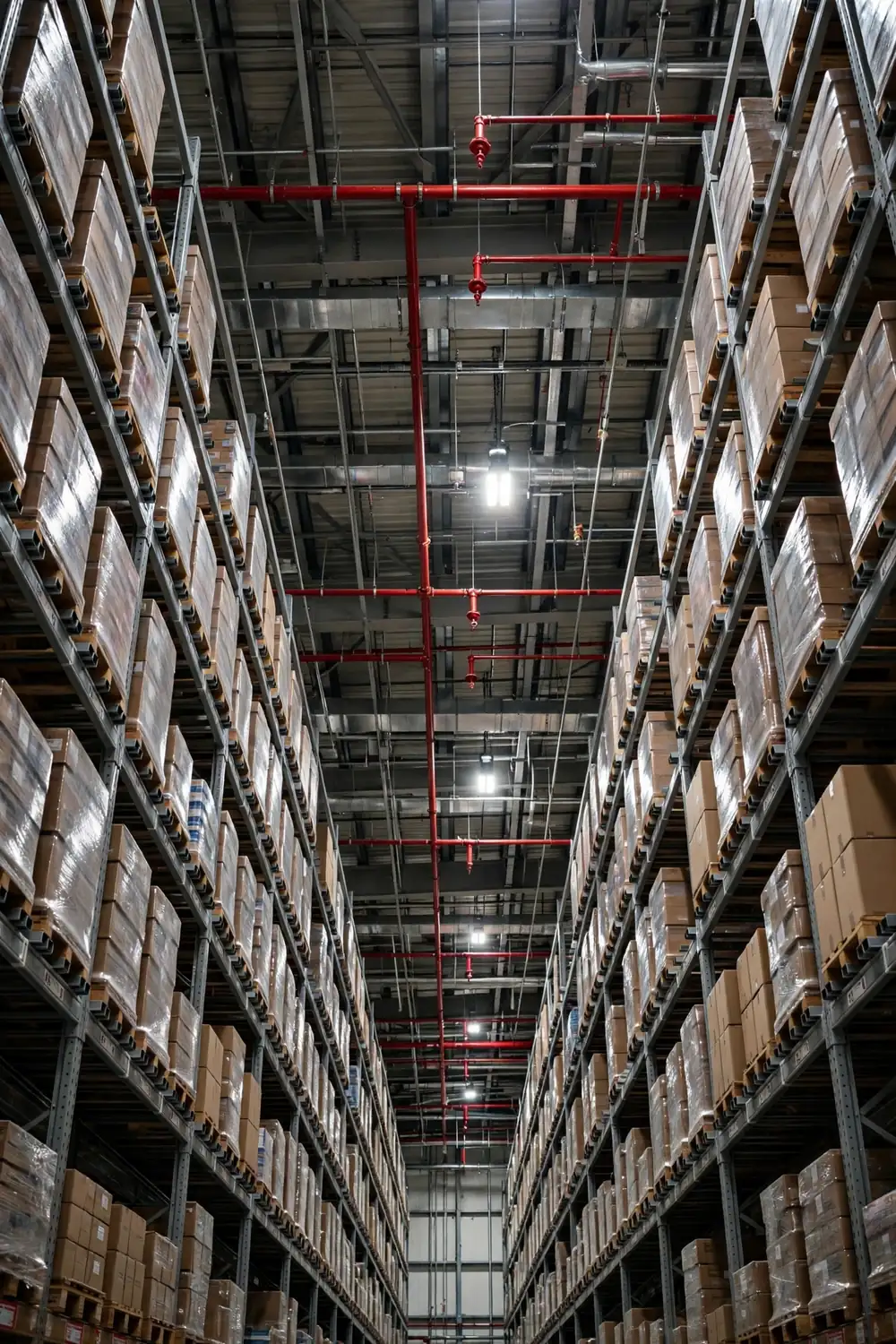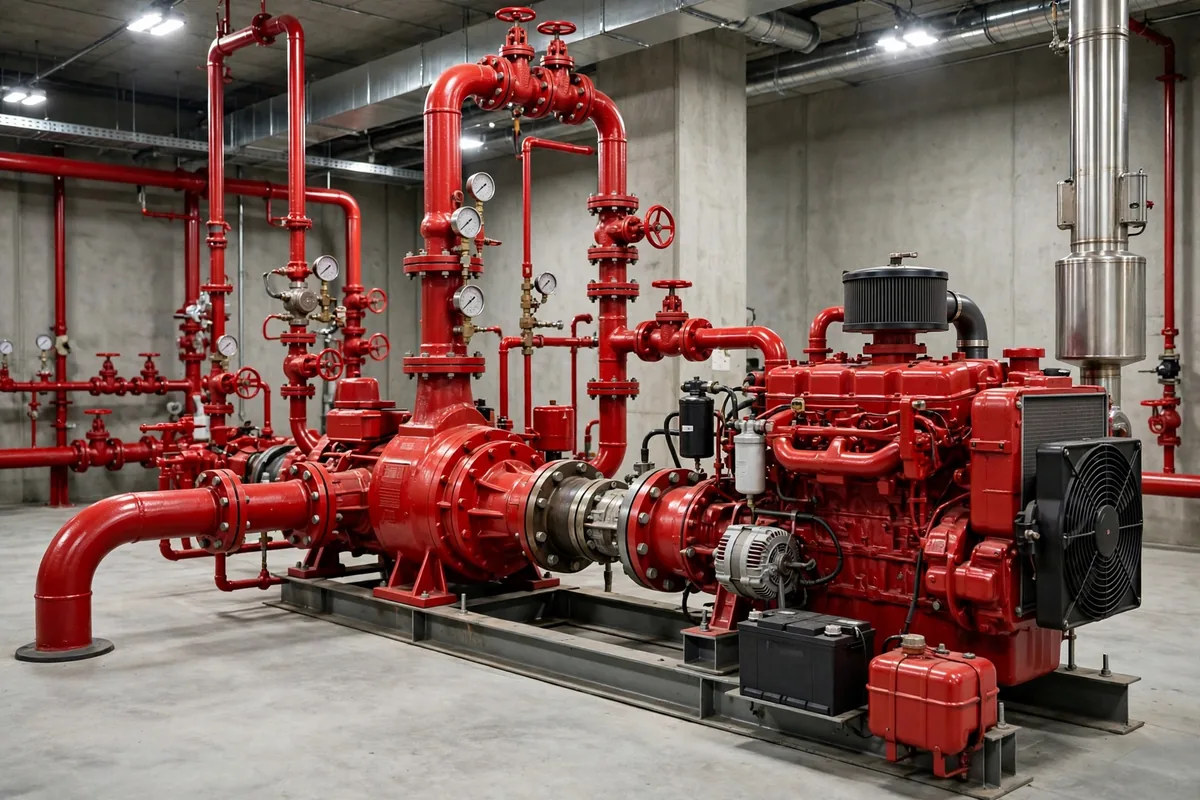
In August 2024, I walked into a 30,000-square-foot 3PL warehouse in Ontario, California, and the warehouse manager led me to the pump room door. He pointed at the big red fire pump and said it had been installed for nine years and had only really spun up once — on acceptance day. I laughed. A fire pump is the quietest piece of equipment in a warehouse on a normal day, and the one piece that cannot fail on the worst day. The pump room bill comes in three parts: spend the money right once at selection, never let routine maintenance lapse, and don't stumble on the annual flow test. The third part is the one people underestimate most.
Size the Fire Pump by the Hydraulics First, Then Look at the Machine
Selecting a pump is not about who makes the biggest unit or the best-known brand. It starts with the hydraulics: how much flow and how much head does the most remote point in the warehouse need? Sprinkler design flow, riser height, friction loss through the piping — add the three together and you get the rated duty point of the pump. Think of it as sizing an engine for the building: an undersized engine never gets the car moving, and an overstated one looks fine until the day it matters.
NFPA 20 draws three hard lines on the performance curve of a centrifugal fire pump, and acceptance testing and the annual test both check against them: shutoff (zero-flow) pressure must not exceed 140% of rated pressure; at rated flow the pump must deliver its rated pressure; and at 150% of rated flow, pressure must stay at or above 65% of rated pressure. Those three points are the pump's medical report. Miss any one of them and the pump room is on duty while sick.
The most common sizing mistake I have seen is treating municipal water pressure as pump head. In 2023, an e-commerce warehouse of 25,000 square feet in Houston, Texas, sized its pump straight off the 60 psi static pressure of the city main. The fire protection design review caught it: the most remote sprinkler head needed 85 psi. Rework meant a new pump, re-piped runs, and a fresh round of approvals — six extra weeks and a bill that could have been avoided entirely. There is no "close enough" in pump sizing. A 5 psi error on the hydraulics shows up on the test curve every time.
Electric or Diesel? The Line Is Drawn at the Blackout
When the choice is electric versus diesel, don't start with price. Start with one question: what happens when the warehouse loses power? A site with reliable utility power, dual feeds, or a backup generator behind it can run an electric pump — simple construction, easy maintenance. Cut the power, though, and an electric pump is a pile of iron. A diesel pump carries its own engine, so it starts when the grid goes down. The price is a higher purchase cost, more floor space, and roughly double the maintenance list: fuel tank, battery bank, coolant, oil, block heater. Any one of those neglected and the diesel engine may not crank.
Think of it as two brake systems on one truck. The electric pump is the service brake — the one you use every day. The diesel pump is the parking brake. Its whole purpose is the one day the service brake fails. In the winter of 2022, a cold storage warehouse in North Carolina lost power for 11 hours in an ice storm. The electric main pump sat dead, and the diesel backup started automatically and kept the sprinkler system supplied with water the whole time. After that night, the site doubled its pump room budget. The owner's words: those 11 hours paid for the diesel pump in full.
Here is a practical dividing line. If the site averages more than 4 hours of outage a year, or the warehouse holds high-value goods, or the insurance policy explicitly requires an independent power source — meet any one of those three and go diesel. Meet none of them and an electric pump plus a compliant backup generator is enough. Remember, the pump room bill is not the purchase price. The cost of the day the power goes out is the big number.
The Weekly Fire Pump Run and the Annual 150% Test
A fire pump rarely dies from overuse. It dies from sitting still. NFPA 25 sets a clear rhythm: a weekly no-flow start test — 10 minutes for an electric pump, 30 minutes for a diesel — checking start, suction, and discharge pressures, listening for odd sounds, watching vibration, and checking the packing glands for a slow drip. Then once a year, a full-flow test measuring real performance at 0%, 100%, and 150% of rated flow, plotted on a curve and compared with the previous year.
In my years running engineering for an integrator, I saw too many pump rooms that were compliant on paper and dead in practice. The weekly logbook had a checkmark every week, but nobody had actually walked into the pump room in months, and the controller's hand/off/auto switch sat in manual year-round. Come annual test day, the diesel engine wouldn't crank because the starting batteries were flat. Another warehouse hit only 58% of rated pressure at the 150% flow point — below the 65% floor. The cause was a worn impeller plus a partially blocked suction line. New impeller, cleaned piping, retest passed.
Maintenance traps cluster in three places. First, diesel starting batteries: cold pump room air drags battery capacity down fast, so winter calls for a heater and a monthly voltage check. Second, silenced controller alarms: a drifting pressure switch goes unnoticed and the pump never gets the start signal. Third, the test drain line: if it isn't connected properly, the annual flow test floods the warehouse floor, and the test itself becomes the incident.
Take a hypothetical example. For an electric pump room rated at 1,000 GPM, counting 52 weeks a year, a weekly check at 0.5 labor-hours, one annual full-flow test with a third-party report, plus diesel upkeep and spares:
| Item | Frequency | Assumed annual cost (USD) |
|---|---|---|
| Weekly check labor | Weekly | 2,600 |
| Annual flow test (incl. third-party) | Annual | 1,500 |
| Diesel engine service and batteries | Annual | 1,200 |
| Spares and gauge calibration | Annual | 800 |
| Total | — | 6,100 |
The figures above are a hypothetical example. Actual costs follow the latest requirements of the local fire department and the insurer.
Here is the counterintuitive part: the best money in a pump room is not the expensive pump. It is the weekly 10 minutes, done without fail. A mid-range pump with a strict weekly routine beats a top-of-the-line pump that gets checked only when someone remembers. The pump room bill is ultimately a probability bill: a few thousand dollars a year buys certainty that the pump will spin up on the day of a fire. One day of shutdown, one denied insurance claim — neither sits in the same league as that few thousand dollars.
Whether the money is well spent comes down to one number: the pressure percentage at the 150% flow point on the annual test report. Above 65%, the pump room passes. Below 65%, stop talking about savings and fix the pump.
By Da Liu, Automation Engineer