Here is the conclusion up front: forklift battery charging area safety comes down to one split — lead-acid and lithium cannot be managed the same way. Lead-acid charging produces hydrogen, so the job is ventilation, explosion control, and acid protection. Lithium barely produces gas under normal charging, so the job is catching thermal runaway early, isolating the truck, and getting people out. Running both battery types under one checklist builds a hazard. Everything below is a checklist built on that split.
Figures below are case experience from projects I worked on, not regulatory numbers. For requirements, follow current OSHA guidance and the battery maker's instructions.
Forklift Battery Charging Area Safety Starts With Knowing Which Battery You Have
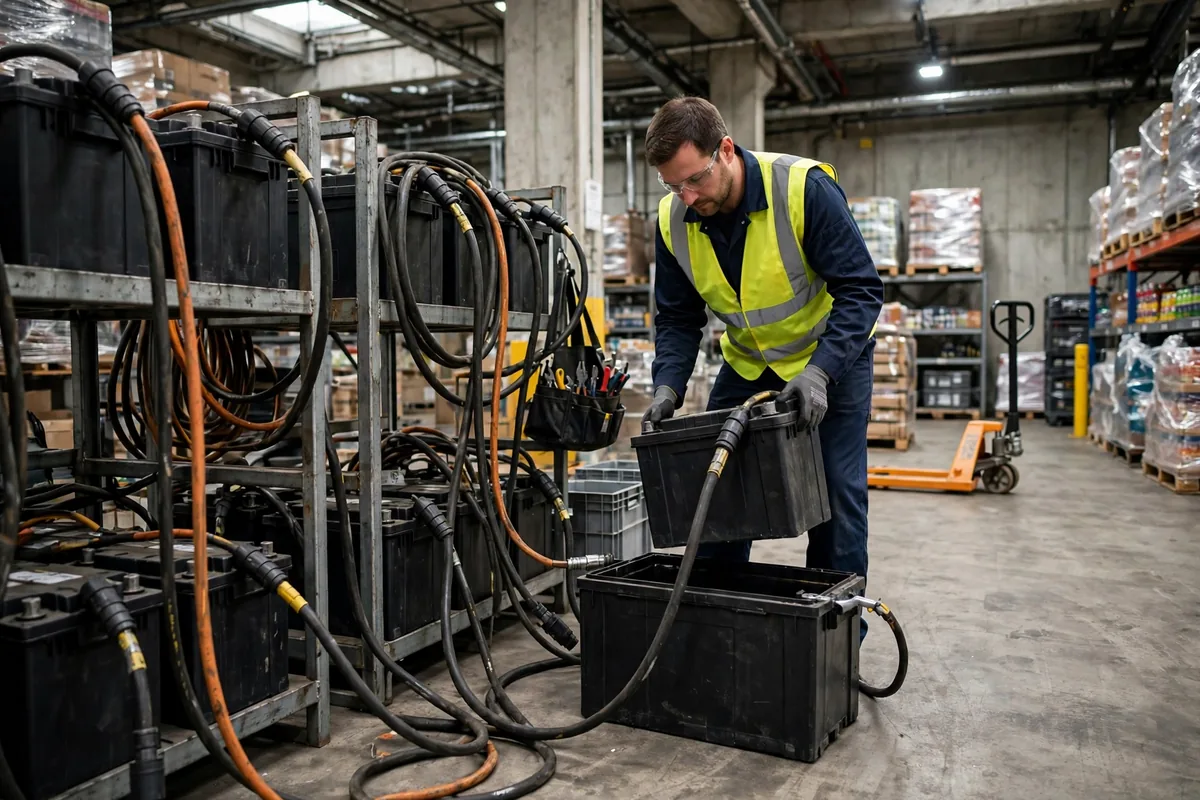
Lead-acid batteries split water while they charge; hydrogen rises and collects near the ceiling. Hydrogen is invisible and odorless, and only becomes a problem when it meets a spark, so the enemy here is accumulation you cannot see. Acid is the second headache: overwatering spills it onto the floor, making the surface slippery and corroding rack feet. Lead-acid gives you one favor: it warns you before it fails. A battery runs hot, the bubbling gets louder, the smell gets stronger, and a night-shift worker can catch it.
Lithium behaves the opposite way. Normal charging produces almost no gas and needs no watering, so it looks effortless. The real risk hides inside the pack: a hit, water, or the wrong charger can leave damaged cells showing nothing on the outside. Once thermal runaway starts, the temperature climbs fast, the pack smokes, and it can set off the truck next to it. Lithium gives almost no warning. By the time someone smells smoke, the only moves left are cut power, alarm, and evacuate.
In October 2024, a 3PL warehouse in Ontario ran 38 lead-acid forklifts from one charging area. The exhaust fan was mounted low, and the hydrogen detector sat at head height. Both were wrong: hydrogen gathers at the top, where a low fan cannot pull it and a mid-height detector cannot sense it. One night the night-shift supervisor smelled something odd and saw the ceiling detector flash red. A charger connector had already sparked. Nothing caught fire. Luck, not design. The fix cost about $18,000 and two days of downtime: fan high, intake low, detector at the ceiling and wired to start the fan.
In March 2025, a beauty-products fulfillment warehouse in Dallas ran 12 lithium forklifts. One truck had been clipped by a pallet at the dock, cracking the battery pack housing. The driver never reported it, and the truck went to charge as usual. Around midnight the pack started smoking. The worker on duty grabbed a dry-chemical extinguisher first, watched the smoke thicken, then cut power, raised the alarm, and evacuated. That truck was a total loss, and the charger next to it had to be replaced. Direct damage: about $45,000, plus six hours of stopped lines. The review found three mistakes: the collision went unreported, no battery-damage check existed, and nobody knew a lithium fire means cut power and alarm first.
| Item | Lead-acid | Lithium |
|---|---|---|
| Gas during charging | Produces hydrogen, collects overhead | Almost none under normal charging |
| Ventilation priority | Continuous ventilation, exhaust high, intake low | Keep air moving and temperature stable |
| Fire priority | Explosion control, no open flame | Early detection, isolation, cut power, evacuate |
| Daily maintenance | Watering, equalizing, acid cleanup | Visual damage checks, battery management alarms |
| Charging time | Slow, often overnight | Faster, top up during breaks |
| Battery cost per truck | Cheap to buy | Considerably more expensive |
| Worst-case event | Hydrogen buildup meets a spark | Thermal runaway in a damaged cell |
Now the three-year math for a 12-truck warehouse. Case-experience figures; they vary by region and brand. Lead-acid: ventilation, detectors, acid-proof flooring, and containment run about $25,000 to $35,000 one time, plus about $12,000 a year for watering, equalizing, replacement, and battery-room labor. Lithium: chargers, early smoke detection, and an isolation area run about $20,000 to $30,000 one time, ventilation to ordinary room standards, almost no watering or equalizing labor yearly. Lithium still costs more over three years: the batteries cost more. What that money buys is charging time: lithium trucks top up during lunch and shift changes instead of sitting in the charging area all night, so a smaller fleet covers the same volume. Compare battery prices alone and lead-acid always wins. Add labor, downtime, and fleet size, and the answer changes.
The counterintuitive part: a lithium charging area needs as much safety spending as a lead-acid one. It just goes to different places. People hear "maintenance-free" and read it as "nothing to manage," pocketing the ventilation savings and skipping detection and isolation entirely. Lead-acid warns you before it fails; lithium does not, and that decides where the money goes: lead-acid money to ventilation and explosion control, lithium money to early detection, damage checks, and isolation. Save in the wrong place and every dollar saved comes back with interest in a single incident.
Forklift Battery Charging Area Ventilation and Fire Protection: A Checklist That Actually Works
Work the eight steps in order; the area is not ready until all eight pass.
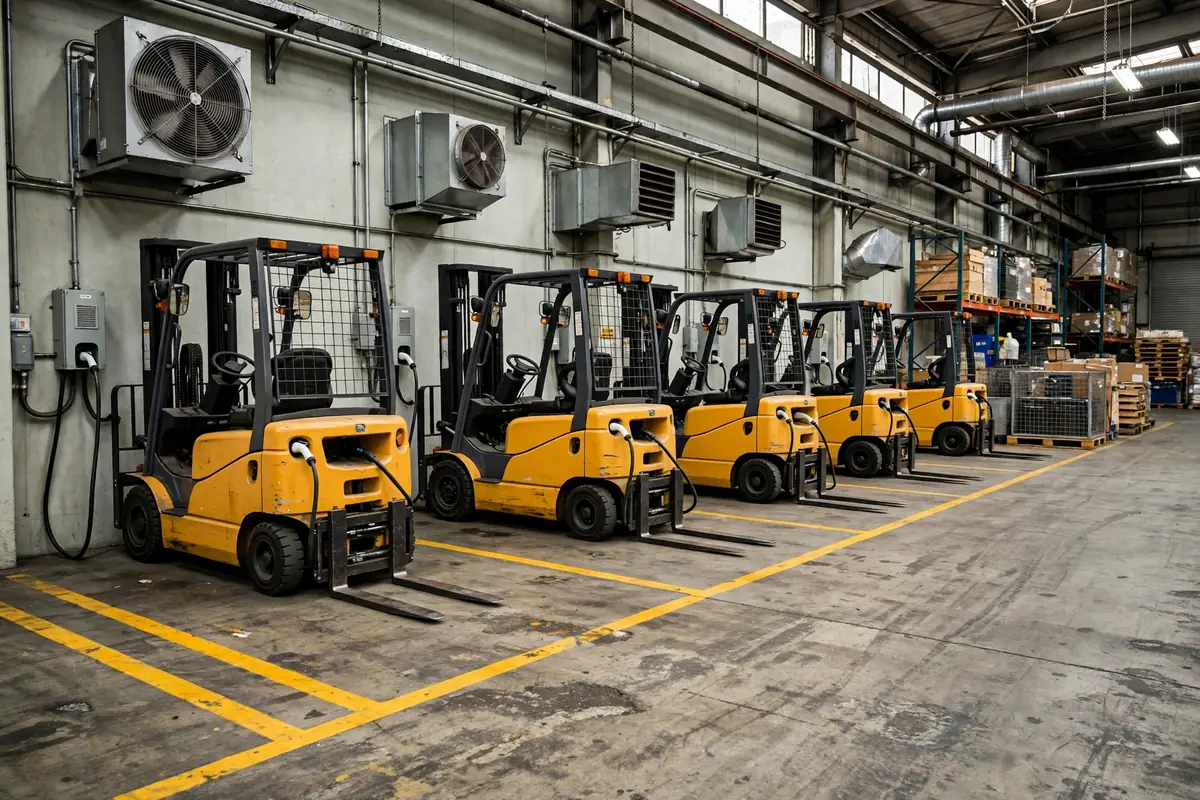
- Zone it first. Give charging its own zone, away from combustibles, carton storage, and exits, marked with yellow floor lines and a sign naming the battery type. Charge lead-acid and lithium separately, and label every charger.
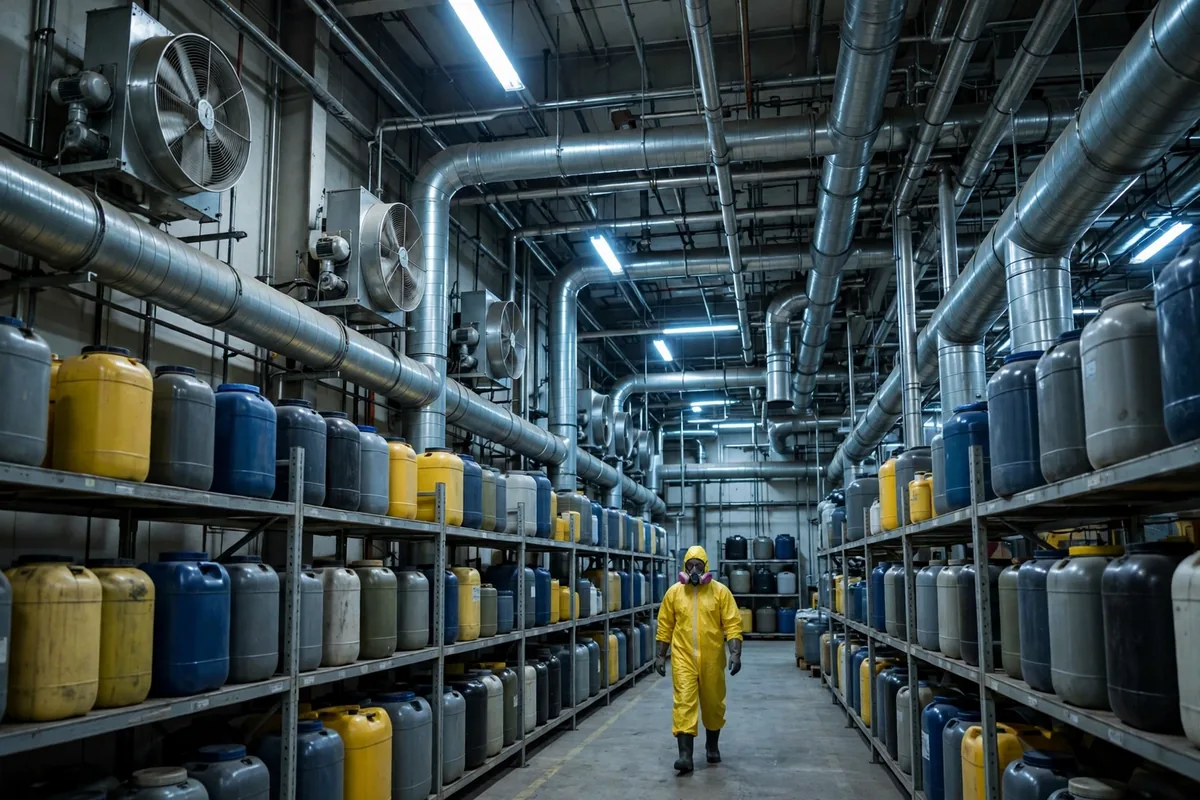
- Ventilate for the battery you have. Lead-acid needs continuous ventilation, intake low, exhaust high, a rated fan, and a hydrogen detector mounted high, wired to start the exhaust. Check the fan every morning; broken fan, same-day fix or no charging.
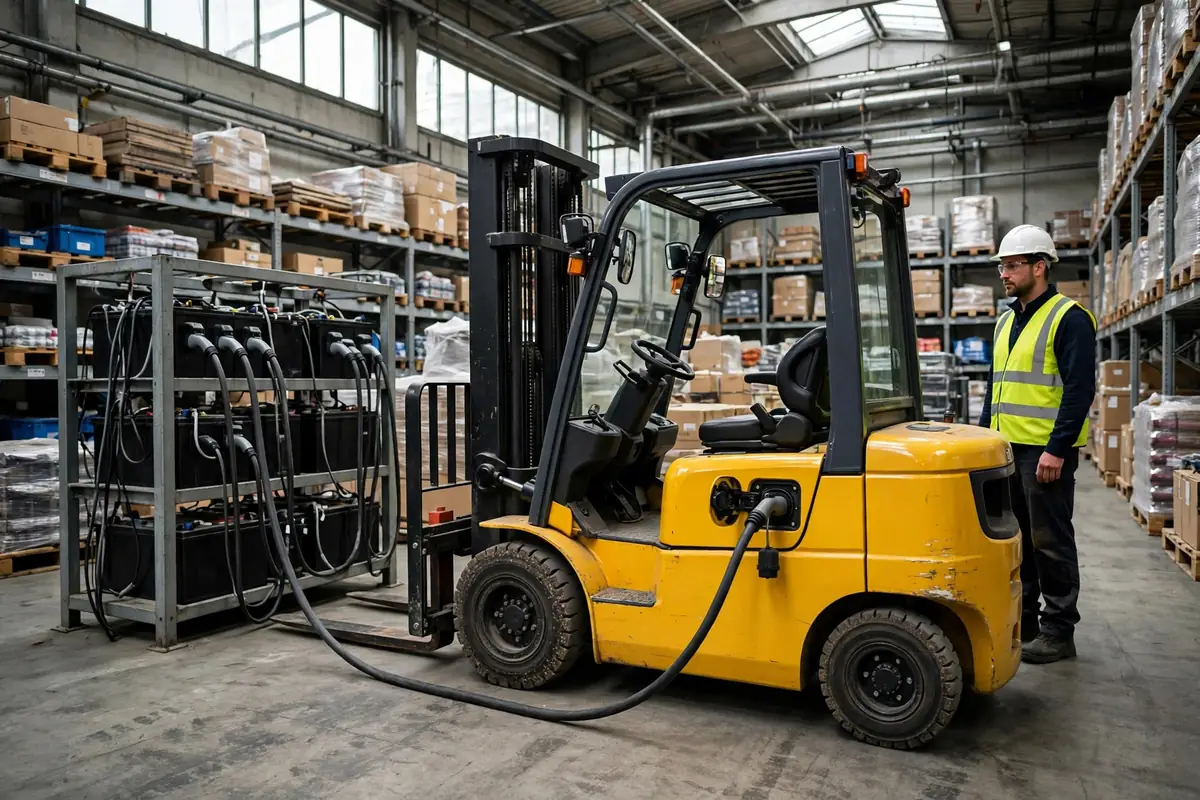
- Electricity only works one-to-one: charger, battery, and truck model must match before anyone plugs in. A frayed cable, scorched connector, or loose plug takes that charger out of service. Keep the emergency cut-off visible, reachable, and clear.
- Handle floors and acid as their own job. A lead-acid area needs acid-resistant flooring, containment, neutralizer, absorbent pads, eyewash, and gloves at the entrance. Acid on the floor gets contained first, cleaned second, and logged.
- Match fire equipment to the battery type. Extinguishers, smoke alarms, and sprinklers go in per the battery type and fire department guidance, checked monthly. The lithium sequence is fixed: cut power, alarm, evacuate.
- Put names on every charging task. Who plugs in, who unplugs, who checks a full charge, who covers nights: write it into the roster. Overnight charging with nobody on site needs remote monitoring; an unanswered alarm is no alarm.
- Turn inspection into one sheet. One sheet a day: fan, detector, extinguisher expiry, charger labels, acid and clutter, cut-off. Six items, all pass or the day fails.
- Train and drill like you mean it. New hires learn the charging area rules before their first shift; everyone refreshes yearly. Drill a lithium smoke scenario annually, from first sighting through power cut, alarm, and evacuation, timed.
The Mistakes I Have Seen Three Times
Charger mix-ups are the one I have seen three times. A lead-acid charger on a lithium battery, or the other way around, looks fine while it charges and damages the battery inside. The fix is crude: color-match the labels, red to red and blue to blue. Labels cost under a hundred dollars; a burned truck, tens of thousands.
Turning the charging area into a storage room is the next failure. Cartons, pallets, and strapping pile up, half the vent is blocked, the extinguisher ends up behind a stack. My rule: the only things on the floor are trucks that are charging and their chargers. The duty manager walks the area before every shift ends and clears the rest.
Deferring a broken fan or detector is the most dangerous delay. Ventilation and detection in a lead-acid area are life-safety equipment, not maintenance. Give them their own work-order category with same-day response; unfixable on arrival means charging stops. One night of stopped charging costs less than one incident.
One more failure hides inside inspections: the pre-inspection cleanup. The area gets scrubbed and the logs filled in the day before the inspector arrives; everything goes back to normal the day after. That fools the inspector, not hydrogen or thermal runaway. An area that can pass inspection runs to inspection standard every day.
Go-live night checklist, six items: fan runs, detector sounds, extinguishers in date, charger labels match, floor free of acid and clutter, a named person on the roster. All six pass, and you start in the morning. One fails, fix it first. Forklift battery charging area safety is not a retrofit you finish once; it is six checks a day, stacked over time.
By Lin Xiao, WMS Implementation Consultant