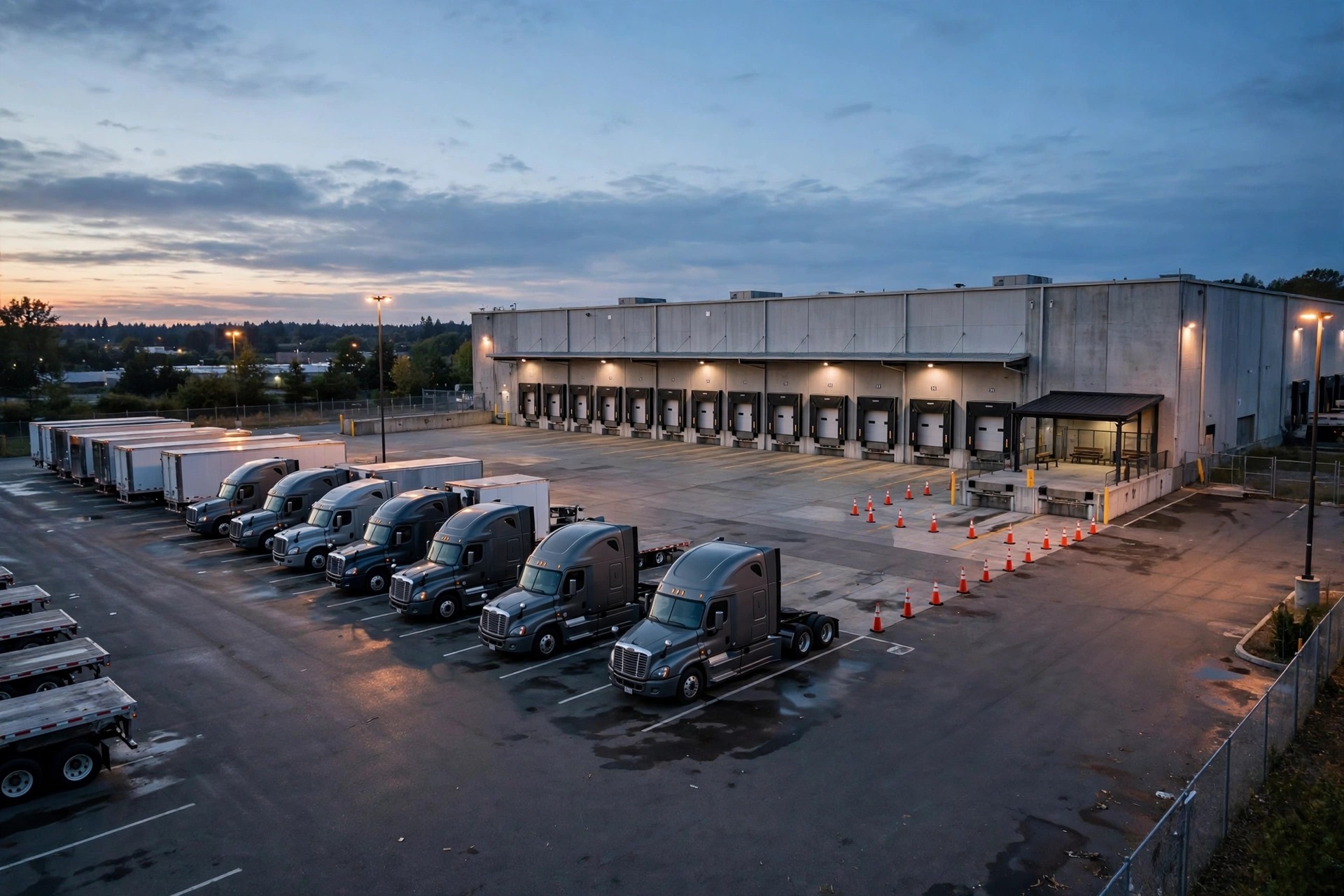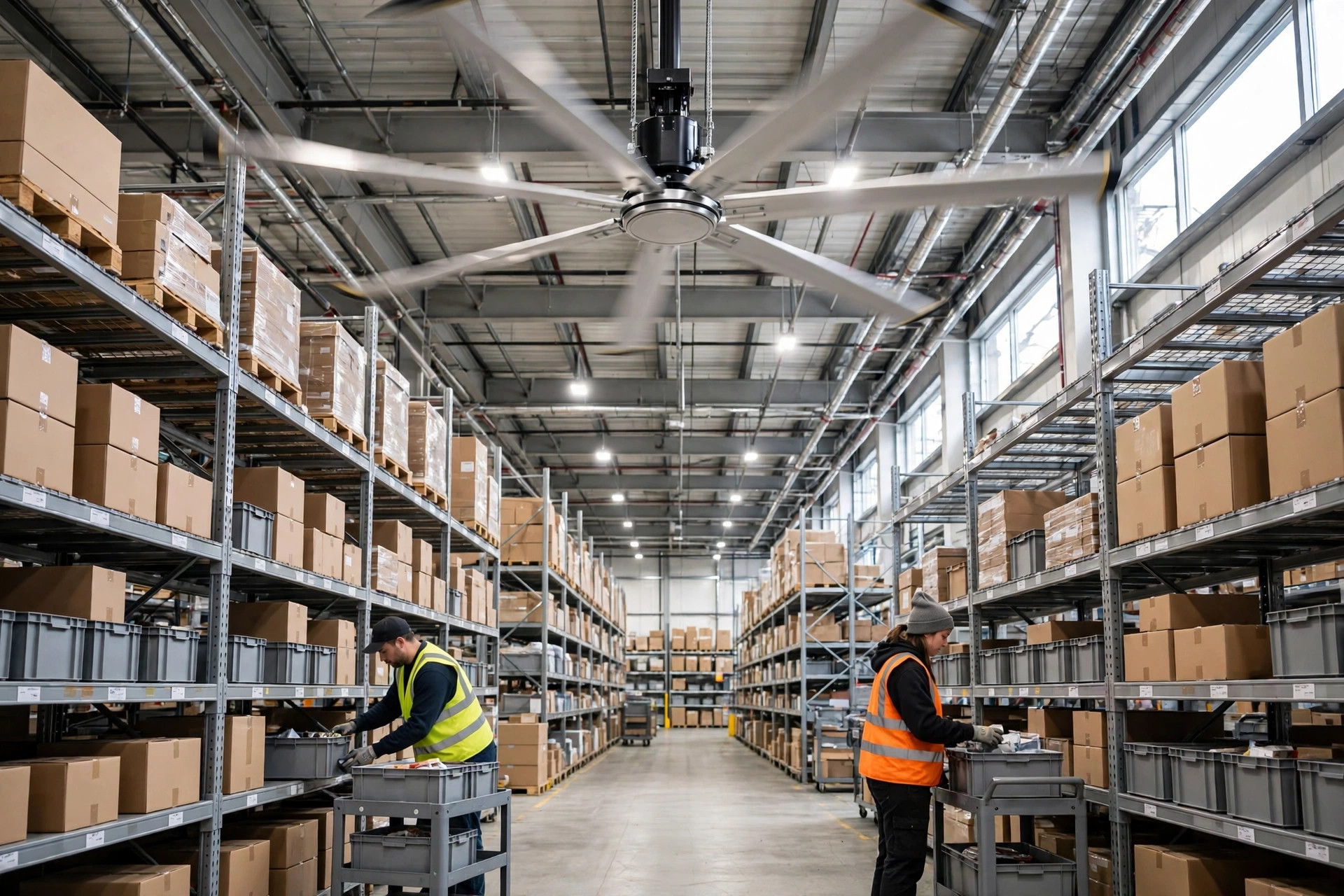
Our warehouse is about 3,000 square meters with a 9-meter ceiling, and on the hottest days last year my pickers finished their shifts with their shirts wrung out. Then the air conditioning quote arrived, and I nearly passed out — that number would have covered several months of payroll. So we bought two big fans instead, and life got bearable. This is what I learned doing warehouse HVLS fan selection on a small-warehouse budget: get it right and the whole floor breathes easier; get it wrong and you have an expensive decoration spinning over your head.
Let me start with the verdict: for a tall space, look at fans before you talk about air conditioning. Air conditioning is not bad — it is just money my kind of warehouse cannot burn. And here is the counterintuitive part most sales brochures skip: a fan does not cool the air at all. The temperature stays exactly where it was. Moving air just dries sweat faster, so people feel cooler. If you buy a fan expecting it to push the thermostat down, you bought the wrong thing. Set that expectation straight first, and everything else gets easier.
Our first fan went up in 2024. The picking zone was the worst spot in summer, a sauna by early afternoon. Trying to save time, I ordered two big-diameter fans based on the coverage area printed on the brochure. Only after installation did the problems show up: one fan hung where the rack tops ran high, leaving barely any clearance above them, and every forklift driver passing under it ducked on instinct. Worse, the second fan sat dead center over a main aisle, so its breeze landed on the walkway while the actual picking stations sat at the edge of the airflow. I paid to move one fan and re-rig it, and that rework cost more than the freight on the fan itself. Lesson learned the expensive way: measure the warehouse before you look at diameters.
Warehouse HVLS Fan Sizing Starts With Your Bay, Not the Diameter
A bigger diameter does cover more floor — but only if it has room to spin. Small bays, dense racking, and lots of partitions chop that coverage to pieces. My low-tech method now is to walk the floor with a tape measure before ordering: first the column spacing and bay size, then the clear height from rack top to roof, then where the partitions cut the space. Every partition slices the air circle, and your real coverage drops fast.
Here is the rough guide I worked out from my own floor and the manufacturer's sizing tables. Treat it as a starting point and check the manufacturer's latest sizing table before you buy — do not copy mine blindly:
| What your floor looks like | Diameter call | What I did | | Around 9 meters high, wide-open bays, no partitions | Go big, one fan per zone | One fan covers two picking teams | | Around 6 meters high, dense racks, many partitions | Smaller diameter, more mounting points | Packing area got two smaller fans, staggered | | Less than two meters from rack top to roof | Move the fan or lower the rack, do not force it | Moved the fan; a smaller air circle beats a collision |
A friend who runs an e-commerce warehouse is the cautionary tale. His floor is just over 2,000 square meters with ceilings a little above 6 meters, and he bought two fans over 7 meters across because the salesperson told him bigger was better value. The blades ran too close to the rack tops, the racks broke up the airflow, and some stations got a gale while others got nothing. He ended up pulling one out and replacing it with two smaller fans, paying for removal and reinstallation on top. His line stuck with me: buying a big fan is like buying shoes — fit beats size.
Before You Install, Settle Three Clearances: Racks, Sprinklers, and Structure
Skip these three and the fan becomes a headache with a power cord. First, racks: keep the blades clear of rack tops both below and to the sides, or the racks block the air and a raised forklift mast risks a strike. In my warehouse the fans hang over the gap between the aisle and the picking teams, so the edge of the air circle just reaches the workstations and no rack top enters the sweep.
Second, sprinklers. Fan blades must stay clear of the sprinkler heads, and the exact clearance and layout rules are whatever your local fire authority currently requires — I will not invent code numbers here. On installation day I had the crew laser-measure every sprinkler head position before fixing the mounting points. Any layout that looked symmetrical on paper but fought with a sprinkler head was rejected on the spot.
Third, structure, the one small-warehouse owners overlook most. A big fan plus its drop rod weighs a serious amount, and you cannot just hang it off a purlin and hope. My steel-structure contractor inspected the roof, and two of my mounting points needed added cross beams. That cost a few thousand extra, and it was money I was glad to spend — something that heavy spinning overhead for a year needs a mounting point someone actually verified. Before signing, ask one question and get it in writing: who verifies the load capacity of the mounting points? That sentence in the contract beats any argument afterward.
Warehouse HVLS Fan Electricity Math: Do Not Just Read the Nameplate
Fan electricity has to be calculated by how long and on what speed you actually run it. The nameplate wattage is only the full-speed number. My two big fans are each rated a little above 1 kilowatt, but we mostly run them on medium speed for 10 hours a day, 26 days a month. The math looks like this:
| Setup | Units | Nameplate watts each | Monthly use (10 hours a day, 26 days a month) | | Big fans on medium | 2 | About 1.1 kW | About 572 kWh | | Industrial wall fans on full | 12 | About 0.75 kW | About 2,340 kWh | | Big fans on full | 2 | About 1.5 kW | About 780 kWh |
Two things jumped out at me. First, unit count drives the bill: a dozen small fans running full tilt cost far more than two big ones, and they eat wall space and outlets everywhere. Second, the speed setting is the money switch: medium is usually plenty, and full speed just blows packing tape around and sends paperwork flying. I will not convert this to money because electricity rates vary by location — check your latest local rate and multiply it by the kilowatt-hours above for your own number.
There is also a winter bonus that quietly improves the payback: run the fan in reverse on low speed and it pushes the warm air pooled at the roof back down to the floor. We tried it last winter and the old problem of hot heads and cold feet eased noticeably. One fan earning its keep in two seasons pays back faster. Fair warning, though: this only matters if you heat the building. A warehouse with no heating gains nothing from it.
So my advice to other small-warehouse owners comes down to three lines. First, measure your bays, rack tops, and sprinkler positions before ordering — let the building pick the diameter, not the brochure. Second, put mounting-point verification in the contract and keep sprinkler clearances to your local fire authority's latest requirements. Third, calculate electricity by speed setting and unit count, not by the single nameplate number. Big companies can buy the whole package; small warehouses have our own way of surviving. Get these three calculations right, and one fan can make the whole floor's summer livable.
By Xiao Ma, Small Warehouse Owner