Let me open with the bill. An AMR clips a picker in a shared aisle. The impact itself takes three seconds. That is the shared space safety problem in one number: three seconds of impact, three months of paperwork. The invoice takes three months: the claim, the downtime, the investigation, the corrective action, the insurance renewal. U.S. Bureau of Labor Statistics data, summarized by the National Safety Council, shows 84 forklift-related deaths in the United States in 2024, and 25,110 forklift cases involving days away, restriction, or transfer in 2023–24. A forklift is not an AMR, but the bill is the same bill: when a moving machine hits a person, the compensation and downtime math barely changes. Public statistics on AMR injuries are still thin, so I will not force the comparison — I use the forklift numbers as a reference frame, to show how long one invoice can run before we talk about what the fix costs.
Direct costs are documented. Industry summaries of U.S. data put a single forklift injury workers' compensation claim at roughly $38,000–$41,000 — and that is the claim alone, before equipment repair and downtime. Indirect costs typically run 4–6 times the direct cost: overtime for replacement workers, management investigation time, damaged goods, missed shipping windows. A major incident's total impact above $200,000 is not unusual. OSHA issued 2,248 forklift-related citations in fiscal year 2024, with proposed penalties above $8 million. The fines are the small part. Downtime is the big part — one line down for half a day in peak season, and which orders cover the gap?
Where the Risk Lives in a Shared Space
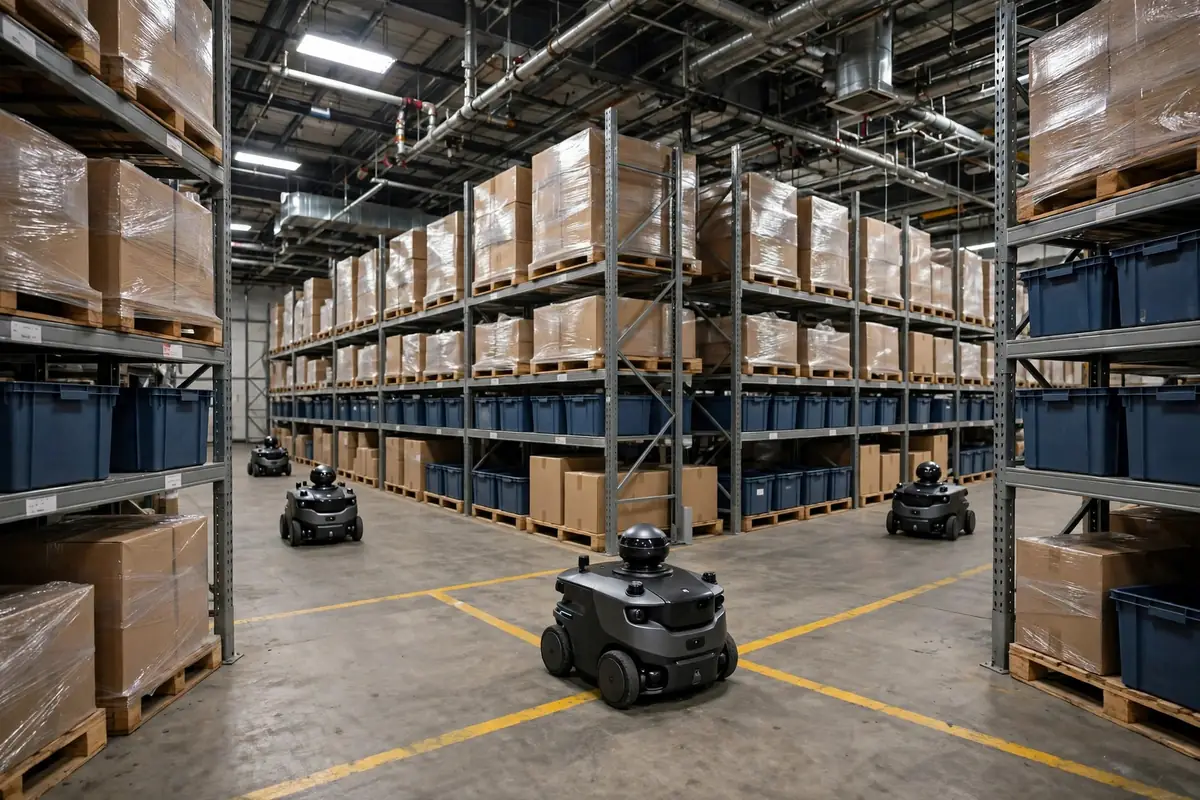
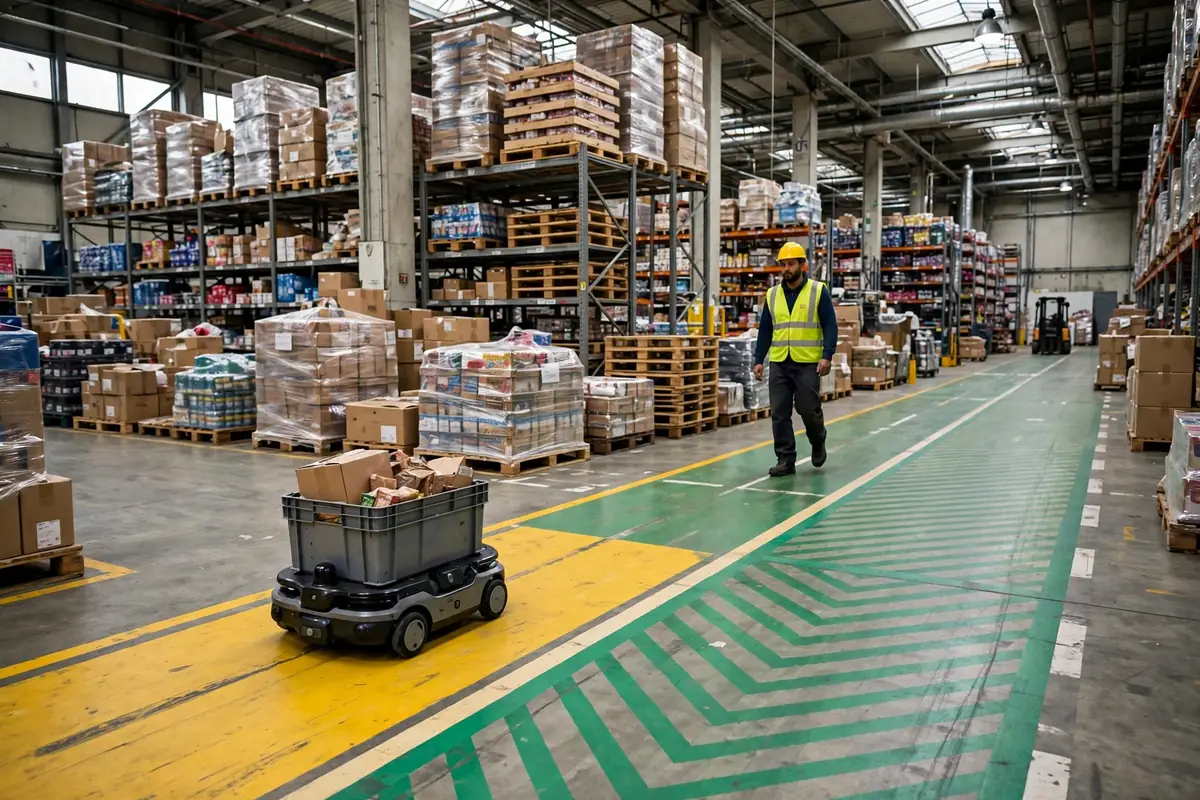
In warehouse human AMR shared space safety, the risk is not the AMR itself. It is three pinch points. The first is the intersection: an AMR turns out of a racking zone into the main aisle while a picker pushes a cart in from the other side, and neither sees the other. The second is the blind spot: the corner of a high rack, the back of a pallet stacked 1.8 meters high — the LiDAR sees the rack, not the person stepping out from behind it. The third is the veteran's gamble: experienced staff learn that the AMR always stops, so they start cutting in front of it to save ten seconds. The more reliable the system, the bolder the gamble.
On standards, responsibility is already split three ways, and many buyers do not know it. ISO 3691-4 (second edition, June 2023) sets safety requirements for driverless industrial trucks themselves. The U.S. ANSI/A3 R15.08 series splits the lifecycle: manufacturer responsibility in Part 1 (published 2020, reaffirmed 2026), integrator responsibility in Part 2 (2023), and user responsibility in Part 3 (2026). In plain terms: the manufacturer must build a compliant machine, the integrator must do the risk assessment at deployment, and day-to-day, the responsibility sits with you, the user. After an incident, you cannot just point at the vendor and say "your vehicle did not stop" — your own risk assessment and site management are written into the standard.
The speed-and-distance math is simple in principle: stopping distance equals reaction distance plus braking distance, and braking distance grows with the square of speed. Double the speed, quadruple the braking distance. So yes, slowing down helps. But exactly how slow, and how many meters of separation — that follows the manufacturer's and the standard's latest specifications, and I will not invent a number here. Different payloads and floor conditions change braking distance by a wide margin; copying one number home is the same as not doing the math.
Three Ways to Spend Money on Shared Space Safety
I have seen three approaches, differing by an order of magnitude in price and in effect. Each one is a different answer to the same shared space question: how much separation can you afford, and how much risk can you carry? The conclusion up front: there is no single "right" answer, only which tier matches your volume and your incident probability.
Tier one is full separation: pedestrian walkways and AMR lanes physically divided, with guardrails, floor markings, and separate entries. The most expensive and the most thorough — right for main aisles with heavy human-vehicle crossings. One warehouse I followed spent $60,000 in 2024 on a separation retrofit — floor markings, guardrails, intersection speed bumps, and audible-visual warnings — cutting the expected incident rate in its mixed zone from about one every two years to about one every five years. Those figures are that project's own estimates, not an industry average; another warehouse must redo the math.
Tier two is zoned sharing: main aisles separated, branch aisles shared, with AMRs automatically slowing in shared zones and audible-visual warnings plus convex mirrors at intersections. The most common choice — moderate cost, manageable risk. The key is that the speed reduction must be written into the system, not left to staff discipline.
Tier three is full sharing with speed limits only: no physical separation, relying on the AMR's own LiDAR and safety scanners. The cheapest, and the most dependent on two things: the vehicle's braking performance, and staff discipline not to cut in front. Discipline is the first thing peak season breaks.
| Option | Retrofit cost (worked example) | Expected incident rate | Best fit |
|---|---|---|---|
| Full separation | ~$60,000 | Lowest, ~1 in 5 years | Main aisles, frequent crossings |
| Zoned sharing | ~$20,000–$30,000 | Medium, ~1 in 3 years | Branch aisles shared occasionally |
| Full sharing + speed limits | Under ~$5,000 | Highest, ~1 every 1–2 years | Low-frequency aisles, small volume |
The costs and incident rates in this table are worked examples, showing the order-of-magnitude differences between tiers. Real numbers must be recalculated from your aisle lengths, AMR count, and daily crossing frequency — copying the table is doing the math wrong.
There is also a hidden cost no quotation lists, but every ledger carries: the downtime of the retrofit itself. Separation work means floor markings and guardrails, and the aisle runs at half capacity while the work goes on — impossible to schedule in peak season. Many warehouses are not short of money for the retrofit; they are short of a window for it. My advice: schedule it in the off-season, or split it into three stages, closing only one branch aisle at a time. The most expensive item in a safety investment is often not the hardware. It is the downtime.
The Payback, in Numbers You Can Check
Here is a formula you can use directly. Run it for your own shared space before you sign a retrofit quote — the formula is free, the retrofit is not. First, expected annual incident loss: annual incident probability multiplied by the total cost of one incident. Build the single-incident cost from the public figures above: direct claims of $38,000–$41,000, indirect costs at roughly 4 times direct, for a total of about $190,000–$200,000. Suppose your mixed zone currently runs at one incident every two years — the expected annual loss is $95,000–$100,000.
Now the loss after the retrofit. Suppose full separation cuts the probability to one in five years, so the expected annual loss falls to $38,000–$40,000 — about $57,000–$60,000 less per year. A $60,000 retrofit then pays back in roughly one year. Every number here is a worked example; the probabilities and costs must come from your own site's records. But the formula does not change: payback period equals retrofit cost divided by the reduction in expected annual loss.
One last counterintuitive judgment: slowing the AMR to a crawl does not make it safer. At very low speeds the AMRs queue up and block the aisle, pickers start detouring around them, climbing over guardrails, cutting in front to make their rate — the risk you pushed down pops up somewhere else. Safety is not "slower is better." It is speed, separation, sightlines, and discipline arriving together. Adjust one number and ignore the other three, and you adjusted nothing.
Whether the money was wasted becomes clear in three years. A warehouse with no incident will feel the retrofit money was wasted. A warehouse that has had one will wish it had spent it sooner. The math ends here; what remains is not arithmetic but whether you are willing to bet that a "one in two years" probability will not land on you. My advice: do not bet. Lose once, and the retrofit money you saved will not even cover the bill.
By Lao Zhou, Logistics Cost Analyst