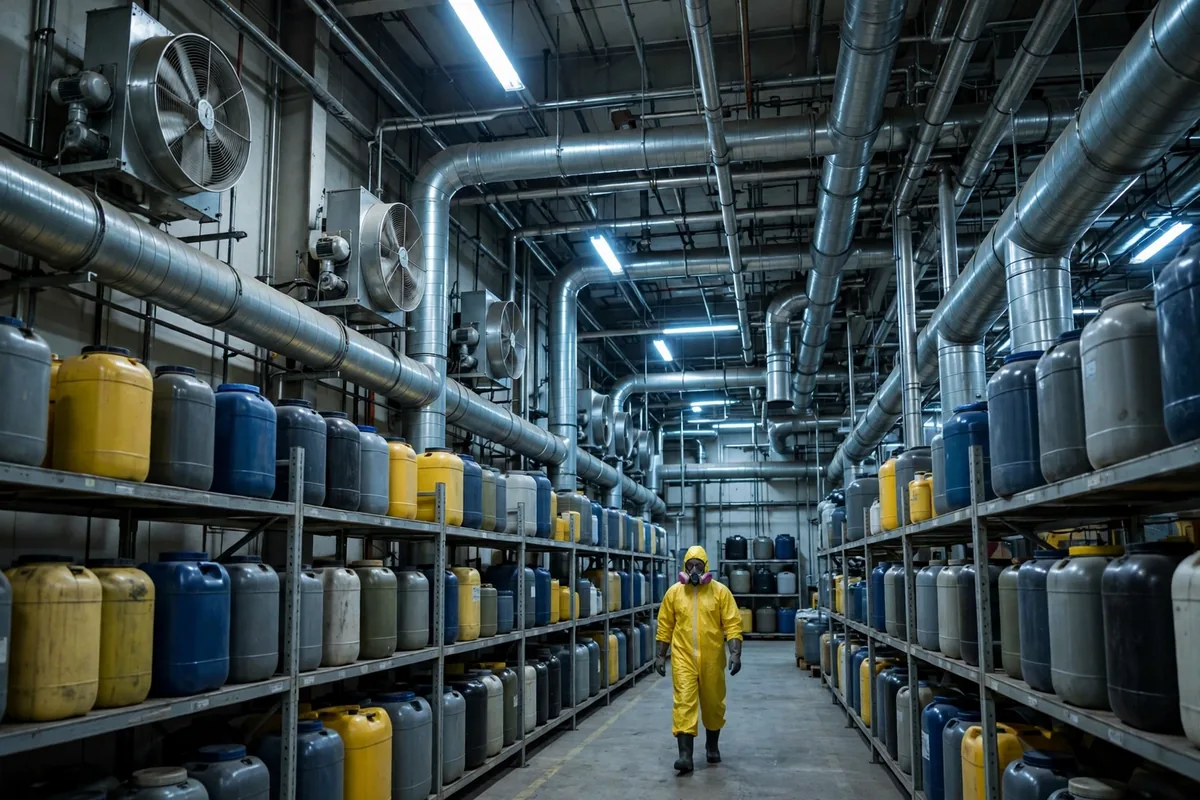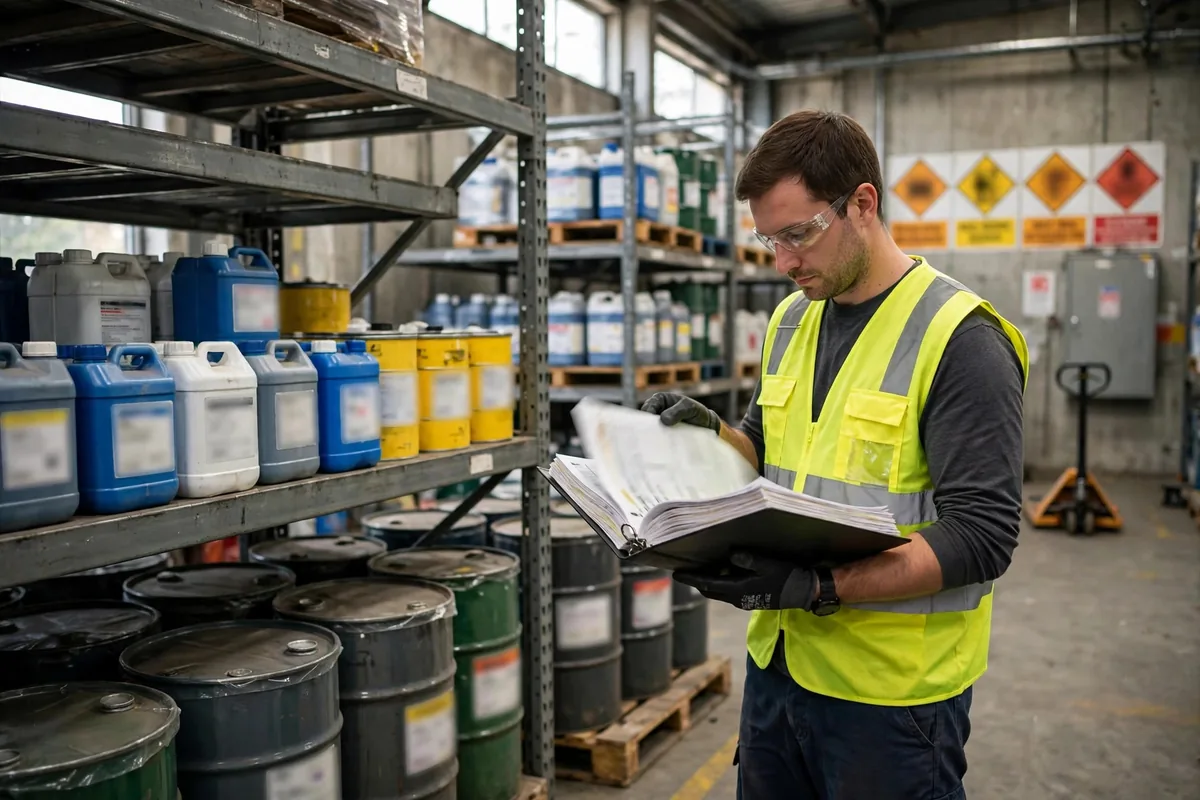
Last summer, I nearly lost my warehouse over a few drums. A regular client sent two pallets of cleaning chemicals — chlorine disinfectant and acidic descaler — and my forklift driver stacked them side by side in our hazmat corner to save a trip. Luckily Lao Wang asked one question: "Can these two sit together?" I had no answer. That night I read until 2 a.m., and the more I read, the worse I felt. Chlorine disinfectant mixed with acid gives off chlorine gas. Mixed with ammonia, it gives off chloramine. Both can kill. That is hazmat chemical compatibility in a nutshell — not theory, chemistry.
Our little warehouse, one corner, and a few drums that nearly ended us
We run a 3,000-square-meter warehouse with seven people. No full-time safety officer, no separate hazmat building, just one corner by the wall. Big clients ask us to store small quantities of hazardous chemicals. Turn them down and they walk away; take the job and one mistake could end us. A big company can survive a fire. We cannot — we would simply close. So I did the homework myself.
On September 29, 2024, at 5 a.m., a corroded sprinkler head failed inside a pool-chemical warehouse in Conyers, Georgia. Water hit a super sack of pool-treatment chemicals. The warehouse held about 5,000 super sacks — nearly 14 million pounds of chlorinated disinfectant in total. A toxic plume spread across the Atlanta metro area: 17,000 people evacuated, 90,000 told to shelter in place, residents within two miles getting shelter-in-place warnings for 17 straight nights, schools closed for nearly two weeks. The gut punch: an inspection in December 2023 had already found more than 1,100 sprinkler heads corroded. Nobody acted. The U.S. Chemical Safety Board released its final report on July 21, 2026, and the facility closed seven months after the incident. No exotic technology failed. Water met an oxidizer, and a rusted sprinkler nobody fixed did the rest.
A warehouse in the UK stored oxidizers, solvents and assorted chemicals together. A fire spread with terrifying speed, and 15 minutes in, a second explosion hit the store holding oxidizers. The smoke carried eleven different chemicals, including hydrogen chloride, and about 3,000 residents were evacuated. The investigation said it plainly: the lack of chemical segregation drove the fire out of control. Both accidents share one pattern: each chemical was fine on its own. The problem was always "stored together."
Hazmat chemical compatibility: the pairs that must never sit together
The whole idea of hazmat chemical compatibility fits in one sentence: never let chemicals that pick fights with each other meet. This is the table taped to our warehouse wall, borrowed from OSHA and EPA compatibility logic and adapted to a small warehouse:
| The feuding pair | What happens if they mix | What we do |
|---|---|---|
| Oxidizers (bleach powder, nitrates, peroxides) × flammables, organics | Fire, sometimes explosion | Separate zones, a row of ordinary goods between them |
| Strong acids × strong bases | Violent heat, containers can rupture, liquid splashes | Opposite ends of the corner, separate cabinets |
| Chlorine disinfectant × acids | Chlorine gas | Never on the same rack |
| Chlorine disinfectant × ammonia cleaners | Chloramine gas | Never on the same rack |
| Acids × cyanides | Hydrogen cyanide, acutely lethal | Cyanides in a locked cabinet, far from every acid |
| Water-reactives × water, damp spots | Heat, flammable or toxic gas | Away from doors, leaks and sprinkler heads |
Two details trip people up. First, never shelve by alphabet: acetic acid and ammonium hydroxide both start with A, and they are incompatible — shelve by hazard class, not by name. Second, keep nitric acid apart from other acids, and put concentrated nitric and sulfuric acid in secondary containment. Under OSHA's flammable liquids standard, one approved cabinet holds no more than 60 gallons of Category 1–3 flammable liquids, and no more than 25 gallons of Category 1 flammable liquid may sit outside a cabinet or storage room; check the latest official policy for current limits.
Reading a compatibility chart, and doing the math on segregation
A compatibility chart is less mysterious than it sounds. The EPA's 1980 chart sorts chemicals into 41 reactivity groups — find the crossing point of two groups and you see whether mixing them makes heat, fire or toxic gas. The U.S. Department of Transportation segregation table is even blunter: an X means never store them together. But a chart is only a guide. The final word belongs to each chemical's safety data sheet: Section 7 covers handling and storage, Section 10 covers what it is incompatible with. Our three-step rule: read Section 10 of the SDS first, cross-check the compatibility chart second, and if still unsure, separate them. When you cannot find an answer, separate by default — separation never hurts.
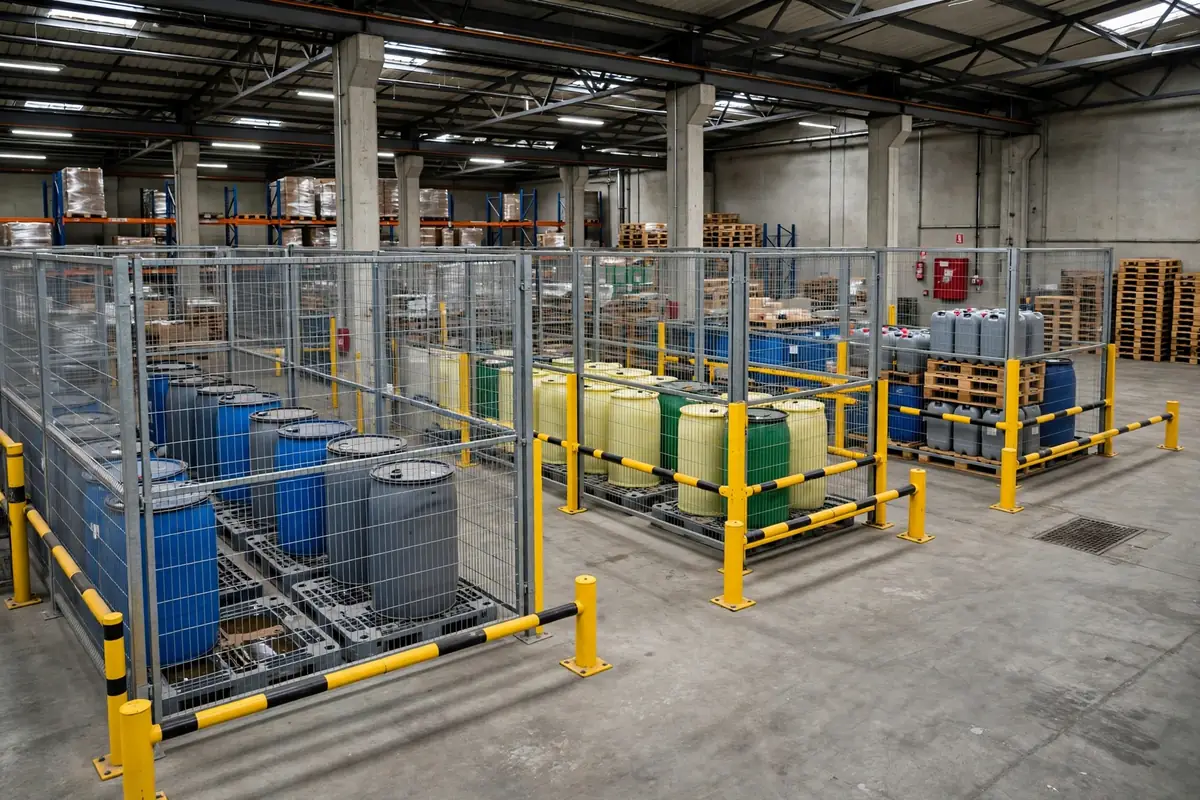
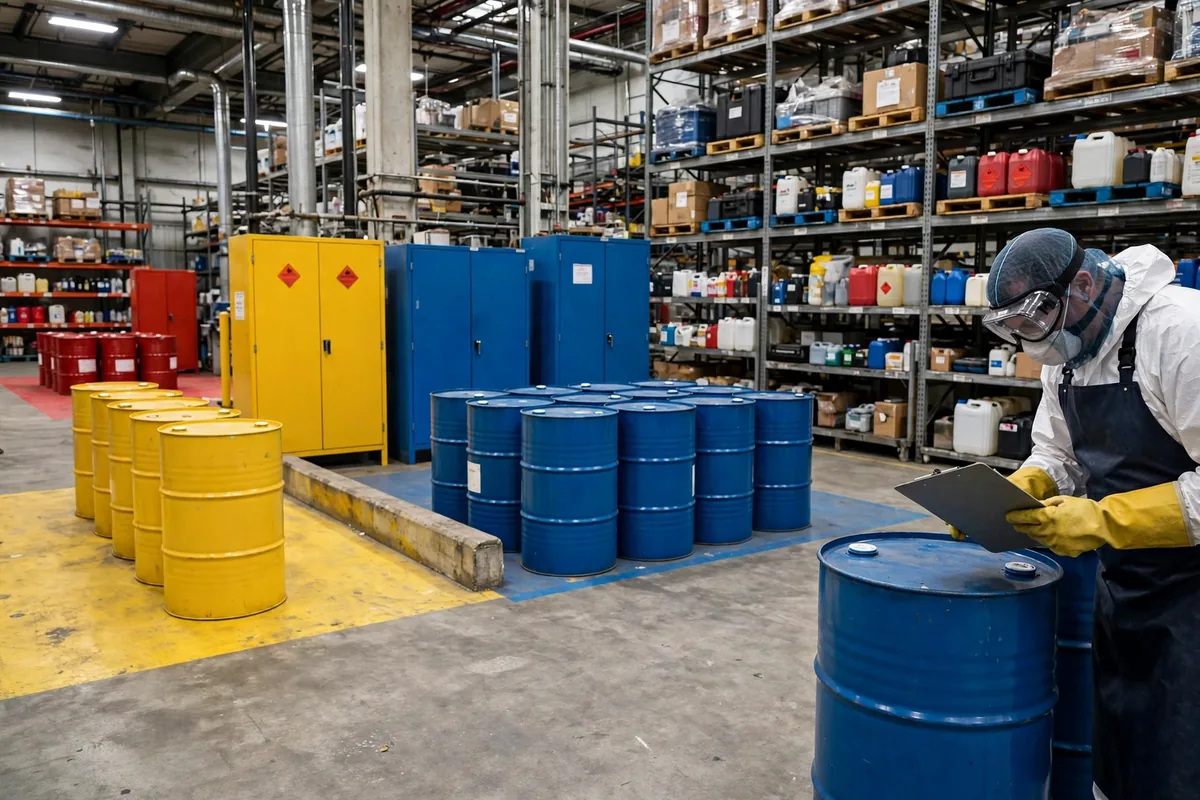
We cannot afford a safety officer, so we use three cheap tricks. First, color-coded zones: colored tape on the floor — red for flammables, yellow for oxidizers, blue for corrosives. The forklift driver does not need to read a word; the color tells him where the pallet goes. Second, SDS quick cards: one laminated page per product — name, incompatibilities, what to do if it leaks — stuck on the rack and saved on everyone's phone. Third, separation distance: at least a forklift-wide aisle between zones, and spill pallets under every liquid so a leak cannot flow into the next zone.
Then the money question. Here is what it cost us — an illustrative example based on quotes we got at the time:
| What we bought | One-time cost |
|---|---|
| Two flammable storage cabinets | About $2,000 |
| Ten spill containment pallets | About $800 |
| Floor tape and labels | About $150 |
| SDS quick cards, printed and posted | About $50 |
| Total | About $3,000 |
Three thousand dollars buys two things: passing a big client's audit, and sleeping at night. Here is the counterintuitive part: the most dangerous chemicals in your warehouse are not the ones you know are dangerous — they are the ones you wave off as "just a few drums, no big deal." Segregation eats floor space, which looks like lost capacity in the short term, but it is what keeps you qualified to take the work at all. Without it, a big client's audit fails on the spot. And one incident — cleanup, fines, shutdown, claims — costs far more than $3,000. Bio-Lab closed its doors. For a warehouse our size, one incident is enough. That is hazmat chemical compatibility on a small-warehouse budget: spend a little, separate the deadliest pairs first, and stay in business.
Small warehouses have their own way of surviving: no safety officer, so the SDS goes on the wall; no separate hazmat building, so the corner gets divided properly; no big budget, so the first $3,000 goes to separating the deadliest pairs. Tomorrow morning, do one thing first: walk to your corner and check whether your acids and bases are still sleeping next to each other.
By Xiao Ma, Small Warehouse Owner