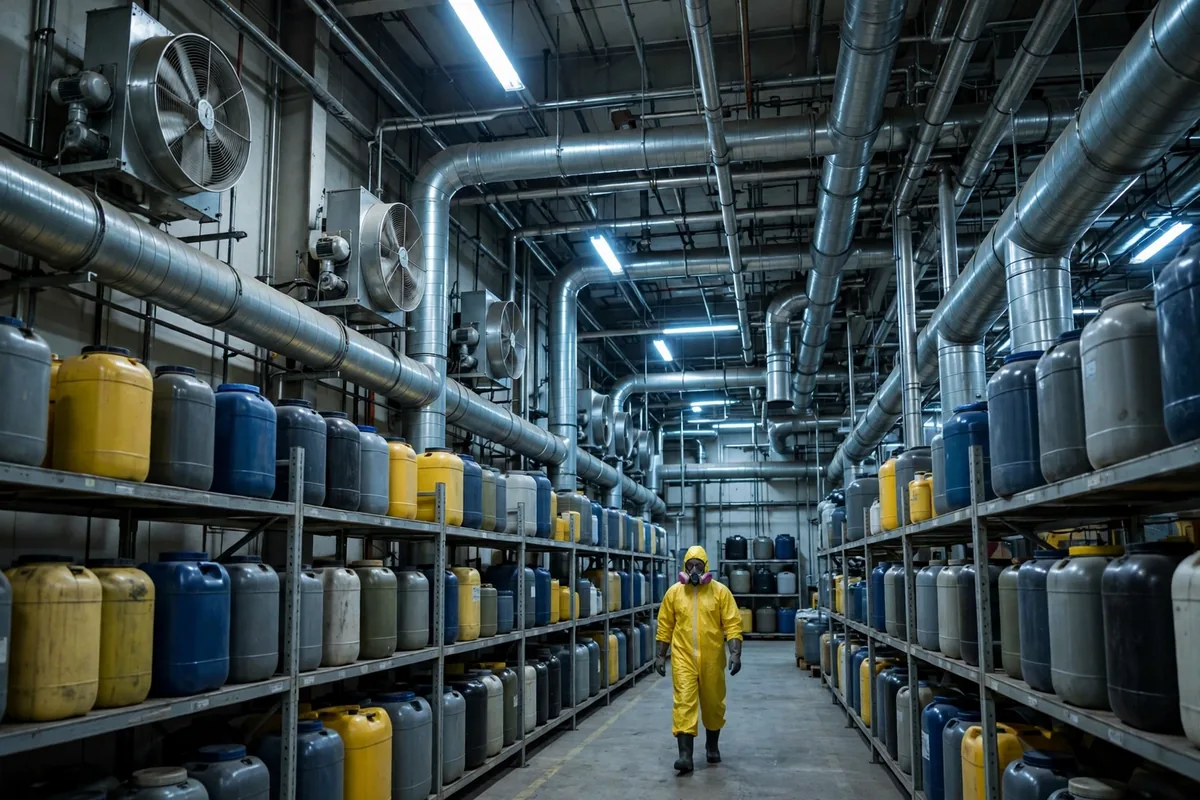
When people talk about hazmat warehouse ventilation requirements, they usually picture fans. Failures rarely start with a missing fan. They start with air going nowhere useful. In the summer of 2024, a third-party warehouse in eastern China storing paint solvents had two high-capacity exhaust fans running around the clock, yet its combustible-gas alarms went off three nights in a row, always around 2 a.m. Nothing was broken. The fans were spinning. The problem was two pallets of newly arrived raw-material drums stacked in front of the air intake. Fresh air could not get in, so the exhaust fans were only circulating a pocket of air in one corner while solvent vapor pooled around the racks where it was most concentrated.
That incident captures the real state of hazmat warehouse ventilation requirements: compliance is not a matter of buying fans. It is a matter of whether air changes, zoning, and monitoring work together as one system. Is the air actually being replaced? Where does it flow? And who finds out first when concentrations rise? If any of those three links breaks, the money spent on the other two is largely wasted.
Air Changes and Ventilation Requirements: The Nameplate Number Is Not the Real Number
Public compliance guidance from bodies such as the U.S. Occupational Safety and Health Administration and the National Fire Protection Association treats air changes per hour — how many times the full volume of warehouse air is replaced in an hour — as the central metric for hazmat storage ventilation. There is no single universal value: the right number depends on the chemicals stored, the quantities involved, and the geometry of the building, and the applicable limits should always be checked against the latest official policy. What deserves attention is the set of mistakes companies keep making when they work out this number.
The first mistake is confusing nameplate airflow with actual air changes. The airflow printed on a fan is measured under ideal conditions. Every bend in the ductwork, every dirty filter, every pallet blocking an intake eats into the real figure. The warehouse in eastern China is a case in point: on paper its airflow was more than adequate, but measured air changes came in at under half the design value. An inspection that only checks whether the fans spin is verifying the invoice, not the air.
The second mistake is the assumption that more air changes are always safer. This is a counterintuitive point, and it matters. Push airflow too high and fast-moving air can carry light flammable vapors into zones that were previously clear of risk; with dusty materials it can lift settled particles back into suspension, widening the hazard rather than shrinking it. What air-exchange design needs is sensible airflow organization, not the biggest fan available. The relative positions of intakes and exhausts, the pressure differential between supply and exhaust, and the way racking obstructs flow all decide whether fresh air actually passes through the places that need it most.
The third mistake is leaving downtime out of the calculation. The figures below are a hypothetical worked example, included only to show the order of magnitude, not as a compliance reference: suppose a storage room holds 3,000 cubic meters of air and is designed for four air changes per hour, which implies an effective exhaust rate of 12,000 cubic meters per hour; if a blocked intake cuts real air changes in half, vapor concentrations build up roughly twice as fast. In the same building, a single shutdown order for non-compliant air exchange can easily cost several times the price of the ventilation upgrade itself in a week of lost operation. Money saved on fans has a habit of coming back as a shutdown notice.
So the first step in air changes is not choosing a fan. It is knowing exactly what is stored. Vapor density, volatility, and flammability limits differ from one chemical to another. Vapors heavier than air sink; lighter ones rise. Put the exhaust at the wrong height and even generous airflow is just ventilating the ceiling.
Zoning: When the Zones Are Wrong, the Fans Make Things Worse
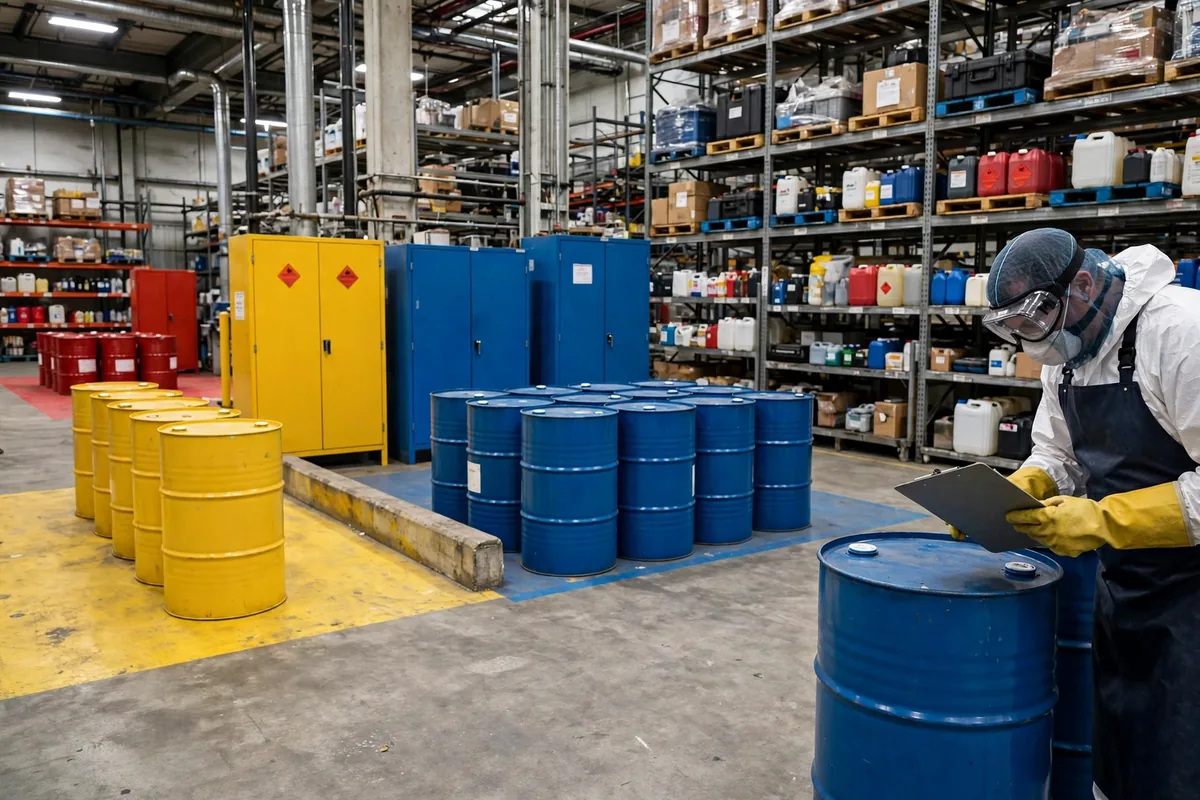
If air changes answer how much air moves, zoning answers where it goes. The logic of hazmat zoning is to keep incompatible chemicals apart and to confine any leak to the smallest possible area. Oxidizers next to flammables, acids next to alkalis, water-reactive materials next to ordinary goods — once these combinations share one air circulation loop, the exhaust system itself becomes the delivery mechanism.
In the winter of 2023, a chemical warehouse in northern China learned this the hard way. The building was zoned by customer, so one customer's oxidizers and solvents ended up on adjacent racks separated only by wire mesh. The exhaust system drew air from the whole building through shared ductwork, so the two zones' air mixed in the ducts. After a small leak, the alarm sounded, and the investigation found that the two zones had never been airflow-isolated at all. Nobody was hurt, but remediation took more than two months, during which half the storage capacity sat empty. Drawing a line on a floor plan is easy; making airflow genuinely respect that line takes fire-rated separation, independent exhaust branches, and separate intake arrangements — real cost, real schedule.
The direction of travel in enforcement is worth noting. According to recent enforcement bulletins and industry reporting, regulators are shifting their attention from whether equipment exists to whether the system works as a whole: individual components all compliant, yet fighting each other in combination. Explosion-proof fans connected to ordinary ductwork, gas detectors mounted at the wrong height, emergency ventilation sharing control logic with routine ventilation so that one undermines the other in a crisis. The reasonable expectation is that future compliance checks will weigh the results of integrated testing — the linked operation of fans, detectors, and alarms — more heavily than the completeness of an equipment list.
A short self-check framework, three questions in order, exposes most gaps quickly. Any question a warehouse cannot answer points to a missing link:
| Self-check question | What "good" looks like | The usual gap |
|---|---|---|
| Is airflow enough? | Effective air changes calculated from the chemicals and volume stored, verified by measurement | Only the nameplate airflow was ever checked |
| Is airflow separated? | Incompatible goods in zones with independent supply and exhaust, no cross-zone flow | Racks separated, airflow not separated |
| Who knows when limits are exceeded? | Detectors placed at the height where vapor gathers, alarms linked to exhaust and to the duty roster | Detectors at the wrong height, alarms nobody answers |
Monitoring: Meeting Ventilation Requirements Takes More Than a Detector
Monitoring is the most underestimated link in the chain, and the easiest to reduce to theater. Many warehouses mount gas detectors on the ceiling, where they look conspicuous and official, but for vapors heavier than air that placement is useless: the vapor pools near the floor while the detector enjoys clean air overhead, and by the time concentrations reach the ceiling, safe limits were passed long ago. Detector height has to follow vapor density, not installation convenience.
The second trap is alarming without responding. Who takes the call when the alarm sounds, how many minutes until someone is on site, whether the first action is to start emergency ventilation or to evacuate — if that sequence is not written down and rehearsed, even the most sensitive detector is just a machine that makes noise. In the eastern China warehouse, the night-shift alarm rang for three nights before anyone investigated seriously, because the alarm had already been written off as a false positive. Once a monitoring system's credibility is spent with the people who are supposed to trust it, the hardware is decoration.
A third development deserves attention: monitoring data is becoming compliance evidence. Regulators and insurers increasingly ask for the history — whether concentration curves show abnormal peaks, how long disposal took after an alarm, whether the exhaust system has maintenance records. Material that used to be treated as internal housekeeping is becoming the proof of compliance itself. Warehouses with good data trails are calmer under inspection and at claim time; those without them cannot explain themselves no matter how new the equipment is.
In the end, the compliance ledger for hazmat warehouse ventilation requirements is not a count of fans. It is a question of whether the system works when nobody is watching: airflow genuinely effective, zones genuinely separated, and an exceedance genuinely noticed and genuinely handled. Any link that exists only on paper leaves the risk exactly where it was. Where regulation goes next — finer zoning standards, stricter data-retention expectations, or something else entirely — is too early to call with confidence. But the direction is already clear: compliance is moving from buying equipment to proving that the system actually works.
By Dr. Chen, Supply Chain Researcher