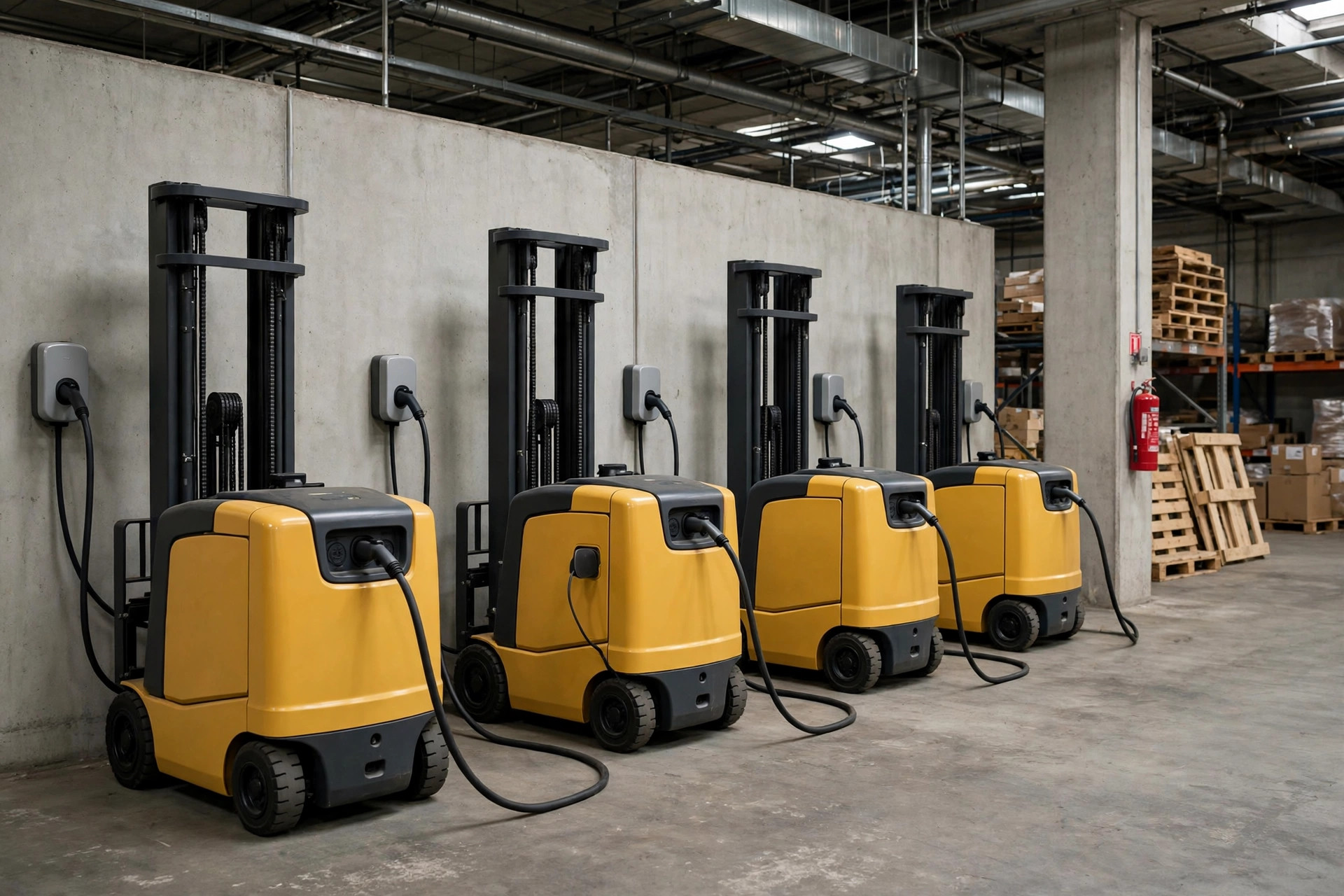
Warehouse forklift charging fire safety is not something I learned from a manual. Let me tell you straight: after all these years on the road, the call I dread most is not about a traffic jam. It is a warehouse calling in the middle of the night. Most people think charging is simple. You plug the forklift in, lock the door, and go home. I have seen what that kind of thinking leads to, so now, whenever I walk into a warehouse, my first look goes to the charging area. If it is crowded and messy, I start worrying before anyone says a word.
A few years ago, late at night, I went to pick up a load at a friend's warehouse. There was a strange smell near the charging area, something like burnt plastic with a sour edge. The night man said it was probably just a hot charger and would fade. I walked over and saw several forklifts charging bumper to bumper, with cardboard boxes and pallets stacked right beside them. A charging cable ran underneath a box, and dust had settled thick on a plug. Nothing caught fire that night. We unplugged the chargers, moved the boxes, and the smell slowly cleared. But driving home, I kept thinking: what if nobody had smelled it? What if the cardboard had gone first, and the night man had not reached it in time? From that night on, my rule for a charging area became simple. It can be old, it can be small, but it cannot be crowded, messy, or left unmanaged.
Another time, in daylight, a forklift had just finished charging when the driver pulled the plug and smelled burning. The battery case felt hot to the touch. It was a lithium battery, the kind everyone likes because it charges fast. After that, the warehouse made a plain rule: someone stays nearby while charging, and after charging, you touch it and smell it before the truck goes back to work. No strange smell, no unusual heat, then it goes back. That rule looks clumsy, but it catches trouble at the first step. Fast charging is a real advantage, but a charging battery and charger both make heat, and heat hates being packed together, covered up, and ignored.
Charging Spacing: A Crowded Row Gives Fire a Path
Spacing is not complicated if you say it in plain words. Leave enough room between charging forklifts that a person can walk through. If one truck starts to give trouble, someone needs to reach the plug and move the truck beside it, not stand outside a blocked row watching. Keep cardboard, wooden pallets, and wrapping film away from the charging area and away from the wall behind it. Fire loves material that catches easily and sits within reach. Do not run charging cables under stacks of goods, and do not let forklift wheels roll over them again and again. A cut cable sheath or a loose plug is a problem waiting for a bad day. Spend five minutes at the end of every shift walking the area: check cables, plugs, and the floor for leaks. Those five minutes are worth more than any poster on the wall.
Alarms are the second half of this. A human nose cannot be trusted overnight, but a machine can stay awake. A charging area needs smoke alarms, and where possible, equipment that notices unusual temperature rises early. Installing an alarm is not the same as maintaining it. Test it regularly, press the button, and make sure it actually sounds. A dead battery in an alarm is a quiet disaster. Everyone on shift should also know what to do when it sounds: cut the power if it is safe, call for help, call the fire department, and get people out. Do not try to be a hero and carry away a smoking battery by hand. Exact local requirements and response procedures vary, so check the latest official guidance for your area rather than copying another warehouse's rules.
Night Charging: The Shift With the Fewest Eyes Needs the Most Rules
Night charging worries me most, because fewer people are around and trouble is found late. I have seen warehouses plug in every forklift at night to save daytime hours, so the whole fleet is ready in the morning. That saves time, but it also piles all the risk into one quiet stretch. My advice is to charge in batches at night, not all at once. Keep the aisles clear so a truck can be moved in a hurry. Make sure the night crew knows where the charging area is, where the power switch is, and who to call first if an alarm sounds. Write those three things on the wall. Written rules beat a hundred spoken reminders.
Lead-acid and lithium batteries should not be managed with one set of habits. Lead-acid charging needs ventilation, so the area must not be sealed up tight, and you should check for leaks afterward. Lithium charging is faster, but it is more sensitive to heat, so after charging you check for unusual warmth and strange smells. Never mix chargers between battery types, and if a plug does not fit, do not force it. A forced plug today becomes your bill tomorrow. Here is the short table I helped a friend post on his warehouse wall:
| Check | Lead-acid battery | Lithium battery |
|---|---|---|
| Watch most during charging | Ventilation, do not seal the room | Temperature and smell, stop if it runs hot |
| Check after charging | Leaks, loose connections | Hot case, strange smell |
| Never do | Mix chargers, force a plug | Charge crowded together, charge under cover |
I also suggest a closing checklist, five items, nothing fancy. First, look for cardboard or film that wandered into the charging area and move it out. Second, feel whether a charger case is hot and whether a cable has been crushed. Third, confirm every plug is seated firmly, because a loose charger running hot is a common troublemaker. Fourth, check that the aisle is open, so a truck can be moved without shifting freight. Fifth, hand over clearly: tell the next shift how many trucks are charging and whether any battery is new. Five items take a few minutes, but they turn the charging area from a forgotten corner into a place somebody looks at every day. I have seen warehouses with thick rule books where the only rules that actually worked were five lines on the wall.
Here is the counterintuitive part. Many people think a bigger charging area with more chargers is automatically safer. It is not. The real risk is not size, it is management. Ten trucks charged properly, spaced out, and watched, are safer than twenty trucks crowded together with nobody in charge. Buying alarm equipment does not finish the job either. If nobody tests it and nobody knows what to do when it sounds, the money is spent and the risk is still there. A small charging area with enough spacing, working alarms, night rules, and a post-charging check is far safer than a large one run on hope.
That is the whole point of warehouse forklift charging fire safety, as I see it from the driver's side of the fence. The charging area looks like the dullest corner of the building, right up until it becomes the most dangerous one. Five extra minutes of looking, one extra batch instead of everything at once, one extra alarm test, these small habits add up to protection for the warehouse, the goods, and the people. An old saying from the road fits here: careful driving gets you home for ten thousand miles. Careful charging gets everybody home, too.
By Shifu Zhao, Trucking Veteran (15 yrs)