In August, the operator of a third-party warehouse in California's Inland Empire put his power bill on my desk: 90,000 square feet, one cold room, $38,760 for a single month. His first instinct was to blame the air conditioning. It wasn't. When I broke the bill apart, warehouse peak electricity pricing was doing the damage. The same kilowatt-hour cost nearly four times as much between 4 p.m. and 9 p.m. as it did after midnight. Most warehouses do not have a consumption problem. They have a timing problem.
Warehouse Peak Electricity, Split Into Two Bills
A commercial power bill is really two bills stapled together. The first is the energy charge: what you pay per kilowatt-hour, split by a time-of-use tariff into peak, mid-peak, and off-peak tiers. The second is the demand charge: what you pay for your highest 15-minute average load in the month, whether that spike happened once or every day. Plenty of operators watch total kilowatt-hours and miss the second bill entirely. One afternoon of simultaneous forklift charging can set the demand baseline for the whole month. Some tariffs go further and base part of the demand charge on the highest peak of the past several months. Check your own tariff before you model anything; the exact clause matters more than any rule of thumb, and rates should be taken per your utility's latest published tariff.
The split matters because each half of the bill responds to a different move. Shifting energy saves kilowatt-hours times the price spread. Shaving the peak saves kilowatts times the demand rate. A warehouse that only does one of the two will watch its bill move a few percent and conclude that load shifting does not work. It works. It just has two levers, and you have to pull both.
Three Loads That Drive Warehouse Peak Electricity Costs
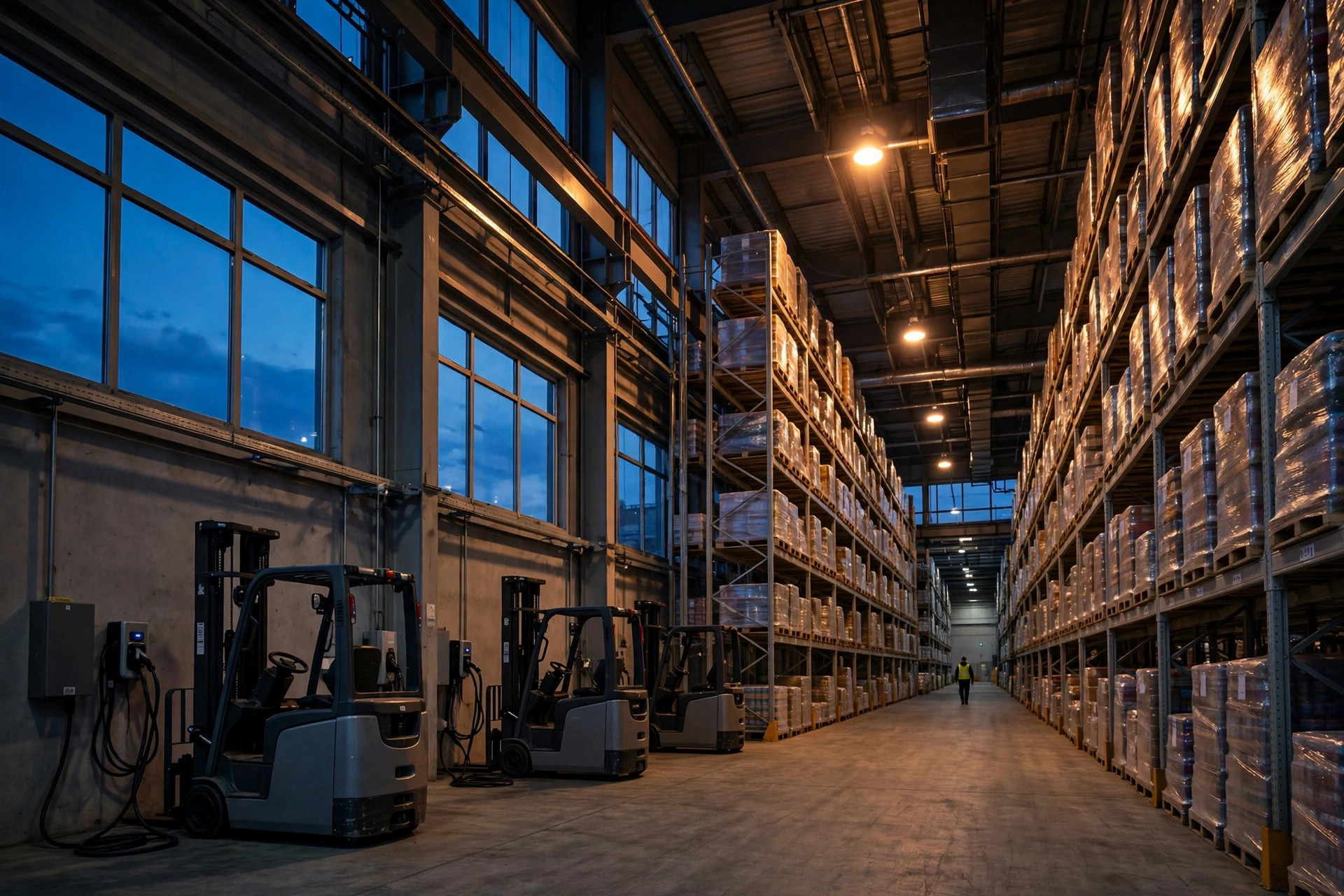
Only three warehouse loads move cleanly in time. The first is forklift charging. Trucks do not draw power evenly; they gulp it during shift-change windows, when a bank of chargers can pull dozens of kilowatts at exactly the wrong hour. Move the heavy charging to the overnight off-peak window and keep daytime charging to short top-ups. Total energy stays the same. The hour it lands in changes. The second is refrigeration pull-down. A cold room does not need full compressor power all day. Do the deep cooling overnight, then hold temperature through the peak window instead of chasing it. The third is lighting and cooling for the building itself: switch off lighting in idle zones by shift, and let high-bay areas drift two degrees warmer during peak hours. Nobody on the floor notices. The load curve does.
Here is the Inland Empire warehouse's bill, before and after. The tariff below is an illustrative example I built for the arithmetic: $0.42 per kilowatt-hour on peak, $0.22 mid-peak, $0.11 off-peak, and a demand rate of $18 per kilowatt. It is not any utility's published rate; run your own numbers per your utility's latest published tariff.
| Line | Before shifting | After shifting |
|---|---|---|
| Peak energy | 28,000 kWh, $11,760 | 19,000 kWh, $7,980 |
| Mid-peak energy | 52,000 kWh, $11,440 | 52,000 kWh, $11,440 |
| Off-peak energy | 40,000 kWh, $4,400 | 49,000 kWh, $5,390 |
| Energy subtotal | $27,600 | $24,810 |
| Peak demand | 620 kW, $11,160 | 480 kW, $8,640 |
| Monthly total | $38,760 | $33,450 |
The 9,000 peak kilowatt-hours that moved break down as 4,500 from charging, 2,500 from cold-room pre-cooling, and 2,000 from lighting and HVAC scheduling. The saving is $5,310 a month, or $63,720 a year, achieved without using one kilowatt-hour less. That is the part operators find hard to believe until they see it in their own bill: the money was never in conservation. It was in the clock. There is one more detail worth isolating. Do not start all the chargers at once: ten trucks plugged in together create a coincident spike that sets a new demand peak. Stagger start times by 15 to 30 minutes and the same energy goes in with a much lower peak. That is the whole economics of peak electricity costs in a warehouse, compressed into a single habit.
Where Shifting Backfires
Shifting is not free, and done crudely it bites back. During peak season in 2023, an e-commerce warehouse near Columbus, Ohio moved all of its forklift charging to overnight in a single step. The morning shift started with six trucks short of a full charge, the pick lines waited 40 minutes, and the building shipped over 900 fewer orders that day. The electricity saved did not cover the orders lost. The fix was unglamorous: charge 70 percent overnight, top up 30 percent at midday, and protect the first hour of the morning shift as untouchable. Charging can move. A full battery at shift start is a hard constraint, not a preference.
Cold storage bites back more quietly. Overdo the overnight pre-cooling and the compressors burn extra energy that eats part of the peak saving. Underdo it and the room drifts warm during the peak window, and spoilage risk costs far more than the electricity ever did. The third trap sits in the bill itself: shove every load into the off-peak window at once and the off-peak window grows its own peak. The demand charge is recalculated against the new spike, and you have simply renamed the peak hour. The goal is to flatten the curve, not to relocate it.
Before you touch a schedule, do four things. Pull twelve months of bills and confirm your tariff's peak, mid-peak, and off-peak windows and how demand is metered. List the three shiftable loads and size each one: how many kilowatt-hours it can move, how many kilowatts of peak it can shave. Move one load first, run it a month, and let the bill arbitrate before you expand. Then set a red line for each load: full batteries at shift start, a maximum cold-room temperature, a minimum light level in active zones. Savings only count inside those lines.
The final calculation fits on one line. Take the peak kilowatt-hours you moved times the peak-to-off-peak price spread, add the demand reduction times the demand rate, and subtract the extra labor and equipment friction the new schedule creates. If the result is positive, shifting pays. If it is negative, spend the effort somewhere else. The most expensive power bill is not the biggest one. It is the one nobody bothered to read.
By Lao Zhou, Logistics Cost Analyst