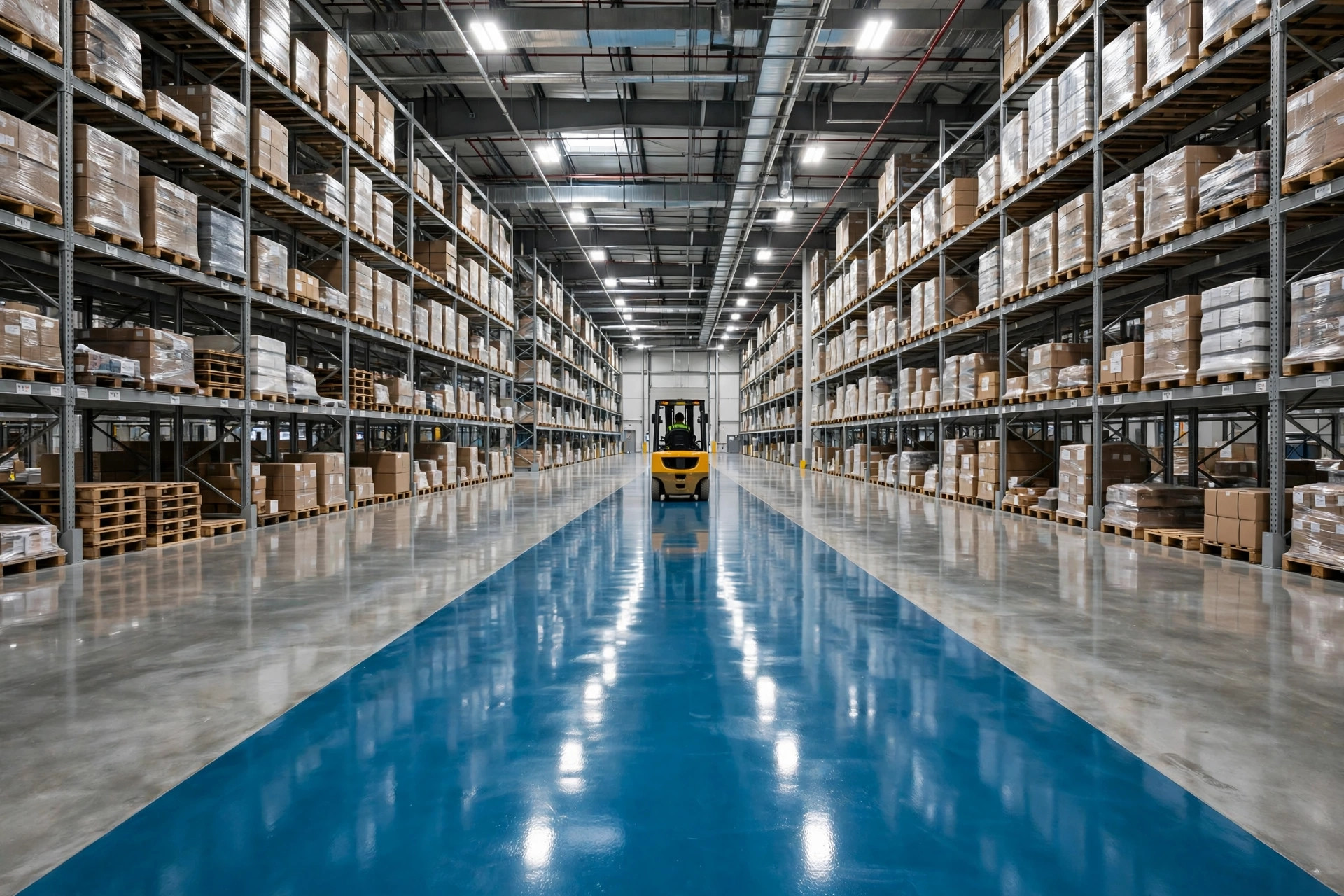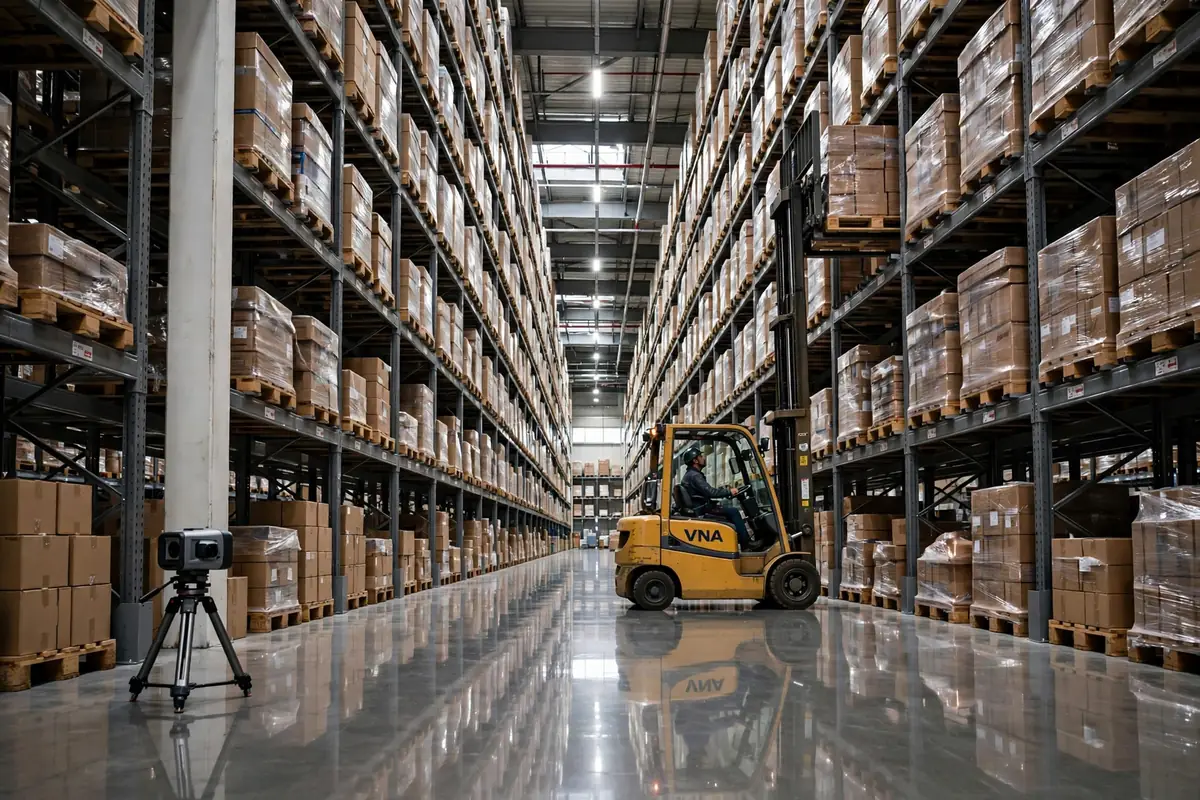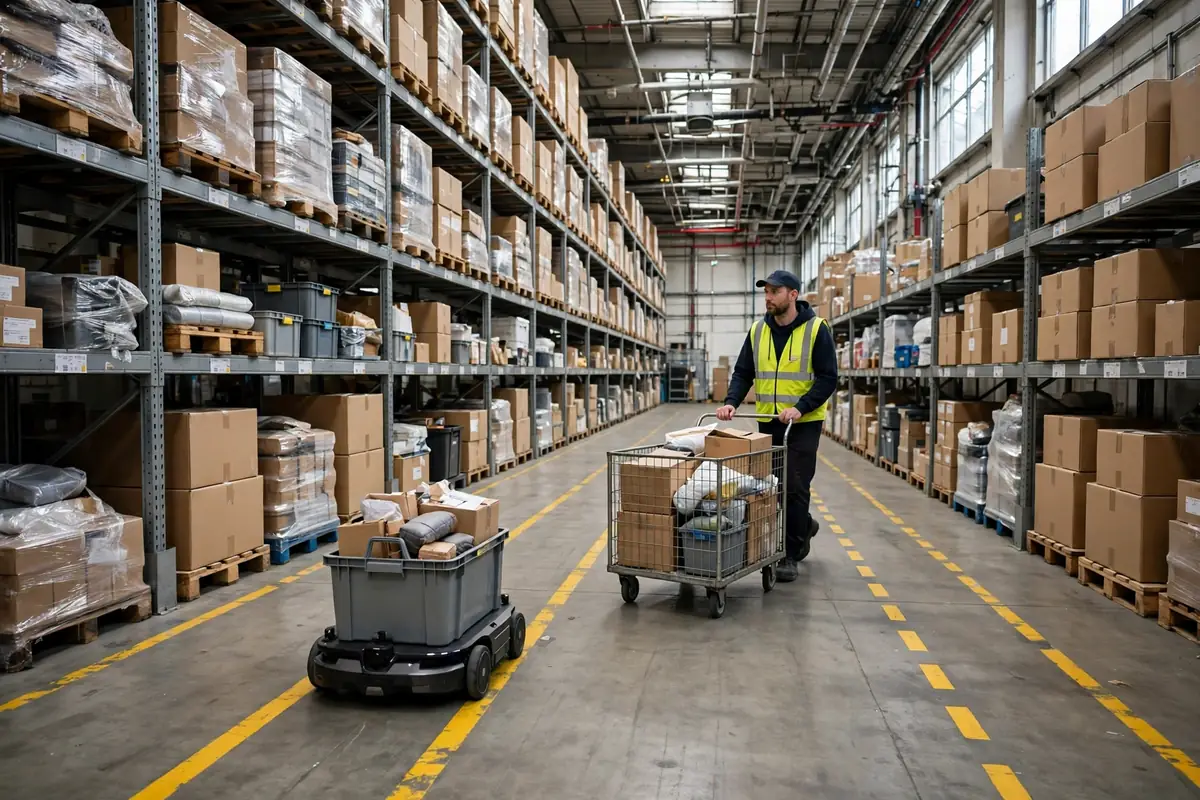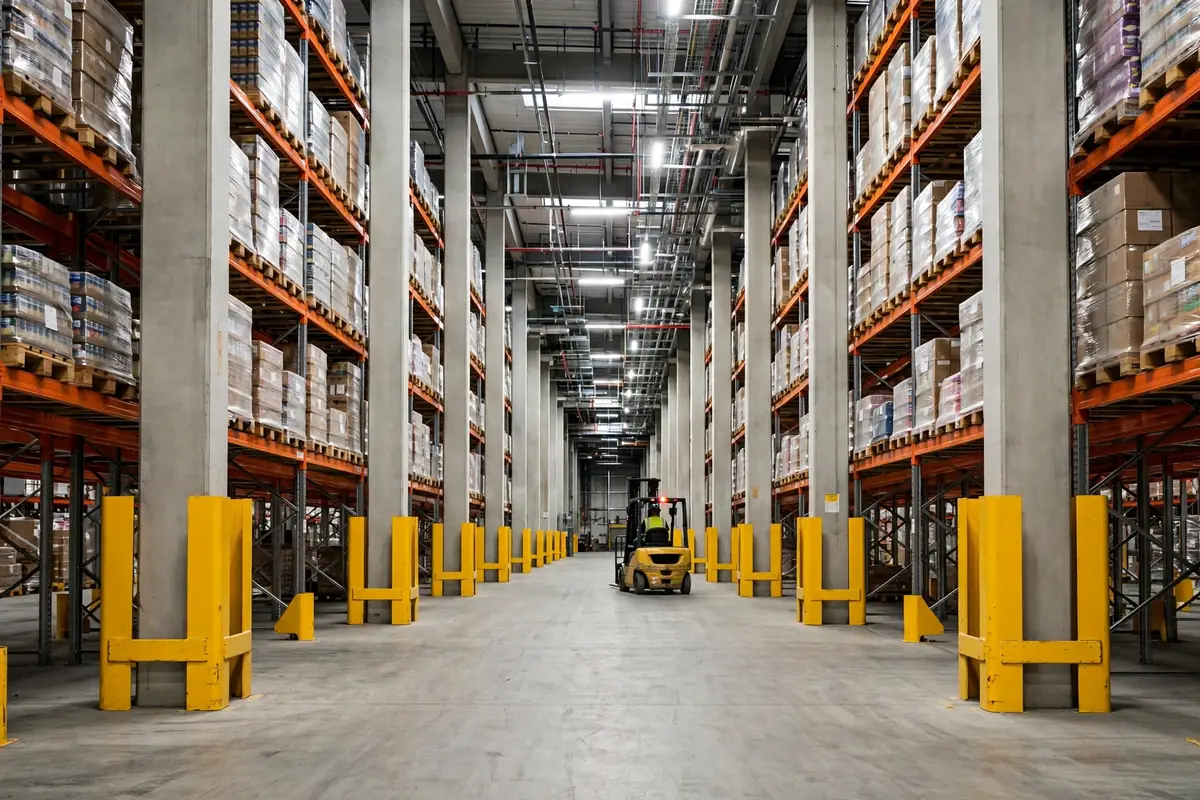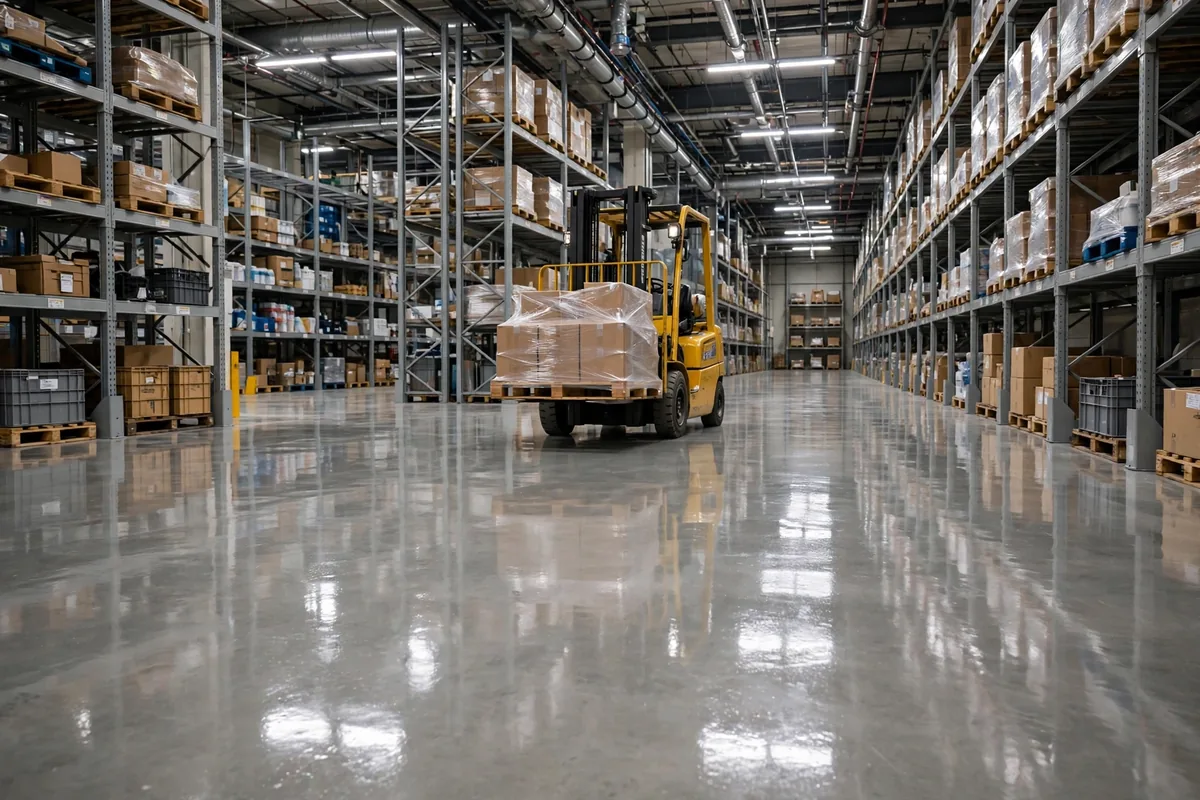
When I took over this 3,000-square-meter warehouse in 2023, the warehouse floor was a disaster. Every forklift pass kicked up a cloud of dust, the barcode scanner needed three tries to read a label, and dragging a pallet left a scar across the concrete. Then the contractors' quotes arrived — dry shake hardener, epoxy, polished concrete — and the three numbers were nearly double from cheapest to priciest. My first thought, honestly, was: we are a small warehouse, we cannot afford to burn money like this.
Big companies do their floors in one go, wall to wall, done. We can't. Dropping several hundred thousand dollars on a floor in one shot would drain our cash flow dry. So this isn't an article about the "best" warehouse floor. It's about how a small warehouse spends the least money possible and still gets a floor that survives three to five years of forklifts. Short version: we put polished concrete on the main forklift lanes, epoxy only in the packing area, and saved dry shake hardener for the new building we'll pour someday.
Three Warehouse Floors, One Table
| Floor | Installed cost | Dust and slip | Life under forklifts | Repair cost | Best for | | Dry shake hardener | Applied during the concrete pour, lowest added cost | Very wear-resistant, average dust control | Lasts as long as the slab, 10+ years | Hard to repair once worn; patch or resurface only | New builds, heavy-traffic lanes | | Epoxy flooring | Industrial systems $5–$10 per sq ft (published 2026 U.S. market ranges) | Great dust control, zoning lines possible, needs anti-slip aggregate | Recoat every 5–10 years | Small peeling can be patched; large peeling means stripping the whole area | Packing zones, food and pharma warehouses, anywhere that needs marked zones | | Polished concrete | $3–$7 per sq ft, large warehouses around $4–$5 (published 2026 U.S. market ranges) | Densifier seals the pores so dust drops sharply; high-gloss can be slippery when wet | 20+ years, nearly maintenance-free | Just re-polish when it dulls | Main forklift lanes, large dry warehouses |
A word on the numbers: those are published 2026 U.S. market ranges. Quotes where you are will be in local currency and local labor rates, so take the latest quote from a local contractor as the real number. Dry shake hardener is the odd one out — it's broadcast onto wet concrete and troweled in during the pour, so it's usually bundled into the slab price and rarely quoted on its own. Its cheapness is "while we're already pouring" cheapness. It only works for a new build. Want it in an existing warehouse? You'd have to tear the slab out and re-pour, and at that point nothing about it is cheap.
Here's our math: 3,000 square meters is about 32,292 square feet. Industrial epoxy across the whole floor at $7 a square foot comes to roughly $226,000. Polished concrete across the whole floor at $4 comes to roughly $129,000. The difference is nearly $100,000 — about half a year of payroll for us. That's the first rule of floor selection for a small warehouse: don't compare the price per square foot, multiply it by your area first.
Three Years of Forklifts Later, Which Warehouse Floor Failed First
Our polished concrete lanes went in at the end of 2023 — 8,000 square feet for about $32,000 at $4 a square foot. Three years of forklifts running over them every day, and all we've done is refill the expansion joints twice. When it dulls we burnish it and carry on. The epoxy in the packing area has held up fine too, but no forklift ever turns there — just hand carts and people on foot.
The cautionary tale is right next door. The warehouse beside us went for a $3-per-square-foot thin epoxy coat to save money. Six months later the forklift turning zones started curling and peeling, pallets dragged off whole flakes, and the dust was worse than before the coating. The re-do quote came in higher than doing it properly the first time would have cost. The money they saved got paid back with interest. That's the counterintuitive truth about floors: the cheapest price per square foot is often the most expensive floor you'll ever own, because one re-do costs more than choosing the pricier option once.
And one honest word: small warehouses should stop chasing "good-looking." High-gloss epoxy looks fantastic in a showroom and survives about two years under forklifts, and a scuffed glossy floor looks ten times worse than a plain matte one. We didn't epoxy the packing area to make it pretty. We did it for the zone lines and because it's easy to mop. Anywhere a forklift drives, epoxy stays off our floor.
The Small Warehouse Way: Zone by Zone, Year by Year
Doing the whole floor at once is the big-company way. Small warehouses have their own way, and ours comes down to three moves.
Zone it and phase it. Do the forklift lanes and the packing area first, leave the storage zones for later. A floor isn't a one-time purchase — lanes this year, packing next year, storage the year after. Cash flow stays comfortable and the result is the same.
If your old floor is dusting, don't rush to replace it — put a penetrating densifier down and buy yourself two years. It's cheap, a weekend job, and it cuts the dust by more than half while you save up for the real work.
And baby the weak points: expansion joints, doorways, and forklift turning zones. Check them every three months. Water and grit get into a joint and the damage spreads from there. Catching a bad joint early costs a few hundred dollars. Catching it late costs a few thousand to cut out and redo a whole section.
If you're running a warehouse like mine, here's my advice: when the quotes come in, don't just compare the per-square-foot price. Multiply by your area, then add the cost of doing it over again in five years, and look at the ten-year total. Protect the forklift lanes first, worry about looks later, and spread the spend over three years instead of swallowing it in one bite. Small warehouses have their own way of surviving, and floors are no different.
By Xiao Ma, Small Warehouse Owner