We had a client, a 3PL handling home goods out of a warehouse near Ontario, California. Last September, before peak-season stocking, he called to say his customer had walked the floor, pointed at a few cracks, and asked whether the floor was falling apart. That was the moment I knew this was no longer a housekeeping issue. Warehouse floor crack repair is a bill that gets more expensive the longer you defer it, and a forklift slip is usually just the first visible installment.
What Causes Warehouse Floor Cracks: Sort Them Before You Fix Them
Not all cracks are the same, and the repair that works for one will fail on another. The first kind appears near expansion joints and is mostly about temperature change and concrete shrinkage. It can look alarming without being dangerous. The second kind shows up where forklifts turn and stop hard every day; the edges start crumbling and shedding, and that is the real problem. The third kind runs long across an area because something underneath has moved or weakened. Spot-filling that third kind alone will not hold.
I have seen too many warehouses start by sealing every crack in sight, pay the invoice, and watch the turning points crumble again three months later. The order was wrong. Start by marking the cracks with chalk and sorting them: cracks in corners where no forklift travels can wait and be watched; cracks in forklift aisles, turning points, and dock areas go first; cracks whose edges already come away in your hand go straight onto the repair schedule. If you cannot tell them apart, get the repair vendor to look and put the classification in writing in the proposal. Otherwise you pay by the meter and receive work that treats every crack as if it were the same.
Warehouse Floor Crack Repair Options Compared: Sealing, Patching, and Partial Replacement
There is no universal fix. The right choice depends on the condition of the crack, what downtime costs you, and how often you are willing to redo the work.
| Method | Best for | Downtime | Durability | Cost level |
|---|---|---|---|---|
| Crack sealing | Narrow, stable cracks with solid edges | Short, roughly half a day per aisle | Moderate, needs periodic re-checks | Low |
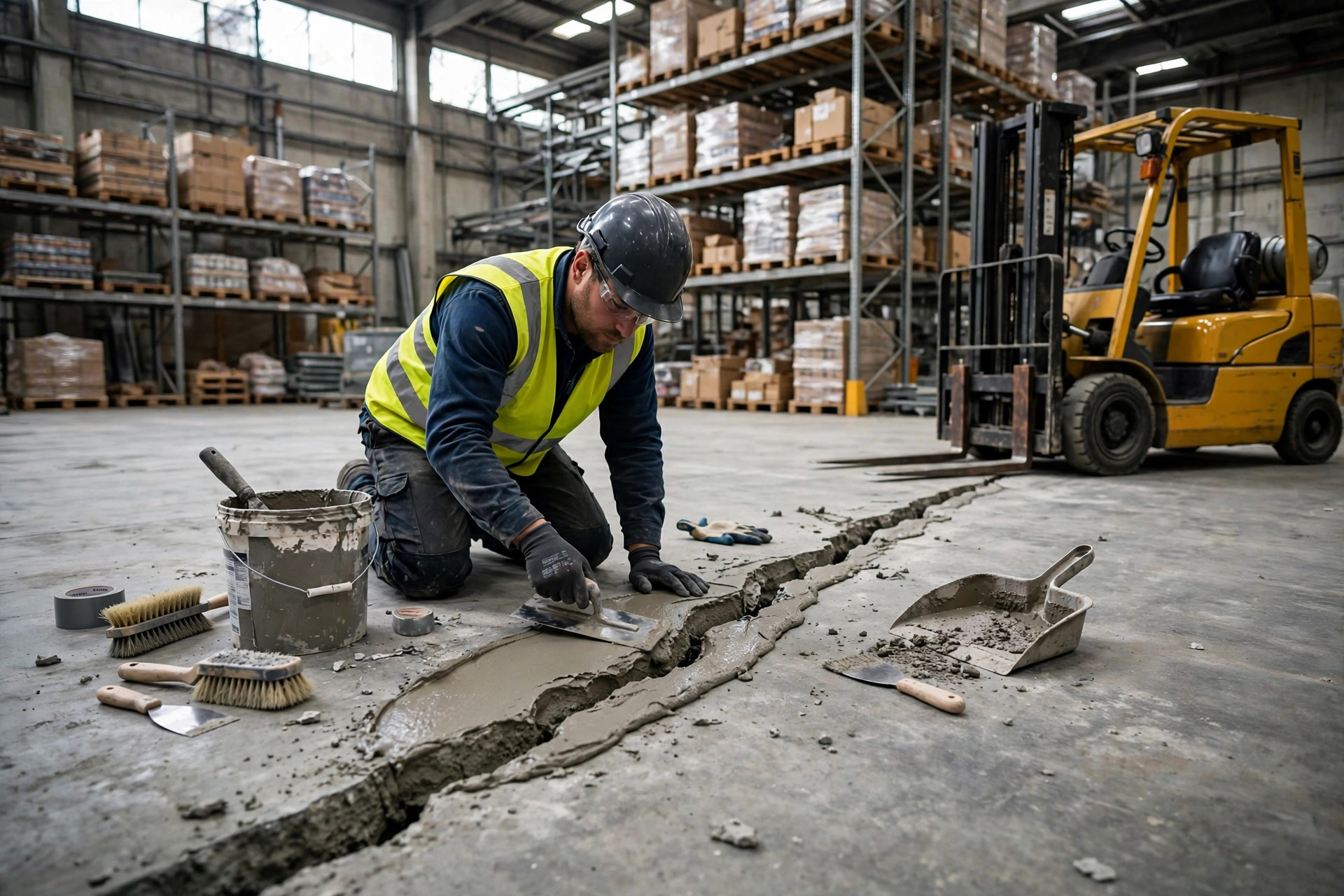
| Patching compound | Small areas where edges are crumbling or pitted | Moderate, needs curing time | Good, if the base is prepared properly | Medium |
| Partial replacement | Areas with loose base material or repeated repair failures | Long, an area out of service for days | Best, effectively a new section of floor | High |
Sealing is the cheapest option, but it only works when the edges are still solid. Pour sealant into a crumbling edge and it has nothing to grip; it peels out within a couple of months. Patching compound is the workhorse for most warehouses, and success has little to do with the brand on the bucket. It comes down to preparation: if dust and loose material are not cleaned out and moisture is not dealt with, even the best compound ends up as a skin sitting on top of a weak base. Partial replacement is the most expensive and the most thorough, reserved for those stubborn zones that get repaired every year and fail every year. When you negotiate, ask for these three priced separately. A single bundled price hides which method was actually used where.
Here is an insider detail vendors rarely volunteer: pricing by the meter versus pricing by the area can produce very different totals. By the meter makes sense for fine cracks; by the area is fairer for damaged patches. If a vendor insists on pricing everything by the meter, ask whether the sections where edges are broken and need widening and cleaning are included in that meter count. Ask that one question and the padding in the quote usually shows itself.
Sealing and Maintenance: Repair Is Not the Finish Line
Many warehouses treat a completed repair as the end of the story, while the dust problem carries on untouched. The cracks may be filled, but if the surface is still powdering, forklift traffic keeps throwing dust into the air. It lands on cartons, works its way into packaging, and eventually shows up as customer complaints and returns. Sealing the surface and keeping up maintenance is what locks in the repair: sealing reduces dusting, routine sweeping should include crack edges and wall lines rather than just the middle of the aisle, and standing water should not be left to sit, since moisture loosens patching material early.
Put maintenance on a schedule instead of relying on someone remembering. My advice to clients is simple: walk the main forklift aisles once a month and photograph how the crack edges are changing; reconcile once a quarter to see which aisle is opening up again. Those photos give you before-and-after evidence for the next vendor quote, and a maintenance record to show customers.
The Full Cost of Dust and Forklift Slips: Tires, Damaged Goods, and Lost Rhythm
We had another client near Dallas, Texas, doing apparel fulfillment. Early this year, the edges along one main aisle started shedding, and dust kept building up. Nobody paid much attention until forklifts slipped three times at the same turning point within a month: twice an empty truck fishtailed and braked hard, and the third time a loaded turn shifted a pallet, damaged two cartons, and bent a rack protector. The damaged goods alone were not dramatic, but the knock-on bill was: rework to restack and recount, protector replacement, and a temporary speed limit on that aisle that disrupted the whole picking rhythm. Worse, dust had settled on light-colored apparel packaging, so customers received goods with visible gray marks, and the return reasons said so plainly.
Count the whole bill, not just the first line. Direct losses are damaged goods and repairs. Indirect losses are the slower throughput while an aisle is restricted and the dent in customer confidence. Hidden losses are tires wearing faster on rough crack edges and coming up for replacement sooner. Most warehouses only count the first category, which is why cracks always feel like something that can wait. Wait, and a small crack becomes a large one, dust becomes complaints, and by renewal time the customer is negotiating a discount while holding site-visit photos. By then the leverage is gone.
Here is the counterintuitive part: the widest, scariest-looking crack is often not the first one to fix. The one that matters most is the unremarkable fine crack at a forklift turning point. Wide cracks usually sit in corners where trucks never travel: ugly, but harmless to operations. A turning-point crack gets run over hundreds of times a day, and once its edge crumbles you get slipping, shedding, and dust all at once. Set repair priority by forklift routes, not by crack width. Sorting by width is for impressing visitors; sorting by route is for protecting the business.
Negotiating the Floor: Do Not Leave It Until Renewal
Who pays for floor repair is a guaranteed argument if the contract does not spell it out. I have seen three versions: the landlord covers structural floor issues while the tenant covers routine maintenance; the tenant covers everything; or costs are split by cause of damage. Any of them can work, but the boundary must be written down before signing or renewal: how wide does a crack have to be to count as structural? Does edge damage from normal forklift wear count as tenant responsibility? How is downtime during repair handled? These questions sound fussy now and cost real money later if never asked.
Also, do not start repair work one week before peak season. Vendor scheduling, curing time, and aisle rotation all need lead time. My approach is to walk the floor and photograph everything two months before peak, get itemized quotes, and re-inspect after peak ends. Two rounds of photos give you a basis for next year's repair budget, and when the customer asks, you are the person with records rather than the person saying the floor seems fine.
Next time you negotiate a contract, ask these three questions: first, where exactly does the contract draw the line between structural floor damage and routine wear? Second, is the repair quote priced by the meter or by the area, and how are broken edges counted? Third, who coordinates aisle rotation and downtime during the repair, and is that written into an appendix? Ask those three, and the floor stops being a hidden trap in your contract and becomes a bill you can actually account for.
By Susan, 3PL Sales Director