Think of warehouse theft prevention the way an automation engineer thinks about a control system: sensors detect, a controller decides, and actuators block. Cameras without access control are sensors with no actuator — you can see the problem, but you cannot stop it. Access control without cycle counting is an actuator with no feedback signal — you block, but you never learn whether the block worked. This article is about how the three work together as one system, not three separate purchases.
Warehouse Theft Prevention Starts with Zoned Access Control
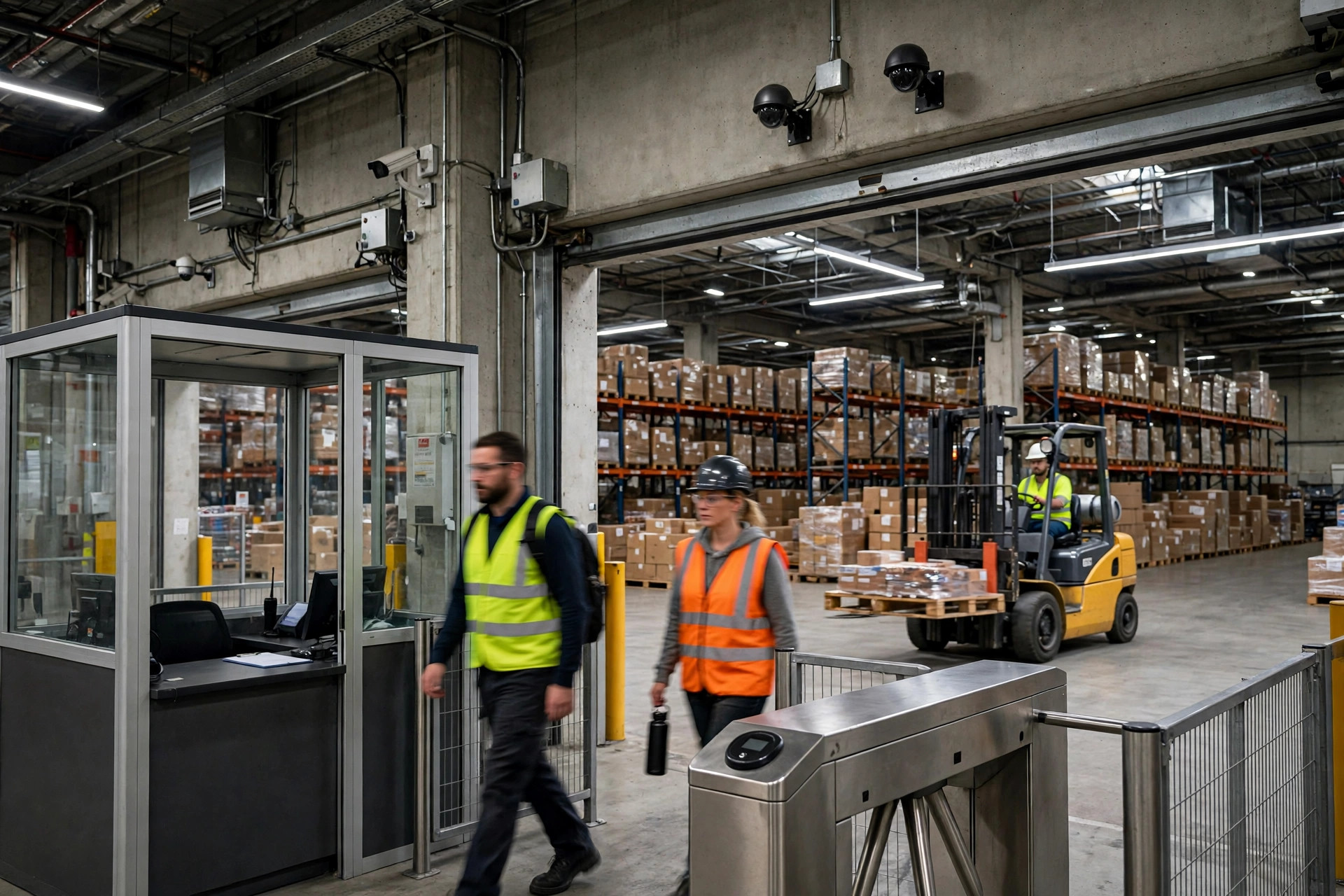
Start with the principle. Access control is not about "locking the door." It is about dividing people into zones. A general warehouse needs at least three: the perimeter zone, the operations zone, and the high-value zone. The perimeter covers offices and parking, where a visitor log is enough. The operations zone covers picking, putaway, and packing, open only to staff on shift and drivers with appointments. The high-value zone holds expensive goods and staged orders, open only to a named list, with every entry logged.
Where do you draw the line between zones? Look at two things: value density and foot traffic. Where value density is high and foot traffic is low, zone it tightly; where the opposite holds, you can be coarse. The most common mistake I see is one badge for the whole building — pickers, cleaners, and visitors through the same door. Once a badge gets lent out, the whole warehouse is effectively open. The fix is boring and cheap: permissions follow the roster, night-shift access expires when the shift ends, and a departing employee loses access the same day. An access list nobody maintains is more dangerous than no access control at all, because it gives you the illusion of being covered.
I ran into this at a third-party warehouse in eastern China during the 2024 peak season. Cycle counts came up short on small electronics for three weeks running — never by much, always written off as picking errors. When we finally pulled the access logs, the gap was a side door on the waste-material route: it was never locked, and staff used it as a shortcut in and out of the high-value area. The access system itself worked fine. The failure was a corridor that was never inside the system at all. The lesson is a very engineering one: the boundary of your system is not where your devices are. It is where your devices are not.
Warehouse Theft Prevention Cameras: Cover the Flow, Not the Walls
Cameras follow a simpler principle: they are not there to "watch everyone." They are there to reconstruct an event after it happens. So place them along the flow of goods, not along the walls. Entrances and exits, loading docks, both ends of high-value racking, packing benches, and the returns area are the five must-cover points. Loss happens at moments of handling and handover, not while goods sit static in an aisle.
How do you find blind spots? Take a floor plan and walk every route a carton travels, marking each spot where a hand can reach goods but no camera can see. Blind spots are rarely in corners. They cluster at handover points — the threshold between dock and warehouse, the back of the packing bench, the returns staging area — where responsibility is fuzziest, and that is exactly where things go missing.
Here is the counterintuitive call: more cameras do not necessarily mean a safer warehouse. Once the camera count climbs, the number of people actually watching footage drops — nobody can watch dozens of feeds at once. What matters is whether critical angles are sharp enough to identify a face and a shipment number, and whether footage can be pulled for a specific order and time window within minutes. When buying equipment, ask "how fast can we retrieve this incident" before asking "how many cameras do we get."
Gate Checks: The Last Line of Warehouse Theft Prevention
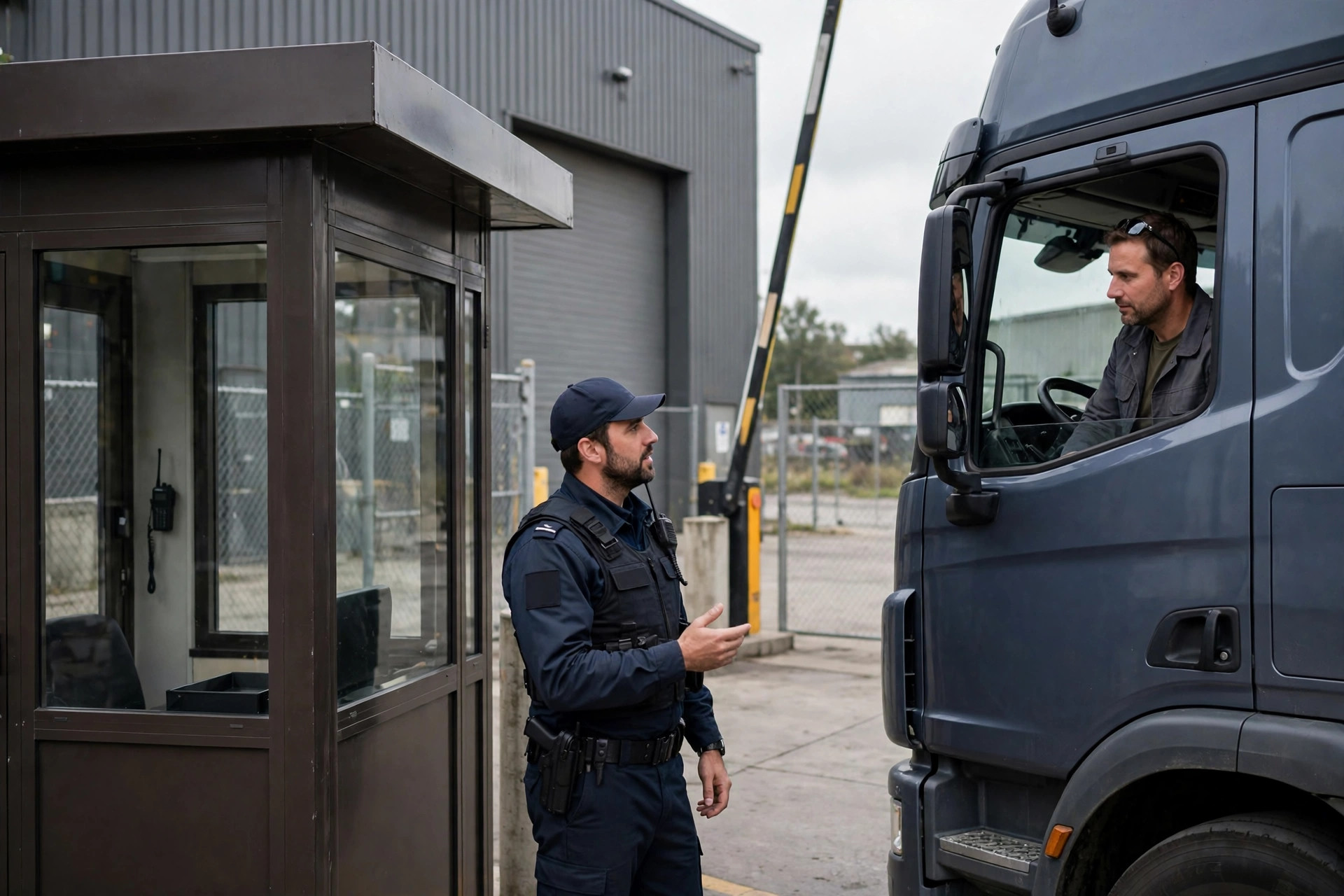
Access control decides who gets in. Cameras let you investigate. Gate checks decide whether goods get out. This is the last line, and the one most often watered down. A gate check has three steps: check the order, check the goods, check the person. Check the order against the release paperwork to confirm this shipment is genuinely due out today. Check the goods by opening cartons or counting the full load to confirm what is on the truck matches the paperwork. Check the person to confirm the driver and vehicle match the appointment — not just anyone who drives up with a truck.
In 2023, a warehouse in southern China stopped an attempted external theft at dawn: two unbooked trucks arrived at the dock, and the drivers presented a blurry pickup note, hoping to load. The guard checked the appointment system, found no booking, and refused release. What saved that load was not a camera. It was a rule with no exceptions: no appointment, no release. The moment a rule can be bent for convenience, the line no longer exists. External thieves are not afraid of cameras. They are afraid of a process with no gaps.
The boundary for gate checks is equally clear: small, high-value goods get item-level checks; bulky, low-value goods get spot checks plus a full-load seal. Record the seal number in the outbound paperwork, and have the receiver check it before opening. A seal costs almost nothing, but it turns a blame game about where the loss happened into a verifiable signal.
Internal Theft vs External Theft: Different Problems, Different Tools
Internal and external theft work on different principles, so they need different tools. External theft attacks the boundary, and the weapons are the three lines above: access control, cameras, gate checks. Internal theft exploits process gaps, and the weapons are entirely different: separation of duties, dual verification, and anomaly data.
The typical internal theft is not a break-in. It is an authorized person finding a hole: the same person picks and verifies, counts and adjusts, or reports damage and approves their own report. Automation engineers call the fix separation of duties: whoever touches goods cannot also keep the books, and whoever reports a loss cannot approve it. Dual verification sounds labor-intensive, but it only needs to apply at high-value steps, not across the whole building.
Data is the best internal-theft detector you have. Count variances that keep appearing in the same zone, on the same shift, for the same product family — that is a signal, and it beats camera footage. Many warehouses only look at total variance, which averages the signal away. Split variances by zone, shift, and product category, and the cell that keeps flashing is where you investigate — the same logic as fault localization on a machine.
Closing the Loop: Cycle Counts Prove Whether Prevention Works
Once the three lines are built, how do you prove they work? Cycle counting, closed properly. Count monthly across the building and weekly in the high-value zone, and every variance must be closed within a set window: root cause found, classified, fixed. A variance adjusted without a cause is not a solution — adjusting quickly is how a hole stays alive. Adjustment is the last step, never the first.
Let us run the numbers as a rough model, not a market quote, for a mid-sized general warehouse:
| Item | Annual shape (illustrative) | Job |
|---|---|---|
| Zoned access control and permission upkeep | Roughly one part-time administrator's workload | Keep the wrong people out |
| Camera upkeep at critical points | Regular inspection and storage cost | Reconstruct incidents |
| Gate-check staffing | One checker per shift | Keep the wrong goods from leaving |
| Cycle counting and variance analysis | Fixed monthly hours | Prove the lines work |
The other side of the ledger is the cost of a loss: not just the goods, but the customer claim, reshipment freight, and trust damage. A single high-value loss often exceeds several months of checker cost. If the system stops one or two serious losses a year, it has paid for itself. Theft prevention is loss avoidance, not a cost center.
One last point that gets overlooked: a prevention system fails most often by falling out of use, not by breaking. Access lists untouched for months, gate checks skipped in peak season, year-end bulk adjustments — a system run that way is decoration, whatever the equipment cost. An automation engineer judges a system by how it performs at its worst. If it holds on a peak-season night shift, it is a real line of defense.
So is the money worth it? Watch one number: the share of last year's count variances closed as "cause unknown." When that share falls, the system works; when it does not, more cameras will not save you.
By Da Liu, Automation Engineer