At 6:40 in the morning the night shift is already changing out of their shoes by the door, and the forklifts are rolling out of the charging area one by one. I stand by the dock and watch, because I have learned that how the whole day goes is mostly decided in the next fifteen minutes. Folks, let me be straight with you: a warehouse daily equipment inspection sounds like paperwork until the morning it saves somebody. I used to treat it that way myself. Then one morning a forklift came out of the yard, the driver pressed the brake, and the truck kept sliding toward two people standing by the dock door. Nobody got hurt. The load stayed on the forks. But the look on those two faces stuck with me, and so did what the night-shift lead said when I got there: he thought the soft brake would hold for one more shift. It did not, and from that day on the pre-shift check in our warehouse stopped being a formality.
The problem had surfaced the night before, quietly, the way these things always do. The night driver felt the brake go soft and decided not to write it up. The morning driver took the truck without testing the brake and headed for the dock with a full pallet. The truck was not going fast, but a soft brake takes longer to stop than you expect. Small faults on equipment never fix themselves. They wait for the busiest moment of the day and then they show up.
Forklifts first: brakes and forks before anything else
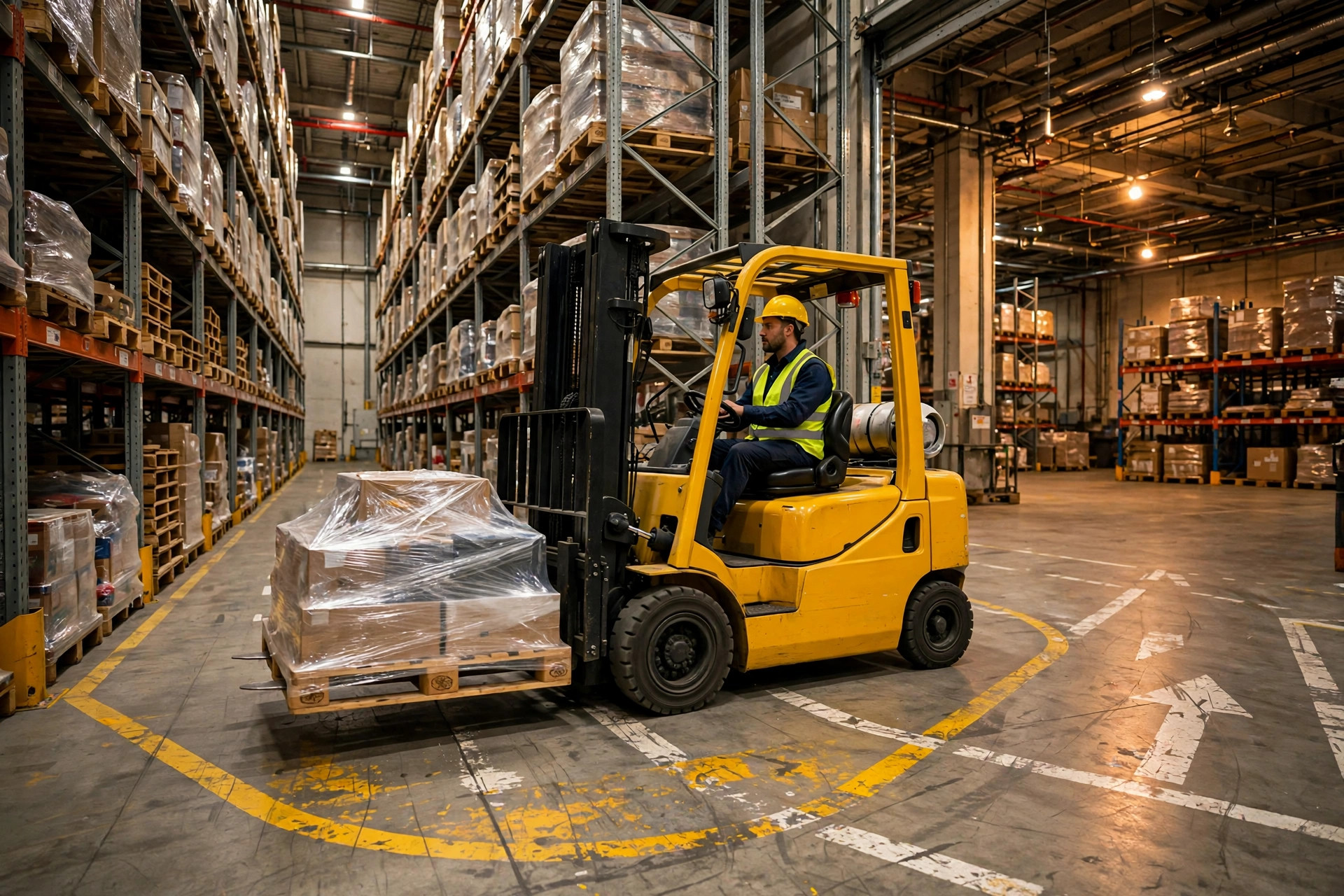
Our forklift check has one fixed order, and we do not shuffle it. Step on the brake twice. Listen for noise. Feel whether the truck stops cleanly or drags on. Then look at the forks: cracks at the tip, bends at the heel, one fork sitting higher than the other. Only after those two pass do we look at tires, lights, the reversing beeper, and the battery gauge. We used to work down the sheet from top to bottom, which meant we spent time on appearance and battery level while the brake sat halfway down the list. Now the thing that can hurt somebody gets checked first, and everything else waits its turn.
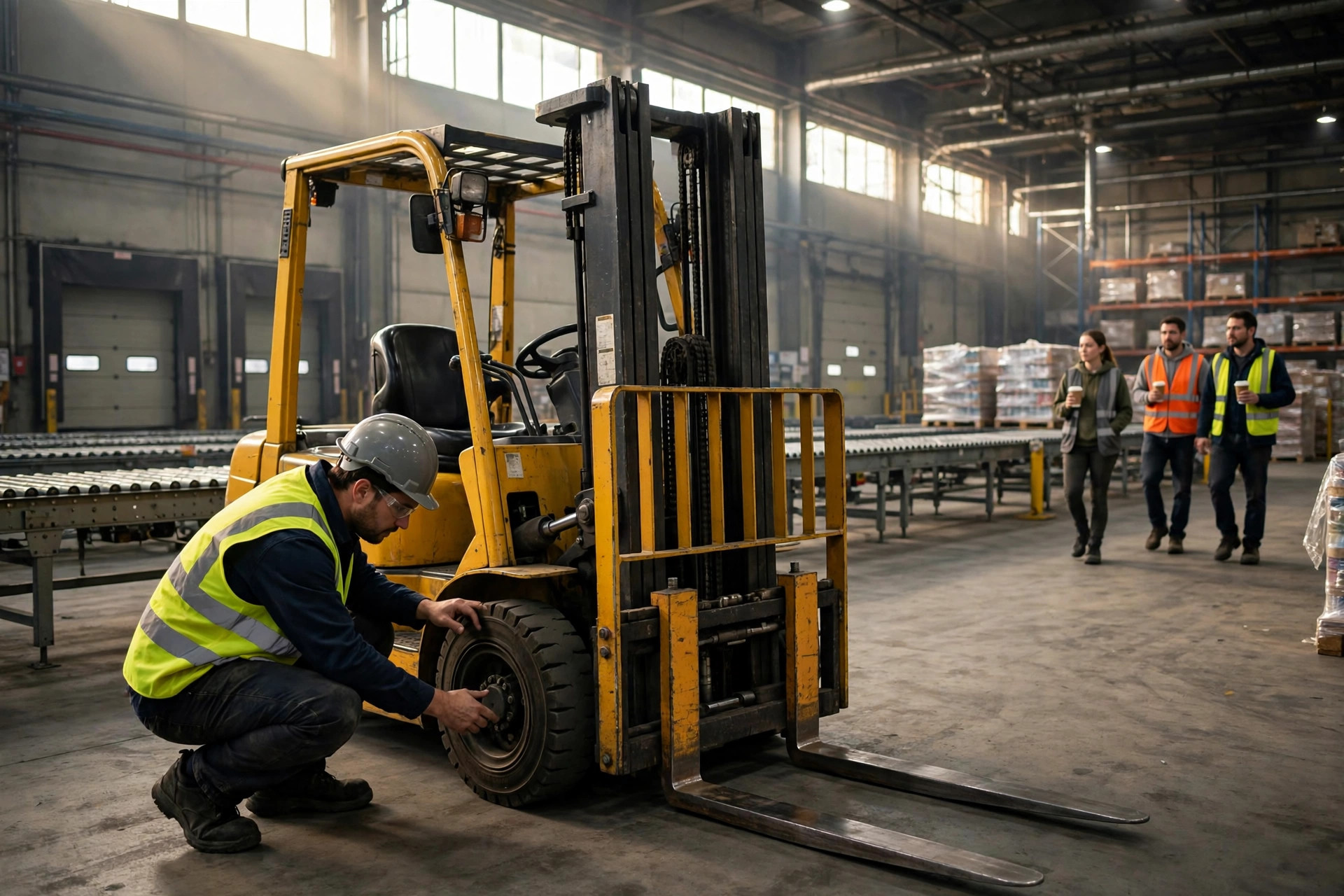
Liu, who has driven forklifts in our warehouse for over a decade, trains new drivers with a habit that looks fussy until it pays off. He walks around the truck before he gets on it, crouches down, and looks at the heel of each fork. Then he sits down and tests the brake. Then one new driver copied the routine and spotted a hairline crack at a fork heel. That truck was parked for the day and the fork was replaced. If he had skipped the walk and driven off with a heavy load, nobody could have promised that fork would hold all the way to the rack.
What a warehouse daily equipment inspection actually covers on the conveyor and dock doors
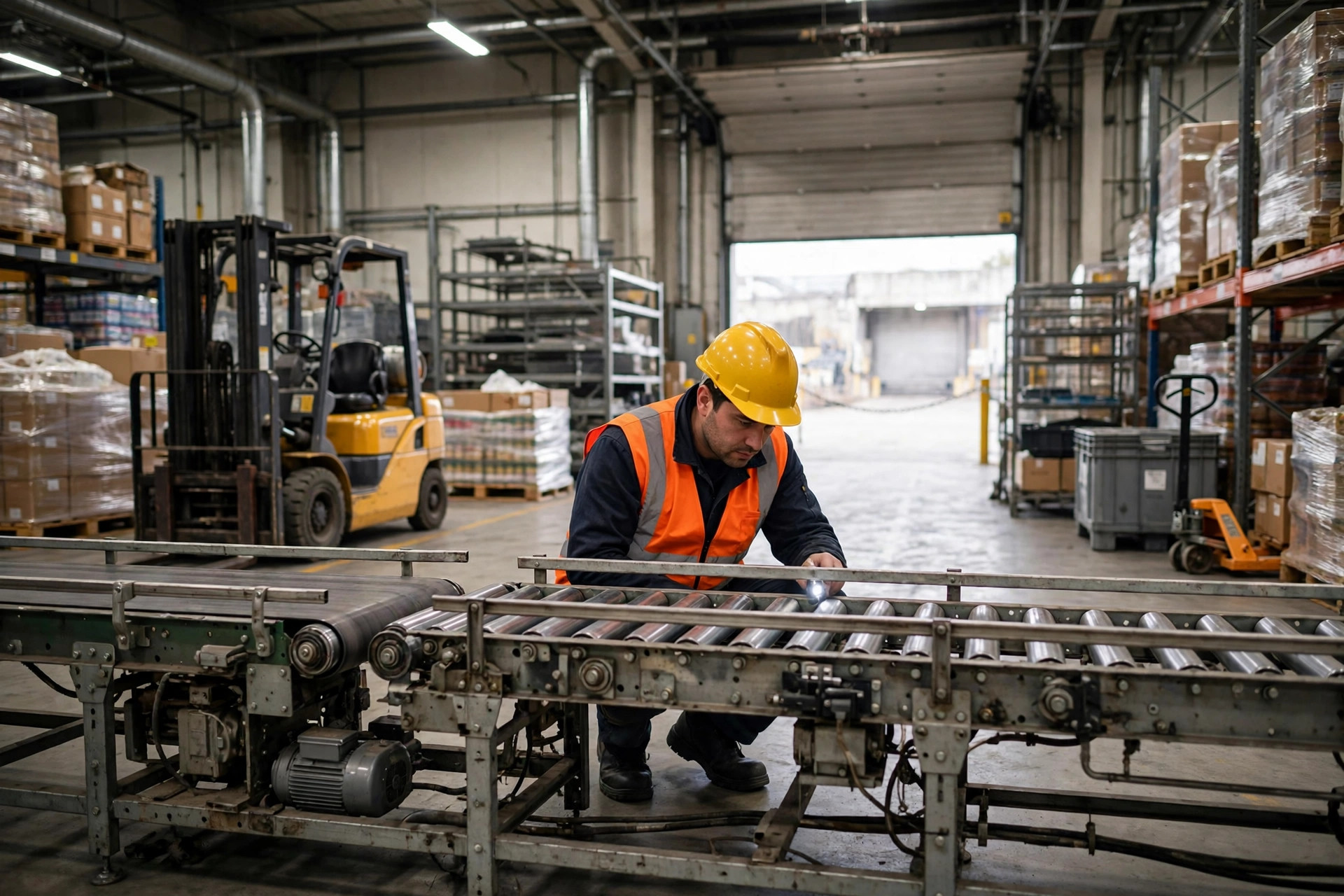
After the forklifts, we move to the conveyor and the dock doors. Neither one looks dramatic, and both can stop the whole line when they fail. The conveyor gets a dry run with nothing on it. You stand beside it and listen. A dull section, a belt drifting to one side, a roller that sounds wrong — you can catch all of that with your ears before a single carton goes on. Then you look underneath, for torn carton corners, loose strapping, and bits of stretch wrap. Those scraps look harmless until they wrap around a roller and stop the line.
Dock doors get raised once and lowered once, every morning, whether that door is scheduled or not. Does it rise smoothly, sit flat when it comes down, and does the edge safety device respond? One cold winter morning a door jammed halfway up, and a driver waited outside while our people waited inside, both sides getting angrier by the minute. The track had a thin layer of ice in it, and nobody had moved that door the night before, so nobody knew. Since then, every door moves every morning.
When the scanner won't read, don't swap the gun first
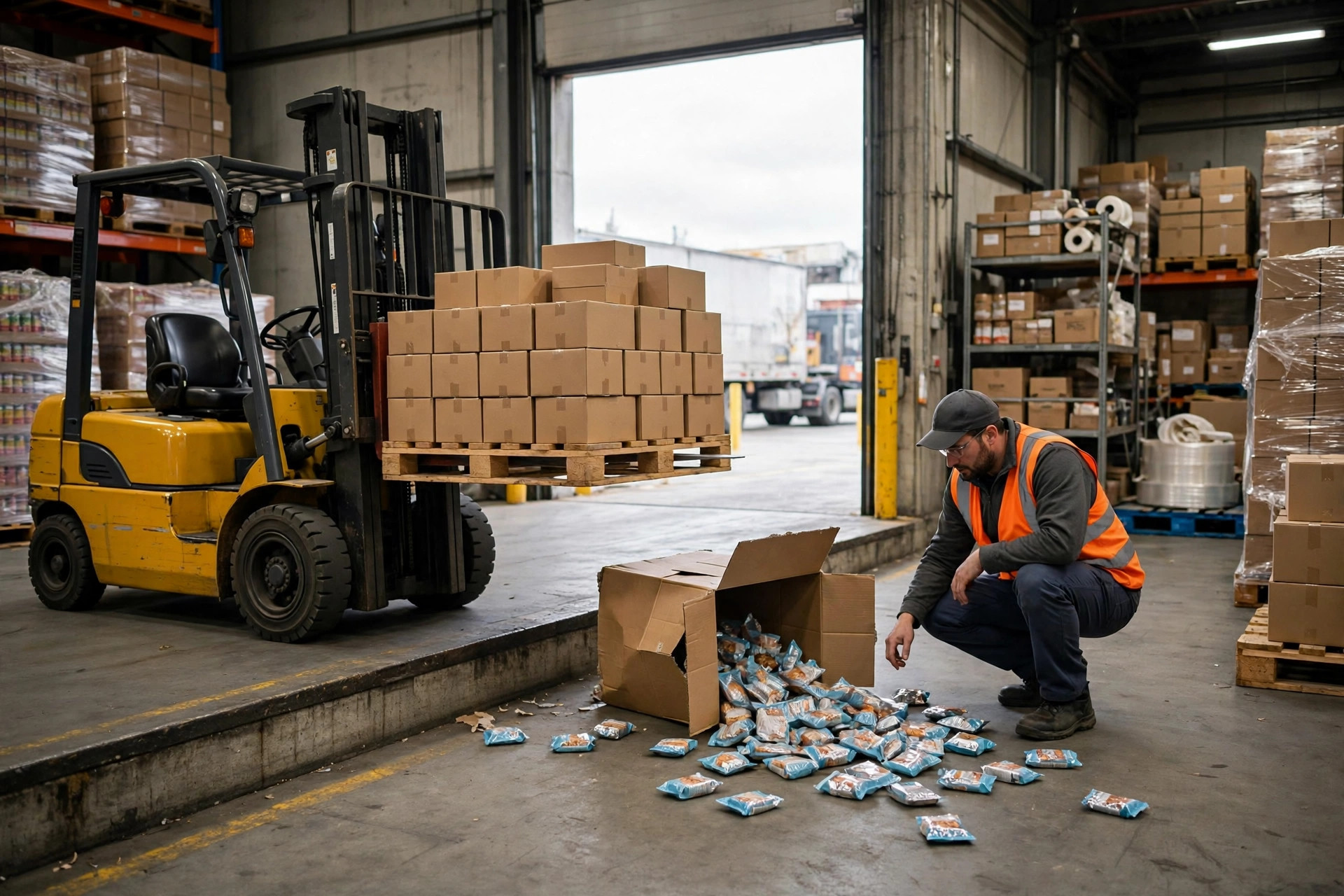
Scanners get blamed more than any other piece of equipment in the building. A code will not read, and the first instinct is to grab a different gun. Then the second gun fails too, and people start arguing about whether the system is down. We went through exactly that one morning when three people's guns all refused the same pallet label, one after another. Two guns were swapped before anyone looked closely at the label itself. It had been stuck crooked, half of it folded over a crease in the stretch wrap, so no gun on earth could have read it. A fresh label fixed it in seconds, and the old guns worked fine.
Our rule now runs in a fixed order: try a different label first, then a different gun, then check the order number in the system. Only after those three steps do we send a gun for repair. Batteries get the same treatment. Every morning we glance at the batteries and the charging cradles, and any battery that looks swollen comes straight out of service. Nobody gets to gamble that it will last one more shift, because a dead scanner in the middle of a wave of orders holds up far more than one person.
The warehouse daily equipment inspection sheet: how fifteen minutes really break down
Our warehouse daily equipment inspection sheet is one page long. It used to be two pages, and it tried to cover everything. The result was predictable: people checked faster and faster as they went down the list, and by the second page most of them were ticking boxes without really looking. Here is the counter-intuitive part, and I learned it the hard way: a shorter checklist gets a more honest check. One page, fifteen minutes, four pieces of equipment, three to five points each. The person who signs is the person who will use that equipment that day. Nobody signs for anyone else, and if we catch a forged signature, the supervisor talks to both people involved.
The fifteen minutes split roughly like this: five for the forklifts, five for the conveyor and the dock doors, three for the scanners and charging gear, and two left over to write problems down, tag a truck out, or grab a replacement. A note that says "forklift problem" helps nobody on the next shift. We write which truck, what is wrong, and who found it. Tagging matters too. A truck that is out of service gets a tag on the steering wheel and its key goes to the supervisor, so the next shift cannot just hop on out of habit.
| What you find | What to do on the spot | Can it run today? |
|---|---|---|
| Soft brake or brake noise | Tag it out, hand the key to the supervisor | No |
| Cracked or bent fork | Tag it out, wait for a replacement fork | No |
| Conveyor jammed or belt drifting | Clear it, run it empty once, confirm | Yes, once confirmed clear |
| Dock door sticking on the way up or down | Try it twice, clear the track, report it if it still sticks | Depends — do not force a sticking door |
| Scanner will not read | Try another label, then another gun, then check the order | Yes, once you find the cause |
One more rule sits behind the whole sheet: reporting a problem costs you nothing, hiding one costs you a conversation. I have told my crew many times over: report it and we lose ten minutes; hide it and we might lose the whole day, and somebody might get hurt. Once people believed that, the reports started coming in, and that is when the sheet actually started working. A checklist only works if people dare to use it. If they are afraid to report, the prettiest form in the world is just a piece of paper.
So tomorrow morning, walk the same loop before the shift starts. Truck, line, door, gun. Check them, sign your name, and then start work. If something fails, do not push through it. Tag it, swap it, and move on. That is not lost time. That is the fifteen minutes that keeps the rest of the day moving.
By Chen Feng, Warehouse Operations Manager