Warehouse dehumidifier humidity control comes down to three bills: the damage bill, the equipment bill, and the power bill. My verdict up front: set your humidity target first, size the machines for the wettest two weeks of the year, and only then worry about the power bill. Get that order backwards and you will pay twice. I have seen too many warehouses do it backwards — buy two cheap units to "get by," watch cartons go soft, then buy more units anyway, paying the power bill and the damage bill the whole time.
The pit I walked into: goods are not ruined by rain, they are ruined by trapped damp
In June 2023, during the humid rainy season in southern China, I was called into a paper-packaging warehouse of about 6,000 square meters near Dongguan. The owner insisted no rain had ever touched the goods, yet customers had returned two batches in a row: cartons gone soft, printed materials with mold spots. One walk through the building told the story: the two rows of pallets against the exterior wall sat less than a hand's width from the wall, the wall felt cool to the touch, and the bottom cartons were already soft and darkened. We counted more than 40 cartons visibly damp.
Look at it from both sides. On one side, the damage: 40-odd cartons were not worth much on their own, but return freight, repacking labor, and the doubt planted in the customer's mind about the next order cost far more than the cartons. On the other side, the misjudgment: the owner believed "no leak means no problem." In rainy season, damp does not need a leak. It creeps in through walls, floors, and dock doors left open, then sits in corners with no airflow and softens cartons within days. Paper goods, apparel, and textiles are the most vulnerable; metal parts rust, and electronics can pick up hidden moisture damage.
A second warehouse taught me the opposite lesson. In the 2024 rainy season, an apparel warehouse near Ningbo ran its dehumidifiers flat out to "be safe" and drove humidity as low as it would go. Nothing molded — but cartons turned brittle, hang tags dried and stiffened, staff complained of dry throats and static shocks, and the power bill jumped well above the same period the year before. Here is the counterintuitive judgment at the heart of this article: drier is not better. Push humidity too low and you buy very little extra protection while paying more for power and damaged packaging. The target has to be a range, not a race to the bottom.
Humidity control targets: pick the number before you buy the machine
My own practice for ordinary carton goods, apparel, and textiles is a relative humidity band of 50 to 60 percent. Precision electronics and metal parts are a different conversation — follow the shipper's or manufacturer's requirements there, and check their latest published guidance when unsure. A band matters more than a single number because a warehouse is not a laboratory: a dock door opens, a forklift drives in, and the reading moves. Chasing one exact figure just makes machines cycle on and off all day.
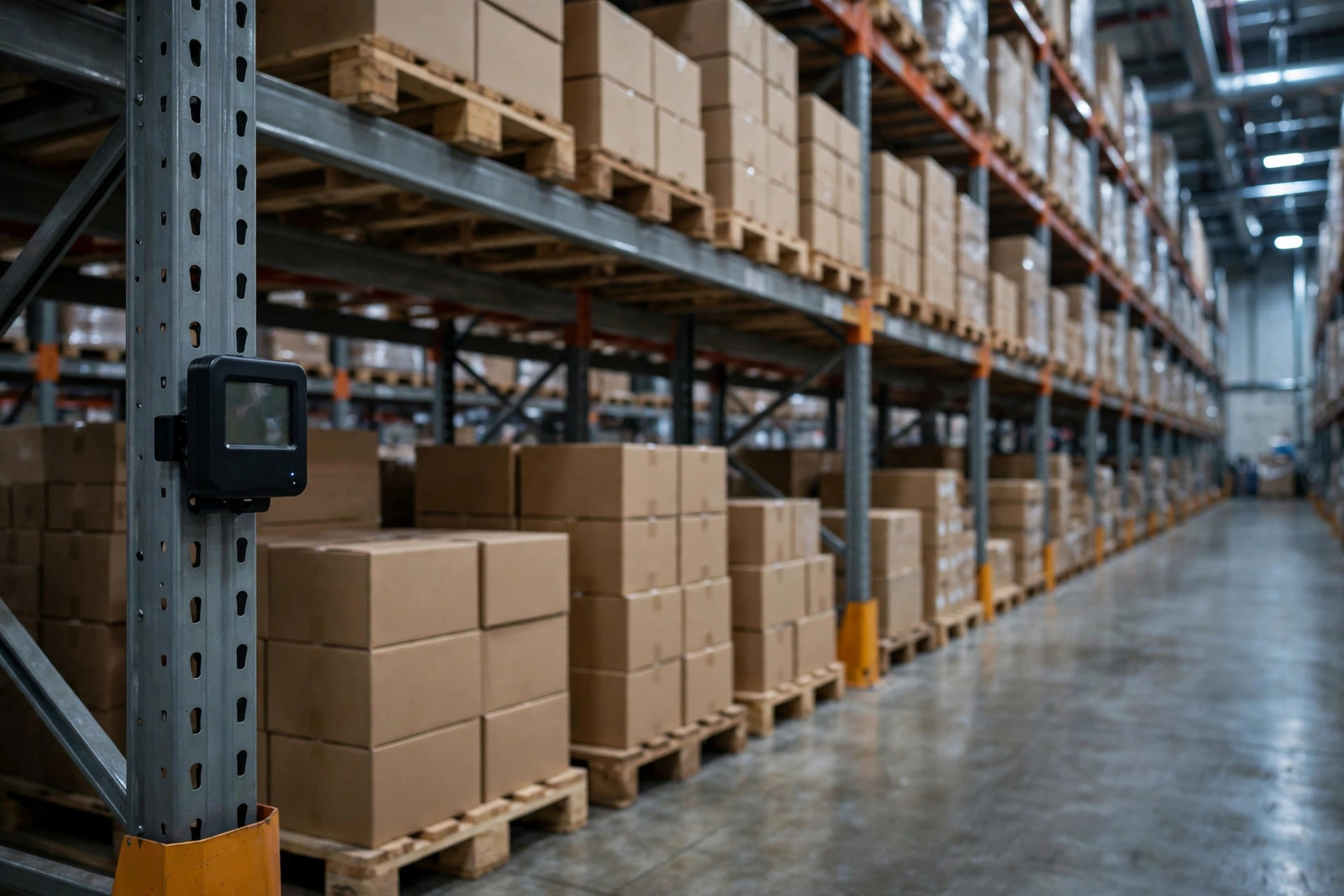
Before you set anything, put out separate hygrometers and stop trusting the reading on the machine itself. Mine go in four places: by the dock door, along the exterior wall, in the middle of the storage area, and up high on the racking. Read them every morning for two weeks, because you need to see what the wettest days look like, not a sunny-day average. Size for the average and the rainy season will beat you; size for the wettest two weeks and the machines will cycle off during normal days, which saves power.
Dehumidifier sizing: where refrigerant and desiccant units part ways
There are two types, and the dividing line is temperature, not price. Refrigerant units cool the air so moisture condenses out: simple, cheap, easy to maintain, and right for ordinary ambient warehouses. Desiccant units use a moisture-absorbing wheel and keep working in the cold. My rule of thumb: where temperatures sit around 10°C or lower for long stretches — cold-store entrances, cool rooms — refrigerant units frost up and lose efficiency, and desiccant is steadier. In an ambient warehouse there is no reason to start with desiccant; the extra money rarely pays back.
Do not size by floor area alone: the area shortcut assumes every warehouse is the same height, equally sealed, and opens its doors equally often, and no real warehouse is like that. My method has three steps. First, calculate volume: length times width times height. Second, look at air exchange: how often the dock doors open, whether there is a draft, whether walls and floors tend to sweat. Third, look at the goods: paper and textiles absorb moisture themselves, acting like a reservoir of damp that deserves extra margin. One more caution: a manufacturer's rated capacity is usually measured at hot, humid test conditions your warehouse will rarely match, so check its published performance curves for your actual conditions rather than treating the rated number as warehouse performance.
Here is my own worked example — a way of thinking, not a standard. Take a 2,000-square-meter warehouse with 7-meter ceilings: 14,000 cubic meters of air. If the dock doors open frequently all day and one exterior wall tends to sweat, I size up for big volume, frequent air exchange, and moisture-absorbing goods, rather than dividing floor area by a rule-of-thumb liters-per-square-meter. The ending for an undersized machine is one I have seen too many times: it runs 24 hours at full load, humidity never reaches target, and you have bought an expensive placebo with your power bill.
Placement and airflow: where the machine sits matters more than how big it is
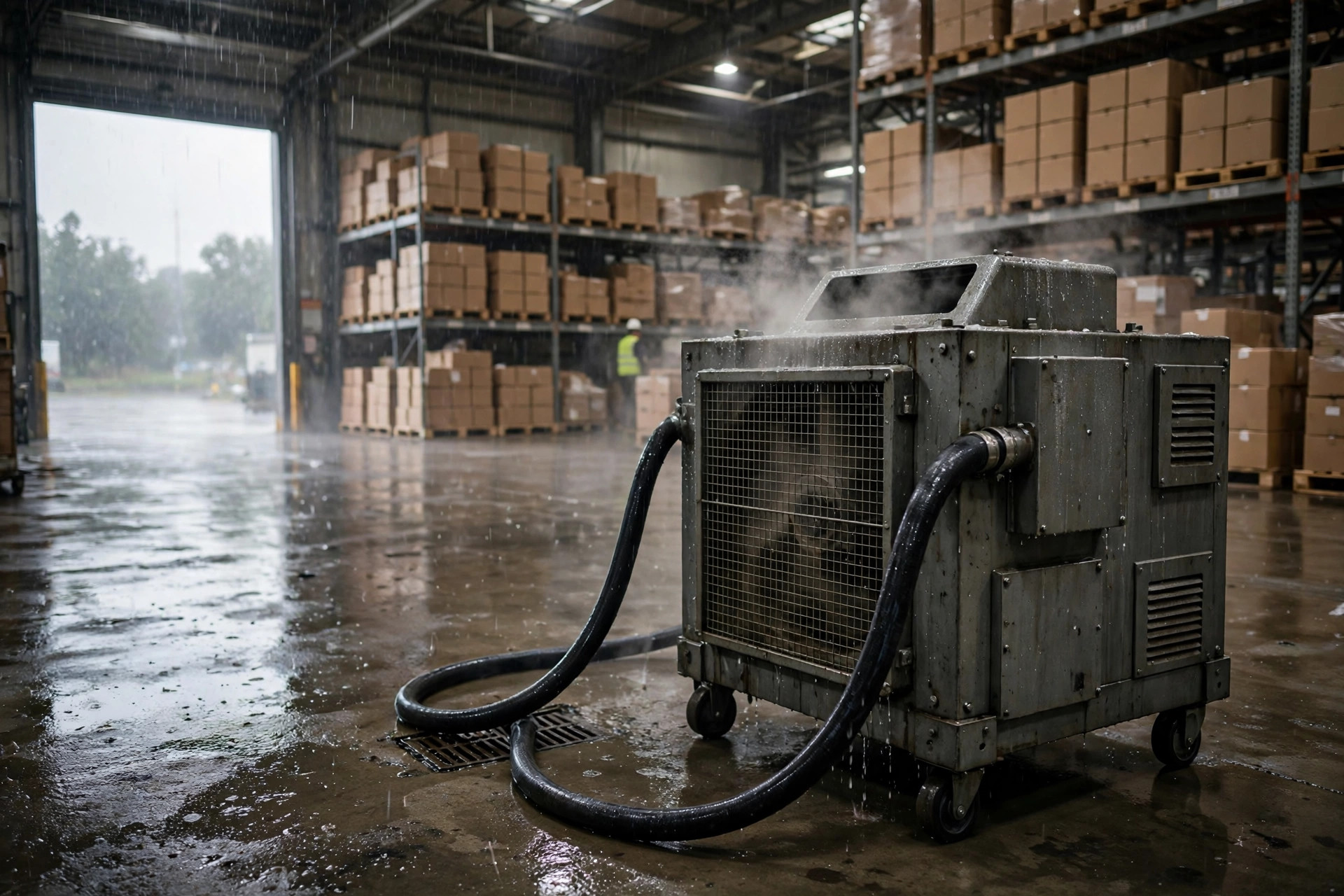
Buy the right machine and place it wrong, and you have wasted the money. I have four plain rules. First, never push a unit against a wall or bury it between pallet rows; it needs clear airflow front and back. Second, point the dry-air outlet down an aisle, not straight at one pallet stack — blowing at one stack dries its surface row while the damp behind it stays put. Third, put the intake near the moisture sources: inside the dock door, along the exterior wall, over the floor that sweats. Fourth, do not forget the high racks: warm air rises and damp collects up high.
Drainage is the most common midnight "breakdown" that is not a breakdown at all. A unit that relies on someone emptying its tank stops the moment the tank fills; at night nobody empties it, humidity climbs by morning, and the day shift reports a broken machine. My requirement: gravity-drain to a floor drain or outside wherever possible, and where that is impossible, wire the full-tank alarm somewhere the night shift can see it. Clear the drain line before rainy season starts, not after water is on the floor.
One more rule costs nothing and trips up plenty of warehouses: do not "ventilate" during the damp season. When outside air is wetter than warehouse air, opening doors invites the damp in. Decide by the hygrometer, not by habit: open up when outside air is drier, keep doors closed and batch dock work into one window when it is raining.
The power bill: undersized costs more, and over-drying is pure waste
Calculate the power bill properly: not from a machine's nameplate power, but from how many hours it actually runs in a month to hold your target. An undersized machine runs 24 hours at full load and never reaches target — every kilowatt-hour spent, goods still damp. A correctly sized machine reaches target and rests, so its monthly running hours are lower. That is the second counterintuitive bill here: buying enough machine does not necessarily raise the power bill; buying too little guarantees wasted power.
The formula is transparent, so plug in your own local tariff: monthly cost ≈ total machine power (kW) × actual running hours × electricity price. One unit drawing 2 kW, run flat out for 720 hours, uses 1,440 kWh; cycling intermittently at 400 hours, it uses 800 kWh. Use your latest local rate.
Over-drying deserves its own line. Pushing humidity from 60 percent down to 40 percent adds many running hours, but for ordinary carton goods it barely reduces damage further — you are paying for the feeling of "extra dry," not for fewer losses. Once the target band is reached, let the machine rest.
So here is my closing question, not a slogan: do you want to work out these three bills before rainy season arrives, or after the goods have already molded? The first costs some thought about sizing and placement. The second costs returns, repacking, and customer trust.
By Lao Mi, Supply Chain Veteran (20 yrs)