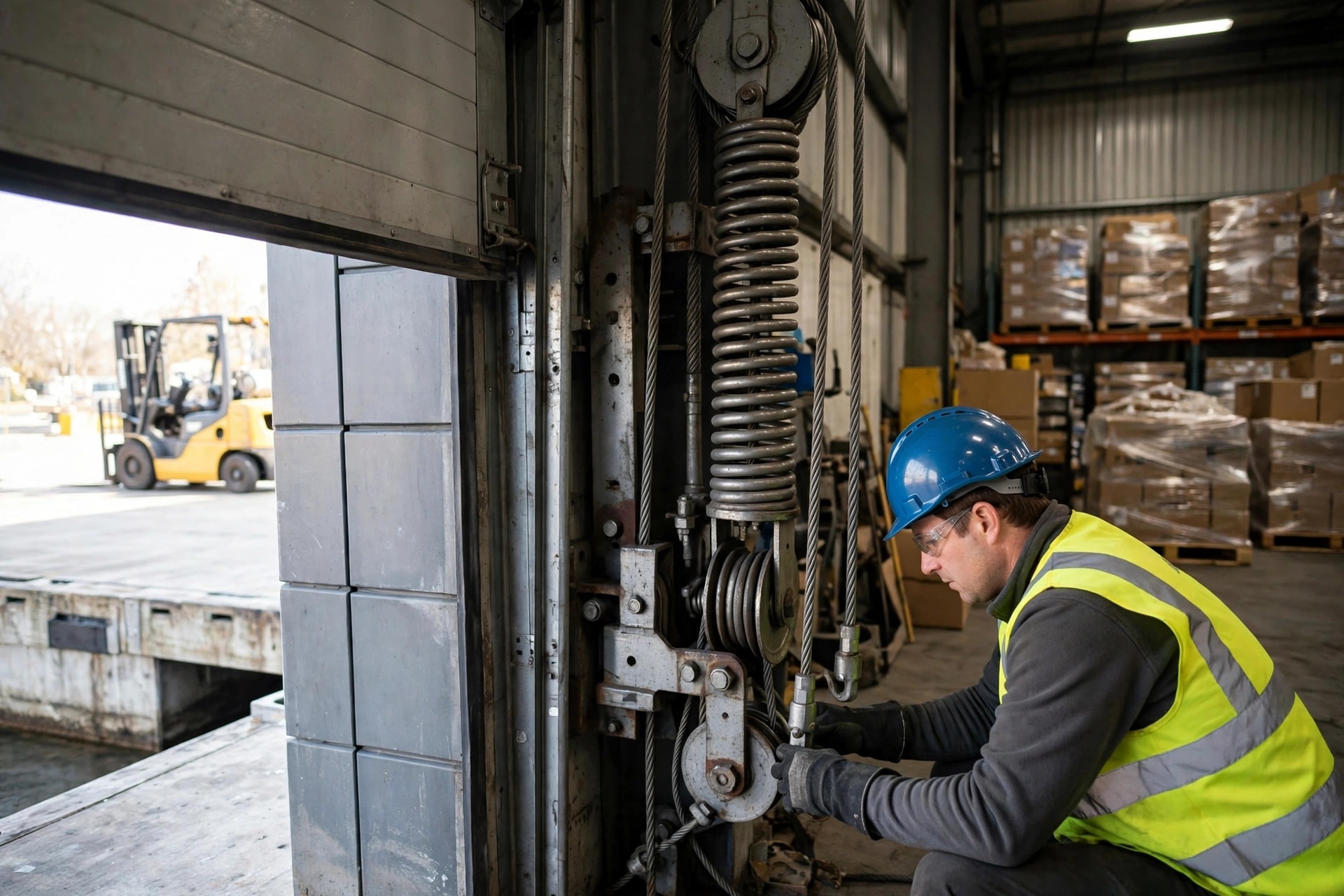
It was 6:40 on a Tuesday morning. I had just walked into the warehouse when dock door 3 jammed halfway up. Two trucks were lined up behind it, drivers honking. Guys grabbed pry bars, somebody climbed a ladder, and forty minutes later the door finally dropped. The whole morning outbound plan went out the window.
Here is the honest truth: nobody looks at a dock door until it breaks. If it goes up and down, we assume it is fine. But dock doors have a habit of failing at the worst possible moment. Peak season. The morning outbound rush. A night shift trying to get trucks out. That is exactly when they jam. So our warehouse made it a hard rule: dock door inspection is a daily job, like cycle counting. Not something you remember after the door breaks.
Dock Door Maintenance: Five Checks, Three Minutes a Door
This is how we do it now. Every morning before the shift starts, the dock lead walks the doors. Six doors, five checks each, about three minutes a door. It does not slow anybody down.
First, the springs. Torsion springs fail from fatigue, and they usually give you a warning first: rust spots on the surface, gaps opening up between coils, or the door rising faster on one side than the other. See rust, write it down. Do not wait. When a spring breaks, there is no warning. It goes bang, and the door drops.
Second, the cables. Frayed steel cables are the most common problem we see. Run a gloved hand along the cable. If it catches your glove, strands are already breaking. Also check how the cable sits on the drum. If it is winding unevenly, it will jump the groove sooner or later and jam the door solid.
Third, the rollers and tracks. A roller that turns stiffly, a pebble in the track, wood chips from a pallet, all small stuff. But all of it causes jams. Clean the track, oil the rollers, and the door runs noticeably smoother.
Fourth, the sensors. Photoelectric sensors hate dust, and docks are dusty places. One layer of dust on the sensor lens and the door thinks something is underneath it. It closes halfway and bounces back up. Wiping it with a dry cloth takes ten seconds.
Fifth, the seals. Worn or cracked weather seals mean the door never really closes. Cold air leaks out, dust blows in. Our cold storage doors show it worst in summer. A cracked seal leaves condensation around the doorway, the floor gets slick, and forklifts have to steer around it.
The lead checks all five and ticks a sheet. Anything abnormal gets handled the same day. We do not push it to next week.
Two Times We Learned the Hard Way
The first was last November, one week before peak season. The cable on Door 3 had already started fraying. The lead saw it and figured we would swap it after peak. Then on that Tuesday morning rush, the cable jumped its drum groove and the door stuck halfway. Two trucks sat blocked at the dock for over forty minutes, and every order behind them slipped. We spent half a day reshuffling labor and reassigning trucks. Later we did the math: one cable costs almost nothing compared with half a day of stopped outbound work. There is no comparison. Since then, a frayed cable gets replaced the same day. No discussion.
The second was in March, on night shift. Door 7 was not closing tight, and the lead figured it was just the wind. Overnight the temperature dropped, air leaked through the gap, and a thin layer of frost formed by the cold storage doorway. Next morning a forklift slipped on it and nearly hit the door frame. The cause turned out to be two small problems together: an aging seal plus a dusty sensor. The door thought it was closed. It was not. Since then, sensor wiping is written into the night shift handover sheet, and seals get a full check every quarter. Cracked means replaced.
Both times taught us the same lesson: a dock door has no small problems, only big problems that have not happened yet.
When a Dock Door Jams: Grade It Before You Touch It
When a door acts up, do not start taking it apart. Grade it first.
Level one, the shift can handle it: dusty sensor, debris in the track, a slightly bent seal, a dead remote battery. Fix it on the spot, under ten minutes, no line stoppage.
Level two, fix it today: frayed cable, stiff rollers, a door running out of square, a noise that keeps getting louder. The door still moves, but it is working sick. Schedule the repair for today, and downgrade that door until it is fixed: light freight only, or inbound only. Stop loading it at full capacity.
Level three, stop using it now: a broken spring, a snapped cable strand bundle, a door off its tracks, a door in free fall. That door is out of service. Tape it off, hang an out-of-service tag, and nobody walks under it. Call the repair crew right away. Until it is fixed, pretend that door does not exist and split its orders across the other doors.
Grading matters because it removes hesitation. A night lead at 3 a.m. hearing a strange noise does not need to call me for permission. The grading sheet tells him whether to stop or to repair.
In-House Repair vs. Outsourced Repair: Our Cost Math
We ran the numbers for our warehouse, and this table is how we split the work now:
| Job | In-house | Outsourced |
|---|---|---|
| Daily checks, wiping sensors, clearing tracks | The lead does it during rounds, no extra cost | Not worth it, every call-out costs money |
| Replacing cables, rollers, seals | Spare parts on hand, about half an hour | Waiting for a technician costs at least half a day |
| Replacing torsion springs, balancing, motor repair | We do not touch it, too dangerous | Always outsourced, needs proper tools and two people |
| Annual picture | Spare parts plus a little labor time | A few big repair bills, but no headcount to carry |
To be straight with you: small jobs we do ourselves, big jobs go to professionals. A torsion spring stores a lot of force. If it lets go while you are working on it, somebody gets hurt. Our warehouse has a written rule: springs are outsourced only. Nobody takes one apart in-house. That is not the place to save money.
Here is a counterintuitive call that a lot of people push back on: replace springs in pairs, even if the other one still looks fine. Two springs share the load. When one breaks, the other one is basically at the end of its life too. Replace only one, and the new spring carries extra load while the old one waits to break. You have just planted the next failure. We learned that one the hard way too. Now we always replace both. It costs more once, instead of costing us twice.
The Dock Door Routine We Stuck With
Here is the routine we run now, and the crew just follows it:
Every morning, the lead walks the doors, five checks, tick the sheet. Every week, clean the tracks, oil the rollers, wipe the sensors. Every month, run a hand over every cable and check every seal. Every six months, we bring the outside crew in to test spring tension and record the numbers, so next time we can see how much they have weakened.
Two safety rules are posted on the dock wall. One: nobody walks under a moving door, no matter how urgent the order is. Two: before any repair, cut the power and hang a lockout tag. Whoever hangs the tag removes it. Nobody else touches it.
A dock door rewards attention and punishes neglect. Treat it like a daily job and it stays quiet. Ignore it, and it will pick your busiest day to teach you a lesson. Our warehouse already took that lesson. I hope yours does not have to.
By Chen Feng, Warehouse Operations Manager