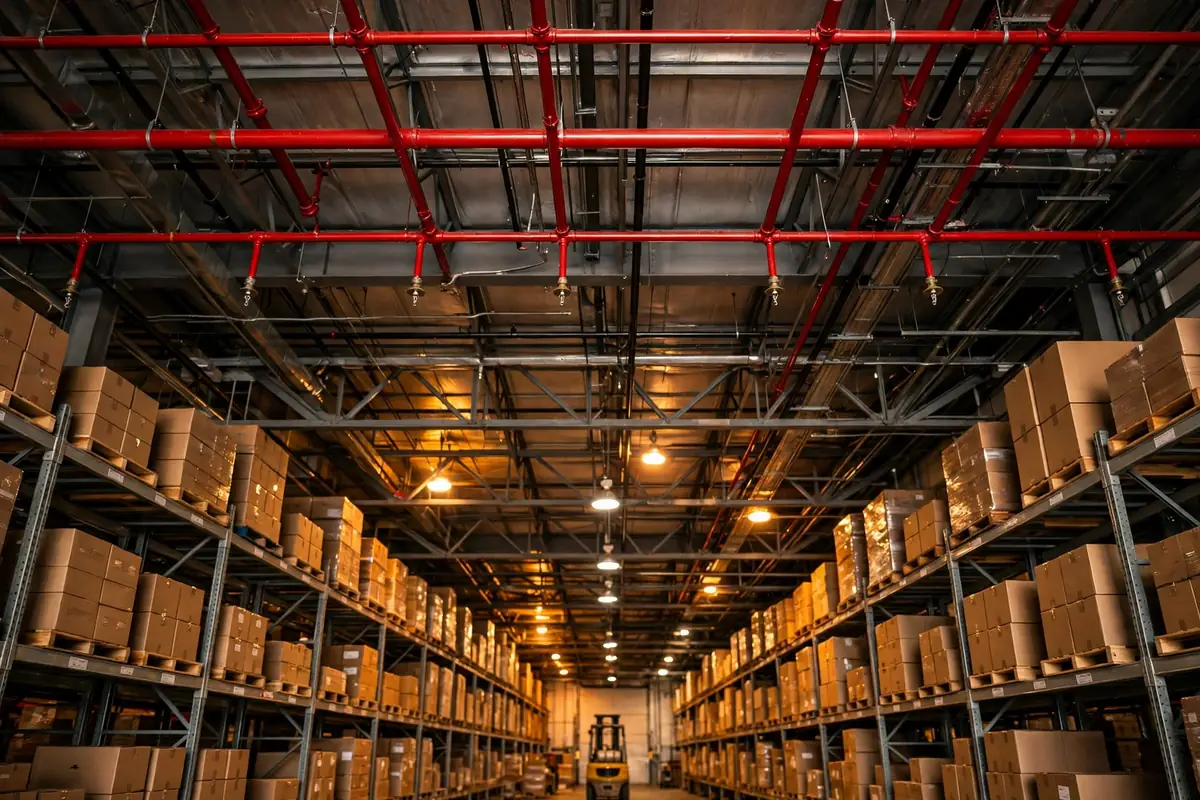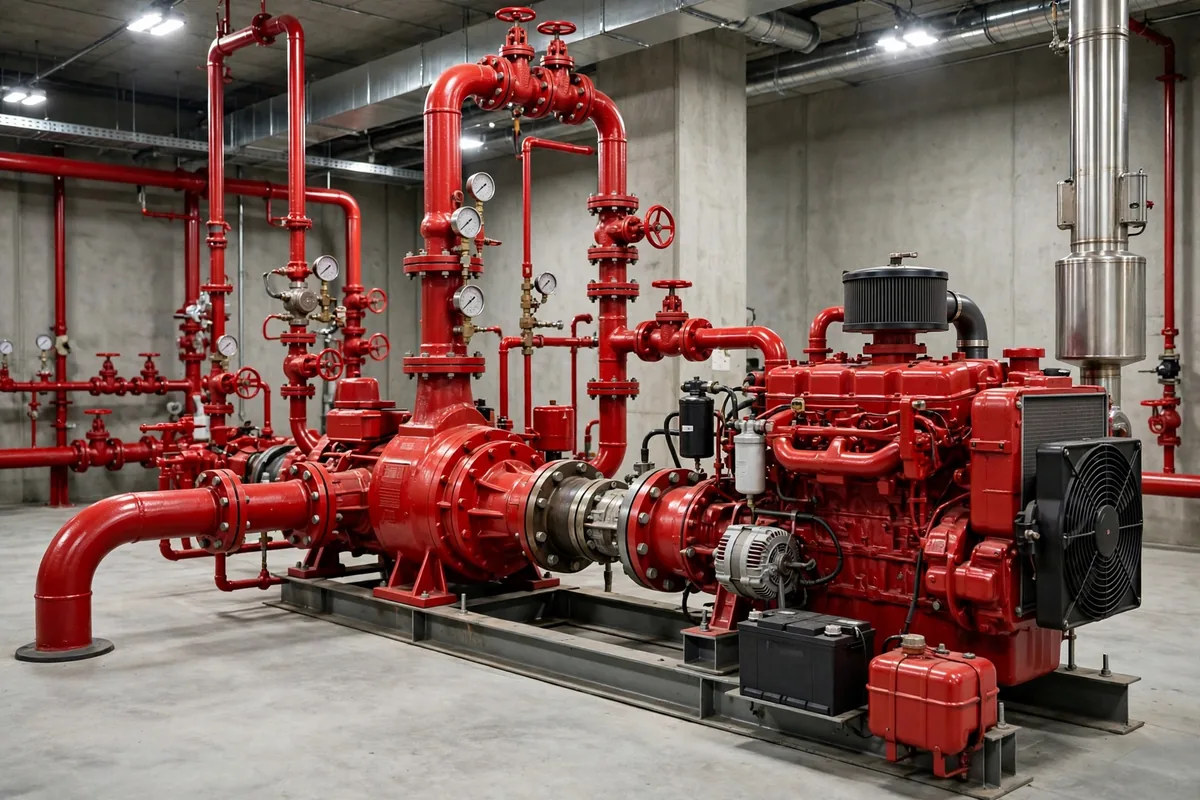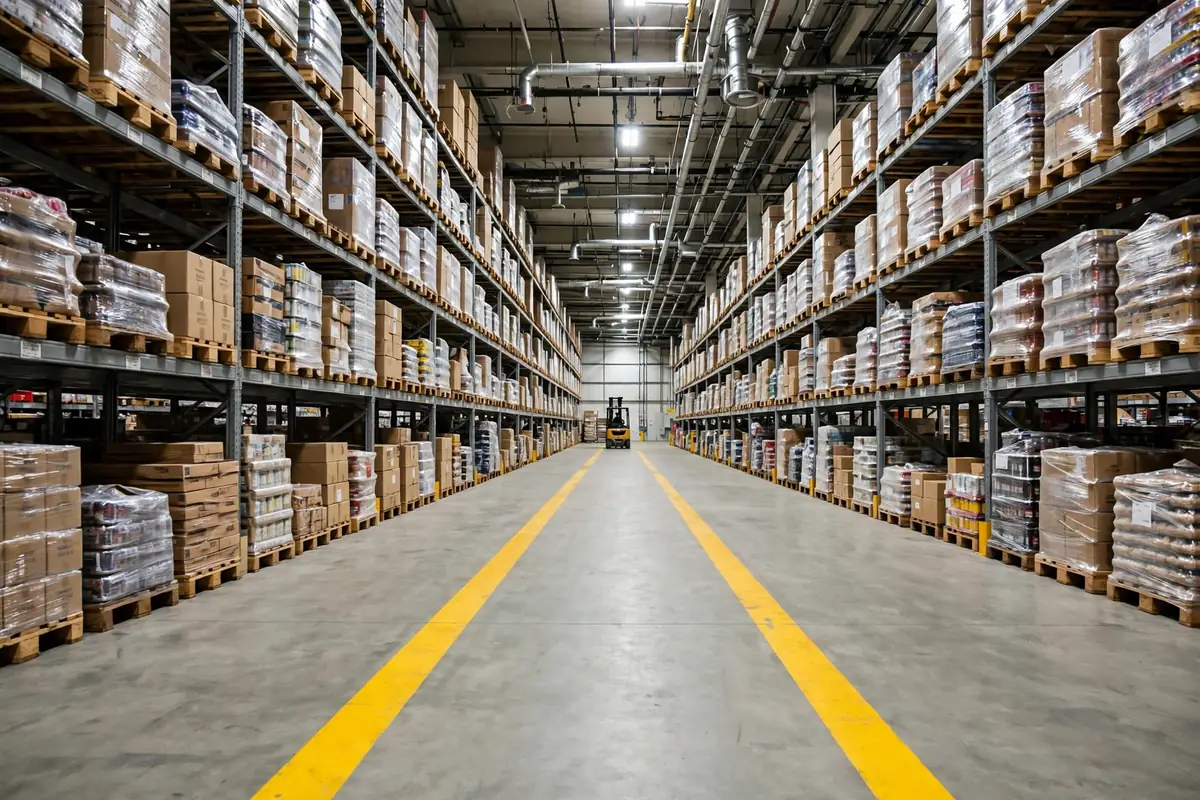
Blocked warehouse fire lanes rarely start as a decision. They start as a pallet that will only be there for an hour, a slow-moving product that needs a home, and a dock that is full on the busiest day of the month. By then the warehouse has quietly accepted a risk its insurance policy, its fire inspector, and its evacuation plan all assume does not exist — and the fines and prevention work that follow cost far more than the space was ever worth.
According to the framework set out in the International Fire Code and NFPA 1, the requirement is straightforward in principle: means of egress and fire apparatus access must remain clear and unobstructed at all times. Local enforcement and penalty amounts vary, so any figure should be confirmed against the latest requirements of the local fire department.
What a blocked fire lane actually looks like on the floor
Consider a distribution warehouse outside Columbus, Ohio, in the autumn of 2024 — scenario illustration, not a verified enforcement case. A promotion ended, returns came back faster than expected, and the overflow went to the widest open space anyone could find: the marked lane along the south wall. The pallets were stacked two high and labelled, so the floor looked organised. Nobody moved them because the space to move them to did not exist.
A second pattern is quieter. In a food distribution facility in Texas in early 2025 — scenario illustration — the lane was never formally blocked. Instead, staging crept into it a little further each week: first a row of empty pallets, then a cage of damaged goods awaiting a decision, then a forklift parked there during lunch because the charging area was full. Together they reduced a marked egress path to a gap a forklift could not pass. The facility passed its internal walkthrough because the walkthrough checked the paperwork, not the width.
These two patterns share a cause. A fire lane is the only space in a warehouse that produces nothing. Every other square metre is measured by throughput or utilisation. In a building under space pressure, the empty lane is the most tempting space to borrow.
The three costs, and why the fine is the smallest of them
The first cost is the penalty. A fire inspector who finds a blocked egress path can issue a citation, require correction within a set period, and return for re-inspection; repeated violations can escalate to a stop-operations order. Penalty structures differ by jurisdiction; amounts are set by the local fire department under its latest published schedule.
The second cost is insurance, and it is larger and less visible. An insurer investigating a claim will ask whether egress and access were maintained as the policy and the applicable codes require. If the answer is no, the claim can be delayed, reduced, or denied, and the renewal that follows can carry higher premiums or narrower terms.
The third cost is operational. A shutdown order does not only stop shipping. It stops receiving, strands inbound trucks, and creates a backlog that takes days to clear. Assume a worked example for illustration: a facility shipping 4,000 orders a day that loses two working days to a shutdown faces 8,000 delayed orders, and the recovery overtime, expedited freight, and customer credits that follow can exceed the original penalty by an order of magnitude. The fine is the receipt, not the bill.
| Cost | When it arrives | Who decides | Why it is hard to reverse |
|---|---|---|---|
| Citation and fine | At inspection | Local fire department | Record follows the facility |
| Insurance dispute | After a fire or loss | Insurer, under policy terms | Coverage decided after the event |
| Shutdown order | At inspection or after incident | Fire authority | Operations stop until corrected |
| Reputational and customer loss | After delay becomes visible | Customers | Trust is rebuilt slowly |
How fire inspections actually work
A common misunderstanding is that inspections are scheduled, predictable, and therefore manageable by clearing the lane the day before. In practice, inspections combine scheduled, complaint-driven, and follow-up visits, and inspectors look for patterns. A lane clear on inspection day but blocked the other 364 days is not compliant.
Inspectors also read the building. Fresh paint on floor markings with scuffed pallets on top tells a story, as does a lane ending at a locked door. The question is whether the egress path is maintained at its required width, marked, lit, and free of storage at all times.
The counterintuitive point is that the best inspection records belong to facilities that treat the lane as fixed infrastructure, like a wall, rather than flexible space. A lane treated that way — painted, signed, physically protected, never used for staging — stops being a daily negotiation. The trade-off is real: the facility gives up a strip of floor permanently, and in return the argument about whether the lane can be used "just this once" stops happening.
Making a fire lane that cannot be blocked
The practical answer is design, not discipline alone: discipline fails on the busiest day, which is exactly the day the lane matters most.
First, plan locations so the lane is not the overflow. If the building regularly runs out of staging space, the problem is capacity planning, not housekeeping; overflow needs a designated home — a marked buffer zone or a mezzanine — that is not the egress path. A facility with nowhere legal to put overflow will put it in the lane.
Second, make the lane physically legible. Floor markings fade under forklift traffic, so they need their own maintenance schedule. Bollards at vehicle crossings make the boundary visible to a driver thinking about the next pick. Exit signs and emergency lighting belong in the same routine: a clear lane leading to a dark exit is not a safe path.
Third, patrol it on a schedule that matches the risk. A daily walk at the start of each shift, with the lane on a short checklist and a named person responsible for clearing it, catches the slow creep before it becomes a blockage. Patrol during the busiest period, not after it.
A fire lane management checklist
| Check | Frequency | Owner | Pass means |
|---|---|---|---|
| Egress paths clear to marked width | Each shift | Shift supervisor | No storage, equipment, or staging in the lane |
| Exit doors unobstructed and operable | Each shift | Shift supervisor | Door opens fully, no lock or blockage |
| Floor markings visible and intact | Weekly | Facilities lead | Lines and wording legible from the aisle |
| Emergency lighting and exit signs working | Monthly | Facilities lead | All signs lit, no failed lamps |
| Fire apparatus access clear outside | Weekly | Site manager | No trailers or containers blocking access |
| Overflow storage in designated zone only | Daily | Warehouse manager | Overflow log shows no lane use |
| Inspection findings closed on time | Per finding | Site manager | Correction documented with photos |
The checklist matters less as a form than as a record. A dated, photographed record of daily checks is what a facility shows an inspector or an insurer when the question is whether the lane was maintained or merely cleared for the visit.
Where this is heading
According to the direction of recent enforcement and insurance practice, the trend is toward less tolerance for temporary obstruction, not more. Warehouses are denser, automation is adding new equipment to the same floor, and e-commerce peaks are concentrating more volume into fewer weeks. Each trend increases the pressure on the lane.
The open question is whether a given warehouse will treat the lane as infrastructure before an inspector, an insurer, or an incident forces the decision. The cost of infrastructure is a strip of floor, given up once; the cost of flexible space is a risk carried every day, priced only when it is too late to renegotiate. That asymmetry is the reason the lane keeps getting borrowed, and the reason the borrowing keeps ending the same way.
By Dr. Chen, Supply Chain Researcher