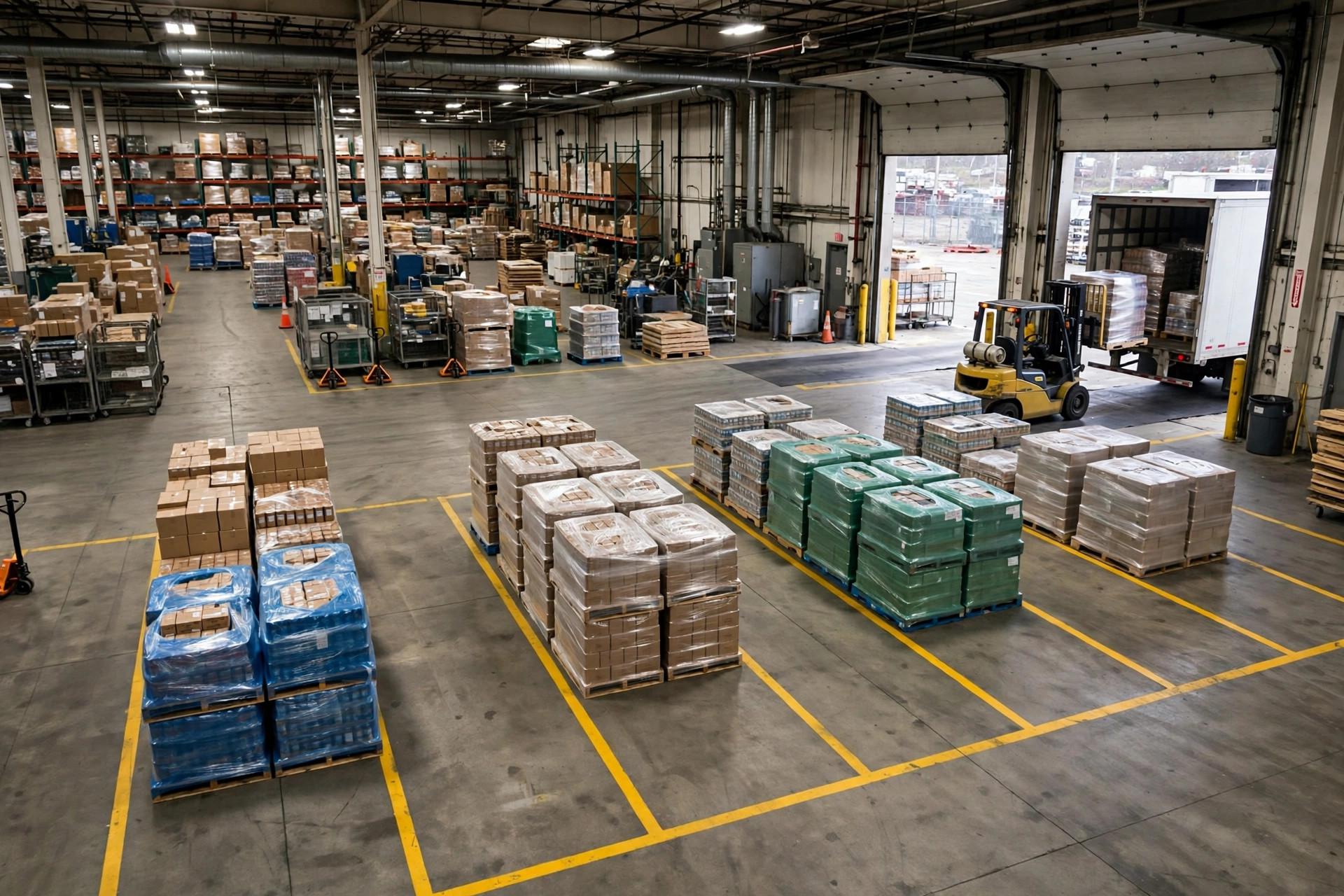
Six ten in the morning. Eight pallets off the first truck, nowhere to put them. Bad warehouse cross dock staging lane design, not a slow crew. The lanes we had marked out by customer the night before: three standing empty, two stuffed full. The full lane held freight that was not leaving until the afternoon. The empty lane belonged to a customer whose freight had not arrived yet. The driver stood at the door smoking and waiting. The unloading crew walked in circles. When cross-dock freight jams a dock, eight times out of ten the crew is not slow. The lanes are wrong.
We used to mark lanes by customer. Big customer, one lane. Small customers, one shared lane. It looked tidy. It photographed well. On the floor it caused nothing but trouble. A customer's freight does not move according to your lane plan. It moves according to trucks. The same customer ships a morning load and an afternoon load, the freight arrives hours apart, and it all lands in one lane. The early freight ends up buried at the back. The late freight blocks the lane mouth. To load the early freight, you first move the late freight. One move eats a quarter of an hour. Do that all day and the crew spends the shift reshuffling pallets instead of loading trucks.
So we changed it. In our building, lanes follow one rule: how long freight sits and when it leaves matters more than whose freight it is. Lanes are sorted by departure time, not by customer. It sounds wrong the first time you hear it. Run one peak season and you will know.
Warehouse cross dock staging lane design starts with departure time
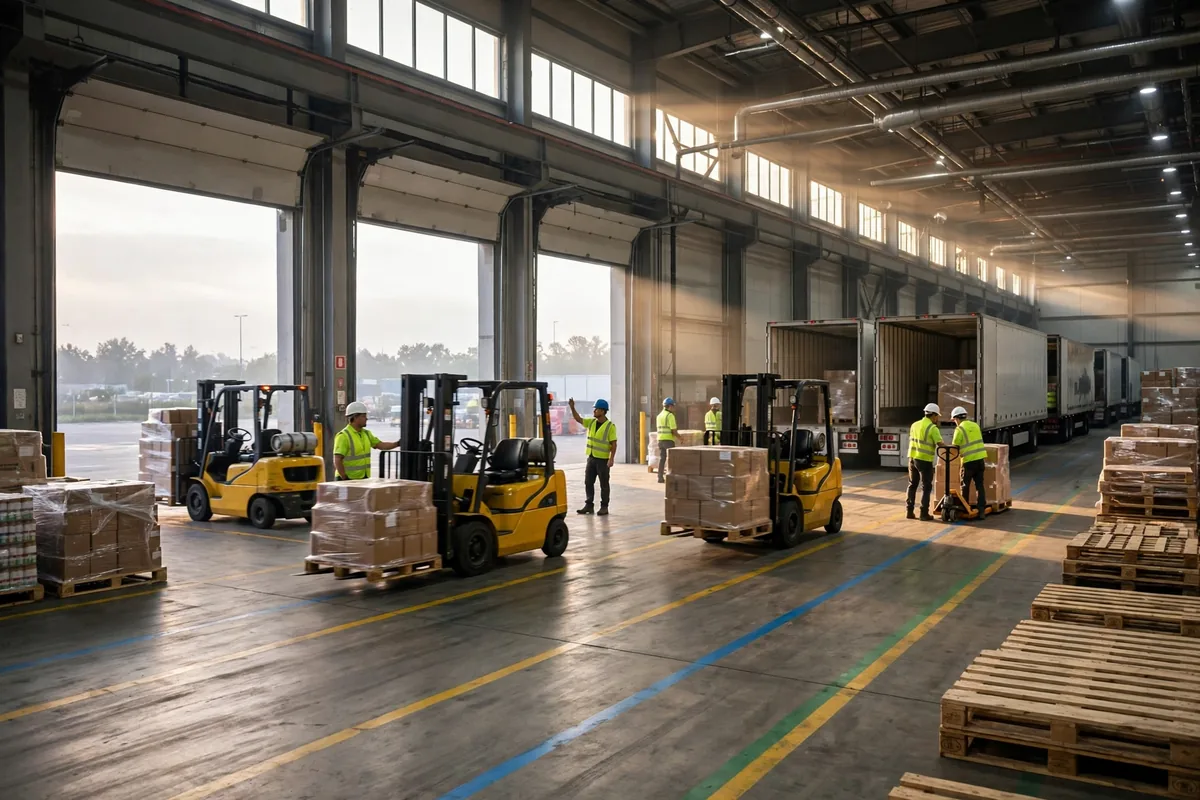
Here is how we split lanes now. Look at the day's departure plan and cut the lanes into bands. The next load out sits closest to the outbound doors. The following departure goes one band back. Freight leaving on the late shift goes deepest. Freight with no confirmed departure gets its own undecided lane, and it never mixes into a lane with a set departure.
Why this order? Cross-dock freight never goes into storage. It comes in, it goes out, and it sits for a few hours in between. The closer the sitting spot is to the outbound door, the shorter the trip at loading time. Freight leaving first sits nearest the door so the most urgent load travels least. Late freight sits deep because it has time to wait. Reverse the order and the first load out is buried at the back, and the whole crew spends loading time digging it out.
Inside one departure band, order freight by arrival. First in goes deepest, later arrivals stay toward the mouth, and loading clears the lane from the mouth inward in one clean pass. Do not sort by pallet size or by which customer matters more. In front of a departure time, every load is equal. Once that rule stuck, the arguments stopped: driver and checker both read the time board at the lane head, and there is nothing to fight about. The board is live. When a departure changes, you swap the board, not the freight. Lanes are fixed, boards move.
We trialled this in a daily goods distribution warehouse before peak season in 2023. Small building, only a few dock doors. Before the change, the two hours before the evening departures were the worst of the day: forklifts queued in the aisles and checkers hunting freight across the floor. In the first month after, same crew, same trucks, the chaos dropped off sharply. Nobody worked harder. The freight simply stopped blocking itself.
Lane depth, turning room, and where the label goes
You cannot design lanes with lines alone. If a forklift cannot turn, your straight lines are decoration.
Start with turning room. Where each lane meets the aisle, leave enough space for a forklift to swing in one motion. If the driver has to reverse twice and scrape past, you pay for it all day in small collisions and slow work. We once marked lanes tighter to fit more pallets. Each lane held a little more, and every trip in and out got slower. The total came out worse. A simple worked example makes the point: tighter lanes might hold roughly a tenth more freight, but if every trip needs one extra reverse, across hundreds of trips a day the lost time is worth far more than the extra floor spots. Floor space bought with aisle time is a bad trade.
Then lane depth. Deeper is not better. In a deep lane, freight stacks in layers and the back pallets are sealed in. Deep lanes suit exactly one kind of freight: one departure, one direction, leaving as a single batch. It all enters together and leaves together, so being buried costs nothing. Never put mixed, multi-stop freight in a deep lane. Loading picks it in sequence, and freight buried at the back means a reshuffle on every pick.
Our standing rule is simple enough for a new hire: shallow lanes for mixed and loose freight, deep lanes only for batch freight. And the gap between lanes is not storage. Every peak season someone wedges two pallets into it. By morning the whole crew knows the mistake: forklifts cannot pass and two lanes jam at once. Whoever fills the gap clears it on the same shift. We enforced that twice and nobody tried it again.
Label position is part of lane design too. Labels face the aisle, at roughly one reading height, so a checker can read a whole row in one pass. The worst spot is the top of the pallet: reading it means climbing, circling, and tearing wrap. Facing the label inward is just as bad. We set orientation at unloading: label side out, every time. It looks minor. Across a peak-season day, the bending and circling you save adds up to real time.
In the summer of 2024, an auto parts transfer warehouse learned this the hard way. A rush load went out with every label facing inward. At loading, the checkers could not match a single pallet, and they dug through the entire lane. The truck waited at the door for over forty minutes and the driver's face said everything. That warehouse put label orientation into the unloading handover: check the facing before you walk away. The mistake never repeated. Floor rules are not invented. They are bought with lessons like that.
Overflow rules for warehouse cross dock staging lane design
Lanes will overflow. Inbound trucks bunch up, an outbound truck runs late, the two squeeze together, and the floor fills. That is the moment a missing rule hurts most. People panic and drop freight in any open spot. After that, only the person who dropped it knows where it is. When their shift ends, the next crew hunts the whole floor.
Our overflow rules fit on the dock wall in three lines. First, overflow goes to the undecided lane, whose freight has no fixed departure, so moving around it costs least. Overflow goes there together, with a big temporary label showing the original lane and departure. Second, if that lane fills too, overflow goes to the tail of the latest departure lane, the last spot touched at loading, as its own separated stack, never mixed in. Third, whatever overflows gets logged on the same shift: how many pallets, from which lane, where they are now, and who put them there, on the dock whiteboard, with a photo to the shift group chat. The next shift reads the board before touching freight.
One line we never cross: aisles are never overflow space. Block an aisle and inbound cannot get in, outbound cannot get out, and the whole building stops together. Let one truck load late rather than make every truck late. The aisle belongs to the whole warehouse, not to any single lane.
And the counterintuitive part: when lanes overflow, forklifts should slow down, not speed up. Rushed drops create searches. One careless placement costs ten hunts later. Place one pallet, log one pallet. It looks slower; on the full shift count it is faster. We ran both ways one peak season. The rushed night made its departure, then spent half the next day failing to reconcile the count. Rules are there so the night shift does not clean up after the day shift.
A last word for anyone about to redraw lanes. Stand on the floor for one full shift first. Watch how freight flows, where trucks turn, where people bunch up. The problems a drawing hides, one shift shows you. After the redraw, change boards and rules first in peak, and save big changes for the slow season. That is how our warehouse runs it now. Nothing fancy, but trucks come and go and we know where everything is.
By Chen Feng, Warehouse Operations Manager