The question behind "warehouse conveyor belt repair vs replace downtime cost" is simple: patch it or replace it? Most warehouse managers lose money on it not by picking the wrong option, but by doing the wrong math — comparing two quotes and forgetting the biggest invoice: downtime.
Start with the formula. Everything below is checked against it:
Repair value = avoided downtime cost − repair cost − expected repeat-failure cost
If that formula means nothing to you, your default decision will always be "patch it, it's cheaper." If it means something, you will ask three questions first: what does one hour of downtime cost on this line? How long will the patch hold? What is the probability it fails again?
Repair vs Replace: The Downtime Cost Is the Real Judge
On a sort line or telescopic boom, the belt itself is never the expensive part. The belt is cheap; every minute it sits still is not.
Here is a downtime cost definition you can use:
Hourly downtime cost = line throughput per hour × contribution margin per unit + idle labor cost + overtime/catch-up cost
Note: contribution margin, not revenue. Multiplying by revenue is what amateurs do.
A worked example — flagged as example inputs, because you must substitute your own warehouse's real numbers: a small-parcel sort line moves 6,000 units per hour; contribution margin of $0.20 per unit gives $1,200 per hour; eight idle sorters at a loaded labor cost of $25/hour add $200; two hours of night-shift overtime to make the carrier cutoff adds the rest. One hour of downtime easily clears $1,500 on the books.
Keep that order of magnitude in mind. Every decision below is built on it.
Belt Repair vs Replace: Three Bills, One Downtime Cost Ledger
A failed warehouse conveyor belt leaves you three options. Cost, downtime, and post-repair life, in one table — figures cross-checked against published industry pricing ranges; treat your supplier's quote as final:
| Option | Direct cost | Downtime | Post-repair life | Fits |
|---|---|---|---|---|
| Local patch (cold repair patch/adhesive) | Materials roughly $50–$300, labor extra | 1–2 hours | Weeks to months | Surface scoring, small-area wear, non-load zones |
| Vulcanized splice (hot vulcanizing re-splice) | Roughly $1,500–$8,000 including labor, materials, lifting, and alignment | 4–8 hours (including cure time) | Near-new belt life; splice strength can exceed 90% of the original belt | Longitudinal tears, splice failure, localized breaks on an otherwise sound belt |
| Full replacement | Belt + labor, typically 1.5–3× the vulcanized splice | 6–12 hours (removal, install, commissioning) | Full new life cycle | Overall aging, multiple damage sites, a belt already layered with patches |
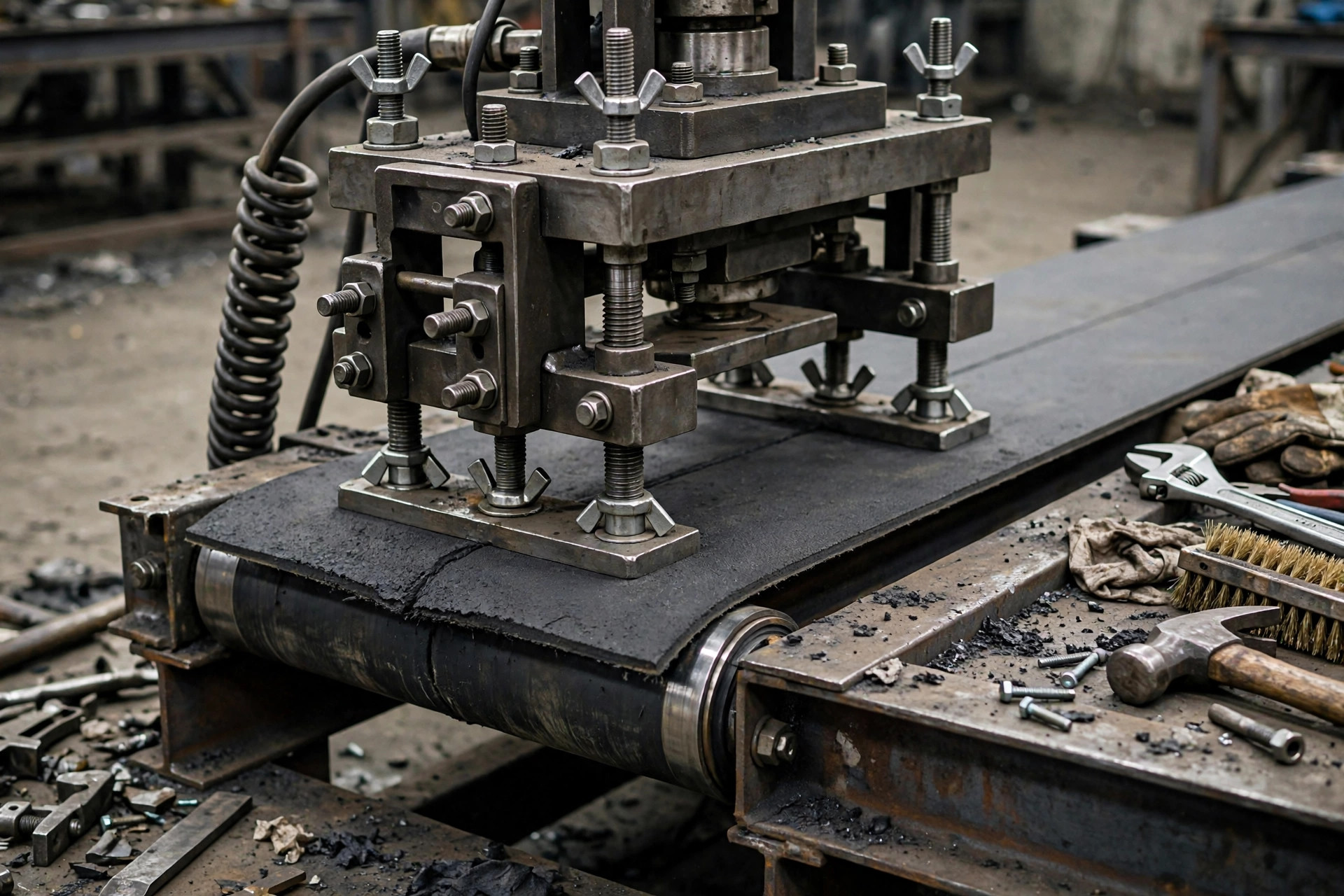
Most people look at this table and think: patch first, it's the cheapest. That is where the money starts leaking.
Direct cost is the smallest slice of total cost. When one hour of line downtime costs well over a thousand dollars, the few thousand saved on materials vanish inside a single unplanned stoppage. Repair vs replace was never a quote comparison — it is an expected-value comparison of total downtime cost plus total repair cost.
Case One: The Longitudinal Tear That Got Patched Twice
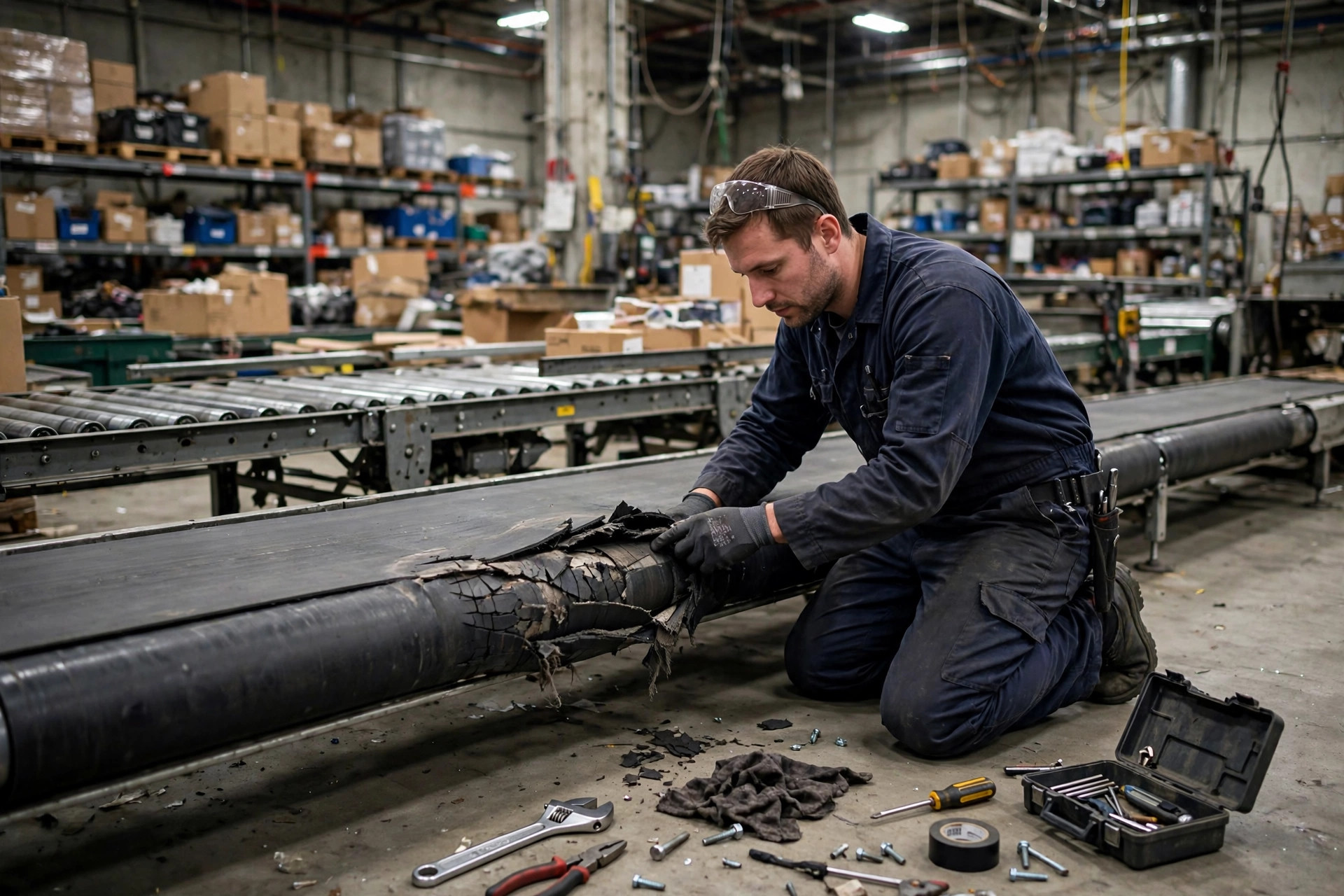
November 2024. An e-commerce fulfillment warehouse in eastern China, 40,000 orders a day. The main sort-line belt developed a longitudinal tear about 1.2 meters long. The maintenance lead chose the cheapest option: a cold patch, under $300 all-in, 1.5 hours of downtime. It looked like a $3,000 saving versus a vulcanized splice.
Three weeks later the patch failed at full throughput — the tear had grown to nearly 3 meters, because the patch edge had become a new stress concentration point. The line went down for 5 hours for a vulcanized splice, right in the pre-peak-season buildup. Roughly 25,000 orders missed the day's cutoff, and a night shift was called in.
When I reconstructed the total bill: first patch ~$300 + first downtime 1.5 hours ≈ $2,250 + vulcanized splice ~$3,300 + second downtime 5 hours ≈ $7,500 + night-shift overtime. The two rounds together cost more than three times what a vulcanized splice on day one would have cost. The maintenance lead's own words: money down the drain.
Where exactly did it drain? The first decision never priced the expected repeat-failure cost. A longitudinal tear is structural damage; a cold patch was never likely to hold. Whenever (probability of repeat failure × cost of repeat downtime) exceeds the price gap between splice and patch, choosing the patch is a gamble with negative expected value.
Case Two: The Telescopic Boom Belt That a Splice Kept Alive for Two Years
Same year, different warehouse — an apparel returns operation in southern China. The telescopic loader's belt splice came apart. The belt itself was only two years old with light carcass wear; just an aging splice.
This time the math was done right. Full replacement quoted at roughly $6,500 with 8 hours of downtime; re-vulcanizing the splice quoted at $2,600 with 4 hours of downtime. Their hourly downtime cost ran about $1,100:
- Replace total = $6,500 + 8 × $1,100 = $15,300
- Splice total = $2,600 + 4 × $1,100 = $7,000
- Difference: $8,300 saved in one decision
The splice delivers near-new life, the carcass was young, failure probability was low. They spliced — and that belt has run another year-plus with zero failures.
Same option, opposite verdicts. There is no universally right answer — only what your numbers say.
The Uncomfortable Part: When "Patch, Don't Replace" Is Wrong
Warehouse folklore says: "Patch whenever you can; layer patches until the belt retires." I will say the impolite thing: financially, that rule is wrong most of the time.
Three reasons. First, it prices only direct cost and ignores downtime. A belt wearing three patches fails far more often than a new one, and every unplanned stop is probability times downtime cost flowing out the door. Second, it confuses "repaired" with "made sound." Cold patches work on surface damage; on structural damage — longitudinal tears, splice failures, ply separation — a patch only postpones a bigger stoppage. Postponement is not elimination; the interest is charged in downtime. Third, it misallocates your scarcest resource: maintenance hours. A crew repeatedly firefighting a belt that should have been replaced is a crew not doing preventive inspection.
When is "patch, don't replace" actually right? Only when three conditions hold together: the damage is localized and non-structural; the carcass has long remaining life; and post-repair failure probability is low. Miss any one of them and you should be looking one tier up.
The Real Levers: Spare Belts and Inspection, Not Repair Technique
Do the math, then find the levers. The real savings are not in repair technique:
Lever one: keep a spare belt. A spare carcass typically costs 40–60% of a full replacement (belt only), and compresses "waiting for delivery" downtime from weeks to hours. No spares means discovering a two-week lead time after the belt is dead — two weeks of downtime buys ten spare belts. A spare belt is insurance with an absurdly low premium.
Lever two: inspect before it tears. A belt goes from "small crack" to "longitudinal tear" over a window of weeks. Fifteen minutes of weekly visual inspection — splices, edge wear, mistracking marks — converts roughly 80% of surprise tears into planned maintenance. Planned and surprise failures differ in downtime cost by an order of magnitude: one gets scheduled into a low-volume night shift, the other picks peak season.
Both levers share a trait: small money in, downtime cost out. Finance calls that high ROI. Warehouses call it "don't wait until it breaks."
The Takeaway: A Checklist You Can Run Tomorrow
Forget concepts; keep this checklist. Next belt failure, answer in order:
- What does one hour of downtime cost on this line? (Use the formula above, compute your own number, write it down, stick it on the wall.)
- Is the damage structural? (Longitudinal tear / splice failure / delamination → yes. Surface scoring / small-area wear → no.)
- Does the carcass have long remaining life? (Widespread aging, already layered with patches → no.)
- Run the formula — Repair value = avoided downtime cost − repair cost − expected repeat-failure cost — for all three options, and pick the highest expected value.
Step 4 gives no precise repeat-failure probability; use a range — 10–50% by damage type, times the cost of going down again. A rough expected value beats no calculation at all. I am allergic to "feel" and "roughly" — the one place I allow them is inside this formula.
The belt is among the cheapest consumables in the warehouse and among the most expensive failure points once you count downtime. Patch or replace — don't ask the equipment vendor. Ask your downtime bill.
By Lao Zhou, Logistics Cost Analyst