Let me start with something that will annoy people: at least half the garment warehouses I have seen with hanging conveyor lines never should have installed them.
In 2023 I did an equipment assessment for an apparel e-commerce warehouse in eastern China. Their garment-on-hanger sortation line went in three years earlier, and there was more dust on the rail than clothes hanging from it. Daily volume was a little over 2,000 units, and fewer than 800 of those actually needed to travel on hangers. The sorter had been specified at 13,000 units per hour. That is like building an eight-lane highway for a county town whose traffic cannot even fill one traffic light.
So let us talk about hanging garment warehouses properly: what the hardware actually is, where the real decision line sits, and the maintenance traps nobody puts in the sales deck.
What a hanging conveyor actually is
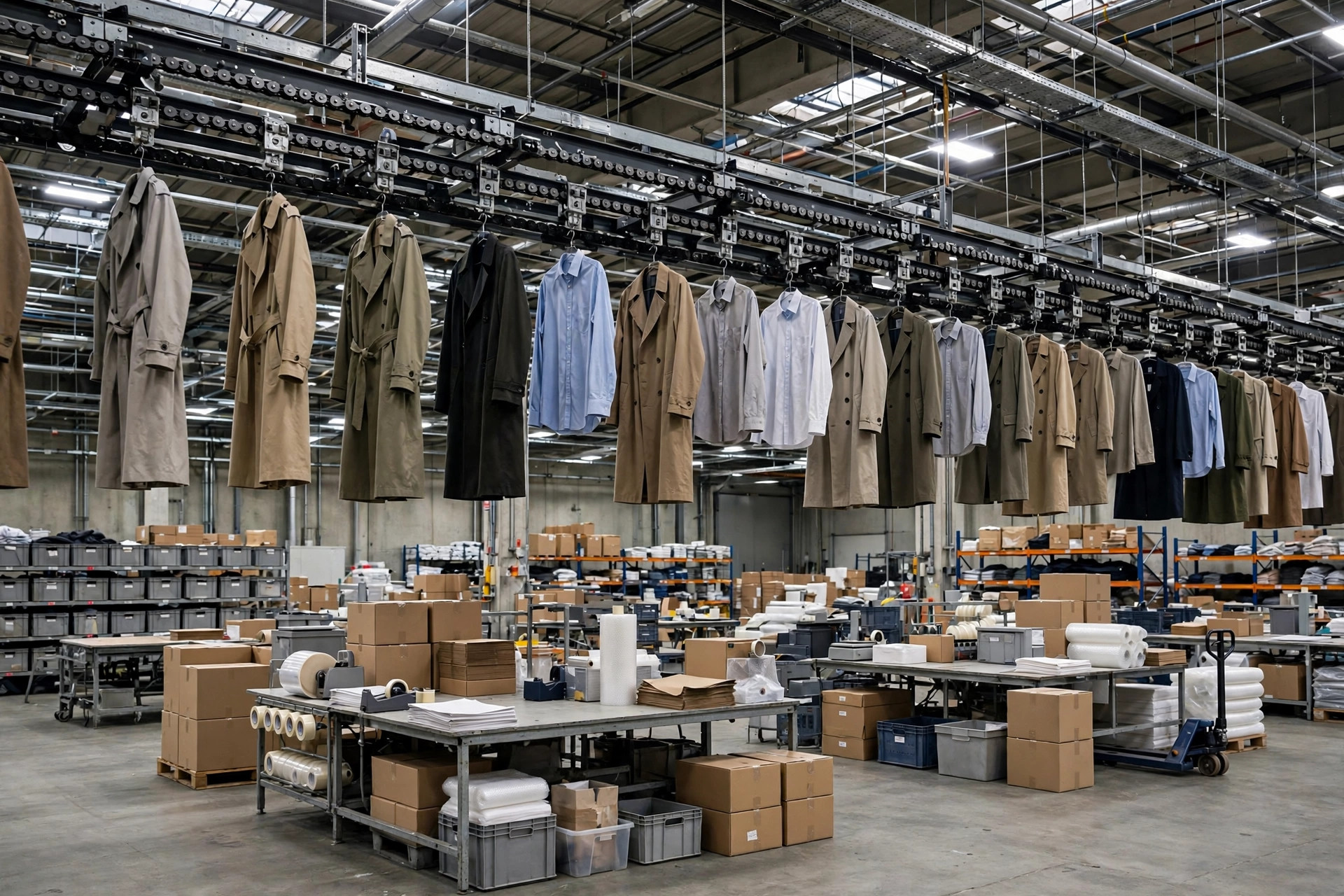
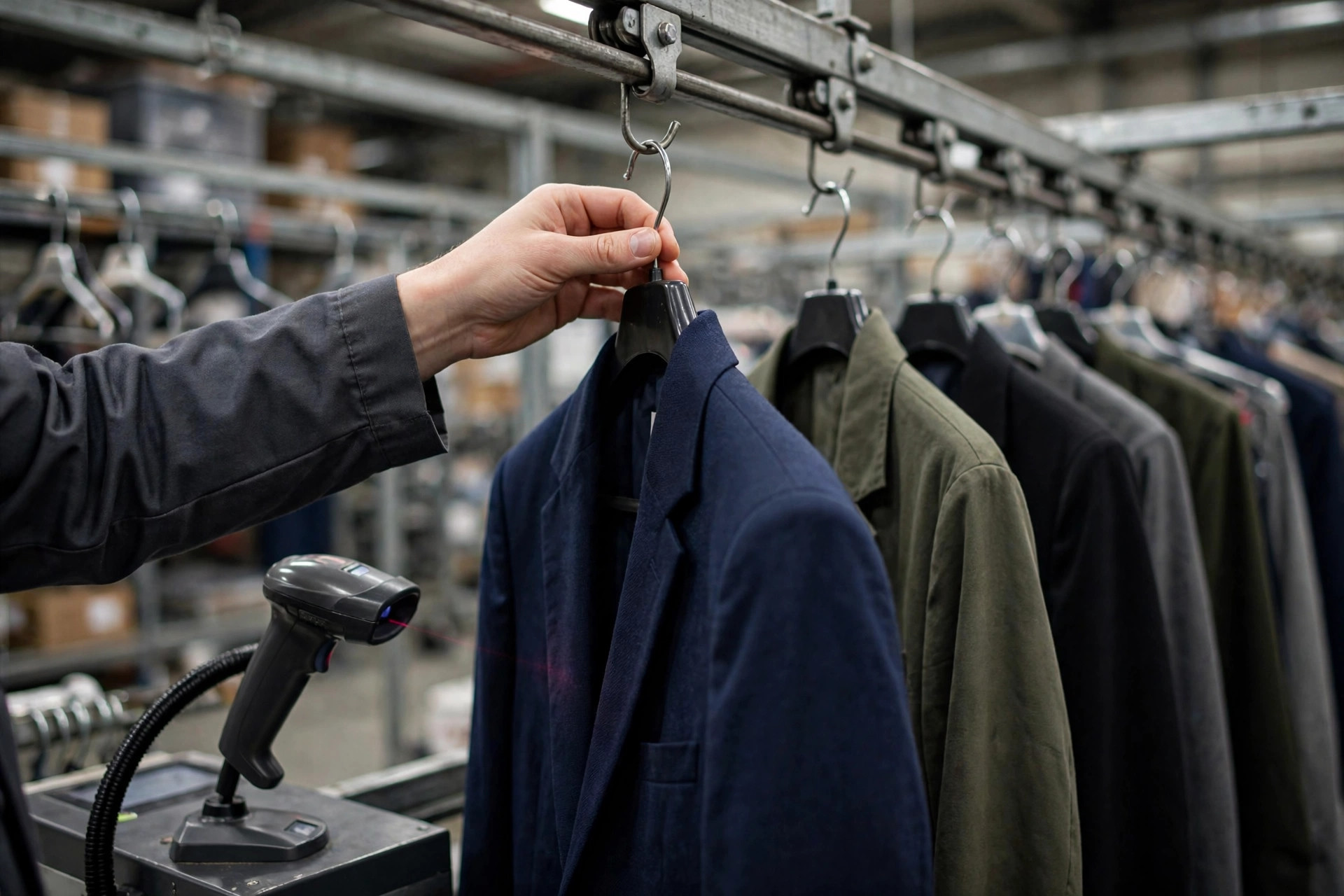
Think of it as a highway in the air. The chain is the road, the trolleys are the cars, and the hooks are the parking spaces. Garments ride on hangers, spaced at fixed intervals, and at each sortation point a pusher or diverter knocks the hook off the main line onto a branch rail. No boxes, no folding, no unfolding.
You can think of the capacity formula the way a traffic engineer would: throughput equals chain speed divided by hook pitch. SDI's GOH sorter literature states it plainly — induction rate is set by rope speed and hook center distance, and their machine tops out around 13,000 units per hour. Railex's System 3500 runs a standard 80 feet per minute and moves about 5,000 garments per hour, with a maximum of 120 feet per minute. Same physics, different lane counts.
The point that matters: this is a sorting and transport device, not a storage device. Hanging rails can buffer a few hundred garments, but if you need deep storage, hanging is a terrible use of cubic space — clothes hang in a single layer and cannot be stacked. Boxes stack four to six high. That one fact decides half of all GOH business cases before you even open the price book.
The three numbers that decide the spec
Chain speed. Do not let a vendor sell you maximum speed as your operating speed. Railex's own numbers tell the story: 80 fpm is the production speed that delivers 5,000 garments per hour; 120 fpm is the headline. Running at max speed all day is like redlining a truck engine — wear, noise, and derailments all go up. Size the line for your peak hour at 70 to 80 percent of the rated speed, or budget for the maintenance you will pay later.
Hook pitch. A European patent on automated hanger sorting (EP0861129) puts hanger spacing at 150 to 180 millimeters with conveyor speeds of 350 to 550 millimeters per second. That is your physics envelope. Go tighter than 150 millimeters with winter coats and the garments bunch, hooks collide in curves, and your beautiful 13,000-units-per-hour machine becomes a 6,000-units-per-hour jam generator. Spec the pitch for your bulkiest garment, not your average one — winter coats and padded jackets decide the spacing, T-shirts do not.
Hook load. One hook carries one garment or one prepack. Coats are heavy, and a line full of winter coats at peak is a different machine from a line full of summer shirts. If your assortment swings seasonally, size the chain and drive for the winter case. This is where underspecified lines die: fine in June, stalling in November.
When it is worth it: three dividing lines
First, category. Suits, blazers, overcoats, dresses — anything that wrinkles when folded and costs money to press — belong on hangers. T-shirts, jeans, underwear, knitwear that ships folded anyway: hanging them is pure theater. If hanging SKUs are under 30 percent of your volume, you do not have a hanging warehouse, you have a folded warehouse with an expensive ornament.
Second, volume. A GOH sortation line earns its keep when the daily hanging volume is high enough that manual sorting cannot keep up. White Conveyors' order-assembly system loads up to 600 pieces per hour with one operator — that is the small end of the market. At the big end, SDI's 13,000 units per hour exists for retail DCs feeding hundreds of stores. Between those two poles sits the honest question: can your hanging volume fill the line for most of the shift? A 5,000-UPH line fed 800 garments a day is a monument, not an asset.
Third, returns. This is the one most people miss, and it is where e-commerce apparel quietly wins with GOH. A returned blazer that comes back folded needs inspection, re-pressing, re-bagging, re-hanging. A returned blazer that comes back on a hanger goes from QC straight back to the hanging rail. Apparel e-commerce return rates are brutal — that re-hang loop is often where the fastest payback hides, because it deletes an entire rework process rather than speeding up an existing one.
Here is the honest comparison:
| Dimension | Hanging (GOH) | Folded in cartons |
|---|---|---|
| Sortation throughput | 5,000–13,000 units/hr (vendor specs) | ~200–400 units per person-hour, manual (field rule of thumb) |
| Floor space | Single layer, cannot stack; hungry for area | Cartons stack 4–6 high; dense |
| Capital cost | Roughly 1.5–2x an equivalent-capacity folded sortation setup (industry experience) | Baseline |
| Pressing / rework | None — arrives store-ready | Pressing, bagging, re-hang on returns |
| Best categories | Suits, coats, dresses | T-shirts, jeans, underwear, knits |
Market data backs the direction if not every number: automated garment handling in high-throughput facilities now shows payback in 3.2 to 4.8 years, fulfillment cycles 25 to 35 percent shorter, and order accuracy moving from about 94 percent to 99.2 percent. Those are the facilities that had the volume to fill the line. The ones that did not are the ones with dusty rails.
The maintenance traps
Rail dust. Overhead rails collect dust and textile lint. Lint plus chain equals accelerated wear, and wear equals stretch, and stretch equals derailments at the curves. If your preventive maintenance plan does not include rail cleaning on a schedule, you do not have a maintenance plan — you have a repair budget.
Deformed hooks. This one is pure self-inflicted damage. The line is engineered for standard hanger hooks; then purchasing buys whatever hangers are cheapest that quarter — thick wooden hooks, wide plastic hooks — and the carriers deform. Deformed carriers drop garments, garments jam the diverters, and suddenly your 99 percent uptime is a story you tell at conferences. Standardize the hanger. It is the cheapest part of the system and the one most likely to kill it.
Sprinkler blockage. Dense hanging garments block sprinkler discharge. A hanging garment zone is not a standard rack-storage fire scenario, and you cannot copy the sprinkler design from the carton area next door. Get the fire protection engineer involved before the layout is frozen, not after the FM inspector shows up. This is the trap that stops projects, not just slows them.
The fake-requirement rant. The most expensive mistake I keep seeing: a warehouse installs a hanging line and then hangs everything, including the T-shirts, because "we paid for the line, we should use it." That is backwards. The line exists to serve the garments that need hanging. Hanging a T-shirt costs more floor space, more energy, and more maintenance than folding it — with zero quality benefit. If your hanging percentage keeps creeping up without a category reason, someone is justifying the purchase, not running the warehouse.
So: is the money worth it? It comes down to one number — how many garments per day genuinely need to travel on a hanger. Multiply that by 365, multiply by the labor and pressing cost each hanging garment saves you, and compare it against the annual depreciation and maintenance of the line. If the savings do not cover the line, do not build the line. Everything else is decoration.
By Da Liu, Automation Engineer