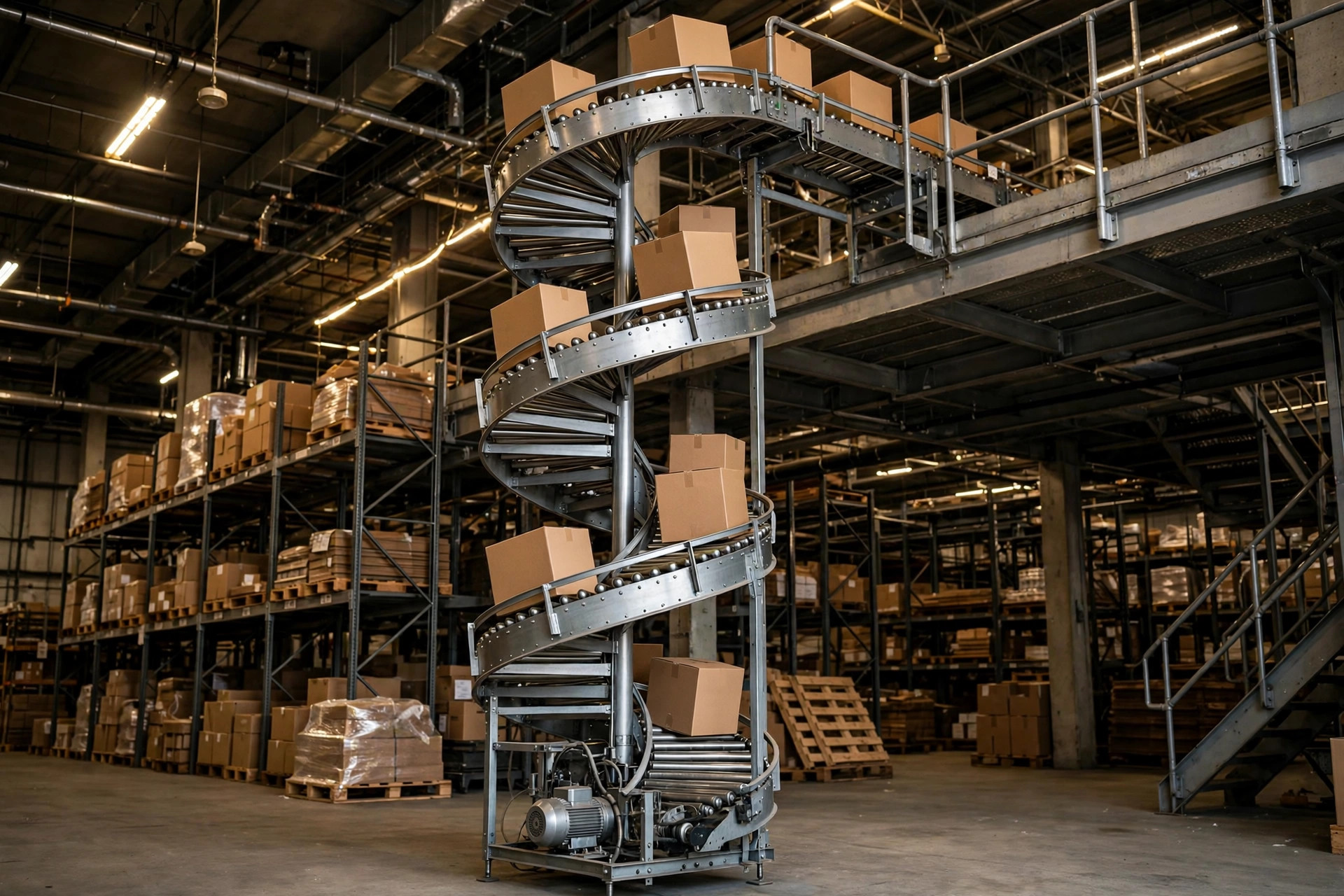
Start with the bill. A powered spiral conveyor to move cartons from the ground floor to a second-floor mezzanine: $135,000, installed. A vertical reciprocating conveyor (VRC) for the same job: $42,000. Same building, same boxes, $93,000 apart.
That was a real quote review I did in the fall of 2024 for a 3PL warehouse in Ontario, California. Two floors, receiving on the ground level, split-case picking on the mezzanine, about 5 meters of lift, roughly 6,000 cartons a day moving upstairs. The owner asked me which machine to buy. My answer: at your volume, the expensive one is money thrown away. At triple the volume, the cheap one is the money pit.
This is the most common mistake in warehouse vertical conveying selection: buyers compare equipment prices instead of total cost. This guide covers only the upward trip: spiral conveyor selection for vertical conveying — what it competes against, and where the money actually goes. One boundary first: the gravity spiral chute that sends boxes downward is a different machine, outside this discussion.
Powered Spiral vs Reciprocating Lift: Run the Full Math
Three mainstream options move cartons upstairs: the powered spiral, the vertical reciprocating conveyor (VRC), and the continuous vertical conveyor. The continuous type handles 5,000–10,000 cartons per hour but sits at the top of the price range — overkill for most two-floor buildings. The real contest is the spiral versus the VRC.
The difference isn't price. It's how they work. The spiral is continuous flow: cartons ride the helix one after another, never stopping. The VRC is batch flow: the platform loads, rises, unloads, and comes back down. One is an escalator; the other is an elevator.
Here is the 5-year total cost of ownership for a typical ground-to-mezzanine job with about 5 meters of lift, in US dollars:
| Cost item | Powered spiral | Vertical reciprocating lift |
|---|---|---|
| Equipment | $50,000–$200,000 (modeled at $130,000) | $10,000–$100,000 (modeled at $45,000) |
| Installation & commissioning | ~$39,000 (~30% of equipment) | ~$7,000 |
| Annual maintenance (parts + labor) | ~$15,000 | ~$8,000 |
| 5-year total (excl. labor & power) | ~$244,000 | ~$99,000 |
On this table alone, the spiral costs more than twice as much. Case closed — "this money was wasted," right? Wrong. The table is missing the line that matters most: labor.
A VRC platform needs someone to load it and someone to unload it. At low volume, upstream and downstream workers handle it as a side task — no extra cost. But once volume exceeds what the lift can cycle — a platform taking 4 cartons per 40-second round trip tops out around 300-plus cartons an hour — cartons queue up downstairs during peak, and you need a dedicated person feeding the machine. In the US, one full-time operator on a VRC costs several tens of thousands of dollars a year in wages and benefits (it varies by state — plug in your own number). One extra headcount adds nearly $200,000 over five years. The spiral is continuous and automatic, interfacing directly with the conveyor line. No extra person needed.
So the real breakeven point isn't in the equipment price. It's in the labor. At low volume, where the VRC gets loaded as a side task, it genuinely is cheaper. At the volume where the lift needs its own dedicated operator, the spiral wins. That's where most buyers get the math wrong.
Warehouse Vertical Conveying Selection: The Three Dividing Lines
Three filters, in order.
First: throughput. The primary dividing line:
- Under 1,000 cartons/hour average: buy the VRC, no debate. The spiral's continuous capacity of 2,000–5,000 cartons per hour would sit half-empty, and every extra dollar buys nothing.
- 1,000–2,000 cartons/hour: the gray zone. Check peak duration. Peaks of one or two hours a day? A VRC with a small accumulation buffer handles it. Peaks running four hours or more? The spiral is the safer machine.
- Above 2,000 cartons/hour: spiral territory. Here a VRC either needs a twin unit in parallel (double the cost, lower reliability) or exhausted workers at peak.
- Above 5,000 cartons/hour: look at continuous vertical conveyors or dual-lane spirals. A single spiral has hit its ceiling.
Second: carton profile and weight. The spiral generally tops out around 30 kg per item. Overweight, oversized, or irregular cartons jam or drift on the helix. Pallets? Forget it — they go on a VRC or a hydraulic lift table. Hard boundary, and money has nothing to do with it.
Third: lift height and floor count. The spiral's economical elevation range is roughly 1–20 meters, but its height is fixed — what you build is what you get, and a later layout change means major rework. The VRC serves multiple floors: three levels, four discharge points, just add stops. The spiral can't do that. More than two floors? Start with the VRC.
A 2023 case from an e-commerce fulfillment center in Dallas, Texas, shows the trap in reverse: peak volume of 3,800 cartons per hour, totes moving continuously from ground-floor storage to second-floor sortation, 7.5 meters of lift. They bought the VRC to save money. During Black Friday week, the 40-second platform cycle couldn't keep up, cartons backed up to the dock, and six temporary workers on rotating shifts were hired just to feed the lift — nearly ten thousand dollars in extra labor for a single week. The next year they switched to the spiral, and the problem disappeared. The lesson: the VRC's "cheap" only holds if volume never grows — and in e-commerce, volume assumptions are the least reliable numbers in the building.
The Maintenance Trap: Chain, Friction Wheels, and That 15–25%
Equipment salespeople won't volunteer this, but I will: maintenance is the most underestimated line in the total cost. Industry research puts the spiral's ongoing maintenance cost 15–25% above conventional vertical conveying equipment — mostly proprietary parts and tight tolerances.
Three specific traps:
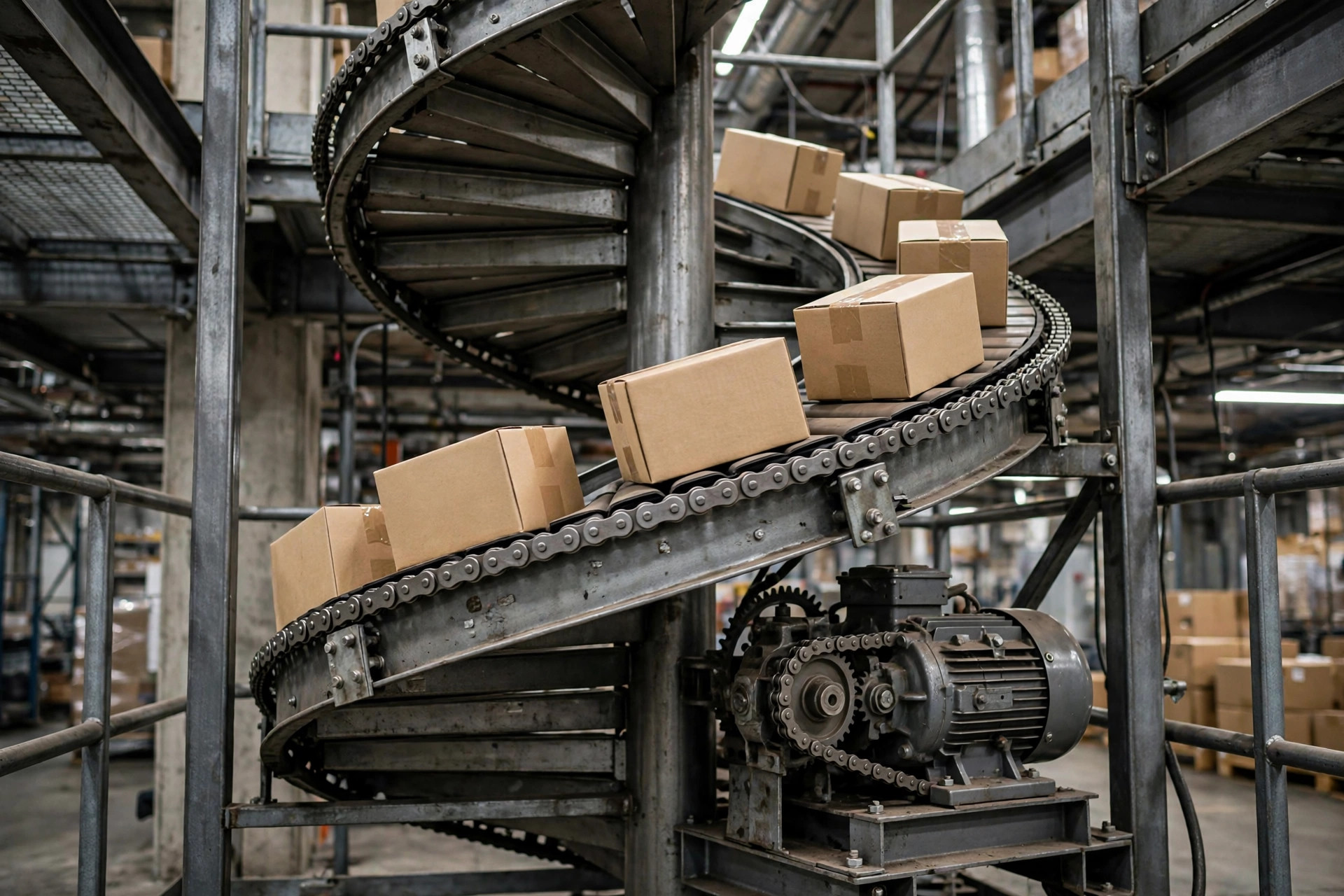
First, chain stretch. The spiral is chain-driven, and on mainstream machines the chain stretches noticeably within the first 200 hours — it must be shortened during a planned stop, then checked on schedule. Skip the checks and you get anything from a jumped sprocket and a dead line to a scrapped chain.
Second, wear strips and friction wheels. The chain rides on UHMWPE wear strips year-round — consumables by design, with wear rate tracking carton weight, dust, and running hours. In a dusty building (cardboard sheds plenty), strip life gets cut in half. Inspecting the chain but not the strips is like changing the oil but never the filter.
Third, electrics. The spiral needs a variable-frequency drive for soft start and soft stop; every hard start is a shock load on the chain. The old fixed-speed option looks cheaper on the quote and quietly halves chain life. Don't cut this corner.
The VRC? Simpler structure, genuinely cheaper to maintain: platform, guides, wire rope or chain, limit switches — fix what's broken, third-party parts easy to find. But don't forget its safety compliance cost: interlocked gates at every level, overtravel switches, guarding. Mandatory, and frequently "priced separately" on the quote.
Three Levers That Actually Save Money
First, installation is the biggest negotiation space. Industry data: total installed cost for a spiral — structural supports, controls, commissioning, integration — typically adds 20–45% on top of equipment price, and in extreme projects installation alone reaches 30–40% of the total budget. Most buyers haggle over equipment price and ignore installation. Wrong battlefield. Civil works, steel, electrical — whatever you can coordinate yourself, do it. That's where the integrator's margin hides.
Second, don't pay for speed you can't use. A high-speed spiral runs up to 90 meters per minute, but if your upstream and downstream lines run at 40, the machine spends its life waiting for product. Size speed to the system bottleneck — every tier up means a bigger motor, drive, and structure.
Third, used and refurbished. VRCs are simple machines with a liquid secondhand market; a three- or four-year-old unit can cost 40% less. Be careful with used spirals: remaining chain and wear-strip life is invisible to an untrained eye, so get a third-party inspection before negotiating.
The Close: One Formula, Do It Yourself
No universally better machine exists — only math that checks out. The formula I use every time:
Annualized equipment gap = (spiral 5-year TCO − VRC 5-year TCO) ÷ 5 VRC extra annual labor = extra peak headcount × fully loaded cost per person
If extra annual labor exceeds the annualized equipment gap, buy the spiral. Otherwise, buy the VRC. Plug in your own volume, lift height, and local labor cost — thirty seconds to an answer. In selection, gut feel lies to you. Formulas don't.
By Lao Zhou, Logistics Cost Analyst