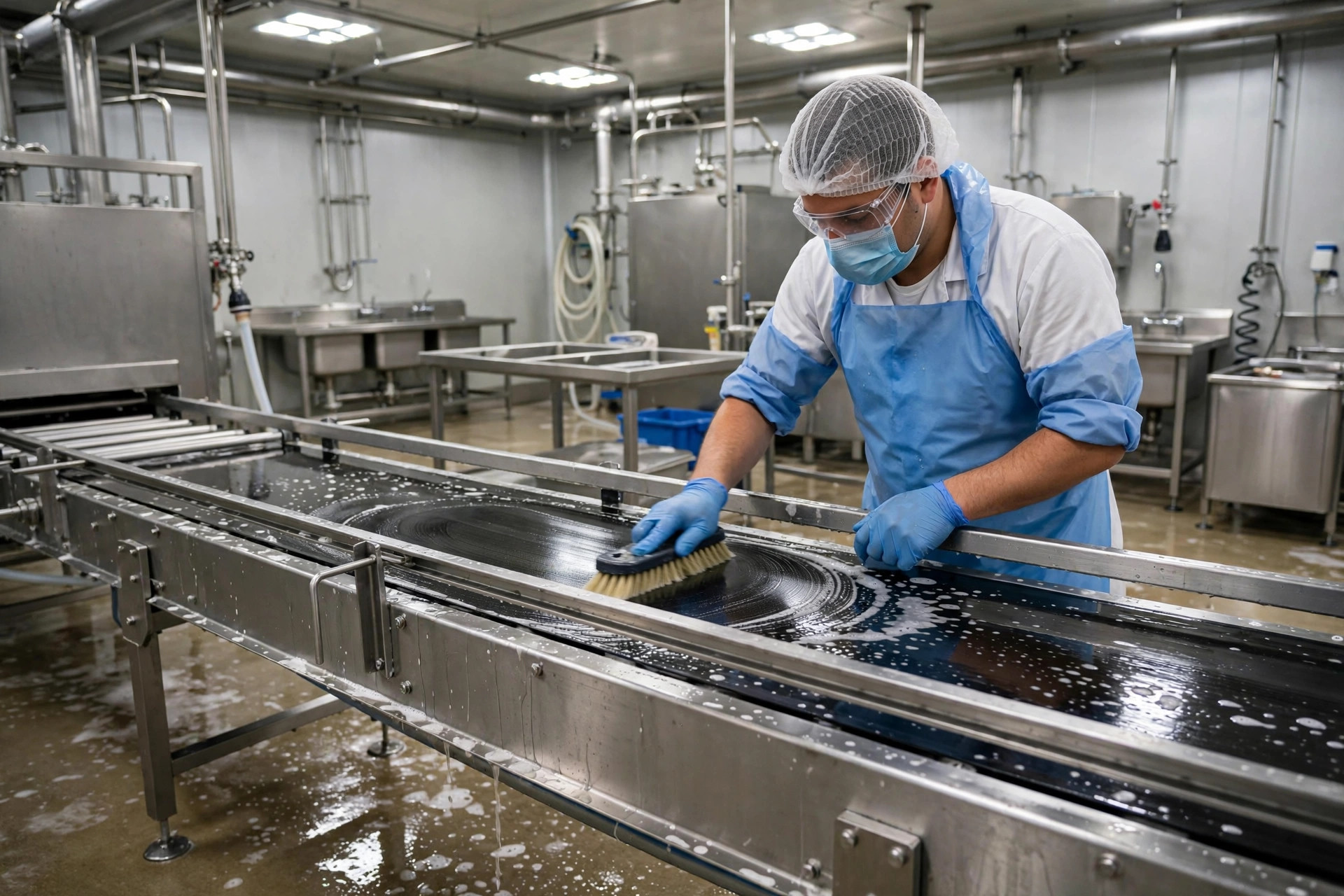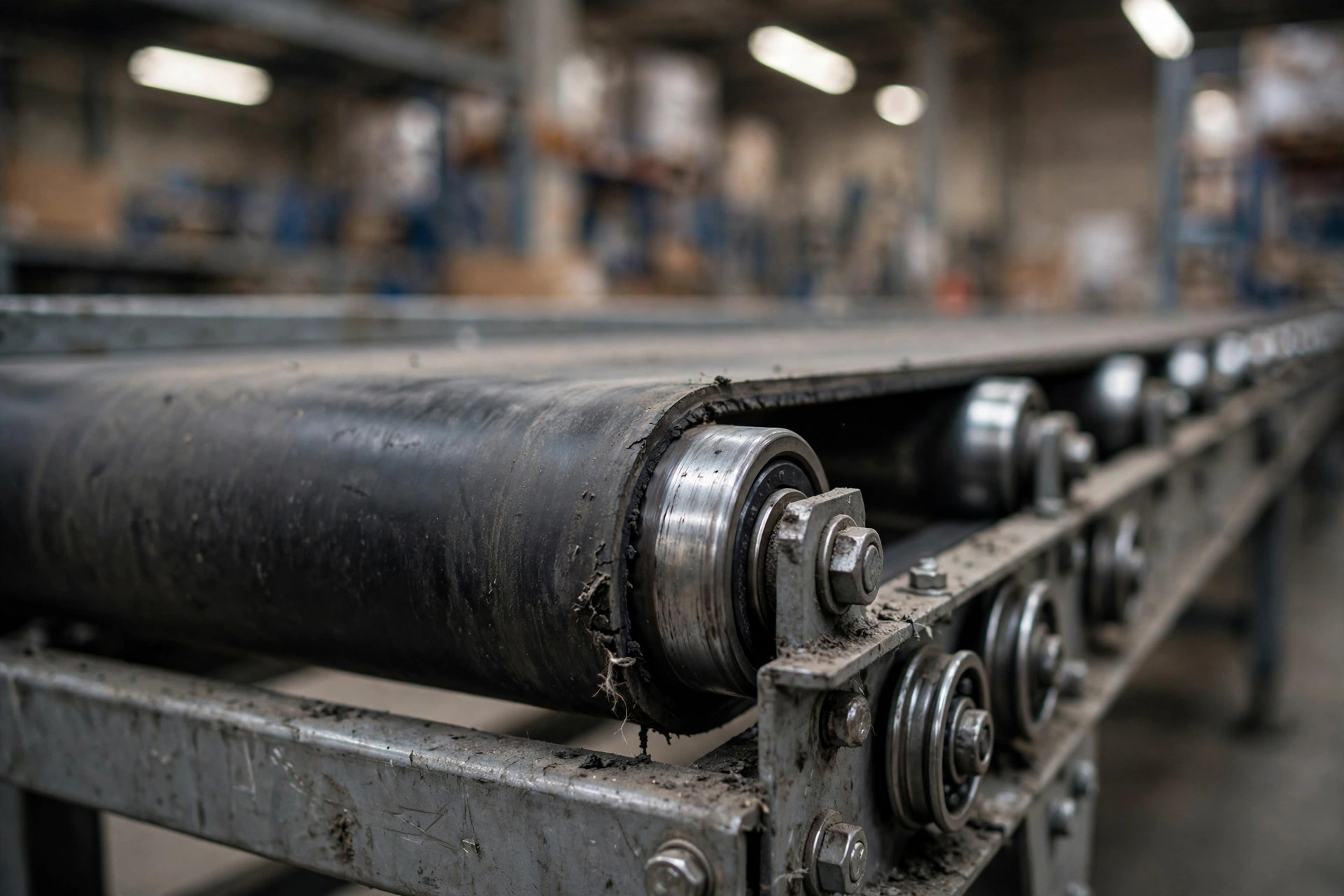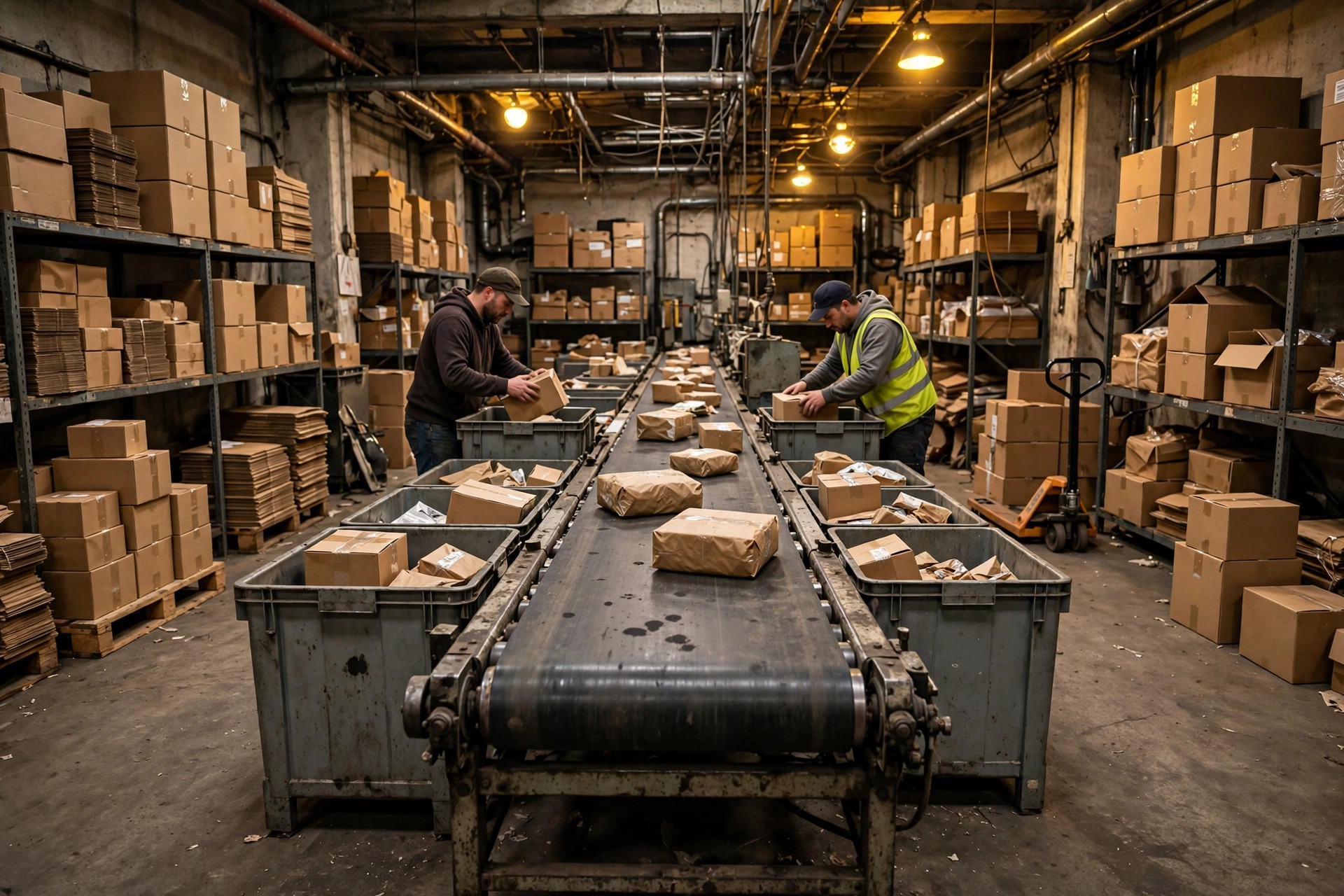
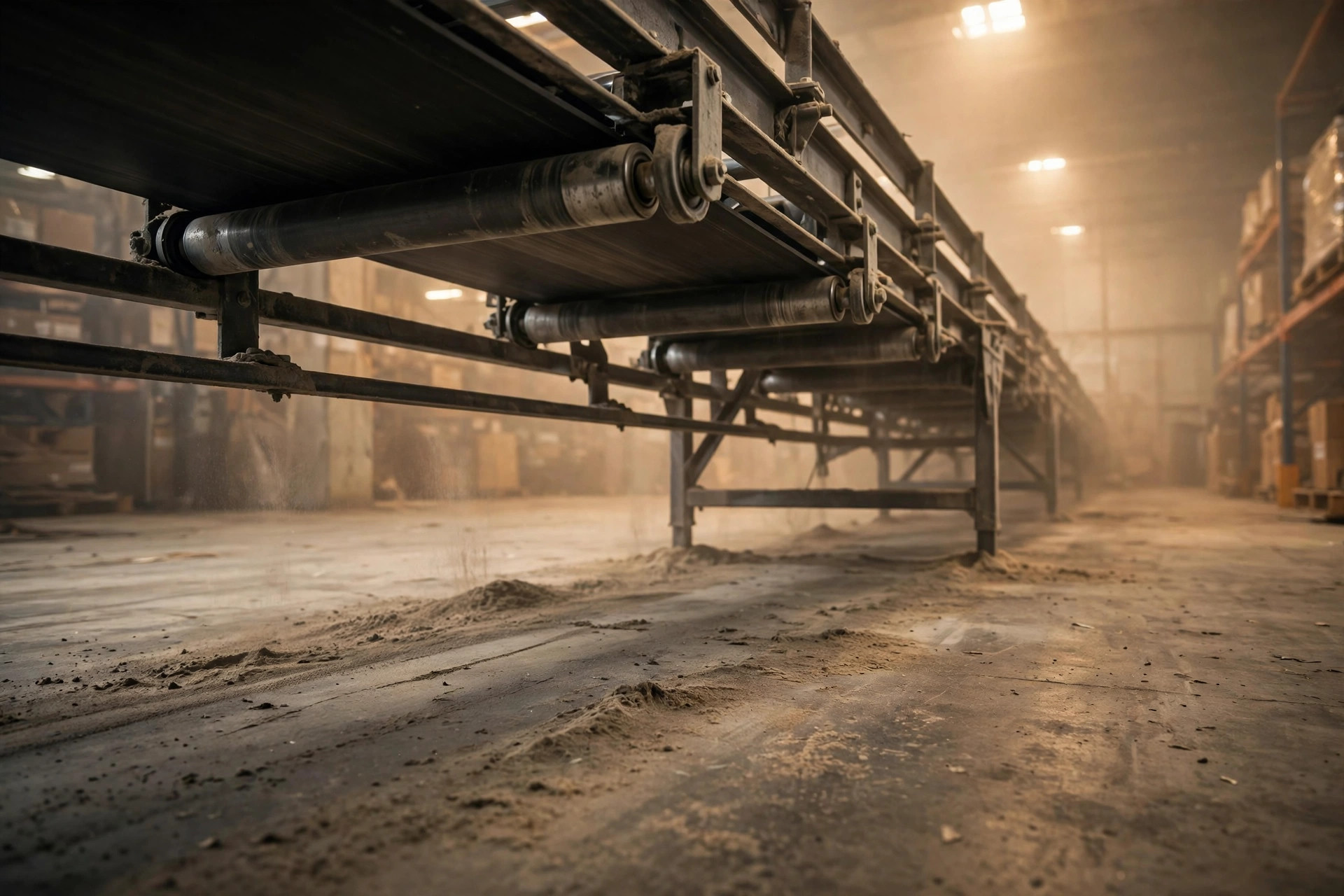
Last March I crouched under our conveyor with my phone flashlight and — oh boy. The return rollers were caked in a ring of black grime thick as a tire. The dust on the floor was deep enough to write your name in. Every day at closing, two people spent half an hour with brooms, and the next morning there'd be a fresh layer anyway.
Our 3,000-square-meter small warehouse can't afford an equipment engineer, and a conveyor looks like something that "just spins," so nobody paid it any attention. Until the day the belt started mistracking and nearly chewed through its own edge. That's when I learned: whatever the return belt carries back, you end up paying for in labor, gram by gram.
Our Mess: What Return-Side Carryback Actually Is
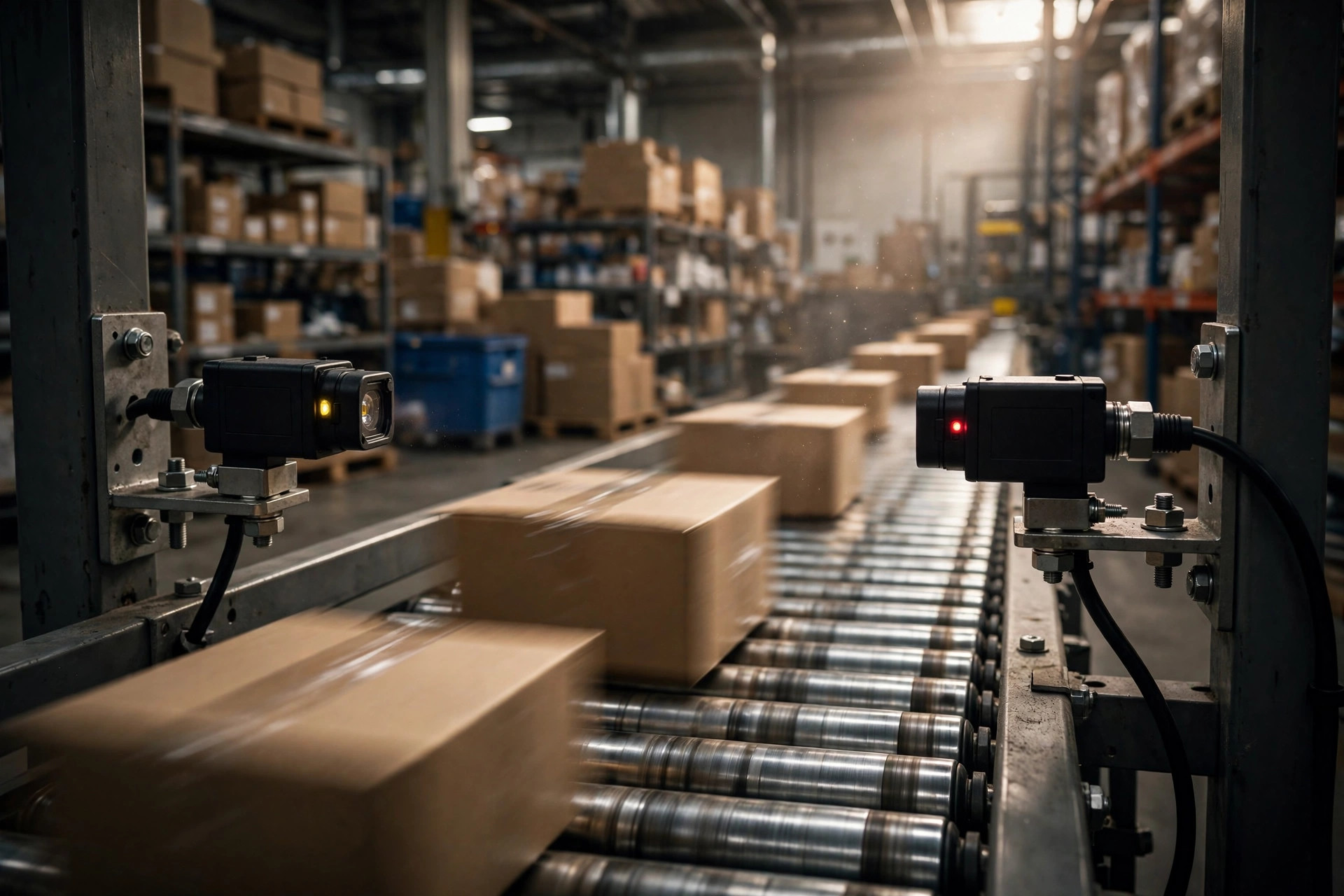
Quick primer, so you're not as clueless as I was. After a belt conveyor discharges its load, the belt surface carries a film of residue back with it — the mining industry calls it carryback. In mines it's ore dust; in a small parcel warehouse like ours, it's dust, tape ends, label backing paper, and cardboard crumbs. Same physics: the stuff rides the belt back to the tail, then rains down everywhere.
The fallout commits three crimes:
- It cakes the rollers. Dust and crumbs build up on return rollers, layer by layer, until the roller seizes. A seized roller grinds against the belt dry — the shiny bald patches on the belt's underside are the belt paying for your laziness with its life.
- It forces the belt off track. Cake more on one side than the other and the belt drifts, rubs the skirting, frays the edge, and the frayed edge snags more debris. Vicious cycle.
- It eats labor. Two people, half an hour a day — that's 30 hours a month. How many extra parcels could we have shipped in 30 hours? Don't get me started.
The embarrassing part: I assumed "conveyors are just dirty, that's normal" — until a seized roller stopped the line for half a day and 400-plus parcels nearly missed their cutoff. That's when I finally read up on it, and discovered the mining industry has actual standards for this stuff.
How the Industry Sees It: Their Numbers Are Worse Than Mine
Martin Engineering ran field tests in Australia: even with good tungsten-carbide blades, the practical lower limit of carryback left on the belt is 6 to 60 grams per square meter — and that's the floor, meaning you can never get to zero. They also defined cleaning levels: Level I at 250 g/m², Level II at 100 g/m², Level III at 10 g/m². The cleaner the belt, the less rains down underneath.
Their ROI math stung even more: on an uncleaned conveyor, spillage, dust, and carryback combined can eat up to 3% of total throughput — and manual cleanup averages about one ton per person per hour. A mine moving tens of thousands of tons a day, losing 3%... I don't even want to do that math. Our warehouse ships a few thousand parcels a day — the spillage is smaller, but two people sweeping half an hour daily is 30 labor hours a month, enough over a year to buy several cleaner sets.
So the disease is the same for big plants and small warehouses. Only the scale differs. They buy the full treatment; we small warehouses just copy half the prescription.
The Cheap Fix: Our Three-Piece Cleaner Kit
Time for the anti-big-vendor rant. The mining-grade systems from Martin or Flexco cost what I'd pay in wages for months. We small warehouses can't burn money like that. My rule: spend little, fix lots, good enough is perfect.
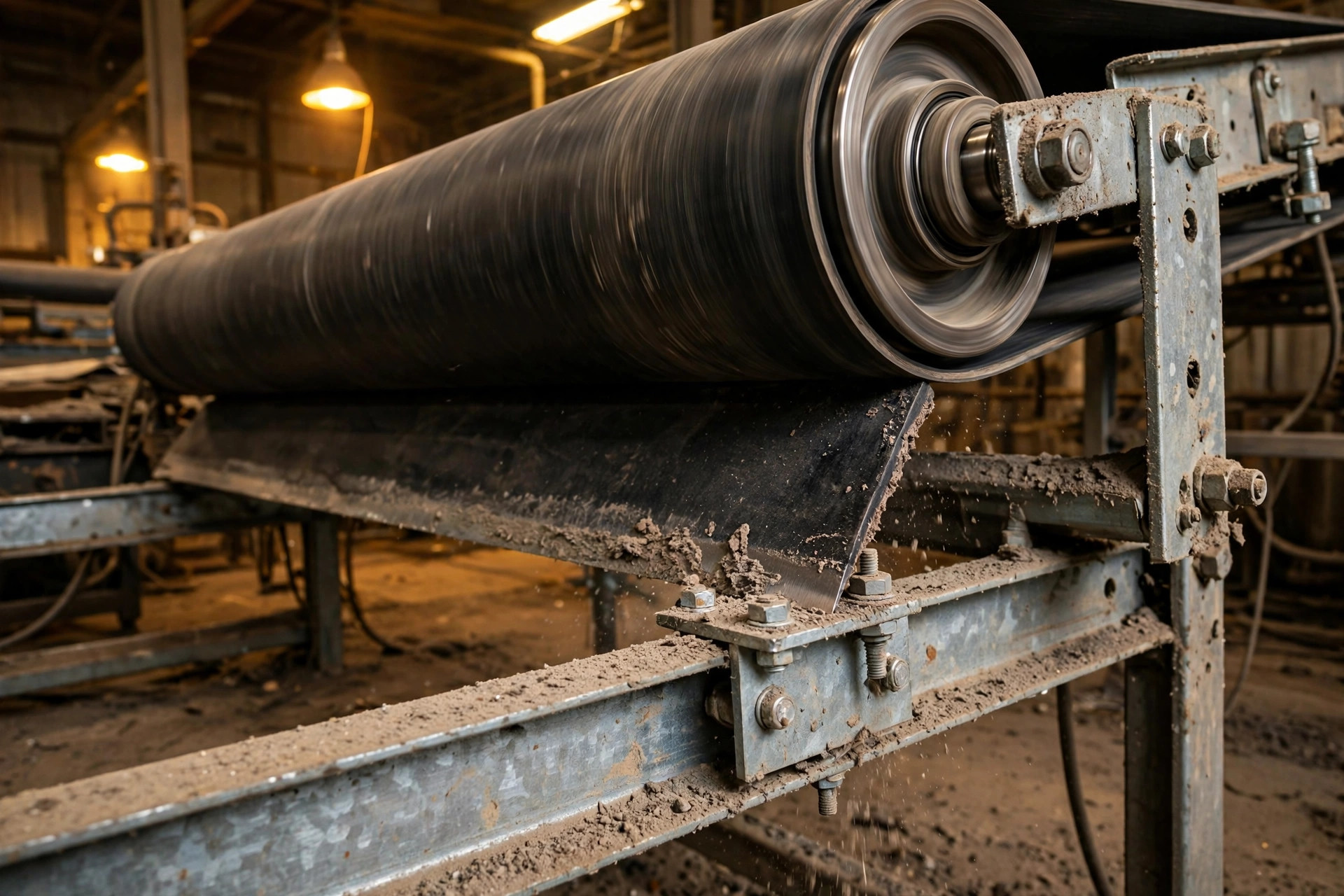
Piece one: a primary cleaner at the head pulley. This is the one that matters — even if it's the only money you spend. The principle is dead simple: a blade pressed against the belt right after discharge, scraping off the coarse stuck-on material. Two blade materials to choose from:
| Blade material | Pros | Cons | Who it's for |
|---|---|---|---|
| Polyurethane (soft blade) | Belt-friendly, cheap, you can swap it yourself | Wears fast, replace every few months | Small warehouses like us — our belt is secondhand, and one belt change means two days of downtime |
| Tungsten carbide (hard blade) | Aggressive cleaning, long life | Wears the belt, unfriendly to belt splices, pricey | Mines and heavy-duty lines that never stop |
I picked polyurethane. Simple logic: our belt is secondhand and can't survive the "sandpaper treatment" of a hard blade. Blades are cheap; belts are not. Even a primary-schooler can do that math.
Piece two: a return-side V-plow cleaner. It sits under the return belt — a V-shaped plow that sweeps debris to both sides. Embarrassingly cheap, shockingly effective — floor dust dropped by at least half.
Piece three: a catch tray (pure DIY). I welded a sheet-metal tray under the head pulley myself. Everything the blade scrapes off lands in the tray; empty it twice a week. Otherwise the scraped-off stuff just lands on the floor and you've accomplished nothing. Cost me about one barbecue dinner.
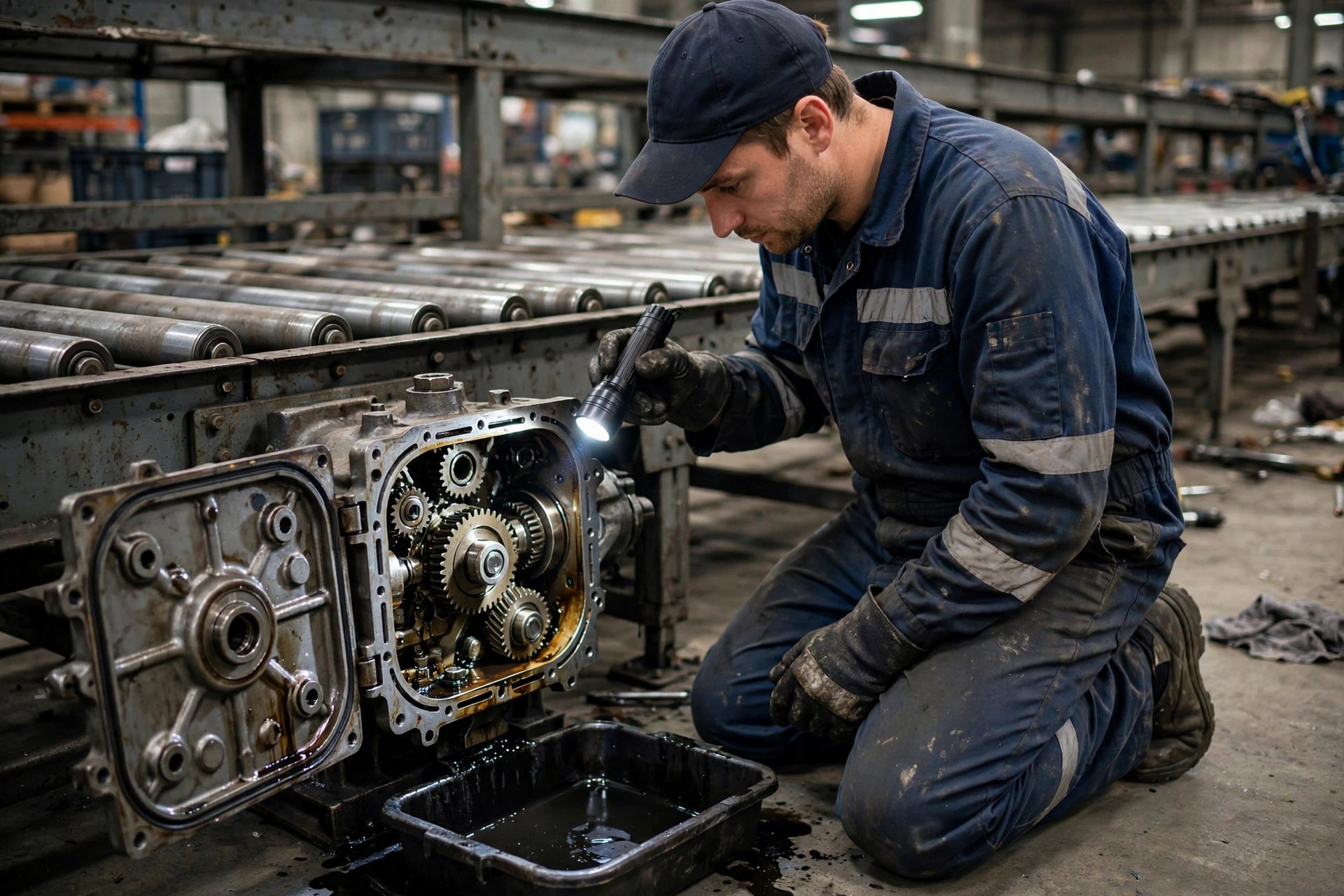
Maintenance is one sentence: check the tension weekly. Cleaners hold the blade against the belt with springs. Springs loosen, blades wear short, and suddenly you have an expensive decoration. My rule: every Monday morning, the shift lead gives each blade a push — if it's loose, two turns on the tensioner, five minutes. Keep two spare blades in the corner of the warehouse; they take up no space.
The Result: Three Months Later
Three months in, here's what I measured with my own stopwatch:
- End-of-day sweeping went from two people for half an hour to one person for ten minutes, plus emptying the catch tray twice a week.
- No seized roller since. No mistracking since that one incident.
- The floor is basically free of dust sheets — during a fire inspection, the inspector actually complimented our housekeeping. I'll be bragging about that one for a year.
Total spend on blades, the plow, and the welded tray: less than two months of the sweeping labor it replaced. Probably the highest-ROI "equipment investment" since I opened this warehouse — and the whole thing cost less than one of my secondhand forklifts.
The Counterintuitive Part: A Badly Installed Cleaner Hurts More Than None
This lesson cost me tuition, so here's the cheat sheet:
- Too much pressure = sandpaper. Some people think tighter means cleaner. Wrong. Over-tensioned, the blade dry-grinds the belt and carves grooves into it, cutting belt life short. The right tension is touching, not pressing — spring set to just maintain contact.
- Misaligned = decorative. If the blade isn't centered on the pulley, the stuck material just goes around it. After installing, shine a flashlight across the full belt width and confirm contact everywhere.
- Hard blade on an old belt = slow suicide. Old belts already have surface damage; a carbide blade keeps digging at the wounds. Small warehouses with secondhand belts: stick with soft blades and stop envying the "longer life" marketing.
The trade-off in one line: hard blades clean aggressively but eat belts; soft blades protect belts but wear out fast. It depends on which is more expensive — your belt or your blades. For us, the belt is expensive (two days of downtime to change one), so we go soft. For a mine, the belt is a consumable and downtime is the real cost, so they go hard. No right answer — only what fits.
Advice for Fellow Small Warehouses
- Buy the primary cleaner first, not the whole set. It solves the bulk of the problem — roughly sixty to seventy percent. Add the rest based on results. Our money goes where it counts.
- Choose polyurethane blades. Unless your belt is new, thick, and abrasion-resistant, don't touch carbide.
- Put tension checks on the weekly plan. Five minutes. If it's not on the plan, nobody does it — that's just human nature.
- Weld your own catch tray. Don't buy a ready-made one; they're overpriced. Any welder finishes it in half a day.
- Don't expect the cleaner to fix everything. Mistracking belts, noisy rollers — repair what's broken. A cleaner is a vitamin, not a cure.
One honest word to close: we small warehouses can't afford the full automation suites and predictive maintenance the big players run. But "a glance every week, a blade change every quarter" — the cheap, unglamorous way — works just as well. Treat your equipment with care, and it returns the favor in savings.
Small warehouses have their own way of surviving.
By Xiao Ma, Small Warehouse Owner