2:40 AM. My phone rang. It was the night-shift lead: the pump in the pit under the fire pump room had jammed, and water was rising past ankle level. First shift's forklifts roll in at 6, and a flooded pit means damaged freight worth hundreds of thousands. I drove to the warehouse with one thought looping in my head: that pit is a confined space under OSHA 1910.146, and please, nobody go down there on their own.
That night, a 22-year-old kid almost did. After that night, confined spaces in the warehouse stopped being a poster on our safety board and became a real procedure we run every time. Here's how we made the permit-required confined space system actually work on the floor.
What happened at the edge of that pit
July 2024, our 250,000-square-foot DC in Ontario, California. Around 2 AM, the sump pit under the fire pump room — the pump had jammed on debris, and the water kept rising.
Li, 22, fresh out of trade school, three months on the job, strong and eager — rolled up his pant legs and said, "Chen, I'll hop down and clear it. Three minutes, tops."
Old Zhou, 45, eighteen years in warehouses, grabbed him by the collar: "First tell me — is there air down there?"
Honest truth: my back was covered in cold sweat. The pit cover was off. Black hole. Water gurgling. Nobody had tested the air. No ventilation. No attendant. If Li had gone down and the oxygen was low, his legs give out, he falls face-first into the water, and then someone jumps in after him — I've read that script in OSHA fatality reports more than once. The would-be rescuer doesn't come back up either.
We brought in a third-party testing firm later. Oxygen in that pit read in the high 17s — well below the 19.5% safe threshold. A person goes down, gets dizzy, hands go clumsy, a few more minutes and they're out. That night we fished the debris out from above with the pump rig. Took two extra hours. Nobody went down.
Next morning at the all-hands, I told all 200 people exactly what happened. I said: "From today, nobody goes down a pit on their own authority. You ask me first."
Confined spaces in the warehouse: what actually counts
A lot of people hear "confined space" and picture mines and sewers — nothing to do with a warehouse. Wrong. Warehouses are full of them. They're just covered with a lid you walk past a hundred times a day.
1910.146 doesn't care about your gut feeling. It cares about conditions: limited openings, restricted entry and exit, not designed for continuous occupancy. Add any one of four hazards — toxic atmosphere, flammable atmosphere, engulfment, or other serious hazard — and it's permit-required. Entry needs a permit, period.
We walked our whole site and made a list, posted on the safety board:
| Warehouse space | Typical hazard | Permit needed? |
|---|---|---|
| Floor pit / sump pit (pump pit) | Low oxygen, standing water, electrical hazard in wet conditions | Yes |
| Silo / hopper | Engulfment from material collapse, dust | Yes |
| Storage tank (fire water tank, oil tank) | Low oxygen, off-gassing from residues | Yes |
| Pipe chase / service trench under the freezer mechanical room | Refrigerant leaks | Yes |
| Service pit under the dock | Poor ventilation, exhaust fumes from trucks | Assess — usually yes |
| Elevator shaft / vertical chase | Fall hazard plus poor ventilation | Assess |
The counterintuitive part: the most dangerous space isn't the deep pit that scares you — it's the lid you walk past every day thinking "it's fine." Pop the lid, conditions change, someone drops in, and nobody can move fast enough.
What the OSHA 1910.146 permit system really requires
A permit isn't a piece of paper. It pins down who does what and how everyone stays alive.
Our fixed five-step practice — no skipping:
Step 1: Identify everything. Every space on that list gets numbered and tagged: CONFINED SPACE — DO NOT ENTER WITHOUT PERMIT. New hires walk the list on day one.
Step 2: One permit per job. The permit names four things: the entrant going in, the attendant watching outside, the entry supervisor who signs off, what was tested and when re-testing happens. A permit is good for one shift. Shift changes, new permit — even if the job isn't done.
Step 3: Test the air and ventilate — both. Test before entry, re-test on a schedule while work continues, ventilation duct running the whole time. Our lines: oxygen between 19.5% and 23.5%, combustibles below 10% of the lower explosive limit. Alarm sounds — everyone out first, questions later. Check the current OSHA standard for exact thresholds; we re-verify ours every year.
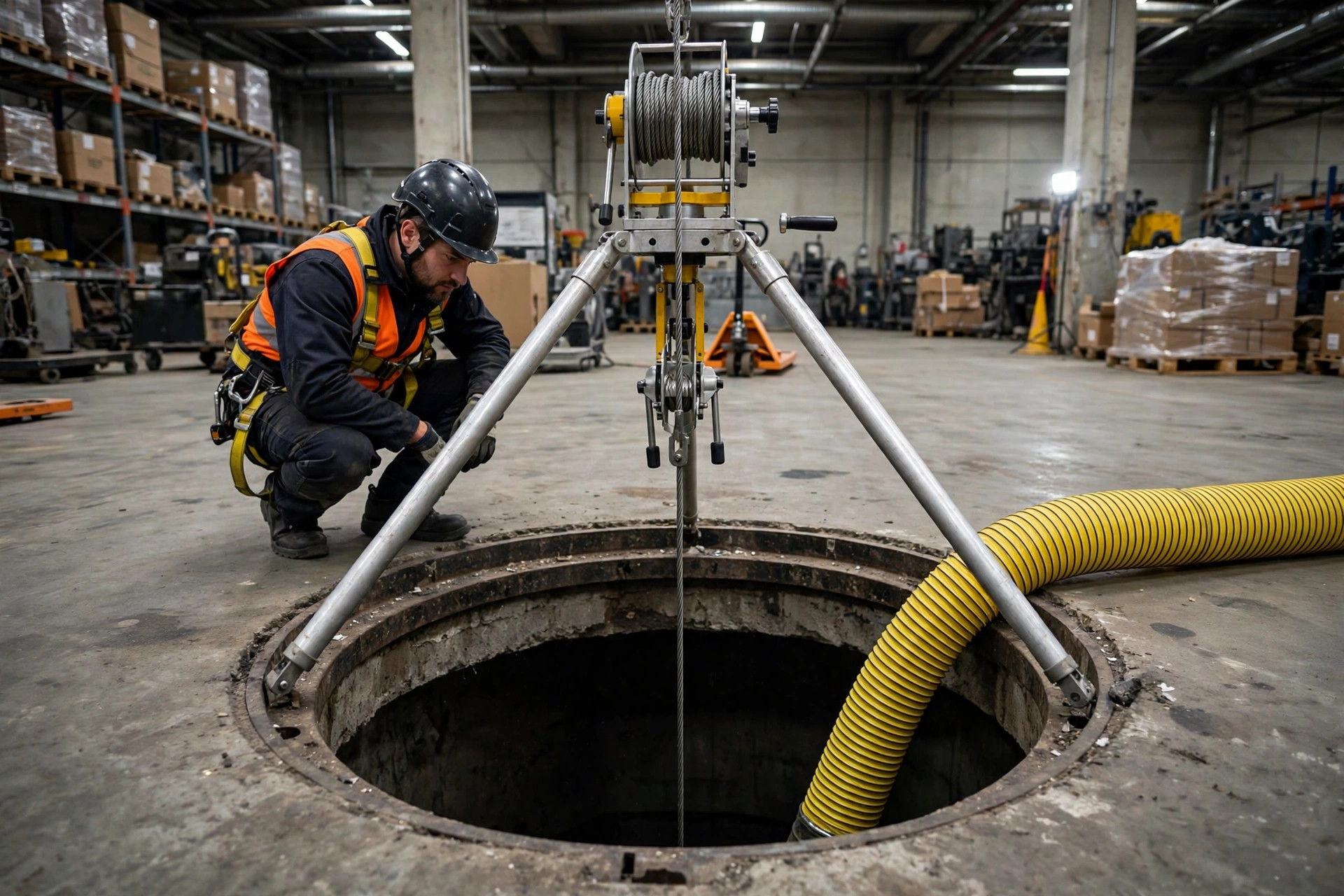
Step 4: Rescue gear staged before anyone goes in. Tripod over the opening, winch rigged, entrant in a full-body harness. And the iron rule for the attendant: you do not go in after them. Your job is the winch, the phone, the plan. The rescue plan is written in advance: who calls 911, who works the winch, where the stretcher is.
The tripod-and-winch setup costs a few hundred dollars and takes up a couple of square meters at the pit opening. We run a drill twice a year: how to crank the winch, how to carry the stretcher, how to wear the harness. New hires have to watch a full drill before their training counts. Old Zhou is now our part-time "pit chief" — he inspects the gear before every job, and if the gear isn't staged, nobody goes down.
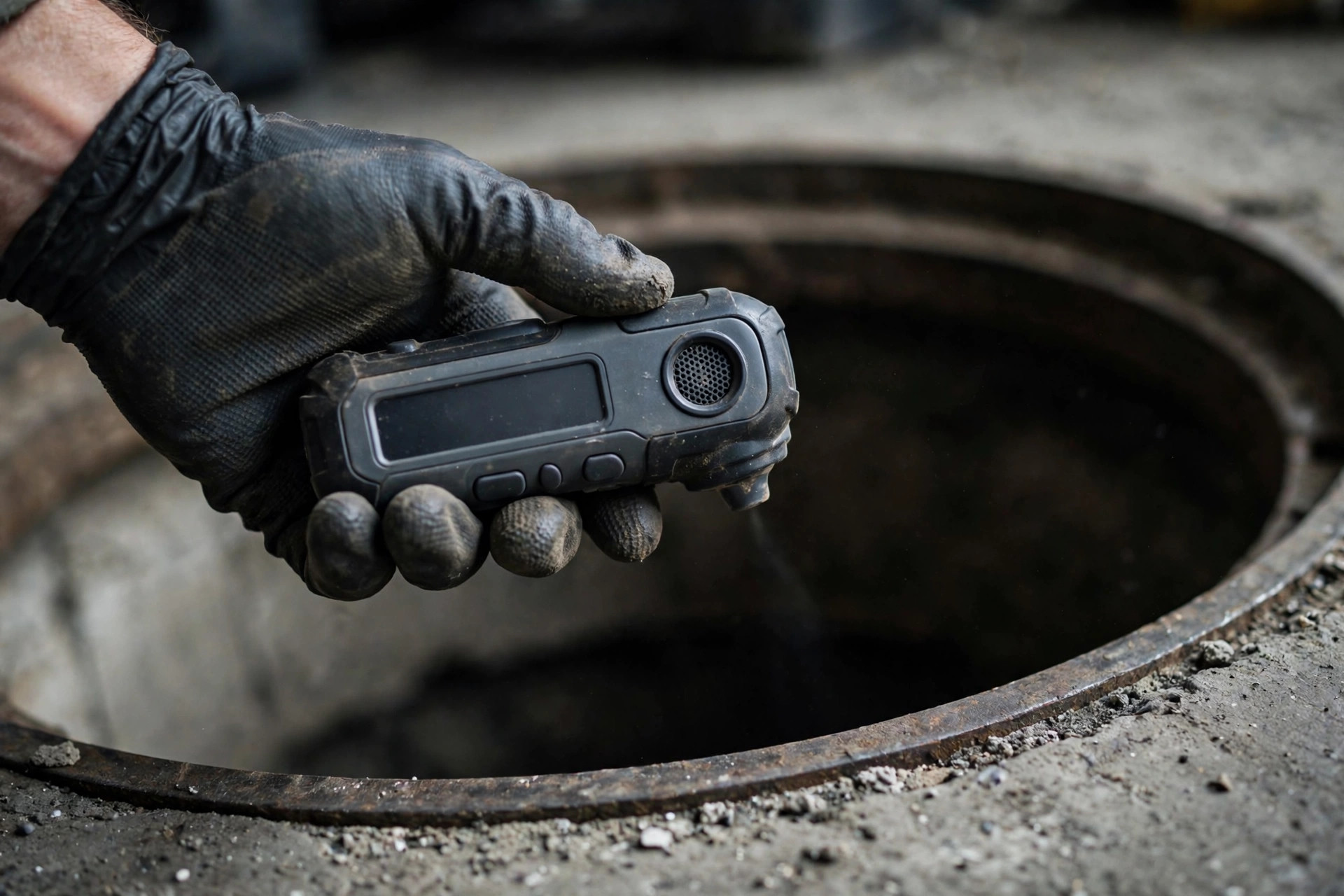
Gas detectors need care too: self-check on power-up, sensors calibrated on schedule, battery fully charged. We learned this the hard way — once a detector went more than half a year without calibration, the readings drifted, and our safety lead noticed the numbers looked "too pretty to be true." Sent it in, and sure enough, it was off. Since then, the calibration log is posted on the charging cabinet door where anyone can check it.
Step 5: Contractor work gets more oversight, not less. Here's a part a lot of people miss: under 1910.146, the host employer has to tell contractors where the confined spaces are, what the hazards are, and what our procedures are.
October 2023, peak season, our Eastvale site — a 5,000-gallon fire suppression water tank needed desilting. The contractor crew showed up, tools laid out, two guys ready to climb in. Our safety lead walked over: no gas detector, no blower, no permit. We stopped them cold. Our people served as attendants, walked them through testing and the permit. Two extra hours. Job still got done. The crew chief told me later: "You're the first site that ever stopped us." I said: "If something had gone wrong, you know whose name would be on it."
Honest talk: the permit isn't slow — it's the fastest way
The most common complaint on the floor: "Forty minutes of paperwork for twenty minutes of work — really?"
Let me do the math. One permit, three people, forty minutes, zero risk. Now the other side of the ledger: a single willful violation under OSHA can run into six figures per violation — and that's just the starting price. Add the shutdown, the insurance hike, the lawyers. And if someone dies, that math doesn't exist.
Here's the math that matters more: morale. In a 200-person building, news travels faster than a forklift. Someone gets hurt in a pit today, tomorrow the whole building works scared, turnover climbs, hiring gets hard. Our rule now: the job can finish two hours late; nobody goes down alone. Since that rule stuck, the veterans actually mentor the new kids more — because everyone knows this building treats a life like it matters.
So my take might run against the grain: the permit system doesn't slow production down. It's the foundation production stands on. People who hate the hassle are annoyed by paper. People who skip it are gambling with lives.
One thing for fellow operators: walk your pits, tanks, and shafts this week. List them, tag them. Next time the phone rings at 2 AM, you'll have a plan, your people will have a procedure, and nobody has to panic.
By Chen Feng, Warehouse Operations Manager