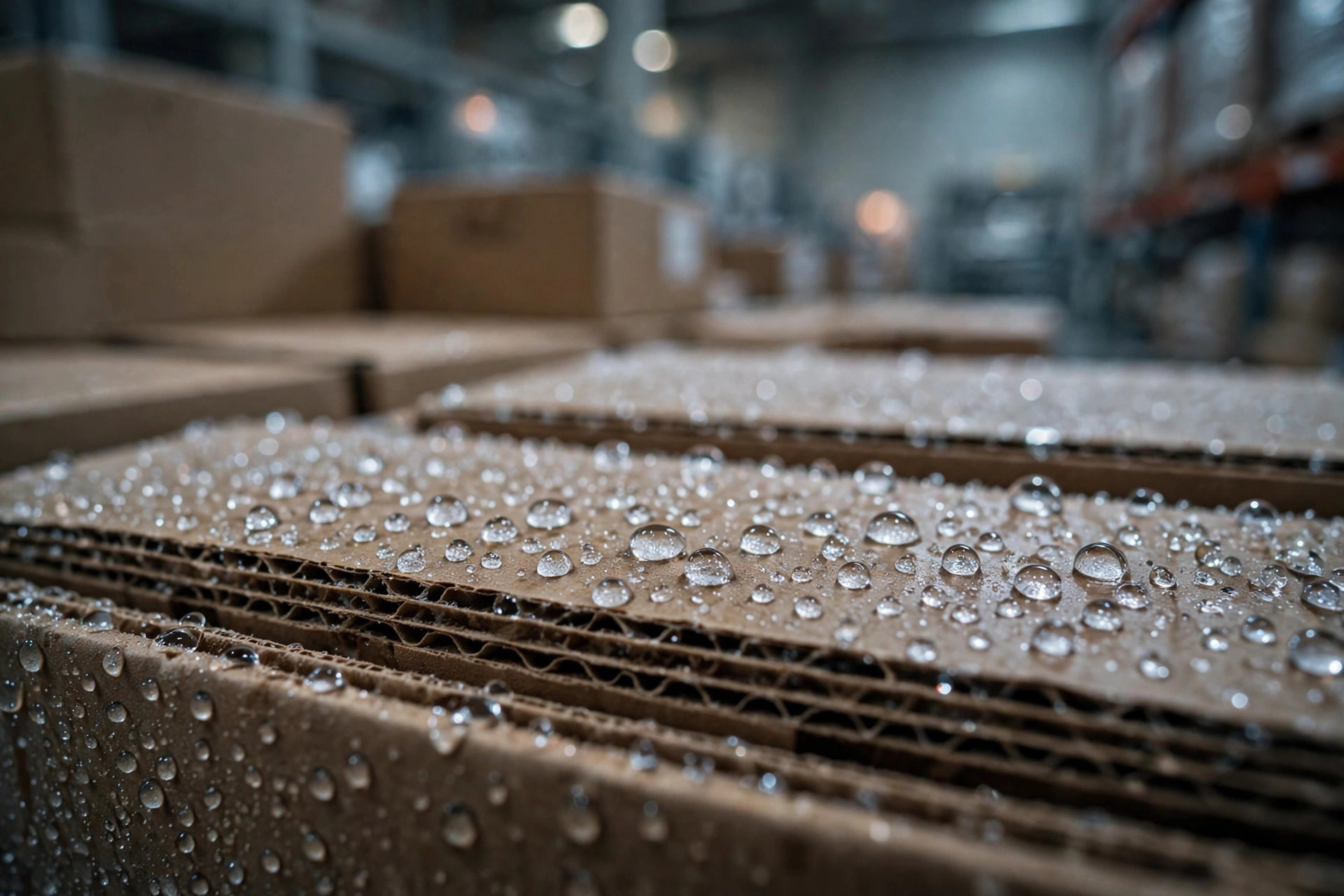
When it comes to warehouse condensation, our little warehouse has paid its tuition: 3,000 m², cold storage and ambient under one roof, fewer than ten people on the team. Last June, during plum-rain season, a batch of an e-commerce client's cartons sat in our ambient warehouse for half a month. When we pulled them out: boxes gone soft, a ring of water stains along the bottom. The client claimed close to twenty thousand yuan. That one order wiped out a month's profit.
It took me a while to figure out that condensation isn't something you can hand-wave away with "bad weather." It's a physics problem — and it has scrappy fixes. Here's the tuition our small warehouse paid over the last two years, laid out so fellow small operators can save a little.
Condensation in one sentence: the dew point
One sentence: air can only hold so much water vapor, and colder air holds less; when a surface is colder than the "dew point" — the temperature at which vapor starts turning into water — you get water.
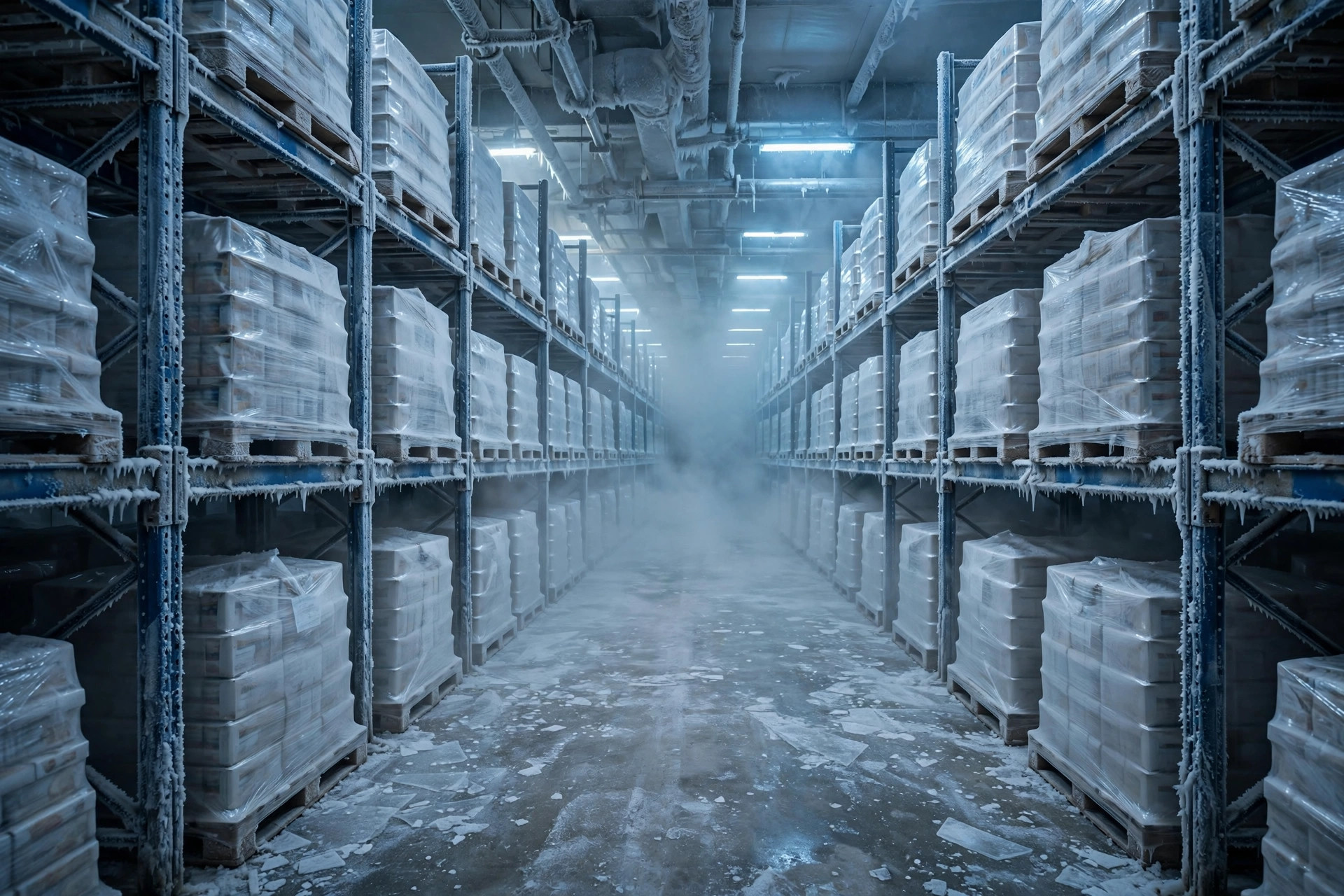
In human terms: at the cold-store dock door, −18°C cold air meets 30°C hot humid air, and every rack, floor patch, and carton surface at that boundary becomes a disaster zone. No need to memorize formulas. Just remember: bigger temperature gap plus higher humidity equals worse condensation.
Three disaster zones, each one paid for in cash
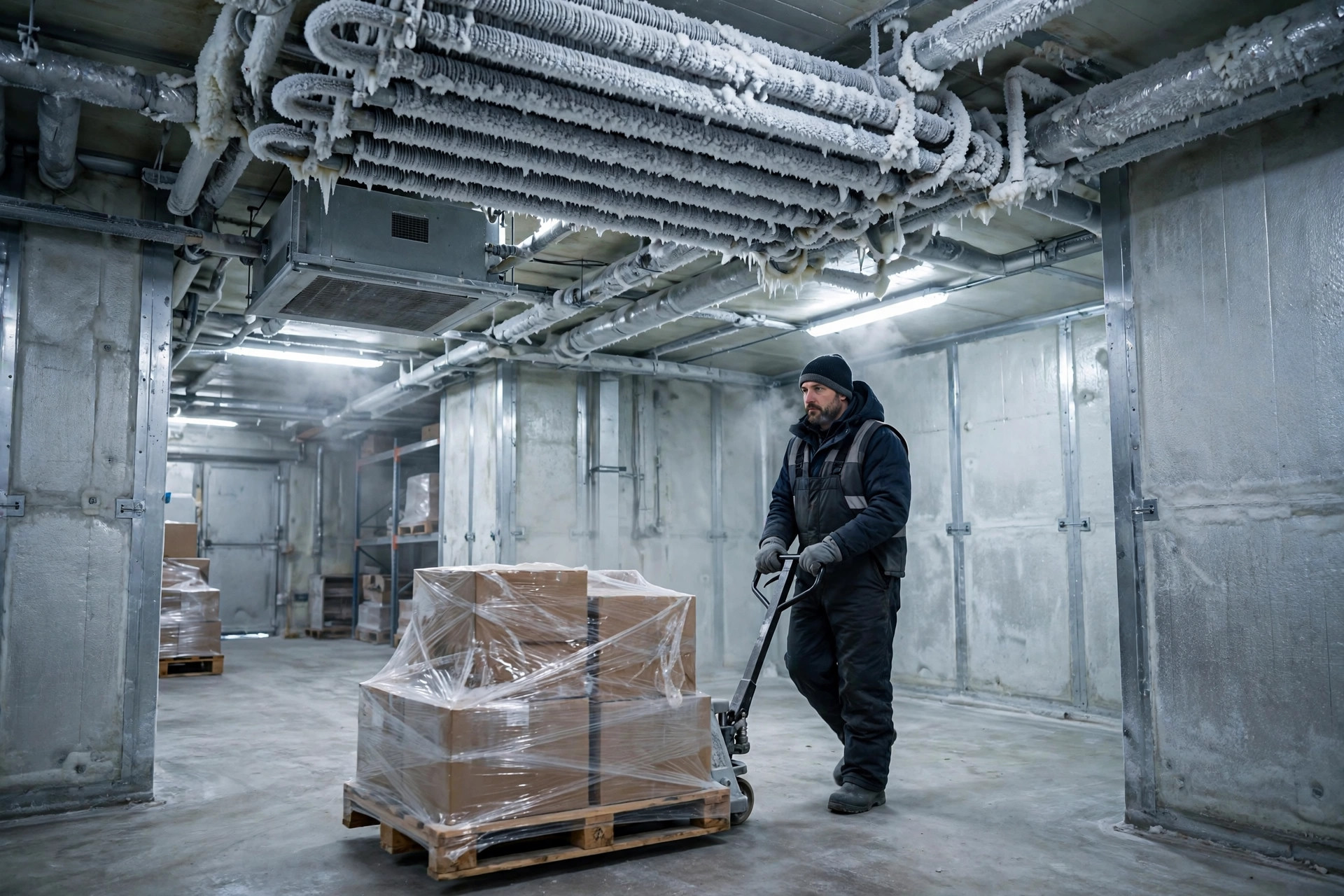
Zone one: the cold-store door. The front line where hot meets cold. Every forklift trip in and out pumps a lungful of warm humid air through the door, and the vapor condenses on the door frame, the floor, and the pallets nearest the entrance. Winter is worse — a thin sheet of ice on the floor, forklifts sliding. That's no longer cargo damage; that's a safety accident waiting to happen.
We learned this in January 2024: no barrier at all on our cold-store dock door, a week of freezing weather, ice on the floor, a forklift fishtailed on a turn and clipped a row of racking. Repairs cost over 8,000 yuan. Nobody got hurt, thank goodness. Since then, that patch of floor has been promoted to "strategic territory" in our warehouse.
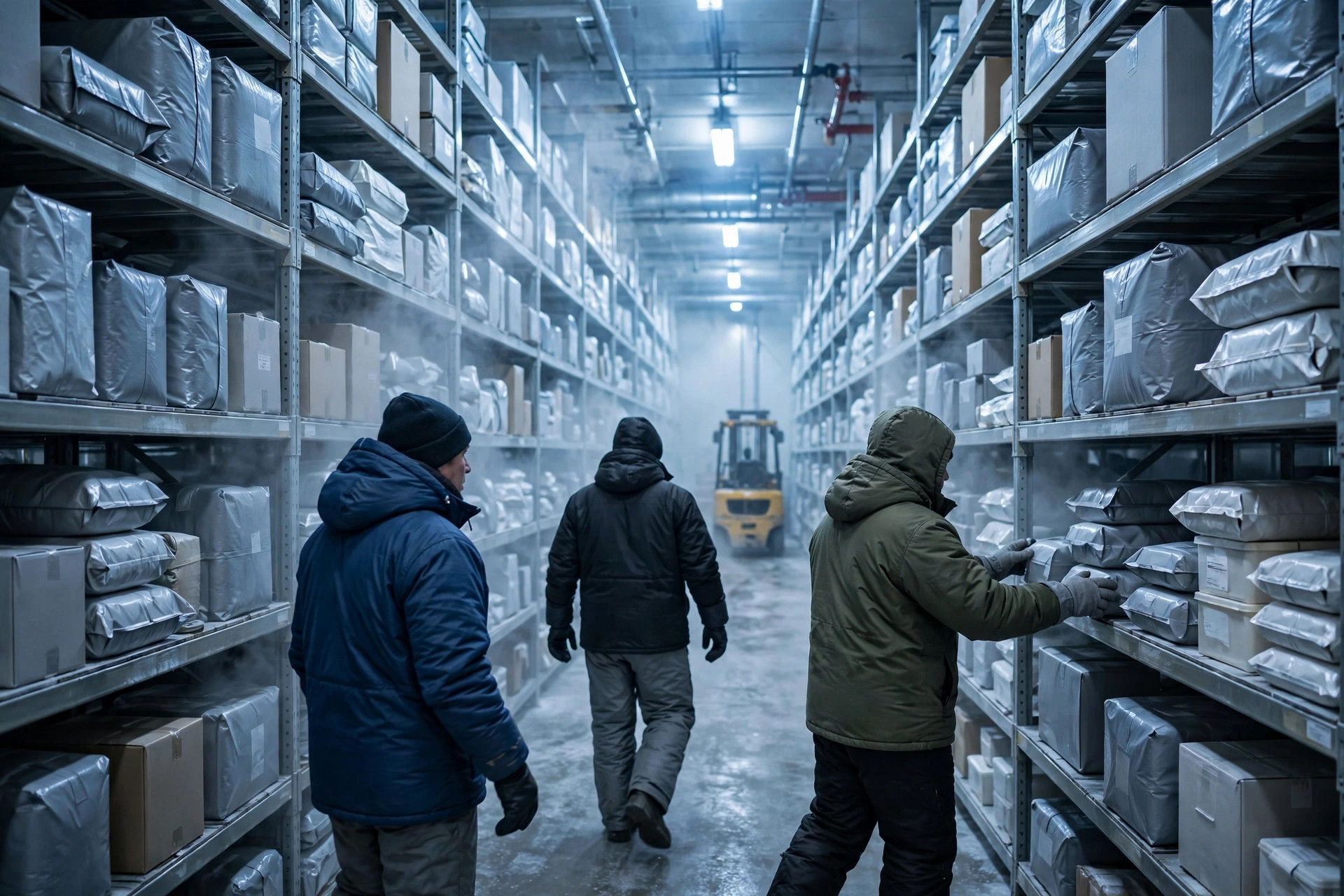
Zone two: freshly arrived chilled goods. Goods coming off a reefer truck are far colder than the warehouse air — basically walking condenser plates. In summer especially: 35°C outside, 2°C on the product surface, and half an hour after unloading every carton is beaded with water. In August 2024 we took in a truckload of yogurt — every outer carton soaked through, and the client rejected 30 cartons. The product was fine. The boxes weren't. We paid anyway.
Zone three: the ambient warehouse in rainy season. No temperature gap, still condensation — because the humidity is just that high. Days of rain push indoor humidity past 85%, cartons go soft first, then moldy. That's how we lost last June's order: the goods never moved, they just quietly got damp sitting there. Tell me that's not unfair.
Scrappy fixes vs. money-burning equipment: a dehumidification comparison
Big companies have a standard answer for condensation: full climate control, desiccant dehumidifiers, high-speed doors, the works. We small warehouses can't burn that kind of money. Here's what two years of quotes and field tests taught us:
| Option | Cost (what we were quoted) | Effect | Xiao Ma's take |
|---|---|---|---|
| PVC strip curtains | A few hundred yuan per doorway | Blocks most air exchange; mandatory at cold-store doors | Best bang for the buck — install these first |
| Air curtain | 2,000–5,000 yuan per unit | A wall of air over the door; humidity can't get in | The strip curtain's golden partner |
| High-speed roll-up door | 15,000–25,000 yuan per door | Door-open time drops from minutes to seconds | Pricey, but fixes the root cause |
| Refrigerant dehumidifier | 3,000–8,000 yuan per unit | Works for small buffer rooms and local spots | Don't expect it to handle the whole warehouse |
| Desiccant (rotor) dehumidifier | Tens of thousands and up | Best performance | Nice to look at for a small warehouse like ours |
| Work rhythm (king of scrappy fixes) | Free | See below | The free stuff is often the most effective |
Now the math, using last June's order: 200 cartons damaged, about 200 yuan of goods per carton — 40,000 yuan gone, not counting the orders we lost when the client's trust wobbled. Compare with the fix: 2 air curtains at the cold-store door (8,000) + 4 PVC strip curtains (2,000) + 1 refrigerant dehumidifier for the buffer room (5,000) = 15,000 yuan. One cargo-damage incident pays for three full setups. I still remember that calculation because my wallet was bleeding: install sooner or later, it's getting installed — sooner would have saved that 40,000.
Two more nearly-free scrappy tricks, on the house: hygrometers — a few dozen yuan each, scatter them around, check morning and evening, and you'll know whether to shut the door or switch the machine on the moment humidity creeps up. And a pre-rainy-season overhaul every May: replace torn strip curtains, wash dehumidifier filters. Don't wait until cartons are molding in June.
The counterintuitive part: the biggest dehumidification lever is the door
After all the equipment was in, I discovered something that stung: the biggest variable in condensation isn't the equipment tier — it's how often the door opens and for how long.
We ran a scrappy little experiment: the same cold-store door, opened 40 times a day for 3 minutes each, versus consolidated work with 12 openings of 1 minute each. The water pooling at the doorway differed several-fold. So now we have a hard rule: cold-store work happens in two consolidated windows per day, doors shut behind you every time (curtains plus air curtain aren't enough — people have to actually do it), and chilled goods rest 2 hours in the buffer room before entering the ambient zone.
That "work rhythm" costs zero and outperforms buying another dehumidifier. Big companies throw equipment at the problem; we small warehouses throw discipline at it. Crude but true.
So, three suggestions for fellow small operators: first, seal the door before talking equipment — strip curtains plus an air curtain are the highest-ROI combo, a few thousand yuan installed, and 80% of condensation problems end there. Second, never move chilled goods straight into ambient zones — set up a buffer area (even just a marked-off corner), let them warm up for 2 hours, cartons stay dry, complaints drop by half. Third, treat every door opening as serious business — consolidated work windows, shut doors behind you, buffer-and-warm-up. Nail those three and they beat any machine.
Warehouses like ours can't out-equip the big players, but we can out-care them. Condensation, at the end of the day, is a "laziness tax": too lazy to shut the door, too lazy to plan the rhythm, and cargo damage comes knocking. Control the simple act of opening the door, and you've won most of the dehumidification battle.
Small warehouses have their own way to survive — and every yuan saved is profit.
By Xiao Ma, Small Warehouse Owner