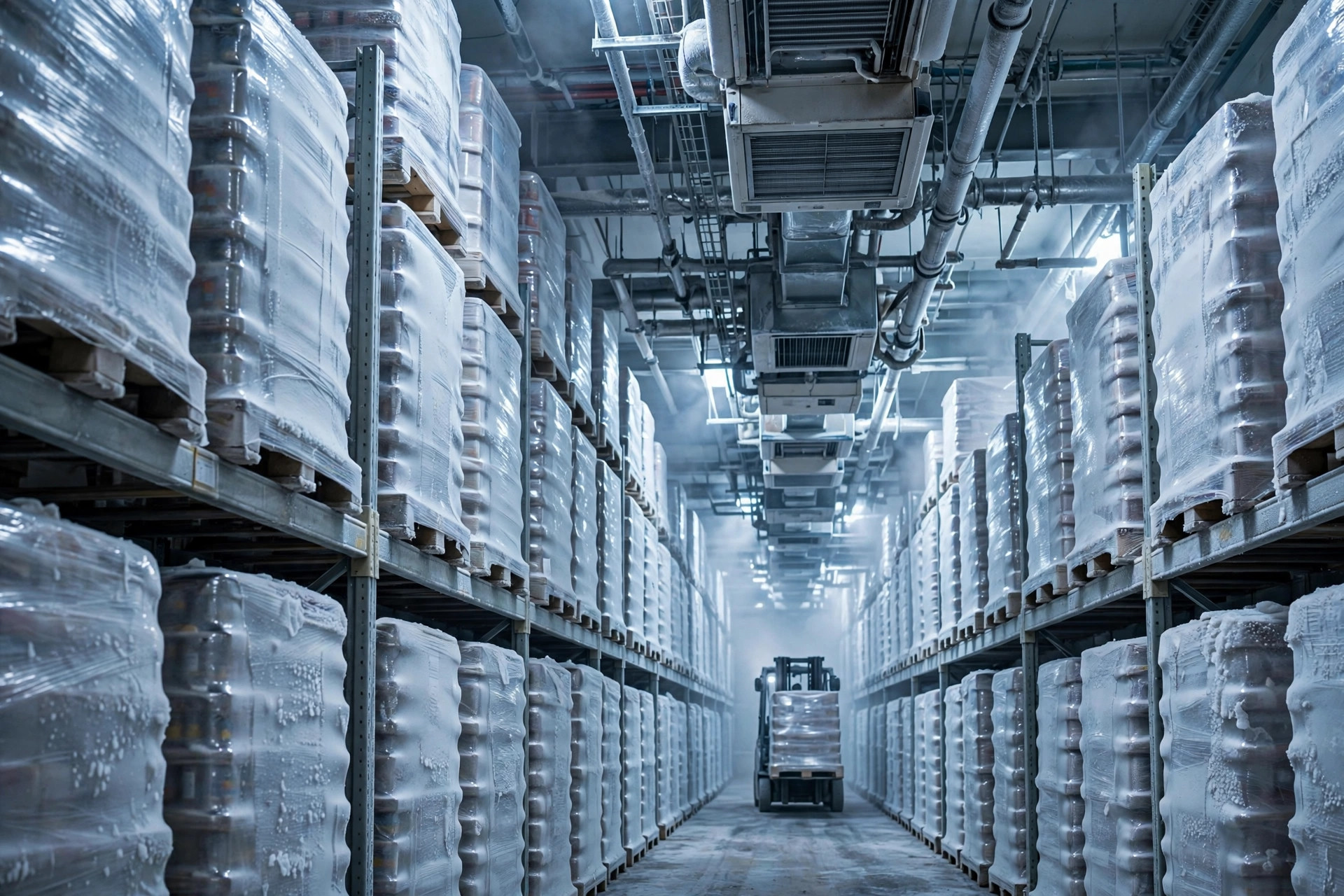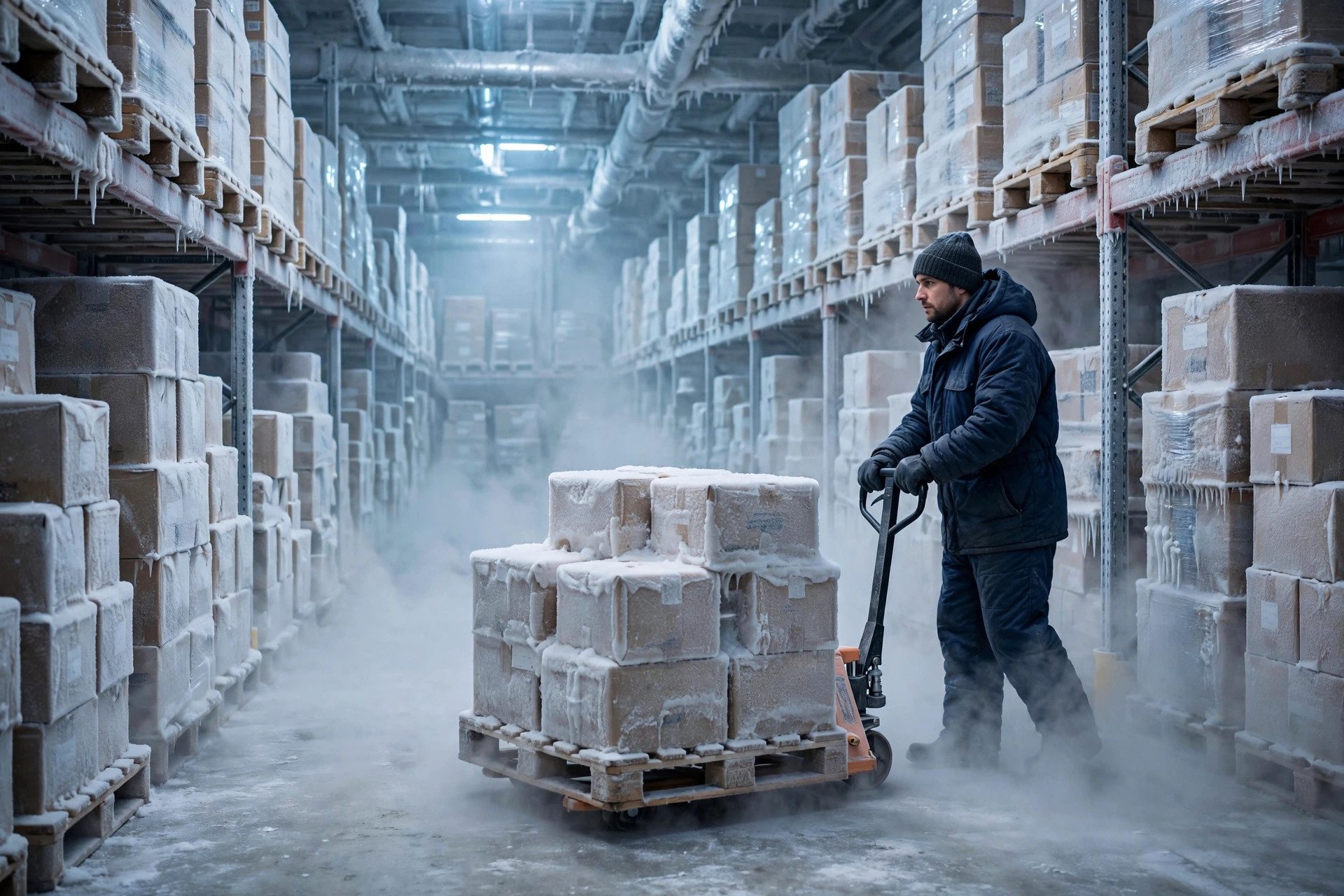
In the second half of 2024, while touring several third-party cold chain distribution centers, I kept noticing the same small detail: the rust stains left behind by condensation on pallet racking in cold storage almost always grew in the same place — around the upright bases and anchor bolts. Warehouse managers were remarkably consistent in their attitude: everyone knew it was a problem, but almost nobody treated it as a formal project to fix, until a forklift clipped a corroded upright or an insurance inspection wrote it up as a corrective action, and only then did the budget get approved. This rhythm of "fix it after it breaks" is, in my observation, close to the norm across cold storage facilities — and the physics behind it had already written the ending on the day the warehouse was designed.
Consider a case from 2023. A third-party cold chain logistics center in East China operated a -25°C freezer with more than 60 door cycles a day. Its racking had been purchased to ambient-warehouse standards — ordinary powder-coated steel. Two years after commissioning, a structural spot check found roughly 15% of anchor bolts severely corroded, and three upright bases had rusted through badly enough to require immediate replacement. That partial replacement plus downtime cost about 600,000 RMB — a quarter of the entire racking purchase price, per the equipment manager. The racking was only two years old.
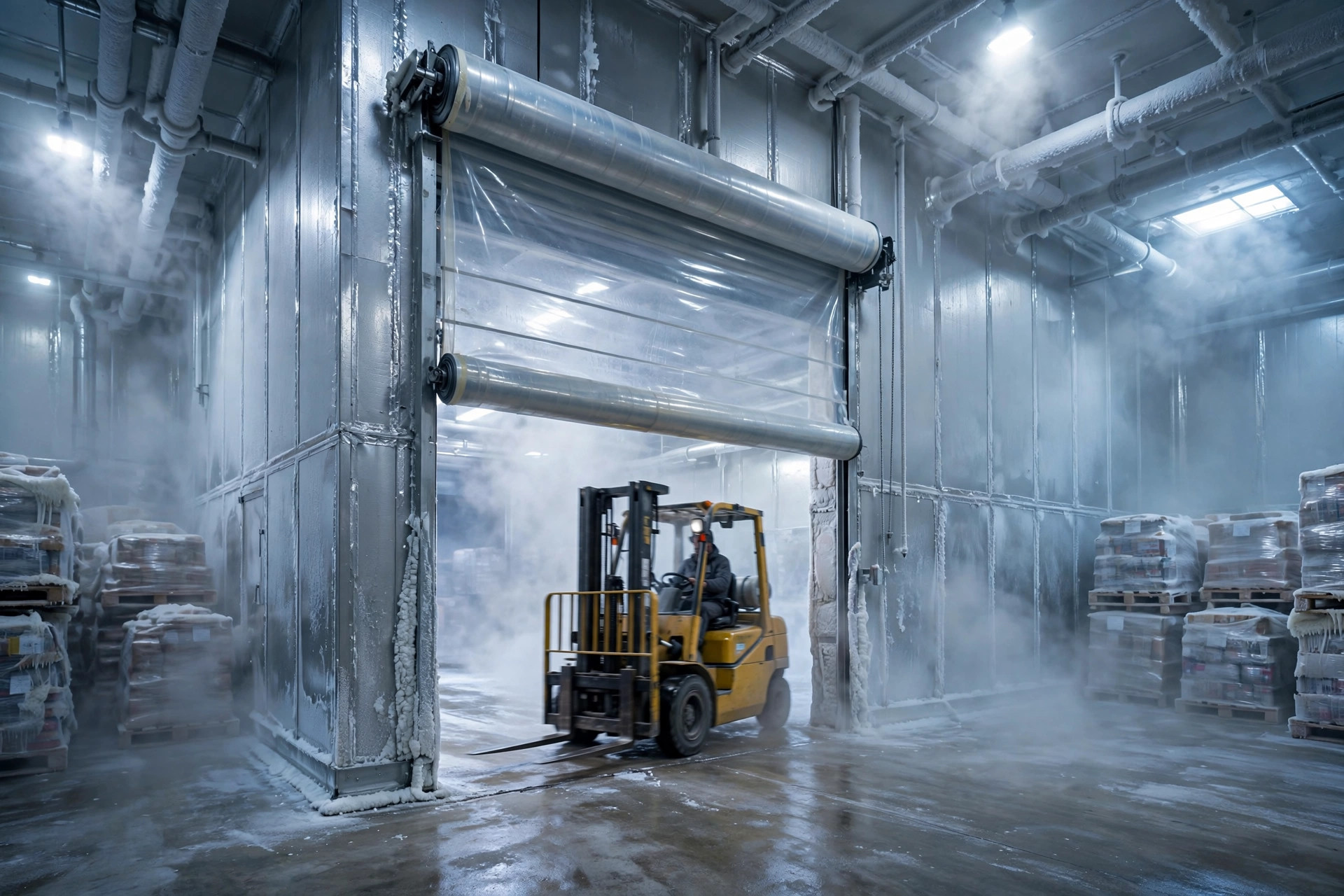
A second case, from 2022, sits at a food distribution company's 2–4°C cooler in the US Midwest. Their fix touched nothing on the racking itself: they installed high-speed roll-up doors paired with air curtains at the dock doors, compressing average door-open time from about 3 minutes to under 40 seconds. At the first winter inspection after the retrofit, newly appearing corrosion spots on racking near the doors were down roughly 70% year over year. The lesson: in the condensation equation, racking material is only half the weight — the other half is door discipline.
The Physics of Condensation on Pallet Racking in Cold Storage: Dew Point Decides Everything
Refrigeration engineering has one basic rule that depends on no management action at all: whenever the dew point temperature of the air is higher than the surface temperature of an object, condensation is inevitable. This is not "poor maintenance." It is physics.
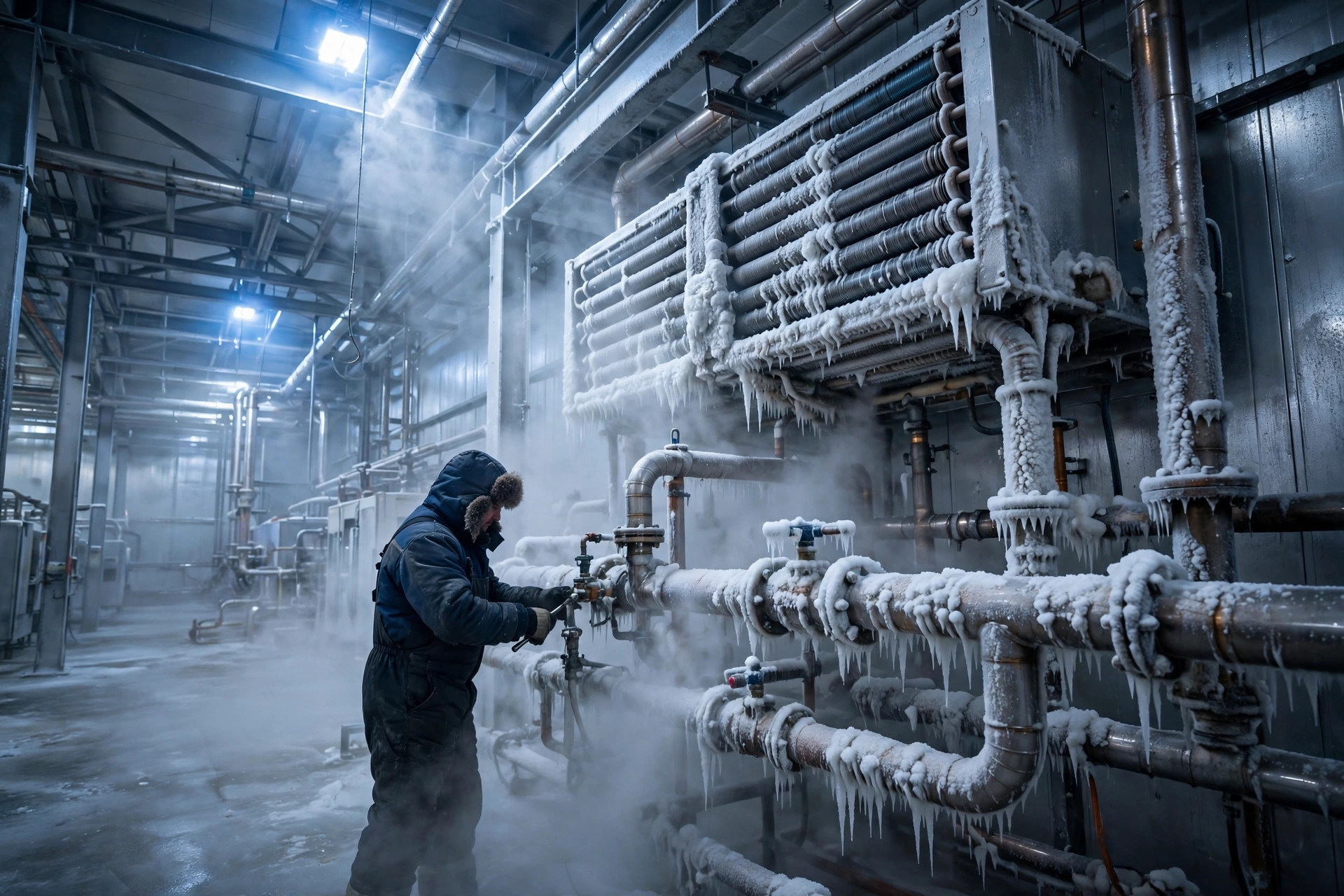
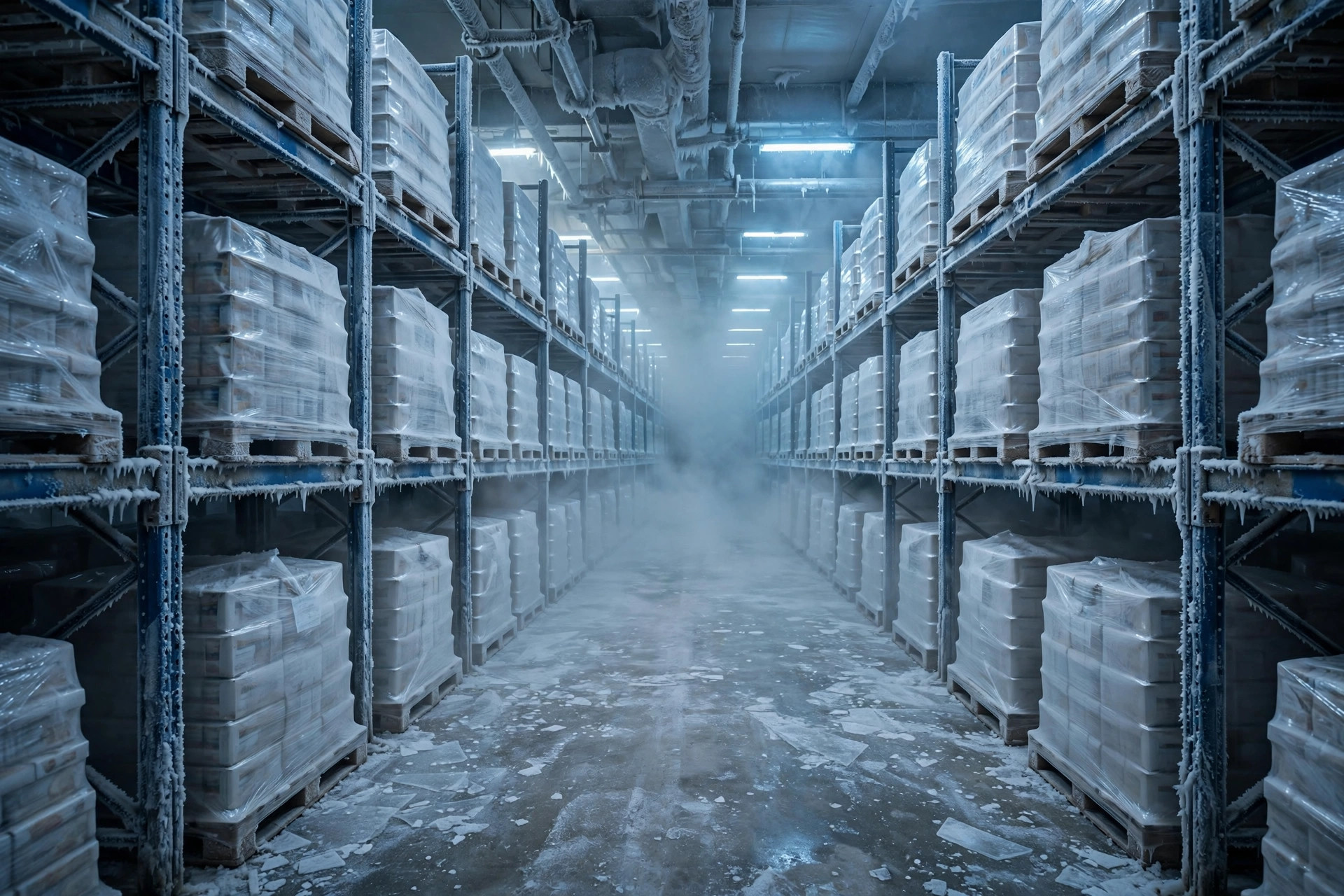
Air inside a freezer at -25°C and 90% relative humidity has a dew point of roughly -26°C — it barely condenses, since that air holds almost no moisture to begin with. But the moment the dock door opens, 25°C air at 60% relative humidity rushes in, and its dew point is about 16°C. When that air mass meets steel racking at -25°C — a gap of more than 40°C — vapor condenses onto the metal within seconds, and in severe cases freezes into frost. That is why the worst condensation on pallet racking in cold storage is always found on the few rows closest to the door, never deep inside where the temperature is lowest.
Here is a counterintuitive finding worth stating plainly: the warehouse with the worst condensation is usually not the coldest one. A -25°C freezer holds very little absolute moisture, so as long as the doors are managed, its racking stays relatively "clean." The genuinely difficult cases are 0–4°C chillers and dock buffer zones with constant traffic — the temperature gap looks modest, but humidity is high and doors cycle constantly, leaving racking in a perpetual loop of condensing, drying, and condensing again. And wet-dry cycling is the fastest corrosion regime for steel — corrosion engineering's general rule puts alternating wet-dry rates several times above constant dampness. That is the fundamental reason cold storage racking rusts in two or three years while ambient racking lasts a decade without trouble.
6 Field-Tested Ways to Prevent Condensation on Pallet Racking in Cold Storage
Once the mechanism is clear, prevention narrows to two strategies: keep the moisture out, or make sure the moisture that gets in cannot hurt the steel. The six measures below run from smallest investment and fastest payoff to largest and slowest.
1. Specify hot-dip galvanized racking at procurement. This is the one decision, made on a drawing, that determines a decade of maintenance spending. Skip ordinary powder coating: one forklift chip down to a pinhole lets moisture creep in and rust spread beneath the coating. Hot-dip galvanizing is a metallurgical bond: even scratched, the zinc layer keeps protecting exposed steel through sacrificial anode action. Following the logic of ISO 12944's corrosive-environment classification, a cold storage interior should be treated as a high-corrosivity category — and anchor bolts, connectors, and beam clips must meet the same grade as the main structure. Case after case, those overlooked small parts rust first.
2. Design the structure so water has nowhere to live. Drainage holes at upright bases so water cannot pool inside profiles; sealed beam ends so vapor cannot condense inside hollow cavities; a 3–5 cm plinth under base plates so washdown and defrost water never sits against the steel. Each is a minor detail alone — but condensation control is precisely the accumulation of such details.
3. Control the doors. High-speed roll-up doors plus air curtains are the highest-ROI combination available, targeting under one minute per opening. Where layout allows, add an anteroom outside the freezer door so goods "transition" through it — a second gate against moisture. Make it a KPI: log daily cycles and open times, investigate breaches. Often the root cause is simply that dock workflow treats the freezer door as permanently open.
4. Control the humidity. Dehumidifiers belong in the anteroom and on the dock, not inside the freezer, where conventional units perform poorly at low temperatures. Normalize pre-cooling: ambient goods first shed heat and moisture in the buffer zone before entering, so product carries less vapor inside. Sensor three points minimum — door, mid-warehouse, return air. When humidity swings, check doors first, refrigeration second, racking last.
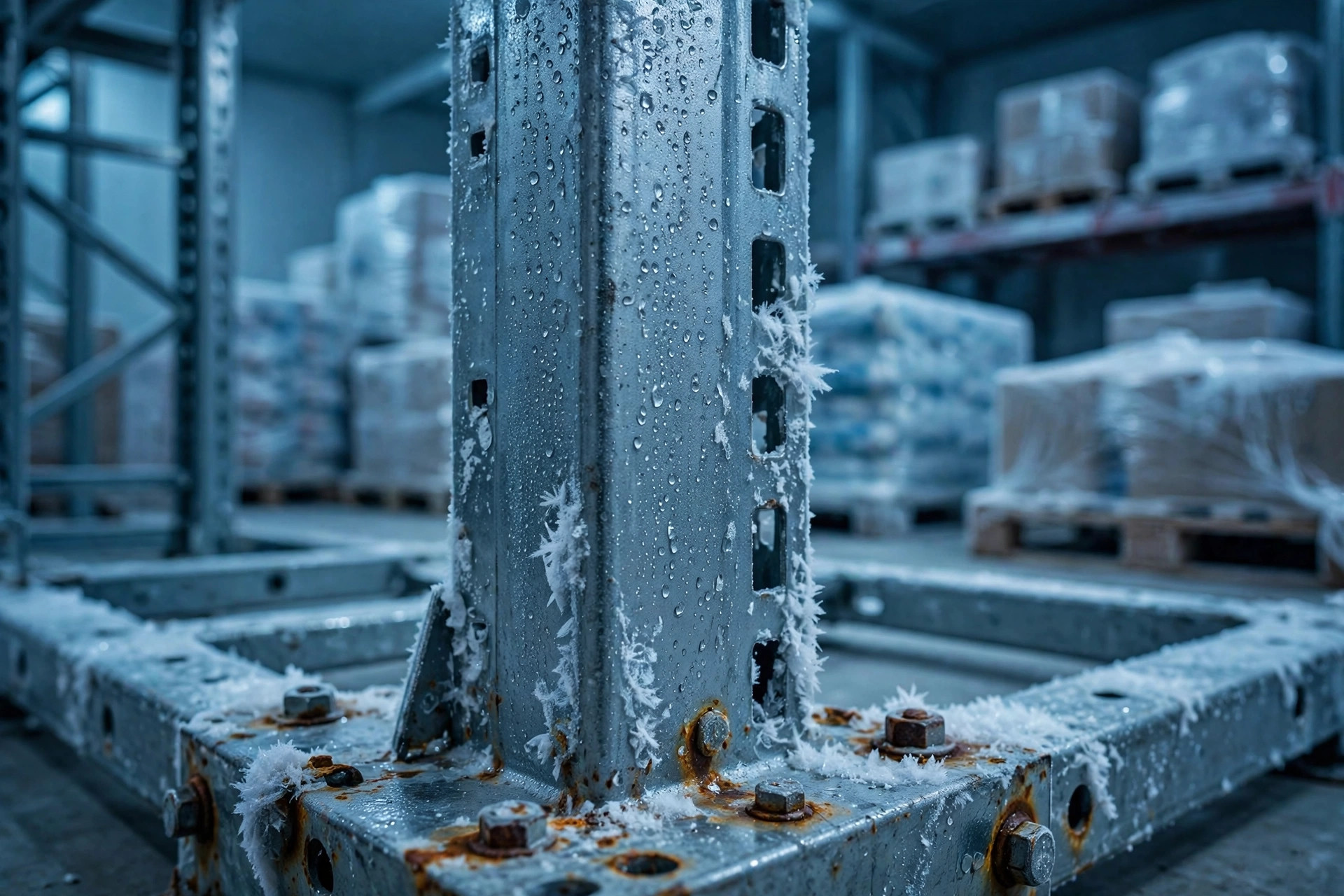
5. Build a condensation-point inspection checklist. Monthly, same four locations: anchor bolts and base plates, beam-to-upright connection holes, rows within 10 meters of the freezer door, racking beneath refrigeration pipework. Keep the standard simple — visual rust color, fingertip check for coating blisters, bolts still turning freely. A checklist turns gut feel into record, shrinking spot-to-treatment time from months to weeks.
6. Intervene at the first sign of rust. Treat any spot within 30 days: grind back and touch up with zinc-rich paint, at trivial cost. Once corrosion forces a full upright replacement, the cost runs dozens of times higher. Log every spot — discovery, treatment, recurrence. Repeat offenders mean the moisture source was never cut off: check doors and humidity instead of repainting.
The Math: What Preventing Racking Condensation Really Costs
A common mistake is comparing only purchase prices. Below is a 10-year total-cost framework for a mid-size facility (model assumptions to illustrate structure — recalculate with actual quotes for any real project):
| Cost item | Standard powder-coated racking | Hot-dip galvanized racking |
|---|---|---|
| Initial purchase (relative) | 100 | 120–130 |
| Anti-corrosion maintenance, 10 yrs | High (repainting, partial replacement) | Low (inspection-led) |
| Replacement / downtime from corrosion | Likely 1–2 events | Unlikely |
| 10-year total cost (illustrative) | 100 + maintenance and replacement | 130 + minor inspection |
The model points to a judgment with a timeline: if facility life exceeds about 8 years and door cycles run medium-to-high, galvanized usually wins on total cost. If the building relocates within 5 years, standard racking with high-frequency inspection may be more economical. One trade-off must be stated plainly: galvanizing is not a death exemption. Where doors stand open and humidity runs uncontrolled, the zinc layer is consumed faster by relentless condensation, and galvanized racking rusts too — just years later than powder-coated. Material choice sets the floor; management sets the ceiling.
A closing observation: this problem has not eased with better refrigeration — high-frequency, small-batch fresh-food flows have made it more common. Three variables could shift it in five years: unmanned cold storage cutting door cycles; new coatings widening the galvanized-vs-painted binary; cheaper sensors moving warnings from patrols to alerts. The physical core won't change: dew point above surface temperature means water appears.
So an open question for your facility: how far from the door is your worst-condensation racking row? If the answer is "the rows right by the door," then before budgeting for new racking, take a look at that door — and ask how long it actually stays open each day.
By Dr. Chen, Supply Chain Researcher