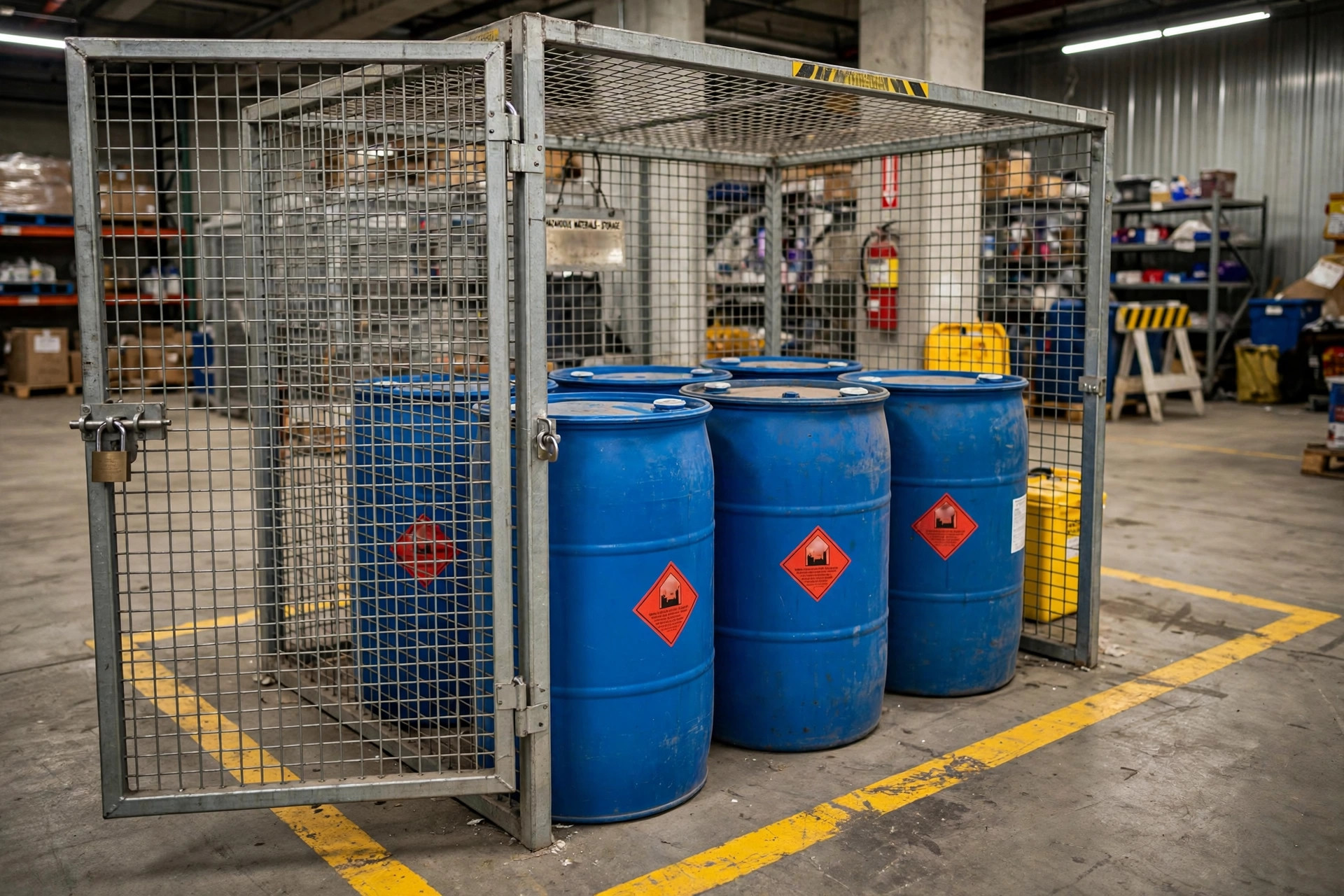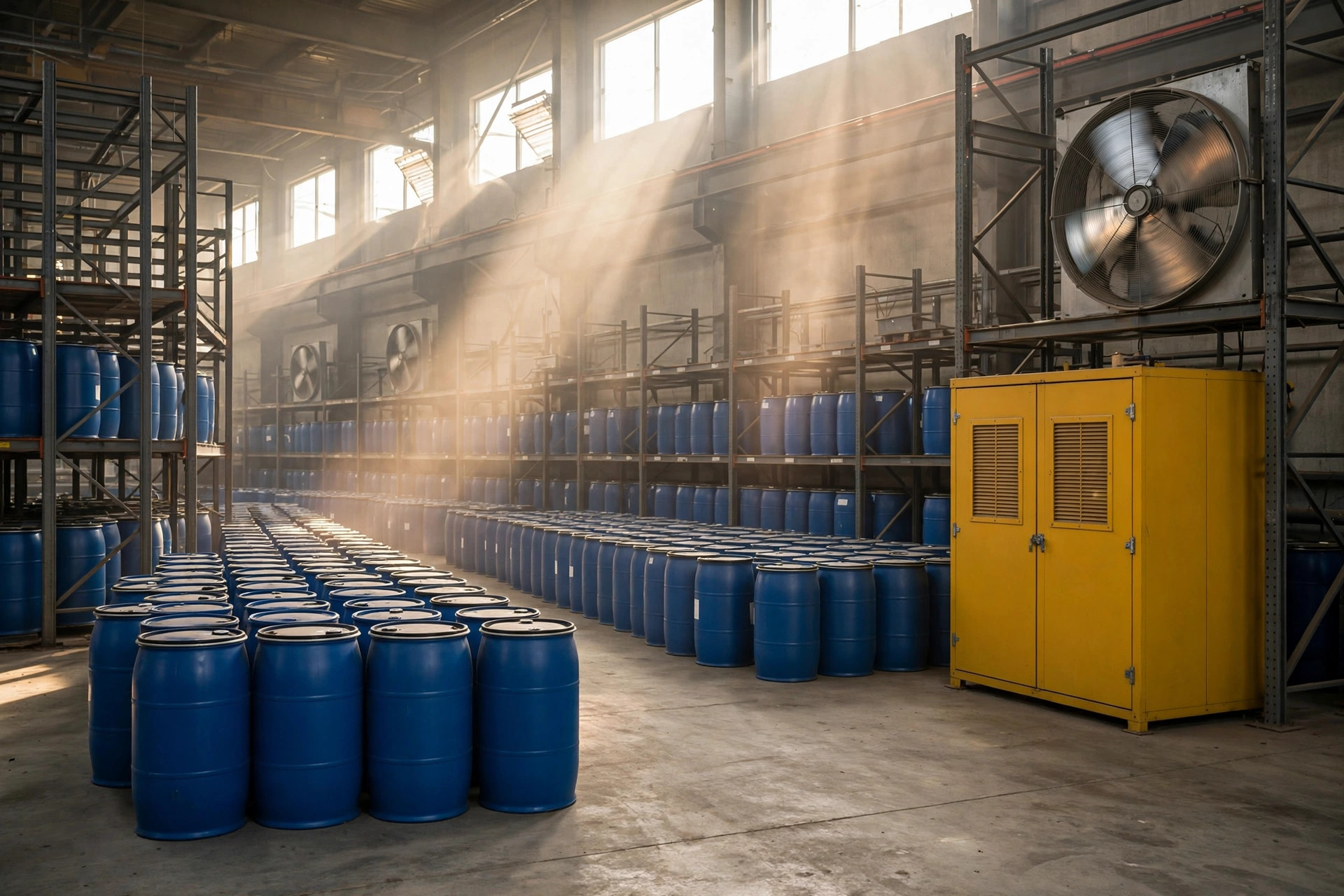
Start with a number on chemical storage in summer heat: in a warehouse without air conditioning, indoor temperatures in midsummer can reach 40–45°C, while sun-baked roofs and walls approach 70°C — measured figures published by the Japanese warehouse equipment maker Taiyo Kogyo. Meanwhile, many aerosol safety data sheets carry the same line: do not store above 50°C.
A warehouse interior at 40-plus degrees against a 50°C limit leaves a safety margin of only a few degrees — and those few degrees explain a large share of summer chemical-storage incidents. What follows: first the data, then the attribution, then what actually works for cooling.
The data: three sets of numbers on chemical storage in summer heat
First: where the heat comes from. The roof dominates. A conventional dark roof can reach 150°F (about 65°C) on a summer day, per a US warehouse equipment provider; a reflective "cool roof" coating cuts that by 50°F or more. Heat conducts downward, so the hottest air sits between the roof and the top rack level — exactly where many warehouses stash slow-moving chemicals.
Second: where the red lines are. Aerosols: nearly every brand's SDS carries GHS statement P410+P412 — do not expose to temperatures exceeding 50°C/122°F. Acetylene cylinders: industry guidance caps ambient temperature for use, transport, and storage at 40°C. Note that number — it equals the peak indoor temperature of a non-air-conditioned warehouse in midsummer. On the hottest days, there is no buffer between compliant and non-compliant.
Third: what one incident costs. At about 5 a.m. on September 29, 2024, a swimming-pool chemical warehouse caught fire in Conyers, Georgia. The US Chemical Safety Board's final report (July 2026) reconstructed the chain: the warehouse held nearly 14 million pounds (about 6.3 million kg) of chlorinated isocyanurate pool chemicals in roughly 5,000 super sacks — versus about 6.2 million pounds planned at permitting time. Chlorine off-gassed by the chemicals combined with humid air and condensed as hydrochloric acid droplets on metal surfaces, corroding the sprinkler system since 2019; a December 2023 inspection found 1,100+ corroded sprinkler heads. On the morning of the fire, a corroded sprinkler component failed, leaking water onto the chemicals and triggering a decomposition reaction that generated intense heat — which activated more sprinklers, wetting more chemicals: a cascade. About 17,000 residents were evacuated and 90,000 advised to shelter in place; nightly warnings ran 17 days within a two-mile radius, and schools closed for nearly two weeks. On May 15, 2025, the company permanently closed the facility.
To be precise: Bio-Lab happened in late September, not midsummer, and water — not heat — was the direct trigger. But one line in the CSB report deserves underlining: the warehouse was not air conditioned, and its ventilation system could not effectively manage humidity. Heat and humidity were the two environmental variables in this cascade — and summer is when both peak at once.
Why chemical incidents cluster in summer: four links in the causal chain
First, the heat source is systematically underestimated. People check the outdoor 38°C, but chemical safety depends on the temperature at the storage location. Roof conduction, west-facing walls, sealed cabinets — all run well above ambient. Without sensors at those spots, nobody knows when a red line is crossed.
Second, temperature limits are scattered across hundreds of SDS documents. Each chemical's requirement sits buried in Section 7 of its own SDS. Nobody consolidates them into a single red-line sheet — so in practice, there is no red line.
Third, cooling stops at "turn on the fans." Fans fix how people feel, not the absolute temperature at the storage location. For chemical storage, ventilation's value is moisture removal and temperature equalization — not "blowing cool air."
Fourth, inspection cadence doesn't change with the season. Many warehouses run the same checklist 365 days a year. The hot season (June–September) deserves a different inspection intensity, but the system never switches.
Cooling chemical storage in summer heat: what works, at what cost
Cooling options ranked from lowest to highest investment, with effectiveness figures from published industry sources:
| Measure | Principle | Cooling effect (order of magnitude) | Relative cost | Best fit |
|---|---|---|---|---|
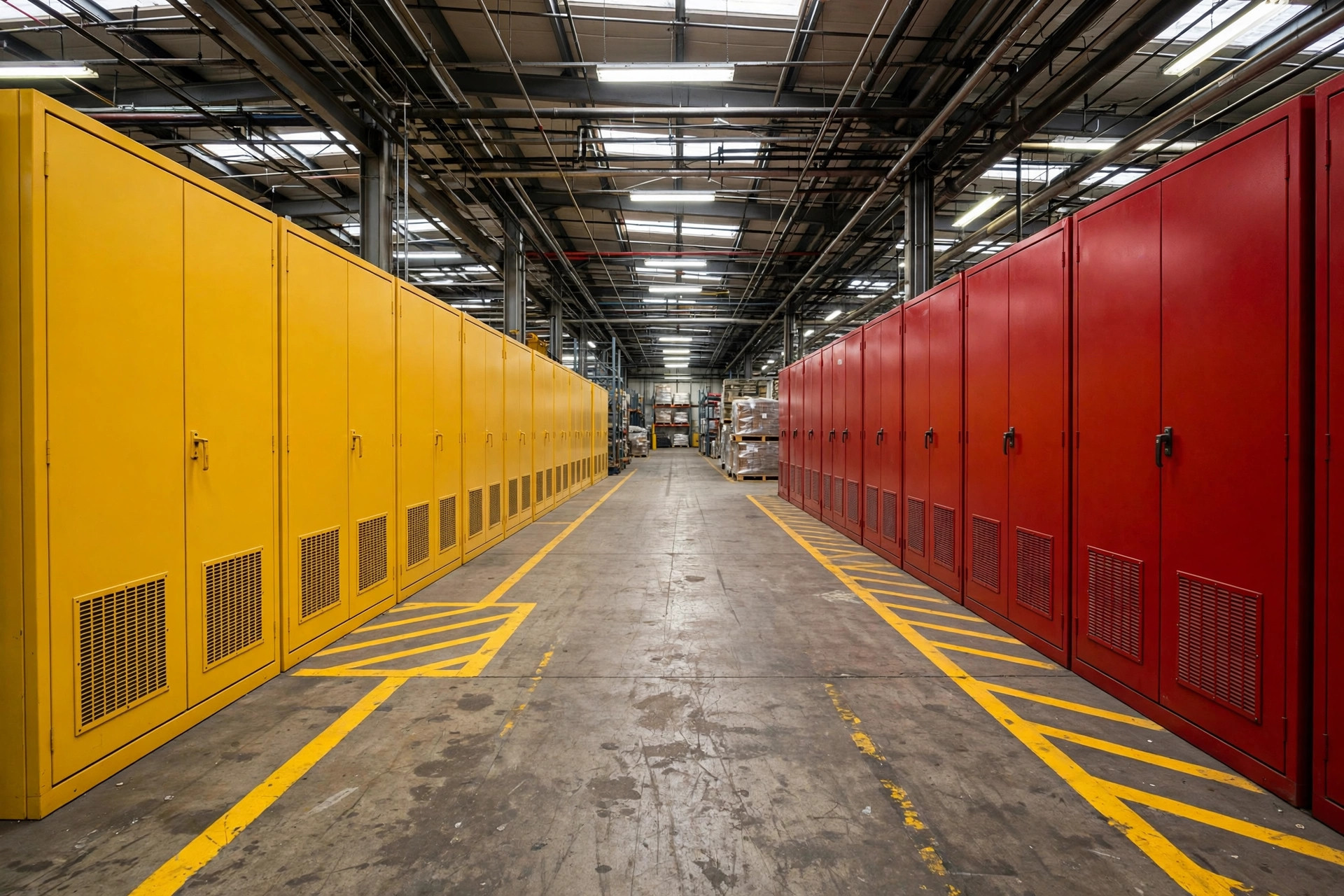
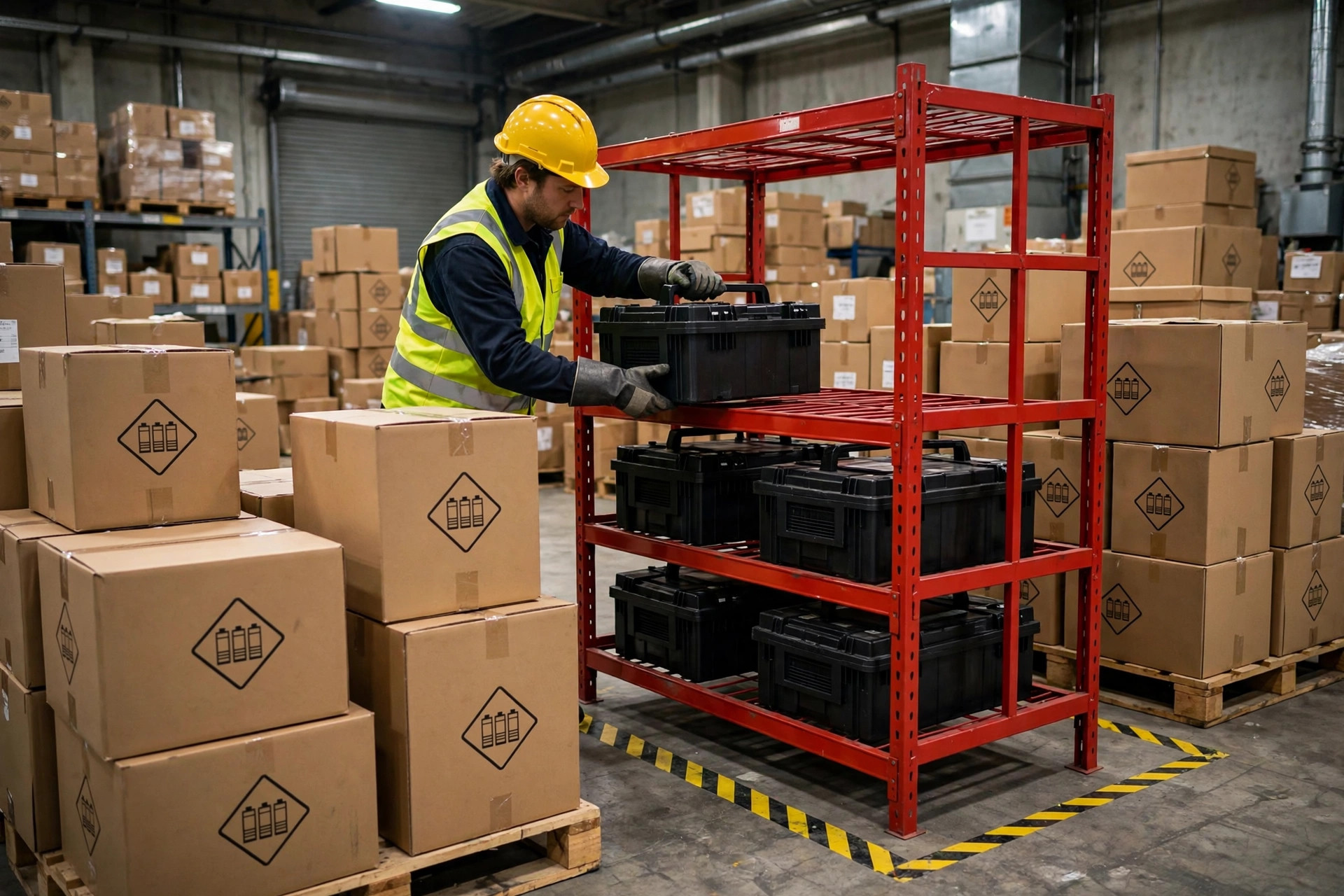
| Segregated placement + shading/insulation | Move heat-sensitive chemicals to cooler zones, away from roof/west walls; add insulating curtains | Avoids extreme spots; location temperatures can differ by 5–10°C | Lowest, near zero | Every warehouse; do this first |
| HVLS fans + roof ventilators | Air movement, temperature equalization, moisture exhaust | Improves perceived temperature; limited effect on absolute temperature | Low | Large spaces, staffed areas |
| Reflective roof coating | Reflects solar radiation, reduces roof heat absorption | Roof surface 50–80°F cooler | Medium, one-time | Owned facilities, long-term holds |
| Roof misting/spray cooling | Evaporative cooling of the roof | Roof temperature down 40–60°F | Medium, ongoing water cost | Hot-dry climates, warehouses with fire-suppression water supply |
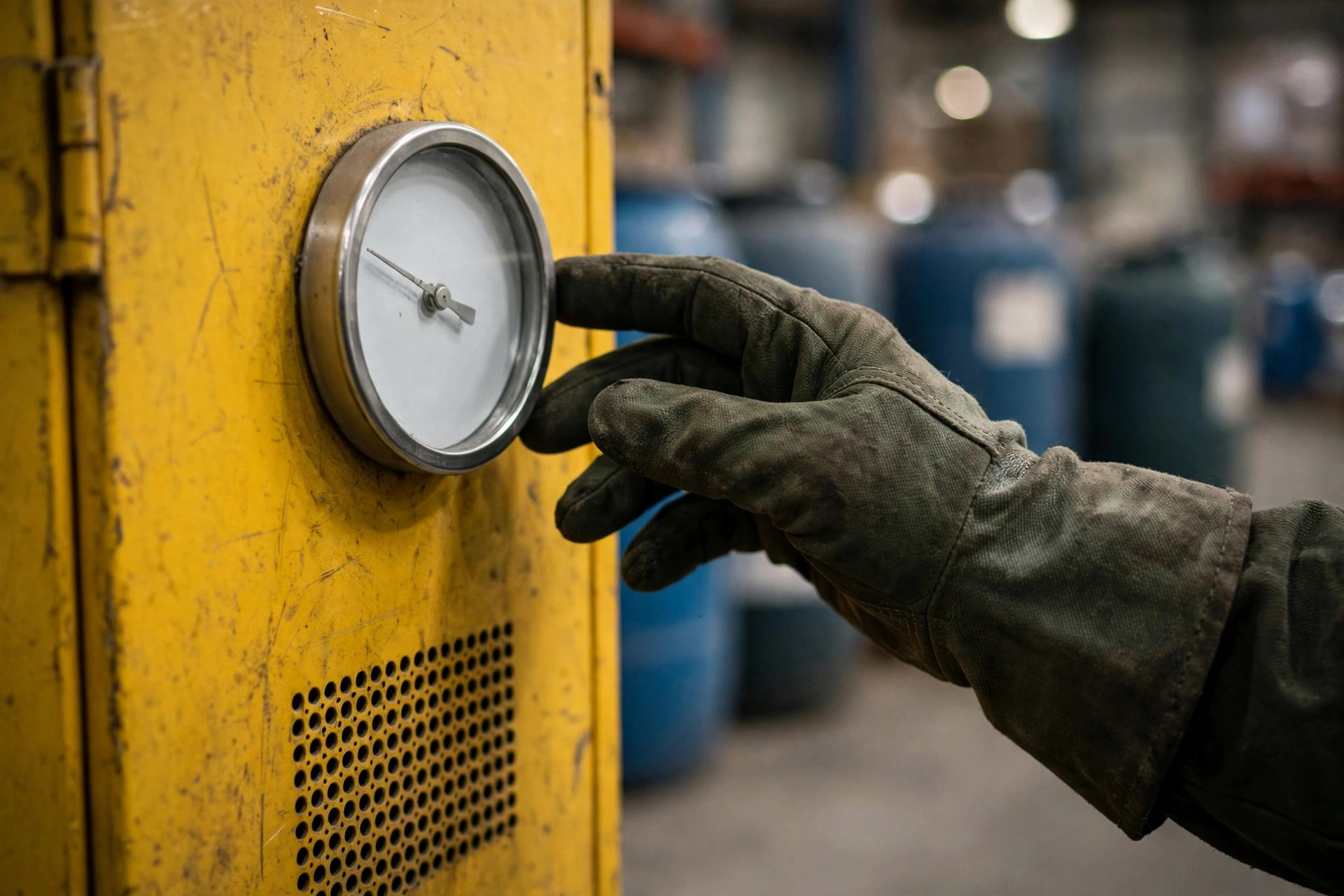
| Online temperature/humidity monitoring + alarms | Early detection | Doesn't cool directly, but turns "unknown" into "known" | Low | Baseline requirement, not optional |
| Localized AC for the hazmat zone | Direct refrigeration | Most predictable effect | Highest running cost | Small dedicated hazmat areas |
One published data point: a 60,000-square-foot US machine shop installed roof misting at a reported average annual maintenance cost under $2,500. Against what? Bio-Lab shut down an entire facility after its incident. I don't offer ROI conclusions lightly, but the orders of magnitude are clear: cooling investments are measured in thousands of dollars; incident costs start in the millions. That math needs no precision.
One trade-off worth isolating: whole-warehouse AC versus localized cooling of the hazmat zone. Air-conditioning tens of thousands of square feet is unrealistic on energy cost — but partitioning the hazmat area and cooling just that zone (partition + small AC units + insulation) is a sensible middle. The common failure mode is binary thinking: "either full AC or nothing," while the compromise in the middle goes unbuilt.
Summer inspection checklist (June–September)
- Place temperature sensors; log daily peaks. Minimum three spots: near-roof storage locations, west-facing walls, aerosol and pressure-vessel areas. Log once daily between 2–4 p.m., the peak window.
- Build a temperature red-line sheet. Consolidate Section 7 temperature limits from every SDS in stock into one sheet, posted at the hazmat area entrance. Without it, temperature readings are meaningless.
- Re-verify compatibility. Oxidizers separated from combustibles — the lesson Bio-Lab paid for with 14 million pounds of chemicals. Do a full re-verification before each hot season.
- Inspect sprinklers and fire systems. Bio-Lab's sprinkler system had corroded since 2019; the December 2023 inspection found 1,100+ corroded heads; the fire came nine months later. Corrosion checks must verify the system itself — not just "is there water."
- Test-run ventilation equipment. Before the hot season, run every fan and ventilator at full load. Don't discover a dead unit on a 40°C day.
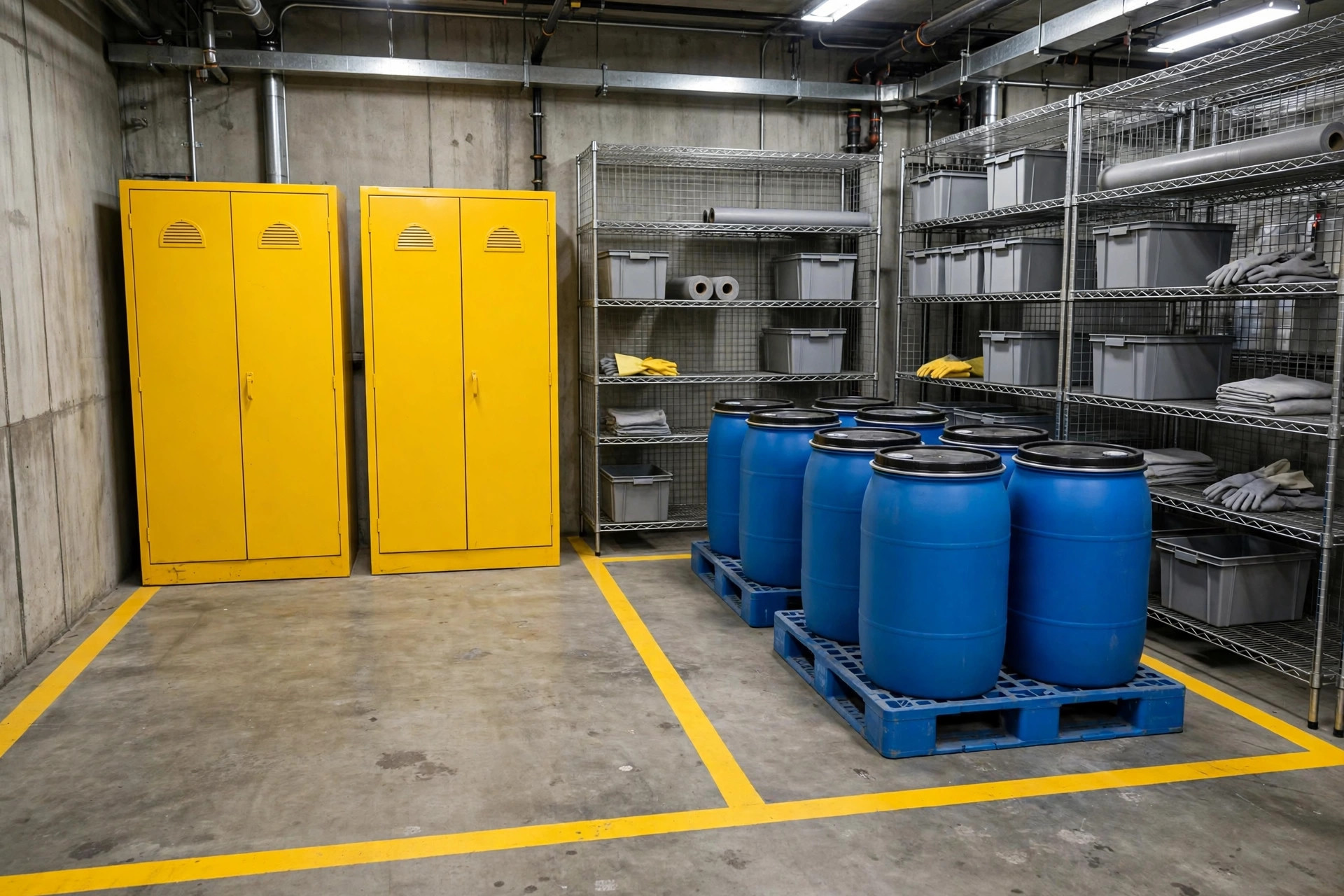
- Stage emergency supplies. Spill absorbents, PPE, emergency contacts — inventory once before the hot season.
Two counterintuitive findings
First, the most dangerous thing isn't open flame — it's slow, daily, unremarkable warming. Incident narratives always say "sudden fire," but temperature exceedance is gradual: 43°C today, 45°C tomorrow, 46°C the next — with no alarm because no alarm threshold was ever set. By the time a decomposition reaction starts generating its own heat, the response window is measured in minutes. At Bio-Lab, roughly one hour passed between the 5 a.m. noise report and full evacuation.
Second, for some chemicals, sprinklers are a double-edged sword. The most counterintuitive line in the CSB report: water was the trigger. A corroded component leaked, water contacted pool chemicals, decomposition generated heat, which activated more sprinklers, wetting more chemicals. The intuition "more fire protection is always safer" does not hold in chemical storage. For water-reactive products, compatibility review and segregation matter more than sprinkler density; which products those are is a per-SDS question.
Trend: hot seasons are getting longer
On trends I offer evidence, not conclusions. Extreme-heat years have grown markedly more frequent over the past decade — public meteorological data. Meanwhile, much of the existing warehouse stock was built to the "unconditioned big box" standard, and the gap between that standard and chemical storage temperature requirements will only widen. On regulation, the CSB's Bio-Lab report explicitly recommended OSHA and EPA expand coverage of reactive hazards — the compliance bar is more likely to rise than fall.
An open question to close: does your warehouse have a temperature red-line sheet? If not, building one before this hot season may be the lowest-cost, fastest-payback action available.
By Dr. Chen, Supply Chain Researcher