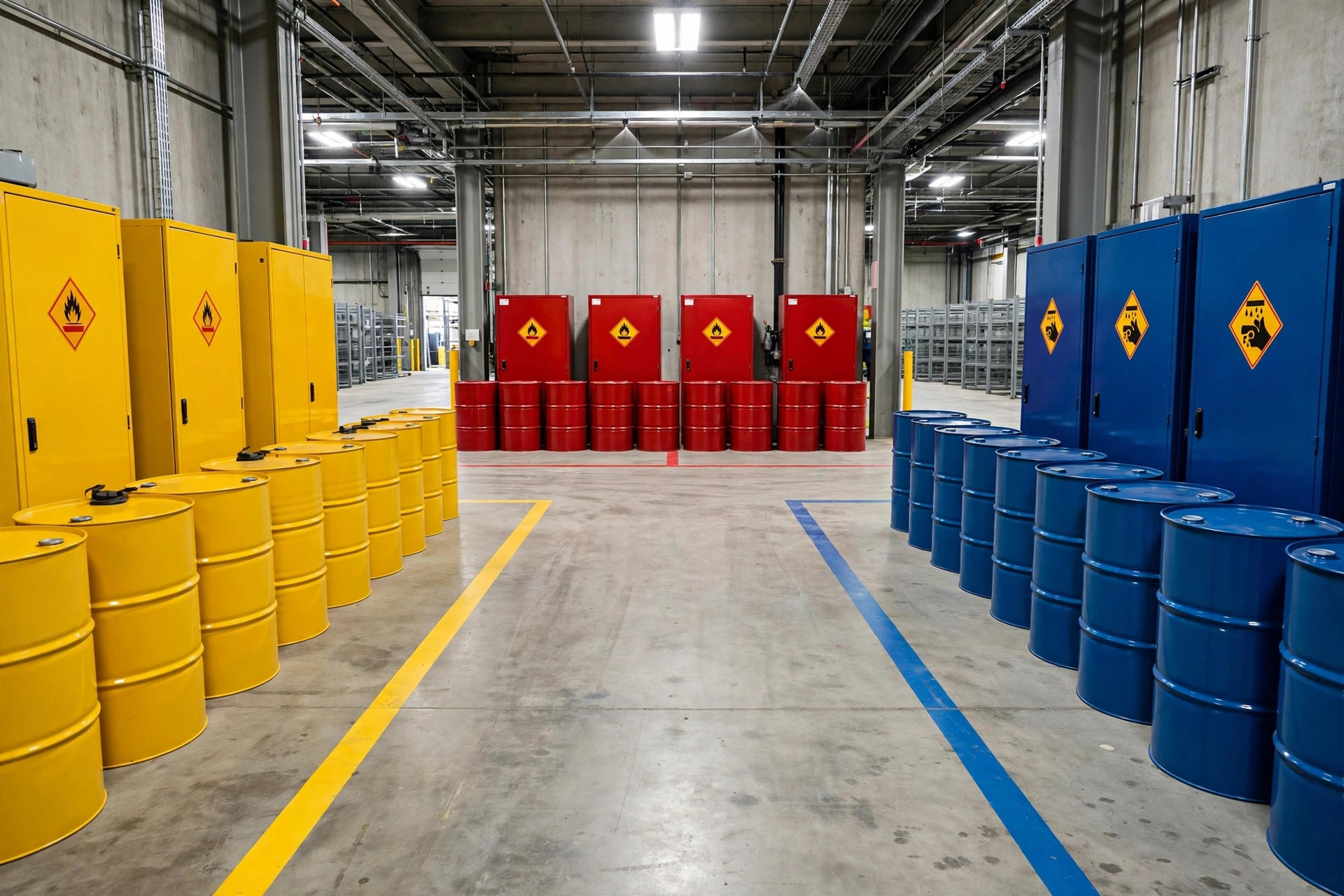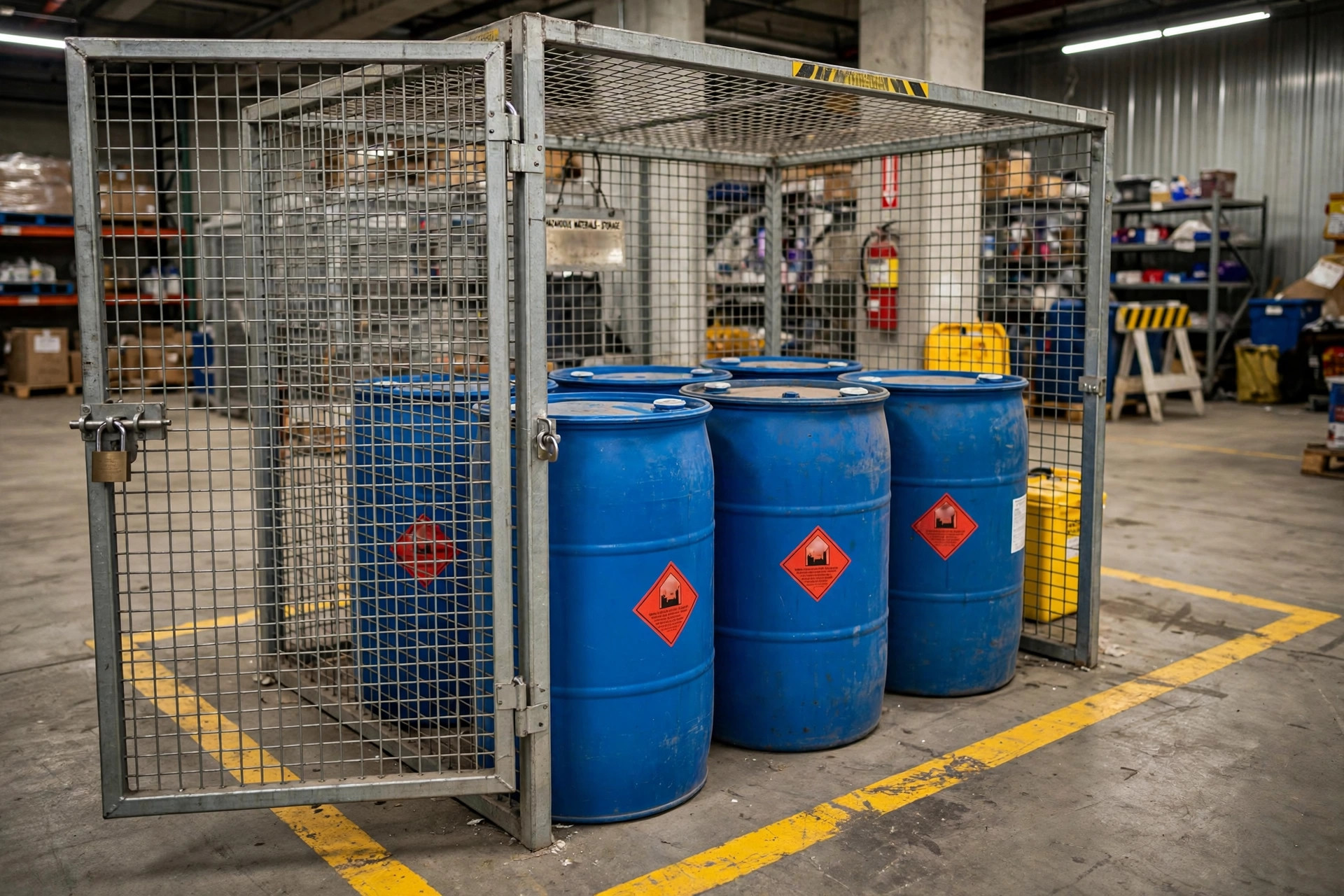
Let me tell you what fifteen years behind the wheel of a hazmat truck taught me: in China, a drum of hazardous chemicals without its label is not cargo. It's a problem nobody wants to touch.
A few autumns back I pulled up to a chemical warehouse outside Jiaxing with a full load. The keeper, Old Li, walked the drums and rejected three on the spot — labels peeled off in transit, contents fine.
"Come on, the labels fell off, the goods are fine," I said. He didn't look up. "It's not personal. A drum with no label is 'unidentified' here — if the fire team finds one on my shelves, the fine won't be small change."
That day taught me the first rule of China's hazmat warehousing: the label is the drum's ID card — no ID, no entry.
What "One Book, One Label" Actually Means
The phrase "one book, one label" comes from China's Regulations on the Safe Management of Hazardous Chemicals (State Council Order No. 591): every manufacturer must provide a chemical safety technical specification — the "book," internationally known as the SDS — and affix a safety label to the packaging — the "label."
The legal duty to provide the SDS and stick the label on falls on the manufacturer, not the warehouse. But warehouses are where both things fall apart: labels scuffed in transit, soaked by rain, torn at the edges; SDS documents separated from the shipment. And when inspectors show up, they check what's on your shelves, not what some factory promised.
The penalty is real and written in black and white — Article 78 of the regulation: a manufacturer that fails to provide the safety technical specification or affix the safety label gets ordered to fix it and fined 50,000–100,000 yuan. Refuse to fix it, and the fine jumps to 100,000–200,000 yuan, plus possible suspension of production. Check the latest official text for the current version, but remember the scale: it starts at 50,000 yuan.
The Rain-Soaked Labels That Cost Me Half a Day
Twenty drums of ethyl acetate, Zhangjiagang to Kunshan. Light rain, I tarped in a hurry, and two labels got damp — edges curling, print half-blurred.
At the gate, young keeper Xiao Liu checked every drum. "Rules are rules — these two I can't take. Haul them back, or wait while I get the SDS and label artwork from the shipper, reprint to match, stick them on, and receive."
We went with option two. An hour by the gate, smoking, watching them print and paste — and it clicked: a warehouse that accepts a half-blind label takes on that drum's risk for as long as it sits on the shelf. They weren't being difficult. They were being right.
What's on a Compliant Label: Eight Elements, No Shortcuts
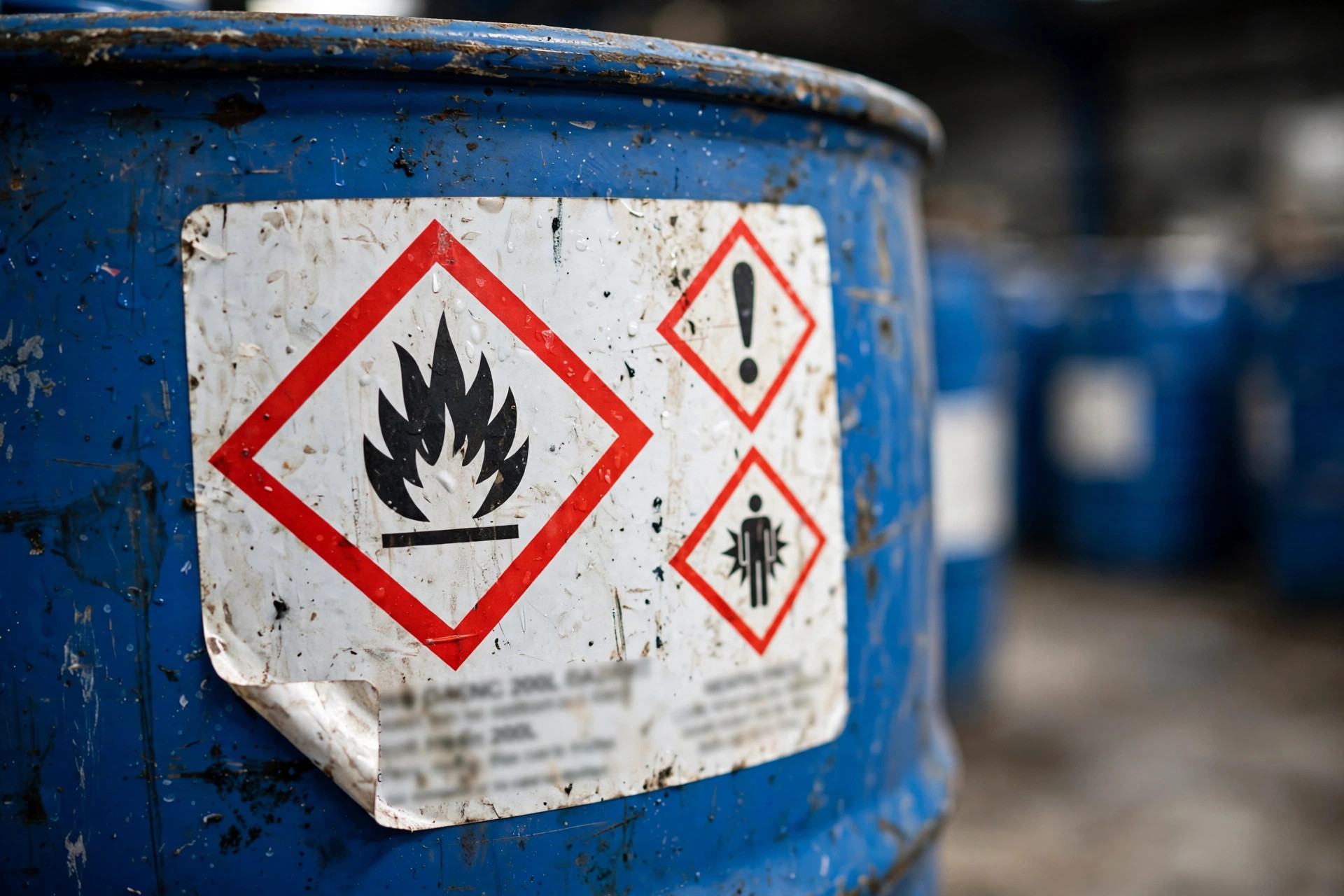
China's GHS labels follow GB 15258-2009. Eight elements, no shortcuts:
- Chemical identification — product name, in both Chinese and English
- Pictogram — red-bordered diamond symbols: flame, skull and crossbones, exclamation mark
- Signal word — "Danger" or "Warning" ("Danger" is the stronger one)
- Hazard statements — what the stuff does to you, e.g., "highly flammable liquid and vapor"
- Precautionary statements — prevention, response, storage, disposal
- Supplier identification — manufacturer name, address, phone
- Emergency phone number — who to call when things go wrong
- Reference prompt — directing readers to the SDS
From a trucker's seat, item seven is the one I'd circle in red. If something goes wrong on the road, the first call that saves lives isn't the fire department — it's the number on the drum, because the manufacturer knows exactly how its own product burns. Some labels print it in ant-sized type, or leave it blank. When I see that, my gut tightens.
The "Book": Sixteen Sections, but the Warehouse Only Needs Six
The SDS follows GB/T 16483-2008 for content and ordering, plus GB/T 17519-2013 as the compilation guide — sixteen sections total. Most warehouses file it in a cabinet and forget it. That's a mistake. The frontline crew really needs six:
| Section | What the warehouse uses it for |
|---|---|
| Section 4: First-aid measures | First response if someone's exposed |
| Section 5: Firefighting measures | Which extinguishing agent to use — and which never to use |
| Section 6: Accidental release measures | How to contain a spill, what to absorb it with |
| Section 7: Handling and storage | What it can't sit next to, temperature and humidity limits |
| Section 9: Physical and chemical properties | Flash point, boiling point — how "hot-tempered" it is |
| Section 14: Transport information | UN number, packing group — for the driver and the escort |
The rest belongs to the safety officer. Here's the contrarian take most managers miss: the SDS is not for the boss's filing cabinet — it's for the front line. In a real emergency, nobody has time to dig through files. The smart warehouses print sections 4, 5, and 6 for every hazmat SKU and pin them on the wall next to the storage bay. Paper is cheap. Lives aren't.
The Seven Checks at the Receiving Gate
Old Li dared to reject my three drums because his label inspection at receiving is ironclad. Seven checks, for shippers and warehouse operators alike:
- Presence: every package has a label — not one drum exempt.
- Completeness: all eight elements? Missing emergency number — send it back.
- Legibility: actually readable? Rain-blurred or oil-stained fails.
- Adhesion: firmly stuck? Curling edges beyond tolerance need replacement.
- Match: label name matches the SDS, the receiving slip, and the actual goods? A mismatched label is the most dangerous kind.
- Pictograms: correct GHS pictograms and signal word — "Danger" and "Warning" aren't interchangeable.
- SDS on file: does the warehouse hold this shipment's SDS? A new SKU's first delivery must be preceded by its SDS — document first, goods second.
Drivers, memorize this too. Check the labels yourself at loading — firm, readable? Five minutes at the dock beats a rejection at the gate, an empty return, and a blown schedule. Time is money, and nobody reimburses your diesel.
When Labels Get Damaged: The Reprint Rules
Labels get worn in transit — it happens constantly. There's exactly one remedy: reprint. But reprinting isn't slapping something off a random printer:
- The reprint must match the original exactly, verified against the manufacturer's SDS and original artwork.
- Confirm with the shipper or manufacturer first — ideally get the artwork file by email.
- The reprint must still meet all GB 15258-2009 element and format requirements.
- When in doubt, reject rather than "make do." A wrong label is worse than no label — it misleads emergency responders, and that's how small incidents become disasters.
Here's the trade-off most bosses miscalculate: rejecting a drum kills that trip's schedule and may cost a return leg. Reprinting takes the keeper an hour or two of verifying, printing, pasting, and logging. Which is cheaper? Reprinting feels expensive in the moment; rejection costs more over time — the drum goes back, the manufacturer reissues labels, days pass while the customer's production line waits for material. Smart shippers brief their carriers upfront: add a waterproof film over the labels, check them at loading. One small habit, a whole chain of trouble avoided.
And one more counterintuitive lesson: a label glued on "too well" can be a problem. Some manufacturers weld labels onto drums with industrial-strength adhesive. When the drum is reused, the old label won't come off, the new one goes on top, and now two product names sit on one drum — worse than no label. In an emergency the fire crew reads the outermost sheet; if outer and inner disagree, the wrong extinguishing agent gets used, and the fire gets fed. Reusable packaging must have old labels fully removed — the spirit of GB 15258: the label must accurately reflect what's inside.
Three Pieces of Advice
First, the label is the goods' ID card, the SDS is its medical record. Lose the ID and you can't get in; leave the record behind and nobody knows how to save you.
Second, don't treat compliance as theater. The 50,000-yuan starting fine is real — but costlier: an unlabeled drum catches fire in your warehouse, and you can't even say what it is. That's not a fine. That's a life.
Third, driver, keeper, and shipper are on the same rope. Driver glances at the labels at loading, keeper holds the line at receiving, shipper prepares the SDS and label artwork before dispatch — five extra minutes each, half the trouble for everyone.
An old trucker's saying: don't fear the ten thousand times you're ready — fear the one time you aren't. In hazmat, "close enough" gets people hurt.
By Shifu Zhao, Trucking Veteran (15 yrs)