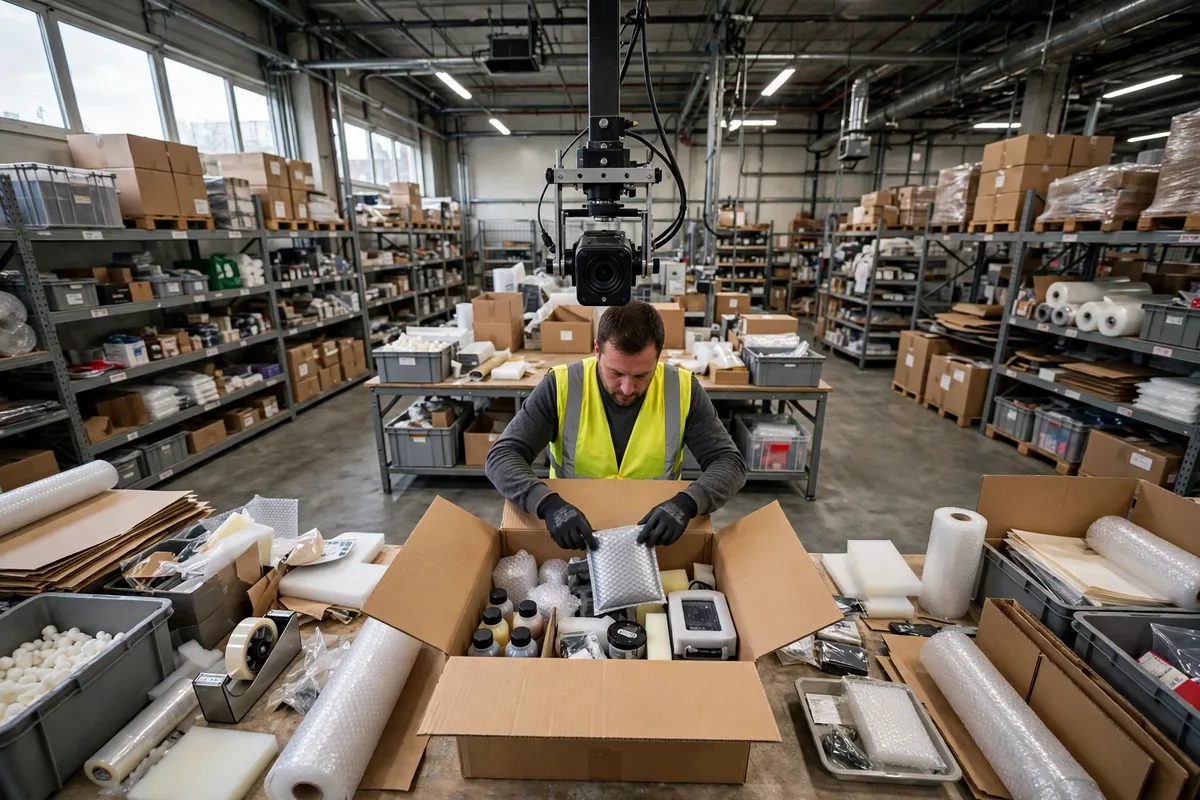
Every warehouse cartonization algorithm packing demo looks clean. Scan the items, the screen pops up a carton, the fill rate looks great, and the savings slide writes itself. Put it on a real packing bench and within a week the packers stop listening. The system says small carton, they grab a large one. The system says it fits, they split the order into two boxes. Do not blame the bench first. I have stood at packing stations long enough to know this pattern: when people overrule the software that often, the software is usually being fed bad physics.
Think of it this way. The algorithm is a calculator with no eyes. It only knows item dimensions and weight, inner carton dimensions and load limits, and how the carrier turns size into billed weight. If any input is fiction, the recommendation will be fiction too, just delivered faster.
How warehouse cartonization algorithm packing actually decides
The work has two parts. First comes placement. The engine tries to arrange items inside a three dimensional box while respecting rules like fragile, do not crush, keep upright, and heavy on the bottom. You can picture it as Tetris where the blocks can leak, break, or punch through the bottom. Second comes carton selection. It tests every carton that could hold the order and scores them with a cost function that should include the carton itself, void fill, freight based on dimensional weight, and damage risk.
That is where theory meets the bench. The system thinks a folded jacket is flat. In real life it puffs up when you close the flaps. It thinks the listed carton size is usable space. In real life corrugate thickness, tape, and a crushed corner eat into that space. A packer carries a second, unwritten rulebook: this carton looks big enough but the flaps will never meet, that mix fits on screen but the bottles will knock together in transit.
Take an illustrative example. Imagine a mid size operation shipping apparel mixed with small home goods, a few thousand orders a day at peak. In the demo, using supplier dimensions, the model recommended the smallest carton again and again. On the floor the overrule rate stayed high. A spot check found the problem: many top sellers had dimensions typed in at purchasing, some with retail packaging, some without, some with length and width swapped. The algorithm was solving the math correctly on the wrong numbers.
Fix the master data first, or buy the algorithm first?
This is the question managers ask me most, and my answer is a little unfashionable: most sites should not buy the algorithm first. They should spend two weeks treating item dimensions like equipment calibration. An algorithm is an amplifier. Good data, it amplifies savings. Bad data, it amplifies rework and arguments.
Use this dividing line. Pull one hundred fast movers, measure and weigh them yourself, and compare with the WMS. If most dimensions land within about a centimeter and weights are close, your base is usable. Turn on recommendations and clean the long tail as you go. If you keep finding gaps of several centimeters, wrong weights, or no dimensions at all, stop and fix the data first. Turning it on in that state only produces wrong answers faster, and once a packer gets burned three times, even good advice later will be ignored.
A second illustrative case makes the point. A home goods warehouse decided not to buy a module before peak. Instead it put dimension and weight capture at receiving, forced every new item through it, and remeasured existing items in sales order, highest movers first, writing results straight back to the WMS. Only after that sweep did it enable recommendations. The result was less dramatic than the sales deck, but packers followed it, because eight or nine times out of ten the carton really closed. The bigger win was not carton spend. It was fewer reopens and repacks at the bench. Carrier billing rules differ by carrier and service, and divisor and rounding details change, so check the carrier official policy for the latest rules.
Here is the quick framework I use on site visits:
| Check | Fix data first if you see this | Ready for the algorithm if you see this |
|---|---|---|
| Dimension completeness | Top sellers missing or estimated | Top sellers measured with a source |
| Spot check error | Frequent multi centimeter gaps | Errors small and consistent |
| Carton records | Outer size only, no load limit | Inner size, load limit, and use rules recorded |
| Order profile | Bulky, irregular, experience driven packing | Mostly standard items, repeatable mixes |
| Packer attitude | No trust in any system advice | Willing to try, frustrated by inconsistency |
If three of the five land in the left column, you do not have a software problem yet. You have a measurement problem.
Choosing a cartonization algorithm without chasing fill rate
When you do shop for an engine, do not fall for fill rate alone. A higher fill rate does not automatically mean lower cost. That is like judging a sorter only by its peak rate and ignoring what happens when it jams. A carton packed to the edge takes longer to close, needs more careful fill, and is more likely to arrive damaged. Sometimes the engine gains a couple of points of fill by picking a carton that barely fits, and you pay the gain back in labor and claims.
I look at four things. First, does it enforce weight and stacking as hard constraints, heavy below light, crushable items protected. Second, does it score dimensional weight, not just carton price. Freight usually dwarfs the box cost, so the cheapest carton can be the most expensive choice once billed weight is counted. Third, does it explain itself. A first choice, a fallback, and a plain reason build cooperation. Fourth, does it learn from overrules. If a packer swaps a carton, require a reason code, wrong dimensions, will not close, damage risk, so after a month you can see whether data, rules, or the carton set is at fault.
There is a trade off here. Lock the bench down and people find workarounds. Let them change everything silently and the system becomes decoration. If overrules stay in double digits week after week, audit data and rules before people. Single digits are probably genuine exceptions. Let those through, but keep the trace.
The maintenance trap nobody budgets for
Even a good start decays. Suppliers change packaging, a new version is slightly taller, seasonal apparel packs differently. Master data rots quietly. It is like sensor drift on a line: nothing alarms, readings just wander until everyone blames the control system.
Three habits keep warehouse cartonization algorithm packing honest. Control the entrance, so no new item goes live without a measured dimension, and any packaging change triggers a remeasure. Turn the bench into a calibration point, with a one tap way to flag a suspect dimension and a same day check. And treat cartons as assets. Measure inner dimensions and test load limits when a new carton arrives, retire cartons you no longer stock, and never let the engine recommend a box that is not on the shelf. That last mistake destroys credibility faster than any math error.
Do not forget void fill. Many engines assume items sit perfectly tight. Liquids, glass, and anything with a sharp corner need buffer, and that buffer takes space. Leave it out and every recommendation will be short by exactly the amount that keeps the flaps from closing.
In the end this is not a module you buy and forget. It is a loop of measuring, rules, and feedback. Get it right and savings show up in carton spend, freight, and bench time.
Whether the money is worth it comes down to one number: the packer overrule rate. If it is, your data and rules are lining up and the algorithm is earning its keep. If it is not, do not upgrade the algorithm. Go and measure your items.
By Da Liu, Automation Engineer